
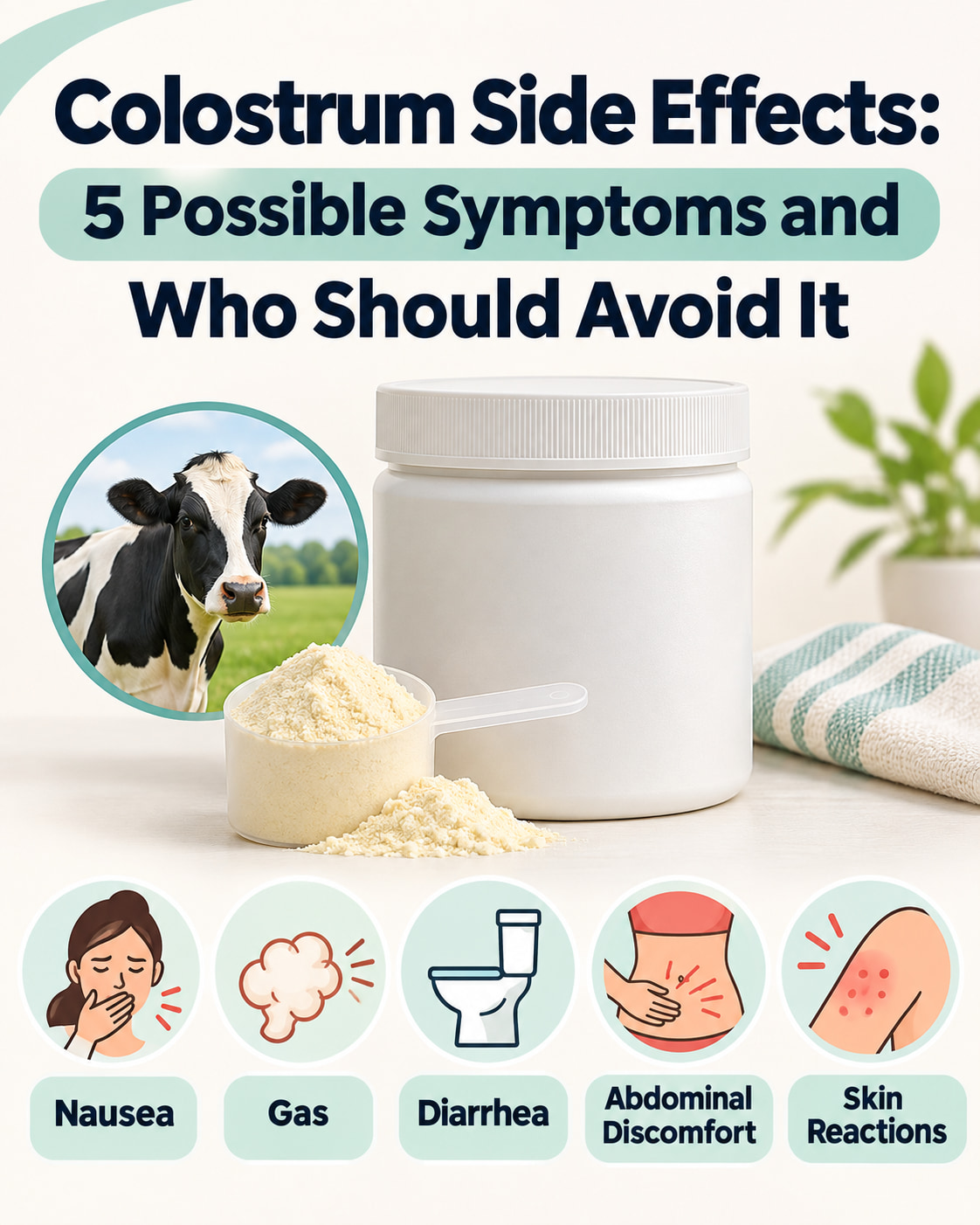
Reported colostrum side effects include nausea, gas, diarrhea, abdominal discomfort, and rash or itching. These symptoms have appeared in studies, but the evidence does not establish how often a typical supplement user will experience them—or that colostrum caused every reported symptom. People with a known cow’s milk allergy should avoid bovine colostrum.
This article covers oral bovine colostrum supplements, such as powders and capsules. Bovine colostrum is the early milk cows produce after giving birth; it is not the same subject as human colostrum during breastfeeding. Memorial Sloan Kettering Cancer Center’s colostrum overview explains its dairy origin and relevant precautions.
Get emergency help for trouble breathing, throat or tongue swelling, or fainting after taking a supplement. These can signal a severe allergic reaction. Use prescribed epinephrine according to your emergency plan and call your local emergency number. See the American College of Allergy, Asthma & Immunology’s anaphylaxis guidance.
5 Possible Colostrum Side Effects
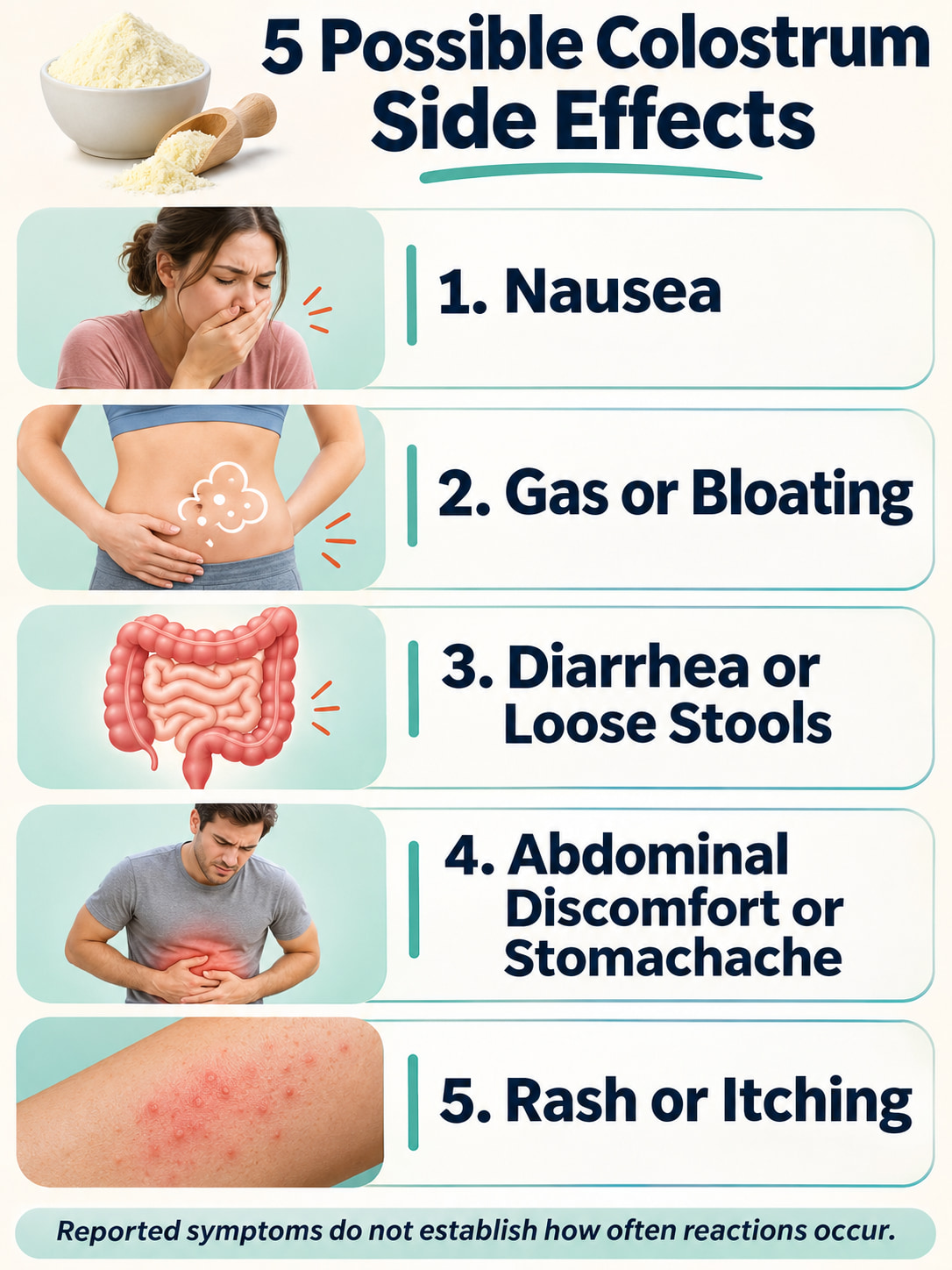
These are possible symptoms—not five reactions everyone should expect. A 2024 systematic review of gastrointestinal studies included different products, doses, and populations, with many studies involving children or people with existing illnesses. That limits how confidently the findings apply to healthy adults taking a retail supplement.
1. Nausea
Nausea, or a queasy feeling that you might vomit, has been reported during colostrum use. The 2024 review identified it among reported adverse effects, but did not establish a reliable risk estimate for consumers.
Do not assume persistent nausea is something you need to tolerate to get a benefit. The FDA’s supplement safety guidance identifies severe or persistent nausea and vomiting as potentially serious reactions. Stop the product and seek medical advice when symptoms are significant or ongoing.
2. Gas or Bloating
Flatulence and increased gassiness have also been reported in colostrum studies. Bloating may have another explanation in someone who has difficulty digesting lactose, the natural sugar in milk. NIDDK’s lactose intolerance guidance lists gas, bloating, nausea, diarrhea, and abdominal pain among its symptoms.
For someone with lactose intolerance, consider the whole serving—not just the colostrum powder. Mixing it into regular milk adds another source of lactose. How much lactose you consume can affect symptom severity.
3. Diarrhea or Loose Stools
Diarrhea appears among adverse events summarized in a 2021 systematic review of bovine colostrum research. It should not automatically be interpreted as evidence that a supplement is “working.”
This can seem confusing because researchers have also studied colostrum preparations as treatments for certain types of diarrhea. However, those studies involved particular formulations and patient groups. They do not establish that every commercial powder prevents diarrhea—or that it cannot be associated with digestive complaints.
4. Abdominal Discomfort or Stomachache
Stomachache and abdominal discomfort have been reported during supplementation. These descriptions do not identify a single cause, and discomfort beginning after a dose does not prove that colostrum is responsible.
Pay attention to severity rather than assuming all stomach pain is a minor supplement reaction. Severe pain, especially with repeated vomiting, bloody stools, or dehydration, needs prompt assessment. NIDDK’s guidance on diarrhea and associated symptoms outlines these warning signs.
5. Rash or Itching
Rash and itching have been reported, including in an uncontrolled study of children taking bovine colostrum. Those reports cannot tell us how common these reactions are in adults or confirm that every rash was caused by the supplement.
Nevertheless, new hives, rash, or itching after a dose deserves attention. Stop taking the product and obtain medical advice before using it again. Hives can be a symptom of milk allergy, and associated breathing problems, throat swelling, or fainting require emergency help—not another dose to “test” your reaction.
Milk Allergy vs. Lactose Intolerance
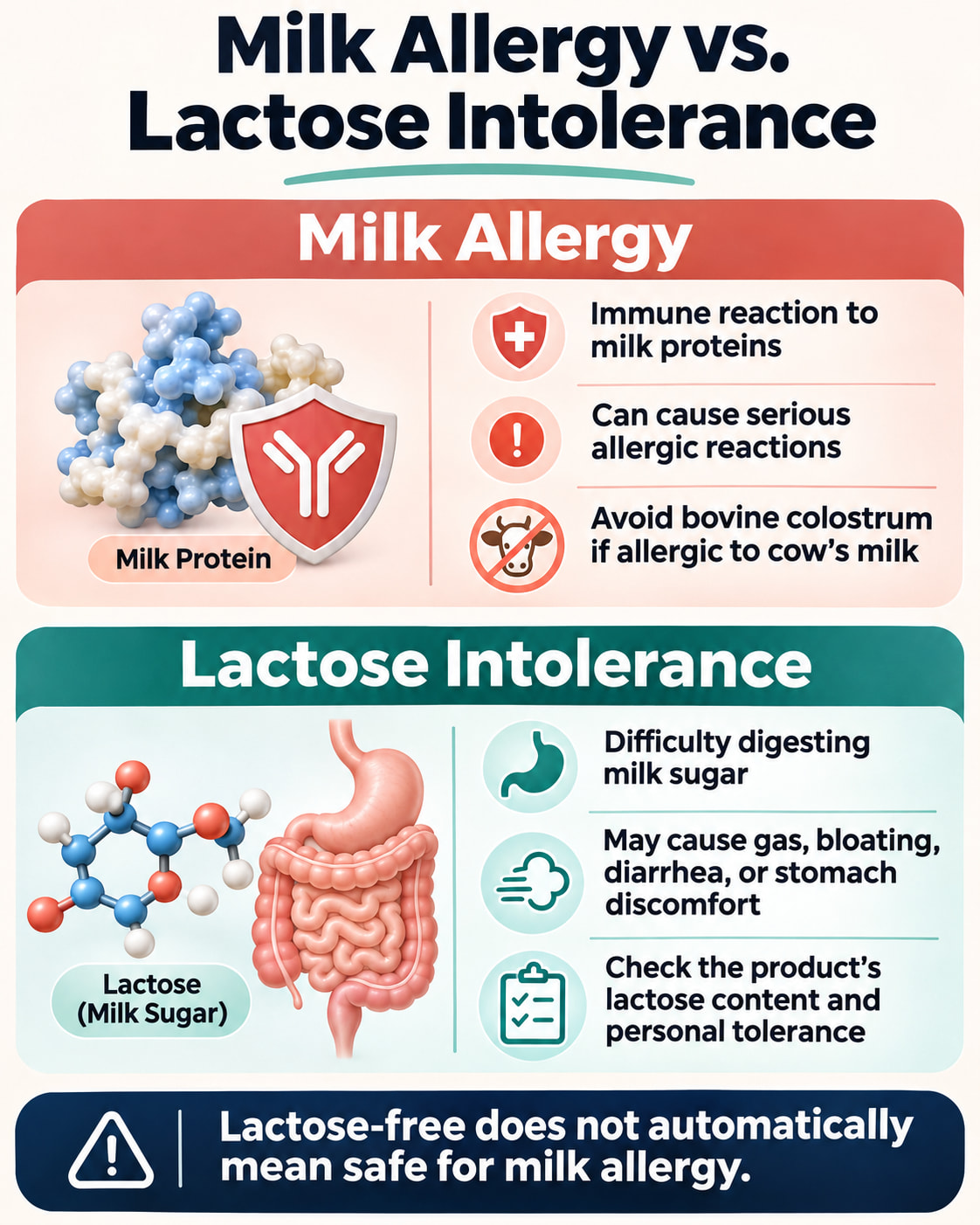
Milk allergy and lactose intolerance are different conditions with different risks.
With lactose intolerance, the digestive system has trouble breaking down lactose. Symptoms generally involve digestion, such as gas, bloating, diarrhea, or abdominal pain. Milk allergy, by contrast, is an immune reaction to milk proteins and can cause a life-threatening reaction. NIDDK explains this distinction.
That means a “lactose-free” colostrum product is not automatically safe for someone with a milk allergy. Removing milk sugar does not establish that milk proteins are absent. The American College of Allergy, Asthma & Immunology recommends avoiding products containing milk protein when you have a milk allergy.
For lactose intolerance, the relevant questions are how much lactose the specific serving contains and how much you tolerate. Check the label and ask the manufacturer for lactose information when it is not provided. Do not assume every colostrum formulation contains the same amount.
Who Should Avoid Colostrum or Check With a Clinician First?
Who Should Avoid It
People with a known cow’s milk allergy should avoid bovine colostrum. Health Canada’s bovine colostrum monograph, dated October, 2025, explicitly lists this as a contraindication. Do not try a smaller serving at home to see whether it causes a reaction.
Who Should Get Medical Advice First
Health Canada’s Canadian product-labeling guidance recommends speaking with a healthcare professional before use when you:
- Are pregnant or breastfeeding.
- Have diabetes, a history of cancer, or an immune-system disorder.
- Take medication that suppresses the immune system.
These are consult-before-use precautions, not proof that colostrum causes harm in everyone in these groups or has a confirmed interaction with every relevant medication.
For people with hormone-sensitive cancer, Memorial Sloan Kettering specifically advises discussing colostrum with the treating clinician because it contains trace amounts of estrogen. This precaution is not evidence that taking colostrum causes cancer.
Children also need separate consideration. Do not adapt an adult serving size for a child or assume that research involving pediatric patients makes routine use appropriate. The NIH Office of Dietary Supplements advises caution with children’s supplement use unless their healthcare provider recommends it.
Drug-tested athletes have an additional concern. The World Anti-Doping Agency’s colostrum guidance says colostrum is not specifically prohibited, but discourages its use because it may contain prohibited growth factors that could influence test results. This is a sports-compliance issue, separate from medical side effects.
What to Do if You Develop Symptoms
For a suspected reaction, stop the supplement and contact a clinician or pharmacist about symptoms that persist, recur, or concern you. Do not keep increasing the amount in an attempt to push through them. FDA guidance specifically recommends stopping a supplement immediately when a serious reaction is suspected.
Before that conversation, write down the product name, amount taken, when you took it, when symptoms began, and any other medicines or supplements you use. Keep the container or photograph the ingredient list. The NIH recommends maintaining a supplement and medication record to help healthcare professionals assess your use.
In the United States, you can also report a suspected supplement reaction to the FDA. Reporting does not replace getting medical care.
When to Get Urgent or Emergency Help
Possible anaphylaxis—such as breathing difficulty, throat swelling, or fainting—requires the emergency response described above. Do not wait to see whether another dose produces the same symptoms.
For digestive symptoms, NIDDK recommends prompt medical contact for:
- Severe abdominal pain, frequent vomiting, or stools that are bloody or black and tarry.
- Signs of dehydration, including reduced urination, dark urine, or dizziness.
- Adult diarrhea lasting more than two days, a high fever, or six or more loose stools in a day.
Do not wait two days when a warning sign is already present. People who are pregnant, older than 65, taking antibiotics, or immunocompromised should stay in touch with their clinician about diarrhea because complications are more likely.
What Dose, Duration, and Product Quality Can—and Cannot—Tell You
A Study Dose Is Not a Personal Safety Recommendation
Research has used different colostrum formulations and amounts. A dose tested in one population cannot establish a side-effect-free dose for everyone, and short studies cannot settle the safety of years of daily use.
Health Canada’s monograph advises consulting a healthcare professional for use beyond 12 weeks. This is Canadian labeling guidance, not a dividing line at which colostrum suddenly becomes harmful—or a guarantee of safety before that point.
Follow the product’s directions rather than copying a research dose, and review the amount per serving and all other ingredients. Label directions still do not establish that the product is appropriate for your health conditions or medications.
Quality Testing Has Limits
In the United States, dietary supplements are regulated, but the FDA does not approve them for safety and effectiveness before marketing. A product being available for sale is therefore not the same as premarket FDA approval.
Independent quality testing can help verify ingredients and check for harmful levels of contaminants. However, as the NIH Office of Dietary Supplements explains, a quality seal does not guarantee that a supplement is effective or safe for you. It cannot make a milk-derived product suitable for someone with a milk allergy.
Avoid Raw, Unpasteurized Colostrum
Do not substitute raw, unpasteurized colostrum for a processed supplement. Unpasteurized dairy can carry disease-causing organisms, creating a separate food-safety risk. The FDA’s raw-milk guidance explains why raw dairy is unsafe. This does not mean that commercial colostrum supplements are routinely contaminated.
The Bottom Line
Colostrum is not something to continue taking through a suspected reaction. Avoid it with a known cow’s milk allergy, discuss relevant health conditions and medications before starting, and seek care for persistent or serious symptoms rather than assuming they are a normal adjustment.
This content is for informational purposes only and not medical advice.