
Yes—for most healthy adults, 8 hours of sleep is enough because it falls squarely inside the recommended range. That said, whether 8 hours is truly “enough” depends on your age, your sleep quality, your schedule, and whether you still feel tired during the day.
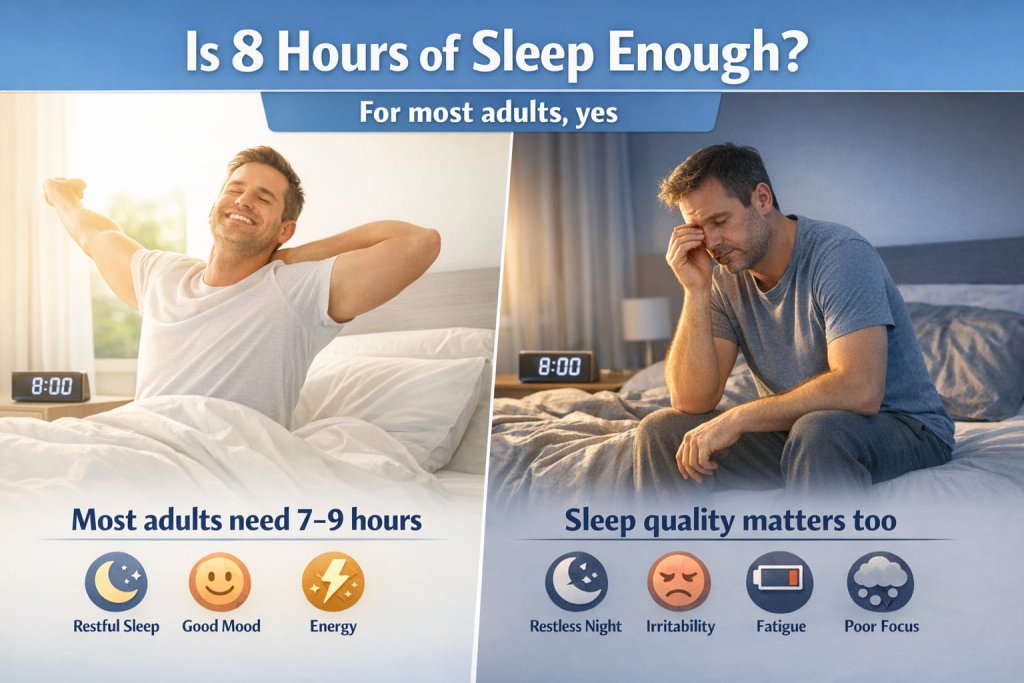
Understanding that difference matters because sleep affects attention, mood, driving safety, heart health, metabolism, and long-term wellbeing. (National Heart, Lung, and Blood Institute)
The short answer on is 8 hours of sleep enough
For most adults, 8 hours is a very reasonable target. The National Heart, Lung, and Blood Institute says adults generally need 7 to 9 hours of sleep per night, so 8 hours is right in the middle of that range.
The American Academy of Sleep Medicine takes a slightly different wording but points in the same direction: adults should get 7 or more hours on a regular basis to support optimal health, productivity, and daytime alertness. In practice, that means 8 hours is not just acceptable for many adults. It is often an excellent goal.
How much sleep people need by age
Sleep needs change over the lifespan, so 8 hours is not the right benchmark for everyone. According to CDC sleep recommendations by age, teens ages 13 to 17 need 8 to 10 hours, adults ages 18 to 60 need 7 or more hours, adults ages 61 to 64 need 7 to 9 hours, and adults ages 65 and older need 7 to 8 hours. That makes 8 hours a good fit for most adults and older adults, and the low end of the recommended range for teens.
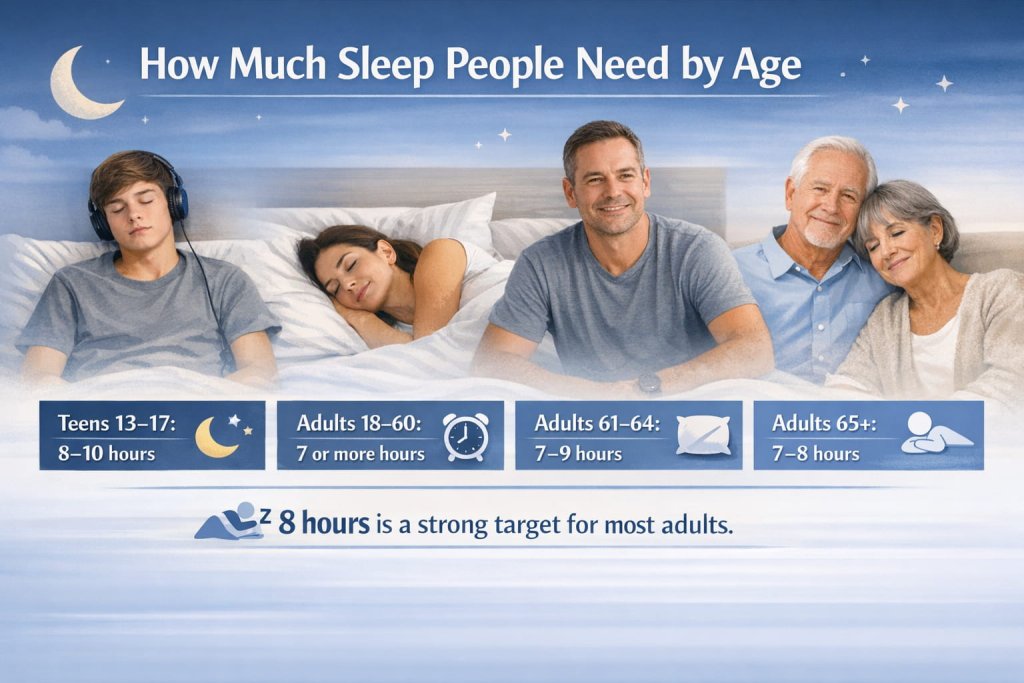
For older adults, the main point is not that they need dramatically less sleep. The National Institute on Aging says older adults generally need about the same amount of sleep as other adults—roughly 7 to 9 hours—but they often go to bed earlier and wake earlier than they used to. Even where official sources phrase the range a little differently, 8 hours remains comfortably within the healthy range.
Why enough sleep matters in the first place
This question matters because getting enough sleep is about more than avoiding grogginess. The CDC’s sleep and heart health guidance says more than 1 in 3 American adults do not get the recommended amount of sleep, and that chronic short sleep can contribute to serious health problems over time.
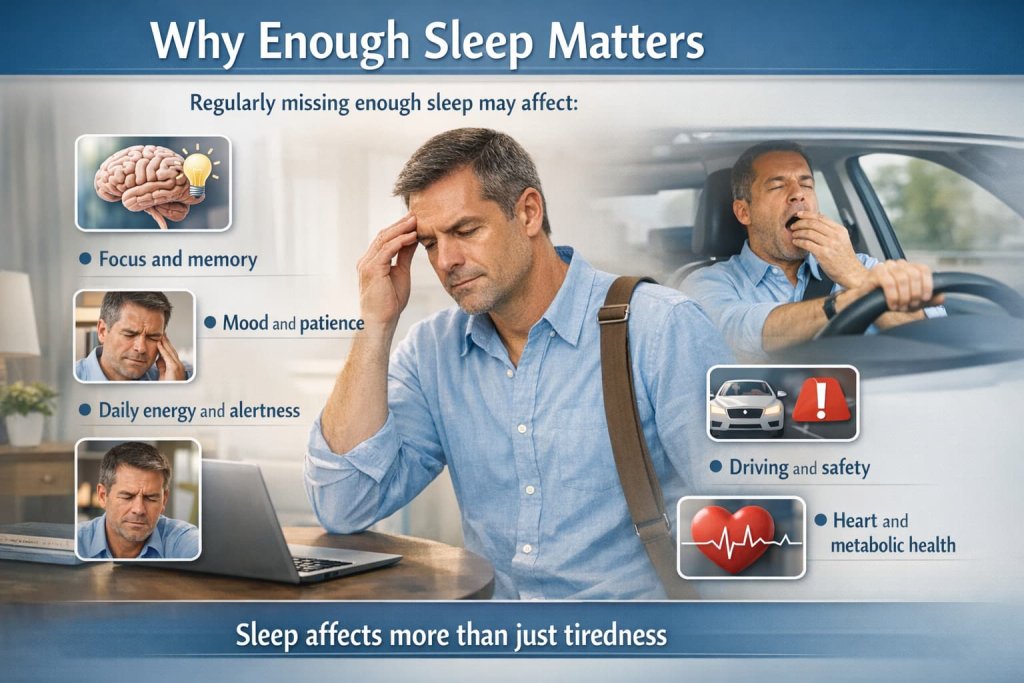
Sleep also affects day-to-day brain function. NHLBI’s overview of how sleep affects your health explains that sleep deficiency can make it harder to learn, focus, react quickly, make decisions, remember things, and manage emotions. So the real question is not just, “Can I survive on 8 hours?” but “Does my sleep leave me functioning well and feeling restored?”
Is 8 hours of sleep enough if you still wake up tired?
Not always. The CDC’s sleep overview explains that healthy sleep is about both enough hours and good sleep quality. Good-quality sleep is uninterrupted and refreshing. Signs of poor sleep quality include trouble falling asleep, waking up repeatedly during the night, or still feeling sleepy even after getting enough time in bed.
That means 8 hours in bed is not automatically the same as 8 hours of restorative sleep. You may spend part of the night awake, sleep lightly, keep an irregular schedule, or have a sleep problem that fragments sleep. In those cases, 8 hours on the clock may still leave you feeling unrefreshed.
When 8 hours is usually enough
Eight hours is usually enough when you are an adult, sleep on a regular schedule, fall asleep without major difficulty, stay asleep reasonably well, and wake feeling restored most days. If you are alert during the day, not fighting sleep constantly, and functioning well without needing to push through every afternoon, 8 hours is likely serving you well. This is the practical, real-world version of what the adult sleep recommendations are trying to achieve.
For many adults, 8 hours is also a useful target because it is realistic. Some people do well closer to 7 hours, while others feel better nearer 9, but 8 hours sits in the middle of the evidence-based range and is often the easiest goal to build a routine around.
Can you make up for short sleep on weekends?
Not fully. The National Heart, Lung, and Blood Institute explains that lost sleep adds up as sleep debt. If you regularly cut sleep during the week and then try to sleep late on weekends, that does not completely erase the effects of chronic sleep loss. Naps may give a short-term boost in alertness, but they do not replace all the benefits of enough nighttime sleep.
This matters because someone may think they are averaging out their sleep by getting 6 hours on work nights and 10 hours on weekends. In practice, a regular pattern of short sleep can still leave you less alert and less restored than a steady routine that gives you enough sleep most nights.
When 8 hours may not be enough
Eight hours may not be enough if you are a teenager, if you are recovering from a period of sleep loss, or if you are sick. NHLBI notes that sleeping more than 9 hours is not necessarily harmful and may be helpful for young adults, people recovering from sleep deprivation, and people who are ill. So while 8 hours is a strong default target, it is not a rigid ceiling for every situation.
It may also not feel like enough if your sleep is repeatedly interrupted. NHLBI’s sleep apnea overview says sleep apnea happens when breathing stops and restarts many times during sleep, which can lower sleep quality and leave people excessively sleepy during the day. Loud snoring, gasping during sleep, or persistent daytime sleepiness are good reasons to talk with a healthcare professional.
Is 8 hours of sleep too much?
For most adults, no. Eight hours is well within the normal recommended range. In fact, it is closer to the center of the adult range than to the edges.
If you regularly sleep 8 hours and feel well, that is not a problem to solve. The more important concern is when you get a reasonable amount of sleep but still feel persistently tired, fall asleep unintentionally during the day, or have symptoms that suggest poor-quality sleep. That is when it makes sense to look beyond the number of hours alone.
How to tell whether 8 hours is enough for you
A simple way to judge your sleep is to look at your daytime function. Eight hours is more likely enough if:
- you wake up feeling reasonably refreshed most days
- you can stay alert through normal daily activities
- you are not relying on constant caffeine just to function
- you are not regularly dozing off during quiet activities
- you are not waking repeatedly through the night
Those signs line up with what CDC and NIH describe as healthy, good-quality sleep.
On the other hand, 8 hours may not be enough—or may not be effective—if you regularly feel sleepy, irritable, unfocused, or mentally slow. Those symptoms can show up when total sleep is too short, but they can also happen when sleep quality is poor.
What to do if 8 hours still does not feel like enough
Start with basic sleep habits. CDC says better sleep often begins with going to bed and getting up at the same time every day, keeping your bedroom quiet and cool, turning off electronic devices at least 30 minutes before bedtime, avoiding caffeine in the afternoon or evening, and avoiding large meals and alcohol before bed.
The National Institute on Aging gives very similar advice and adds that regular exercise, a calming bedtime routine, and avoiding late-evening naps can also help. These are simple changes, but they often matter more than people expect.
If you are already getting around 8 hours and still feel tired for weeks, it is worth talking with a clinician. Persistent fatigue, heavy snoring, gasping, frequent night waking, or trouble falling asleep can point to a sleep disorder or another health issue that deserves proper evaluation.
When to talk to a doctor about your sleep
Talk with a healthcare professional if you usually get around 8 hours of sleep but still:
- wake up feeling unrefreshed most mornings
- struggle to stay awake during work, meetings, or driving
- snore loudly or have choking or gasping episodes during sleep
- wake up often during the night
- have ongoing trouble falling asleep or staying asleep
The CDC says to talk to your healthcare provider if you have problems sleeping. The American Academy of Sleep Medicine also highlights excessive daytime sleepiness, unrefreshing sleep, trouble staying awake during daily activities, and breathing-related symptoms during sleep as signs that deserve medical attention.
These symptoms do not automatically mean you have a sleep disorder, but they are good reasons to look beyond total sleep hours alone.
FAQ
Is 8 hours of sleep enough for most adults?
Yes. For most adults, 8 hours is enough because it falls within the main recommended range and supports health, alertness, and daily functioning.
Is 8 hours of sleep enough for a teenager?
Sometimes, but it is the low end of the recommended range. CDC says teens ages 13 to 17 should get 8 to 10 hours per night, so many teens need more than 8 hours to feel and function their best.
Is 8 hours of sleep enough for older adults?
Usually yes. CDC places 8 hours inside the recommended range for older adults, and the National Institute on Aging says older adults generally still need about 7 to 9 hours of sleep each night.
Why am I still tired after 8 hours of sleep?
Because sleep duration is only part of the picture. Poor sleep quality, repeated awakenings, insomnia, sleep apnea, irregular schedules, or other health problems can all leave you tired even after a full night in bed.
Is 8 hours better than 7 hours?
Not always for every individual, but for many adults it is a strong target because it sits comfortably inside the recommended range. The goal is not to chase a perfect number. It is to get enough sleep on a regular basis and feel well-rested during the day.
Bottom line
For most adults, 8 hours of sleep is enough and is a healthy goal. It fits squarely within major sleep recommendations and is often a practical target for protecting energy, mood, focus, and long-term health. But the number alone is not the whole story. If you sleep 8 hours and still feel unrefreshed, look at sleep quality, habits, and possible sleep problems—not just the clock.
If 8 hours leaves you feeling good, alert, and steady through the day, you are probably in a good place. If not, improving sleep habits or getting medical advice can make a real difference.
This content is for informational purposes only and not medical advice.
References
- National Institute on Aging — Sleep and Older Adults
- Centers for Disease Control and Prevention — About Sleep and Your Heart Health
- National Heart, Lung, and Blood Institute — How Sleep Affects Your Health
- National Heart, Lung, and Blood Institute — How Much Sleep Is Enough?
- National Heart, Lung, and Blood Institute — What Is Sleep Apnea?
- American Academy of Sleep Medicine — Daytime Sleepiness Affects Daily Activities of Most Adults