
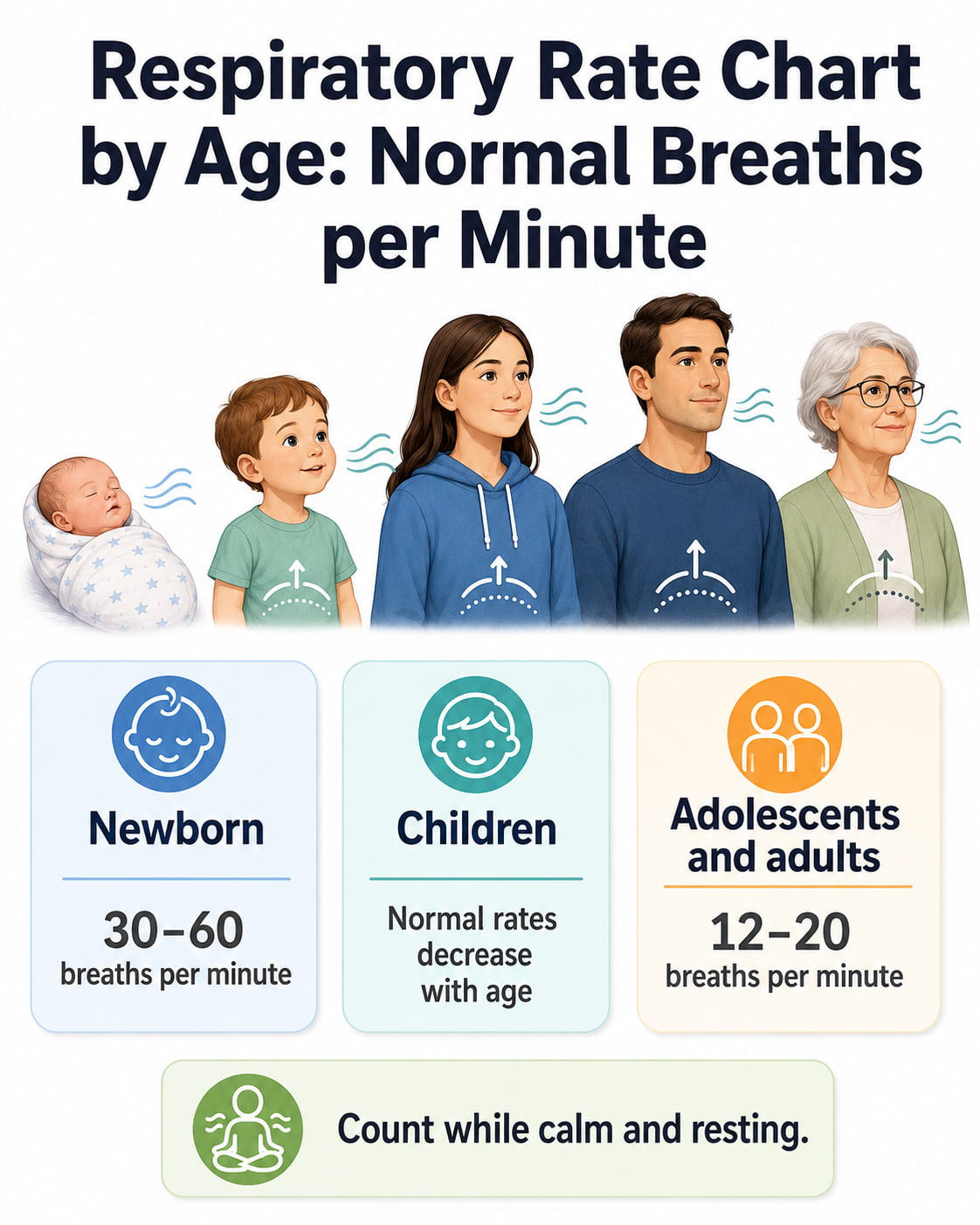
A normal resting respiratory rate ranges from about 30–60 breaths per minute in newborns to 12–20 breaths per minute in adolescents and adults. Babies and young children normally breathe faster, so the meaning of a breathing rate depends heavily on age.
Use the respiratory rate chart below as a general reference. Count breathing while the person is calm and resting, and consider symptoms such as chest retractions, grunting, color changes, confusion, or difficulty speaking. A number alone cannot diagnose the cause of abnormal breathing.
Respiratory Rate Chart by Age
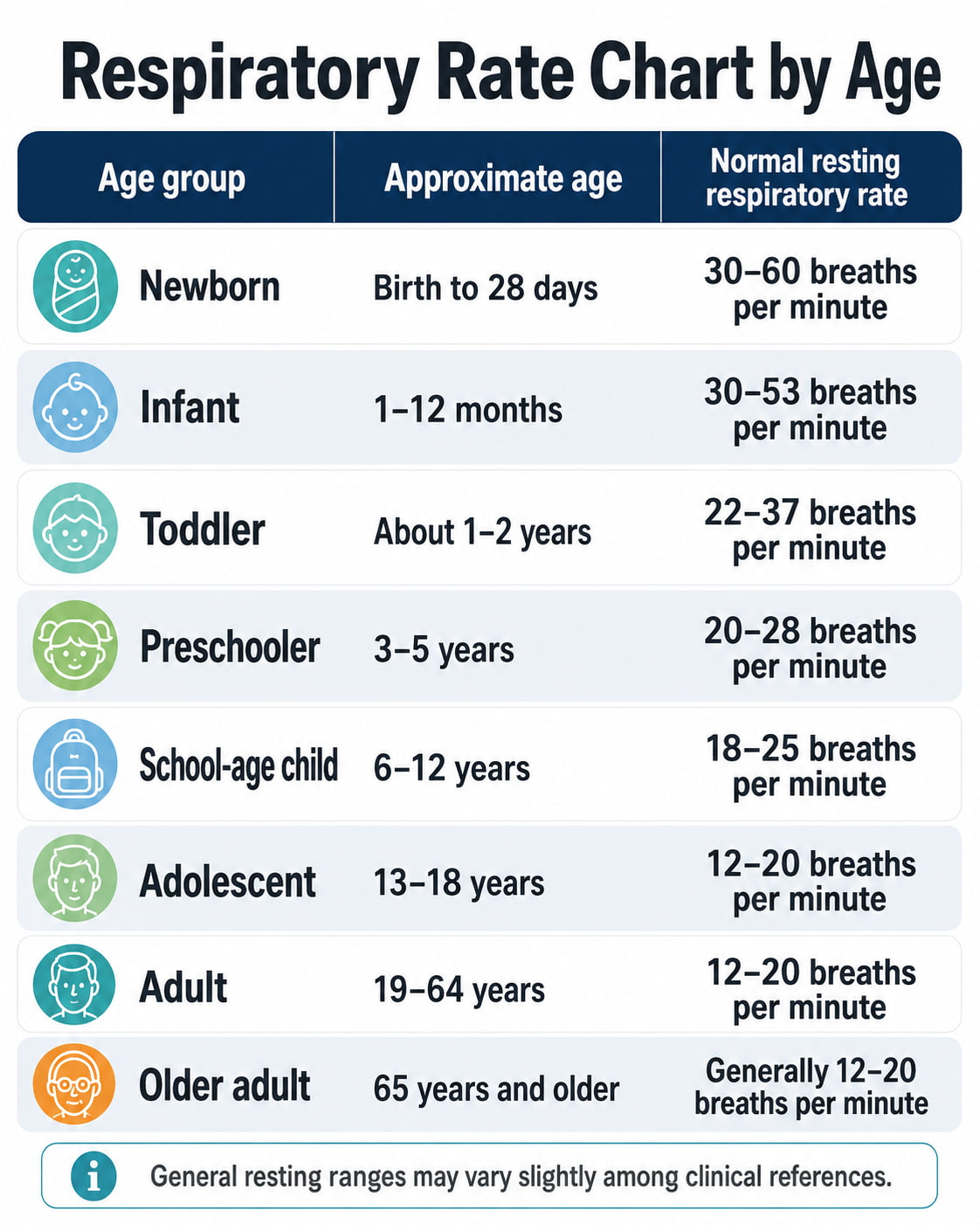
The following chart shows commonly used resting respiratory rate ranges. Pediatric figures are based mainly on the Pediatric Advanced Life Support ranges published in the NCBI Vital Sign Assessment guide. Newborn and adult ranges also reflect guidance from the National Library of Medicine’s MedlinePlus.
| Age group | Approximate age | Normal resting respiratory rate |
|---|---|---|
| Newborn | Birth to 28 days | 30–60 breaths per minute |
| Infant | 1–12 months | 30–53 breaths per minute |
| Toddler | About 1–2 years | 22–37 breaths per minute |
| Preschooler | 3–5 years | 20–28 breaths per minute |
| School-age child | 6–12 years | 18–25 breaths per minute |
| Adolescent | 13–18 years | 12–20 breaths per minute |
| Adult | 19–64 years | 12–20 breaths per minute |
| Older adult | 65 years and older | Generally 12–20 breaths per minute |
These are general reference ranges, not strict diagnostic limits. Age-group definitions and upper or lower limits can differ slightly among hospitals, pediatric guidelines, and research studies.
A major systematic review available through PubMed Central found that children’s respiratory rate falls substantially during the first years of life. The median decreased from approximately 44 breaths per minute at birth to 26 at age 2. The same review found notable disagreement among several published pediatric reference charts.
What Is Respiratory Rate?
Respiratory rate is the number of breaths a person takes in one minute. One complete rise and fall of the chest or abdomen counts as one breath.
Healthcare professionals assess more than the number. They also consider:
- How deep each breath appears
- Whether the rhythm is regular
- Whether breathing looks effortless or labored
- Whether unusual sounds are present
- Whether the person can speak, feed, or remain alert normally
A respiratory rate may change before some other vital signs become abnormal, making careful measurement useful when someone appears ill.
How to Count Breaths per Minute Correctly
Follow these steps to measure respiratory rate at home:
- Let the person rest. Wait until breathing has settled after walking, exercising, crying, feeding, or an emotional event.
- Position the person comfortably. Sitting or lying down is usually easiest.
- Watch the chest or abdomen. One rise and fall equals one breath.
- Count for a full 60 seconds. A complete minute is especially important for babies because their rhythm may be irregular.
- Note the breathing effort. Look for chest pulling, nasal flaring, grunting, wheezing, pauses, or unusual depth.
- Repeat an unexpected result. Movement, talking, crying, or distraction can affect the count.
For a baby or young child, count while the child is calm or quietly sleeping. The World Health Organization also instructs health workers to count for one full minute while the child is calm.
Example
Suppose you count 16 chest rises during 30 seconds. Doubling that number gives an estimated rate of 32 breaths per minute.
However, counting for the full minute is more accurate, especially when breathing is irregular or when evaluating an infant.
Normal Respiratory Rate for Babies
Newborns and infants breathe faster than older children because of differences in body size, metabolism, lung development, and oxygen needs.
A general newborn respiratory rate is approximately 30–60 breaths per minute. A PALS-based range for infants is approximately 30–53 breaths per minute, although MedlinePlus provides the broader infant range of 30–60.
Brief changes in rhythm can occur, particularly during sleep. However, contact a healthcare professional promptly if a baby’s rate remains unusually high or low or the baby shows signs of increased breathing effort.
Signs That a Baby Is Working Hard to Breathe
Watch for:
- Nostrils widening with each breath
- Head bobbing
- Rhythmic grunting
- Skin pulling inward between or below the ribs
- Pauses or difficulty breathing
- Poor feeding because of breathlessness
- Pale, gray, or blue lips, skin, or nail beds
- Markedly reduced activity or alertness
The American Academy of Pediatrics describes nasal flaring, head bobbing, grunting, belly breathing, and chest retractions as important signs of respiratory difficulty in babies.
Normal Respiratory Rate for Children
A child’s normal respiratory rate gradually decreases with age:
- Toddlers commonly breathe about 22–37 times per minute.
- Preschool children commonly breathe about 20–28 times per minute.
- School-age children commonly breathe about 18–25 times per minute.
- Adolescents generally reach the adult range of 12–20 breaths per minute.
Always count when the child is calm. Crying, running, fever, pain, and anxiety can temporarily raise the rate.
A reading outside the chart does not automatically mean that the child has a serious condition. Repeat the measurement after the child settles and assess how the child looks and behaves.
Normal Respiratory Rate for Adults
For a healthy adult at rest, a commonly used normal respiratory rate is 12–20 breaths per minute. Some clinical references use a narrower range, such as 12–18, which illustrates why the person’s symptoms and usual baseline remain important.
In the average resting adult:
- Tachypnea generally means more than 20 breaths per minute.
- Bradypnea generally means fewer than 12 breaths per minute.
- Apnea means that breathing has stopped.
These terms describe the breathing pattern. They do not explain its cause.
Normal Respiratory Rate for Older Adults
Healthy older adults generally use the same resting range as other adults: approximately 12–20 breaths per minute.
Breathing rate usually does not change substantially with age, although lung function and respiratory reserve gradually decline. For that reason, a new change from an older adult’s usual rate may be important even when the number remains near a traditional reference limit.
Persistent fast breathing in an older adult may accompany infection or another acute illness, sometimes before more obvious symptoms appear.
What Is Considered Fast Breathing?
Fast breathing is called tachypnea. In adults, a resting rate above 20 breaths per minute is generally considered faster than the usual range.
In babies and children, fast breathing must be judged according to age because their normal rates are naturally higher.
WHO Fast-Breathing Thresholds for Children Under 5
The WHO uses the following thresholds when assessing a calm child with cough or difficult breathing:
| Child’s age | WHO fast-breathing threshold |
|---|---|
| Birth to 59 days | 60 breaths per minute or more |
| 2 months to under 12 months | 50 breaths per minute or more |
| 12 months to under 5 years | 40 breaths per minute or more |
For a young infant with a count of 60 or more, WHO guidance recommends repeating the measurement because infant breathing can be irregular.
These WHO numbers are sick-child screening thresholds, not universal normal-range limits. They help healthcare workers evaluate children with cough or breathing difficulty, particularly for possible pneumonia or serious infection.
Is 30 Breaths per Minute Normal?
The answer depends on age and circumstances.
| Person | How to interpret 30 breaths per minute |
|---|---|
| Newborn or infant | Usually within the general resting range |
| Toddler | May fall within the general range |
| Preschool child | Slightly above the PALS-based resting range |
| School-age child | Above the general resting range |
| Teenager or adult | Faster than the usual resting range |
An adult who has just exercised, climbed stairs, experienced anxiety, or developed a fever may temporarily breathe 30 times per minute. A persistent rate of 30 at rest, particularly with shortness of breath, chest pain, confusion, or color changes, needs prompt medical assessment.
What Can Cause a High Respiratory Rate?
Respiratory rate can temporarily rise because of:
- Exercise
- Crying or agitation
- Anxiety
- Pain
- Fever
- Pregnancy
Persistent rapid breathing can also occur with lung infections, asthma, airway obstruction, pulmonary embolism, heart problems, sepsis, or metabolic disturbances. These are examples rather than a complete list, and respiratory rate cannot identify the cause by itself.
What Can Cause a Low Respiratory Rate?
A slow rate may occur during deep sleep or in highly conditioned people, but it can also result from:
- Opioids or other sedating substances
- Excessive medication-related sedation
- Neurologic problems
- Severe metabolic disturbances
- Respiratory failure
A low number becomes more concerning when breathing is shallow, irregular, difficult, or accompanied by confusion, extreme drowsiness, blue or gray coloring, or trouble waking.
What to Do When the Rate Is Outside the Chart
When you get an unexpected reading:
- Make sure the person is resting and not talking.
- Count again for a full minute.
- Check whether fever, recent activity, pain, crying, or anxiety may have affected the rate.
- Observe breathing depth, rhythm, effort, skin color, and alertness.
- Compare the result with earlier readings when available.
- Contact a healthcare professional if the abnormal rate continues or the person appears unwell.
Do not delay care merely because the respiratory rate falls inside the chart. Someone can have serious breathing difficulty without a dramatically abnormal number.
Emergency Signs of Breathing Difficulty
Seek emergency medical care immediately when a child or adult has:
- Severe difficulty breathing
- Blue, gray, or unusually pale lips, face, skin, or nail beds
- Ribs or the area under the neck pulling inward with each breath
- Persistent chest pain or pressure
- New confusion, fainting, or inability to stay awake
- Pauses in breathing or stopped breathing
- Inability to speak, cry, drink, or feed because of breathlessness
- Rapid breathing that is worsening quickly
- A suspected choking event
The Centers for Disease Control and Prevention lists trouble breathing, chest pain, confusion, reduced alertness, bluish coloring, and chest retractions among warning signs that need immediate medical attention.
Frequently Asked Questions
What is the normal respiratory rate by age?
General resting ranges decrease from approximately 30–60 breaths per minute in newborns to 12–20 in adolescents and adults. Young children fall between these ranges according to age.
How do I count respiratory rate accurately?
Watch the chest or abdomen and count each complete rise and fall for 60 seconds. Measure while the person is calm, resting, and not talking.
What is a normal breathing rate for a sleeping baby?
Use the baby’s age-based range as a general guide. Quiet sleep is often a convenient time to count because the baby is calm. Count for a full minute because infant breathing can be irregular, and seek help for persistent pauses, color changes, poor feeding, or visible breathing effort.
Is 25 breaths per minute normal for an adult?
Twenty-five breaths per minute is above the usual adult resting range. It may occur temporarily after activity or with anxiety, but a persistent rate at rest should be evaluated, especially when symptoms are present.
Does fever increase respiratory rate?
Yes. Fever can cause temporary faster breathing, particularly in children. However, do not assume fever is the only cause when breathing appears difficult or remains unusually fast.
Is respiratory rate the same as oxygen saturation?
No. Respiratory rate counts breaths per minute, while a pulse oximeter estimates blood oxygen saturation. A normal-looking oxygen reading does not replace an assessment of breathing effort, symptoms, and respiratory rate.
When should I call a doctor about rapid breathing?
Contact a healthcare professional when rapid breathing continues after rest, repeatedly exceeds the age-based range, or occurs with fever, cough, wheezing, poor feeding, unusual tiredness, or a noticeable change from the person’s baseline. Use emergency services for severe breathing difficulty or other emergency signs.
Conclusion
A respiratory rate chart by age can help you recognize whether a resting breathing rate falls within a commonly used range. Babies normally breathe much faster than adults, and pediatric rates decline gradually as children grow.
Measure for a full minute, repeat unexpected readings, and pay attention to breathing effort and behavior—not only the number. Persistent changes or signs of respiratory distress deserve timely medical evaluation.
This content is for informational purposes only and not medical advice.