
A normal resting heart rate usually gets slower with age, from about 70 to 190 beats per minute in newborns to 60 to 100 beats per minute for children 10 and older, adults, and seniors. A good resting heart rate chart by age helps you see what is typical for each life stage, but the number only makes sense when it is measured while the person is calm, awake, and not moving. This guide gives you the age-by-age chart, explains what can change a reading, and shows when a high or low pulse may need medical attention.
Resting heart rate chart by age
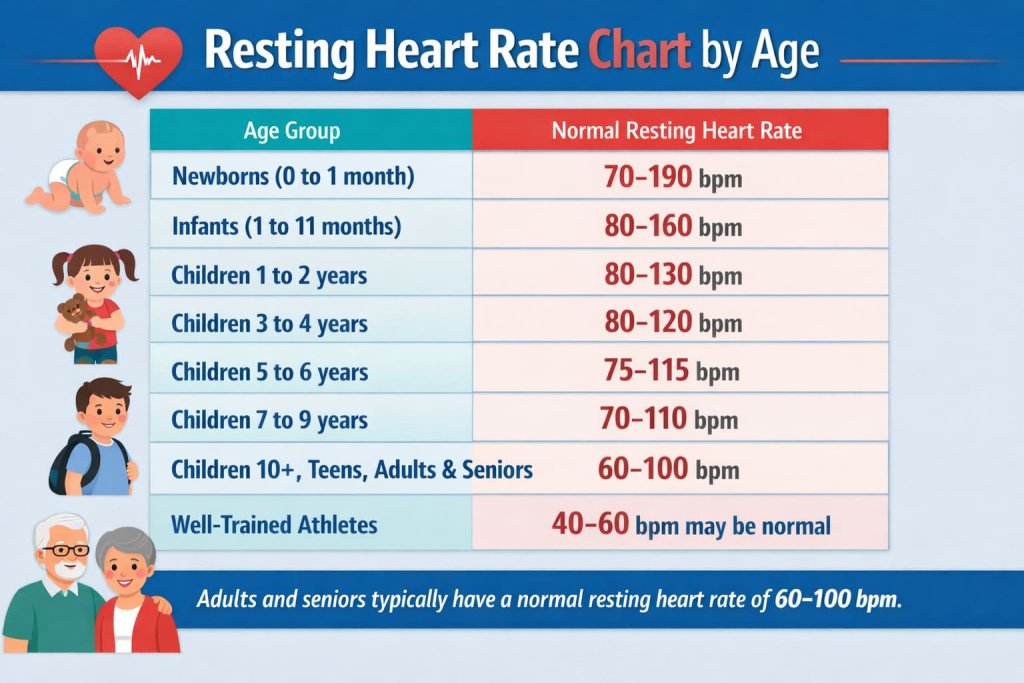
The clearest age-based clinical chart comes from MedlinePlus, which lists the following resting pulse ranges.
| Age group | Normal resting heart rate |
|---|---|
| Newborns (0 to 1 month) | 70 to 190 bpm |
| Infants (1 to 11 months) | 80 to 160 bpm |
| Children 1 to 2 years | 80 to 130 bpm |
| Children 3 to 4 years | 80 to 120 bpm |
| Children 5 to 6 years | 75 to 115 bpm |
| Children 7 to 9 years | 70 to 110 bpm |
| Children 10 years and older, adults, and seniors | 60 to 100 bpm |
| Well-trained athletes | 40 to 60 bpm may be normal |
One of the most important points in this chart is that seniors are generally included in the same 60 to 100 bpm resting range as other adults, not in a separate lower “normal” category just because of age.
Do not confuse a resting heart rate chart with an exercise heart rate chart. Resting heart rate is measured when you are calm, awake, and not active. Target heart rate during exercise is intentionally higher and is used to gauge workout intensity, not to judge whether a seated or lying-down pulse is normal. The American Heart Association separates these two numbers for a reason.
What counts as a true resting heart rate?
A reading only counts as a true resting heart rate when the person is awake, calm, and not moving. The American Heart Association says a normal resting rate is measured when you are sitting or lying down, calm, and feeling well. Mayo Clinic adds that the best time to check your resting pulse is often in the morning, before the day gets going.
That matters because a pulse checked right after climbing stairs, crying, drinking coffee, feeling anxious, or dealing with pain may be temporarily higher than your true resting number. When you want to compare readings over time, try to check under similar conditions each day.
Why a resting heart rate chart by age changes over time
Age-based ranges are higher in babies and younger children and gradually shift lower through childhood and adolescence. The chart itself shows that expected pattern clearly. U.S. reference data from the CDC show the same trend in average resting pulse: about 129 bpm under age 1, about 96 bpm at ages 4 to 5, about 78 bpm at ages 12 to 15, and around 72 bpm in middle and older adulthood.
CDC reference tables also show that females often had slightly higher average resting pulse rates than males in many age groups. Still, that does not create a separate official adult clinical chart for men versus women. In practice, the standard adult resting range remains 60 to 100 bpm for most adults.
Normal resting heart rate by life stage
Babies and infants
Babies normally have the fastest resting heart rates. A newborn’s resting pulse can still be normal anywhere from 70 to 190 bpm, and infants 1 to 11 months are typically in the 80 to 160 bpm range. If a baby is crying, upset, in pain, hot, sick, or dehydrated, the pulse may run higher for reasons that are not the same as a quiet resting reading.
Kids and teens
As children grow, the normal resting pulse range narrows and shifts lower. By ages 7 to 9, the expected resting range is 70 to 110 bpm. By age 10 and up, the standard range moves into the same 60 to 100 bpm category used for adults. That makes older children and teens easier to compare with adult pulse guidance, but symptoms and context still matter.
Adults
For most adults, the usual resting heart rate is 60 to 100 bpm. A lower number can be completely normal in people who are very fit. Mayo Clinic notes that very fit athletes may have a resting heart rate closer to 40 bpm, and the American Heart Association says active people and athletes may have readings as low as 40 to 60 bpm.
Seniors
A common question is whether older adults should use a different pulse chart. In general, no. MedlinePlus includes seniors in the same 60 to 100 bpm resting range as other adults. What changes with age is often not the official range itself, but the chance that medicines, sleep changes, heart disease, diabetes, or other health conditions may affect the reading.
How to measure resting heart rate correctly
You can check your pulse at the wrist or neck. The simplest method is usually the wrist. Mayo Clinic recommends using your index and middle fingers, pressing lightly, and counting for one full minute.
Step-by-step
- Sit quietly for a few minutes.
- Turn your palm up.
- Place your index and middle fingers on the thumb side of the inner wrist.
- Press lightly until you feel the pulse.
- Count each beat for 60 seconds.
Also pay attention to whether the pulse feels regular
Rate is only part of the picture. While you count your pulse, notice whether the beats feel steady or irregular. NHLBI explains that an arrhythmia is a problem with the rate or rhythm of the heartbeat, so a pulse that feels uneven, fluttering, or hard to count accurately may still deserve medical attention even if the number itself is not extremely high or low. Mayo Clinic notes that an ECG can be helpful when a pulse is too irregular to count accurately by hand.
If you check at the neck, use one side only. Do not press both sides of the neck at the same time, because that can make you feel dizzy or lightheaded.
The American Heart Association says a 60-second count gives the most accurate wrist reading. Mayo Clinic also describes shorter counting methods, such as 15 seconds times four or 30 seconds times two, but a full minute is easy and dependable when you want a true resting number.
What can raise or lower a resting heart rate?
A single number does not tell the whole story. The American Heart Association says resting heart rate can be affected by stress, anxiety, emotions, pain, temperature, body position, exercise, obesity, and medications. Mayo Clinic adds that age, fitness level, sleep health, smoking, body type, diabetes, high cholesterol, and cardiovascular disease can also affect heart rate. MedlinePlus notes that a fast pulse may signal infection or dehydration.
A few practical examples:
- Higher than usual: stress, illness, fever or heat, dehydration, pain, recent activity, standing up, or smoking can push the number up.
- Lower than usual: athletic training, sleep, and some medicines such as beta blockers can lower the number.
This is why trend matters. A pulse of 88 bpm may be normal for one person, while a steady change from your usual 62 to the high 80s when you are resting and feeling unwell may mean something more important is going on.
If you take beta blockers, use your clinician’s target
If you take a beta blocker, a lower resting heart rate may be expected because these medicines are designed to slow the heartbeat. The American Heart Association says people on beta blockers may be asked to monitor and log their heart rate so a healthcare professional can decide whether the dose or medication needs to change. In that situation, your personal target may matter more than a general chart.
When is a resting heart rate too high or too low?
For adults, a resting heart rate over 100 bpm is called tachycardia. A heart rate below 60 bpm may be bradycardia, but that does not automatically mean there is a problem. Athletes and some people taking heart-related medicines may normally run lower.
A useful rule from Mayo Clinic is this:
- Regularly above 100 bpm at rest: talk with a healthcare professional.
- Often below 60 bpm at rest if you are not a trained athlete: talk with a healthcare professional.
- Act sooner if symptoms are present, especially fainting, dizziness, or shortness of breath.
For children, do not use adult cutoffs alone. Compare the reading with the age-based chart first, then consider how the child looks and feels. A child who is calm but clearly outside the expected range, or who has breathing trouble, fainting, unusual weakness, chest discomfort, or severe illness symptoms, should be evaluated promptly.
Quick guide: what the number may mean
| Reading | What it may mean |
|---|---|
| Within the age-based chart | Usually normal if the person is calm, awake, and feeling well |
| Above the chart once | May reflect stress, pain, illness, heat, dehydration, or recent activity |
| Repeatedly above the chart at rest | Worth discussing with a clinician |
| Below the chart in a trained athlete | May be normal |
| Below the chart in a non-athlete | May need medical review, especially if symptoms are present |
| Very high or very low with chest pain, fainting, or shortness of breath | Emergency care is appropriate |
This kind of symptom-based interpretation is often more useful than looking at the number alone.
When to seek urgent medical help
The American Heart Association advises calling 911 if your heart rate is suddenly very high or very low for you, especially if it comes with chest pain, shortness of breath, dizziness, or fainting. The association’s bradycardia guidance also lists fatigue, confusion, and tiring easily during exercise as symptoms that can matter when a pulse is too slow.
Safety box
Get urgent care right away if an abnormal resting pulse is paired with:
- Chest pain
- Shortness of breath
- Fainting or near-fainting
- Severe dizziness
- Confusion
- A sudden major change from your usual pulse
These warning signs matter more than the number by itself.
FAQ
What is a normal resting heart rate for seniors?
For most seniors, the normal resting range is still 60 to 100 bpm, the same range used for other adults. There is not a separate official lower chart just for older age.
Is 55 bpm normal at rest?
It can be normal in a trained athlete or during sleep, but if you are not a trained athlete and your resting rate is often below 60 bpm, Mayo Clinic recommends discussing it with a healthcare professional, especially if you have fainting, dizziness, or shortness of breath.
Is 90 bpm a good resting heart rate?
For adults, 90 bpm is still within the usual 60 to 100 bpm resting range. Even so, trend and context matter. If 90 is much higher than your usual resting pulse, or if you also feel unwell, it is worth paying attention to.
Are smartwatch resting heart rate readings always accurate?
Not always. Mayo Clinic says wearable devices can make resting heart rate easy to track, but they may not always be accurate, and some devices perform better than others.
Conclusion
A resting heart rate chart by age is one of the easiest ways to put a pulse reading in context. Babies and younger children normally run faster, older children and teens gradually shift lower, and most adults and seniors fall in the 60 to 100 bpm range. Use the chart, measure your pulse when truly at rest, and pay close attention to symptoms, rhythm, and changes from your usual pattern. If a reading keeps looking off, feels irregular, or comes with chest pain, shortness of breath, fainting, or severe dizziness, get medical advice promptly.
Sources and References
- MedlinePlus — Pulse
- American Heart Association — All About Heart Rate
- American Heart Association — Target Heart Rates Chart
- Mayo Clinic — Heart rate: What’s normal?
- Mayo Clinic — How to take your pulse
- Mayo Clinic — Electrocardiogram (ECG or EKG)
- CDC National Center for Health Statistics — Resting Pulse Rate Reference Data for Children, Adolescents, and Adults: United States, 1999–2008
- National Heart, Lung, and Blood Institute — Arrhythmias
This content is for informational purposes only and not medical advice.