
The best barbell back exercises are those that build strength through heavy pulling patterns, strong hip hinges, and full-range rows that activate the lats, traps, rhomboids, and spinal erectors. Barbell lifts allow you to train multiple back muscles at once and progressively add load, making them essential for size and strength.
Understanding these movements matters because back strength supports posture, pulling power, injury prevention, and overall functional performance. Whether your goal is a wider back, stronger deadlift, or better athletic carryover, barbell exercises give unmatched results when practiced with proper technique.
This guide covers the 12 best barbell back exercises, how they work, benefits, programming tips, safety guidelines, and FAQs — all based on up-to-date evidence.
Why Are Barbell Back Exercises Important
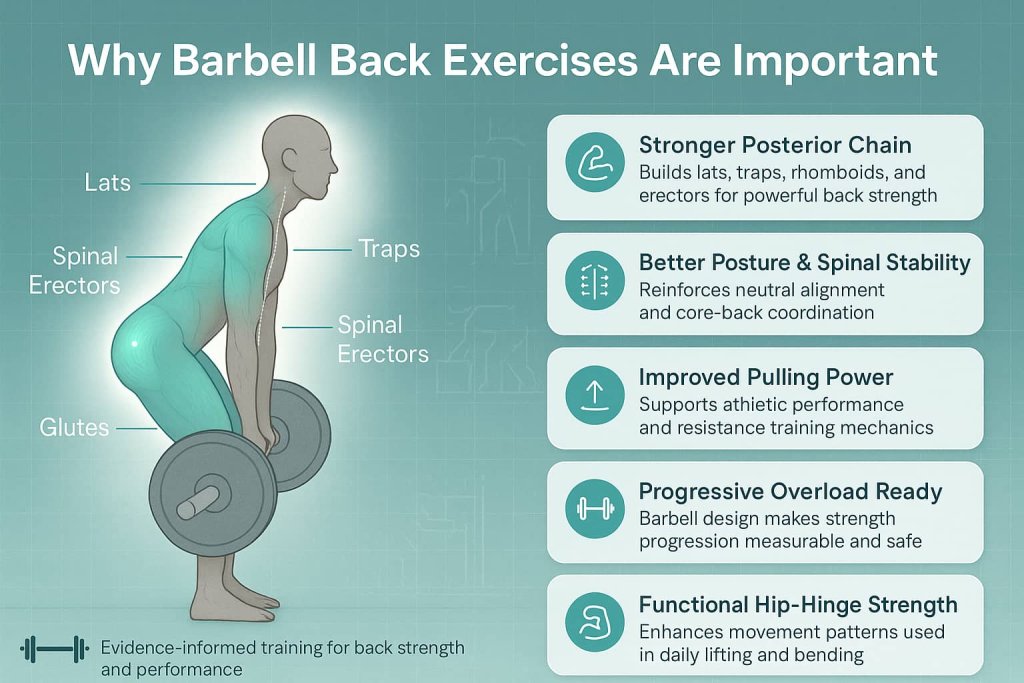
Barbell back exercises are important because they strengthen multiple major muscle groups at the same time, helping improve posture, pulling strength, and overall functional movement. These exercises support the spine, enhance upper-body stability, and allow progressive overload — a key driver of long-term strength and muscle development. By training with a barbell, lifters can build a stronger, more resilient back that carries over into both daily activities and athletic performance.
Key reasons they matter include:
- Strengthen the lats, traps, rhomboids, and spinal erectors
- Support better posture and spinal stability
- Improve pulling power for sports and resistance training
- Allow progressive load increases for consistent muscle growth
- Enhance hip-hinge mechanics used in deadlifts and daily movement
- Build overall back thickness and width more efficiently than lighter variations
12 Best Barbell Back Exercises
A full-body strength builder that targets the entire posterior chain. Ideal for developing total back strength, power, and stability.
1. Barbell Deadlift
A foundational hip-hinge movement that trains the entire posterior chain.
Why it works:
The deadlift loads multiple major muscle groups at once — including the spinal erectors, lats, hamstrings, and glutes. This creates high mechanical tension, which is strongly associated with strength and hypertrophy. Its full-body demand also reinforces proper bracing, posture, and force transfer.
Muscles worked:
Spinal erectors, lats, upper and mid-traps, hamstrings, glutes, core stabilizers.
How to do it:
- Stand with feet hip-width and the bar over your midfoot.
- Grip the bar just outside your legs.
- Brace your core and maintain a neutral spine.
- Push through the floor, extending hips and knees to stand tall.
- Lower the bar with control by hinging at the hips first, then bending the knees.
Trainer Tip:
If your lower back fatigues quickly, reduce load and improve hip-hinge mechanics before progressing heavier.
2. Romanian Deadlift (RDL)
Why it works:
The RDL isolates the hip hinge with a long, controlled range of motion. This places focused tension on the hamstrings and erectors without the full-body fatigue of standard deadlifts. It’s one of the best lifts for posterior-chain hypertrophy.
Muscles worked:
Hamstrings, glutes, spinal erectors, lower lats (stabilizing).
How to do it:
- Begin standing with the bar in your hands.
- Keep knees soft and hinge backward at the hips.
- Maintain a neutral back and keep the bar close to your legs.
- Lower until you feel a strong stretch in the hamstrings.
- Drive hips forward to return to standing.
Trainer Tip:
Think about “pushing your hips back, not down” to keep tension where it belongs.
3. Bent-Over Barbell Row (Overhand)
Why it works:
This row variation loads the mid-back through a stable hinge position. The overhand grip increases upper-back activation, helping build density and strength across the lats, traps, and rhomboids.
Muscles worked:
Lats, mid-traps, rhomboids, rear delts, spinal erectors, biceps (secondary).
How to do it:
- Hinge at the hips until torso is ~45° to the floor.
- Grip the bar slightly wider than shoulder-width.
- Row the bar toward your lower ribs.
- Lower slowly while keeping the torso still.
Trainer Tip:
If your torso rises during each rep, reduce weight and focus on controlled pulling.
4. Underhand (Supinated) Barbell Row
Why it works:
The underhand grip places the shoulders in a more externally rotated position, allowing stronger contraction in the lower lats. Lifters often use more weight in this version due to improved leverage.
Muscles worked:
Lower lats, rhomboids, biceps, rear delts, spinal erectors.
How to do it:
- Grab the bar shoulder-width with palms up.
- Maintain a stable hinge position.
- Row the bar to the lower abdomen.
- Control the descent fully.
Trainer Tip:
If you feel wrist pressure, slightly narrow the grip or use wrist straps to reduce strain.
5. Pendlay Row
Why it works:
Because the bar starts on the floor each rep, momentum is eliminated. This forces explosive pulling power from the lats and upper back, building strength and improving deadlift and row performance.
Muscles worked:
Lats, upper traps, rhomboids, spinal erectors.
How to do it:
- Position torso nearly parallel to the floor.
- Start with the bar resting on the ground.
- Pull explosively toward the sternum.
- Return the bar to the floor for a full reset.
Trainer Tip:
Speed should come from the back muscles — not from jerking the torso upward.
6. T-Bar Row (Barbell Landmine Row)
Why it works:
The arc-like pulling path targets the mid-back while reducing lower-back strain. This makes it ideal for lifters who need a heavy row but want a more forgiving hinge angle.
Muscles worked:
Mid-back, rhomboids, lower traps, lats, biceps.
How to do it:
- Place one end of the bar in a landmine.
- Straddle the bar and hinge slightly.
- Row the bar upward toward your chest or lower ribs.
- Lower with control.
Trainer Tip:
A neutral-grip handle increases comfort and helps maintain shoulder alignment.
7. Seal Row (Barbell)
Why it works:
By lying on a bench, the torso is fixed, removing all momentum. This isolates the back muscles and increases time under tension — one of the key drivers of hypertrophy.
Muscles worked:
Lats, rhomboids, mid-traps, rear delts.
How to do it:
- Lie face-down on a high bench with the bar below.
- Pull the bar upward until it touches the underside of the bench.
- Lower slowly to full stretch.
Trainer Tip:
Use lighter weight than standard rows — the strict form makes even small loads challenging.
8. Barbell Shrugs
Why it works:
Shrugs strengthen the upper traps, which play a major role in posture, scapular elevation, and supporting heavy deadlifts and rows.
Muscles worked:
Upper traps, levator scapulae, stabilizing muscles of the neck and upper back.
How to do it:
- Hold the bar at thigh height with arms straight.
- Shrug shoulders directly upward.
- Pause briefly before lowering.
Trainer Tip:
Think “up and back,” not “roll.” Rolling shoulders adds unnecessary joint stress.
9. Barbell Rack Pulls
Why it works:
Rack pulls allow very heavy loading with reduced range of motion. This strengthens the upper back, spinal erectors, and grip — especially useful for improving deadlift lockouts.
Muscles worked:
Upper traps, erectors, lats, glutes (stabilizing).
How to do it:
- Set the bar on pins below knee level.
- Grip the bar and brace as for a deadlift.
- Drive hips forward to stand tall.
- Lower under control to the pins.
Trainer Tip:
Use straps if grip fails early — the goal is heavy upper-back loading, not grip testing.
10. Barbell Good Morning
Why it works:
This strict hinge pattern builds strength in the spinal erectors and hamstrings while improving hip-hinge mechanics for deadlifts and squats.
Muscles worked:
Erectors, glutes, hamstrings, deep core stabilizers.
How to do it:
- Place the bar across your upper back.
- Hinge backward at the hips while keeping a neutral spine.
- Stop when hamstrings stretch.
- Return slowly to standing.
Trainer Tip:
Start with an empty bar or even a PVC pipe — load increases should come very gradually.
11. Barbell Meadows Row (Single-Arm Barbell Row)
Why it works:
This unilateral row trains the lower lats through a unique angle that’s difficult to achieve with traditional barbell rows. It also helps correct strength imbalances.
Muscles worked:
Lower lats, rhomboids, rear delts, obliques (stabilizing).
How to do it:
- Stand sideways to a landmine bar.
- Grip the thick end of the bar firmly.
- Row toward your hip while keeping shoulders square.
- Lower with full control.
Trainer Tip:
Keep your torso locked in — twisting reduces back activation and increases strain.
12. Barbell Yates Row
Why it works:
With a more upright torso and underhand grip, the Yates row provides strong lat loading while reducing lower-back fatigue. It allows controlled heavy lifting.
Muscles worked:
Lats, traps, biceps, rhomboids.
How to do it:
- Use an underhand grip.
- Keep torso at a 30–45° angle.
- Row the bar to the lower abdomen.
- Lower with a controlled stretch.
Trainer Tip:
Focus on locking your elbows into your sides as you pull — this maximizes lat activation.
How to Program Barbell Back Exercises
Weekly Frequency
- Most people benefit from 2 back sessions per week.
- Beginners may start with 8–12 total sets per week.
- Intermediates/advanced may use 12–20 sets per week, per ACSM volume guidelines.
Reps & Sets
- Strength: 3–6 reps, heavy loading (80–90% 1RM).
- Hypertrophy: 6–12 reps, moderate/heavy loads.
- Endurance: 12–20 reps, lighter loads.
Progression
- Increase weight by 2.5–5% once reps feel comfortable.
- Add sets gradually to avoid excessive fatigue.
Common Mistakes Beginners Should Avoid
- Rounding the back during rows or deadlifts.
- Jerking the bar instead of using controlled tension.
- Lifting too heavy too soon.
- Overtraining the lower back without proper recovery.
- Ignoring mobility and warm-ups before heavy work.
Who Should Avoid Heavy Barbell Back Exercises?
While barbell back exercises are effective for building strength, they may not be suitable for everyone. Certain individuals should use caution or consult a qualified professional before performing heavy barbell lifts.
You should avoid or modify heavy barbell back exercises if you:
- Have acute or unexplained back pain
- Are recovering from a recent spine, hip, or shoulder injury
- Experience numbness, tingling, weakness, or radiating pain
- Find it difficult to maintain a neutral spine during hip-hinge movements
- Have been advised by a healthcare professional to limit heavy lifting
- Are new to resistance training and have not yet learned proper hinge mechanics
If any of these apply, consider using lighter loads, machine-based rows, or bodyweight variations until proper form and comfort improve.
When to See a Healthcare Professional
Consult a qualified professional if you experience:
- Sharp or radiating back pain
- Persistent stiffness that worsens with training
- Sudden weakness or numbness
- Difficulty performing basic hip-hinge movements without discomfort
Barbell lifting is safe when performed with proper technique, but pre-existing back conditions may require medical guidance.
FAQ — Barbell Back Exercises
1. Are barbell back exercises good for beginners?
Yes — start with light weights, learn the hinge pattern, and progress slowly.
2. How many barbell back exercises should I do per workout?
Most lifters see great results with 3–4 exercises per session, combining rows + hip hinges.
3. Is deadlifting necessary for building back muscle?
It’s highly effective but not mandatory. Rows and RDLs can also build strong back musculature.
4. Can I build a wide back using only barbell exercises?
Yes — exercises like Pendlay rows, Yates rows, and deadlifts help create width and thickness.
5. Should I row heavier or lighter?
Use moderate-heavy weight with clean form for best hypertrophy results.
6. How long does it take to see muscle growth?
With consistent work, many people notice changes in 8–12 weeks.
7. Do barbell back exercises improve posture?
Strengthening the rhomboids, traps, and erectors may support better posture over time.
Conclusion
Barbell back exercises remain some of the most effective movements for building strength, improving posture, and developing a powerful posterior chain. By combining rows, hinges, and isolation lifts, you create a well-rounded program that supports long-term muscle and strength growth.
Always begin with a proper warm-up, progress loads gradually, and choose variations that match your experience level. If you experience pain or difficulty maintaining form, seek professional guidance to ensure you’re training safely.
With consistent practice and attention to technique, barbell back exercises can help you build a stronger, more resilient back that supports both daily life and athletic performance.
References
- ACSM – Resistance Training for Health and Fitness (Guidelines PDF)
- ACSM Position Stand – Progression Models in Resistance Training for Healthy Adults
- Systematic Review – Electromyographic Activity in Deadlift Exercise and Its Variants
- Study – Impact of Different Ranges of Motion in the Prone Barbell Row
- EMG Comparison of Row Variations – Lumbar, Dorsal, and Shoulder Regions