
A barbell curl is a classic biceps-building exercise where you curl a straight bar by bending your elbows while keeping your upper arms steady and your torso still. Done with clean form, it’s one of the simplest ways to load elbow flexion progressively, track strength gains, and build arm size over time.
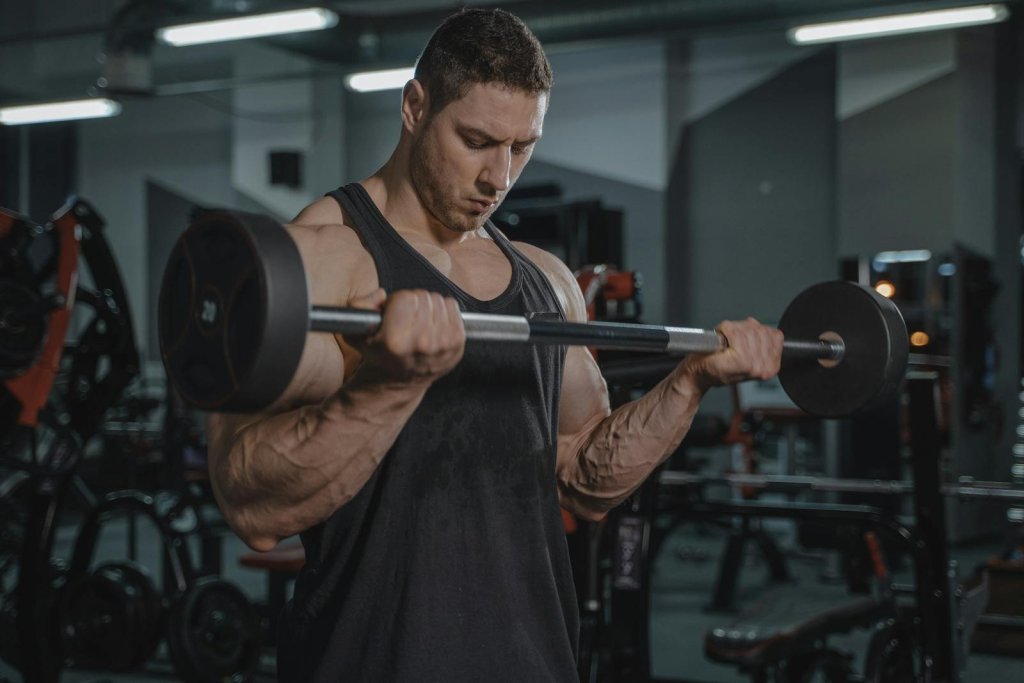
Understanding the barbell curl matters because small technique mistakes (like swinging, drifting elbows, or using an ego load) can shift work away from the biceps and increase stress on the wrists, shoulders, and low back. In this guide, you’ll learn the exact setup, form cues, programming, and best variations—plus how to fix the most common problems using evidence-based resistance training principles from the Mayo Clinic.
What muscles does the barbell curl work?
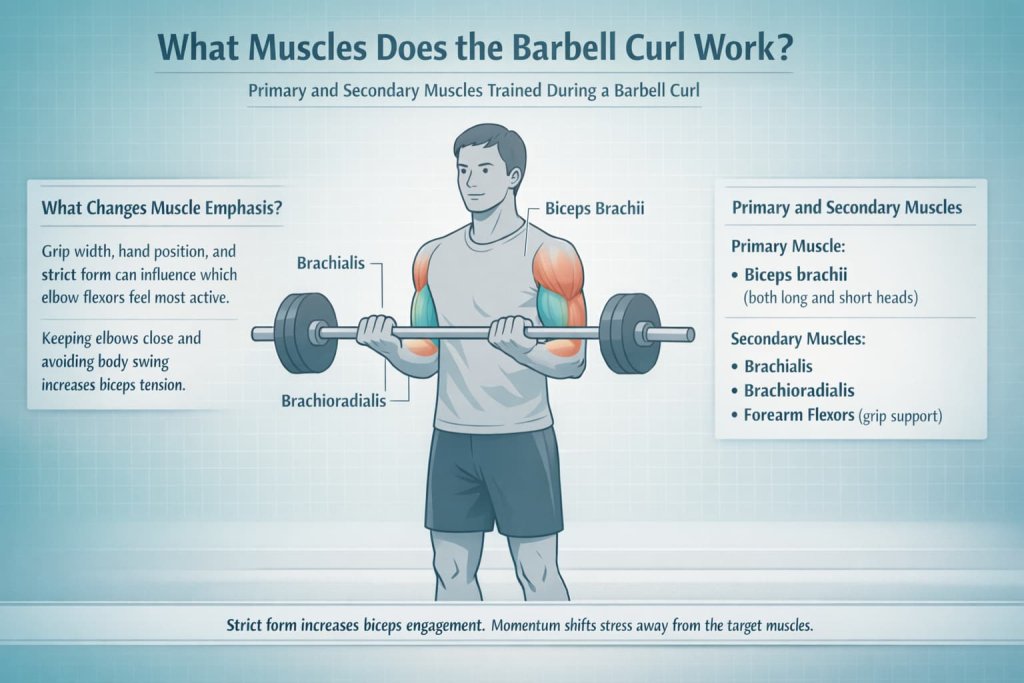
The barbell curl primarily trains the biceps brachii (both heads), with help from the brachialis and brachioradialis (forearm). How you grip and how strict you stay can change what you feel most.
How to do a barbell curl with perfect form
Setup checklist
- Stand tall with feet about hip- to shoulder-width.
- Hold the bar with an underhand grip (palms up), typically around shoulder width.
- Start with the bar near your thighs and your arms nearly straight.
- Brace your core and keep your ribcage stacked over your pelvis (avoid leaning back).
How to do it
- Curl the bar up by bending your elbows.
- Keep your upper arms close to your sides as the bar rises.
- Pause briefly near the top without letting shoulders roll forward.
- Lower the bar under control back to the start position.
Key form cues that make the curl hit your biceps harder
- “Elbows stay near your sides.”
- “Wrists neutral, knuckles up.”
- “No torso swing—move only at the elbows.”
- “Control the lowering phase.”
Best barbell curl variations
Explore the best barbell curl variations to target your biceps from different angles and reduce joint strain. These options help improve muscle balance, grip strength, and overall arm development.
1. Strict barbell curl
Why it works:
This is the most “honest” curl variation because it removes momentum. When your torso stays still and your elbows stay close, the biceps have to produce the force through the whole rep, which makes it easier to build consistent tension and track real progress.
How to do it:
- Stand tall with feet hip- to shoulder-width and brace your core
- Grab the bar with an underhand, shoulder-width grip
- Start with the bar at your thighs and arms nearly straight
- Keep elbows close to your sides (don’t let them drift forward)
- Curl the bar up smoothly without leaning back or swinging
- Pause briefly near the top while keeping shoulders relaxed
- Lower slowly and fully under control to the start position
Trainer Tip:
If you can’t stop your body from rocking, you’re too heavy. Drop the load and aim for “quiet reps” where only your forearms move.
2. EZ-bar curl
Why it works:
The angled grips often feel better on wrists and elbows because they place your hands in a more neutral position than a straight bar. That comfort can let you train curls more consistently and push closer to hard sets without joint irritation.
How to do it:
- Stand tall and hold the EZ-bar on the angled grips (palms up)
- Choose the grip width that feels strongest and most joint-friendly
- Brace your core and keep your chest up
- Curl by bending the elbows while keeping upper arms close to your sides
- Stop near the top without rolling shoulders forward
- Lower the bar slowly to a controlled stretch at the bottom
Trainer Tip:
Most people get the best balance of comfort and biceps feel using the inner angled grips, but use whichever position keeps wrists neutral and elbows happy.
3. Reverse curl (barbell or EZ-bar)
Why it works:
An overhand (palms-down) grip changes leverage and typically shifts more work toward the brachioradialis and brachialis, which can build thicker-looking forearms and improve overall elbow-flexor strength. It’s also a smart way to train the “curl pattern” without always hammering the same biceps emphasis.
Muscles worked:
Brachioradialis (major), brachialis, biceps brachii (secondary), wrist extensors/forearms (grip).
How to do it:
- Stand tall holding the bar with an overhand grip about shoulder width
- Keep wrists straight and knuckles pointing forward/up (no wrist bend)
- Brace your core and keep elbows pinned near your sides
- Curl the bar up under control (expect a shorter range than regular curls)
- Pause briefly near the top
- Lower slowly to the start position without letting shoulders shrug
Trainer Tip:
Go lighter than you think. Reverse curls punish sloppy wrists, so prioritize straight wrists and smooth tempo over heavy weight.
4. Preacher curl (barbell or EZ-bar)
Why it works:
The preacher bench supports your upper arms, which reduces swinging and helps isolate elbow flexion. That support makes it easier to keep tension on the biceps and train the bottom-to-mid range with cleaner reps—especially if you struggle with strict standing curls.
Muscles worked:
Biceps brachii (primary), brachialis, brachioradialis (secondary), forearms (grip).
How to do it:
- Set the preacher bench so your armpits rest comfortably on the top pad
- Grip the bar (straight or EZ) with palms up and hands about shoulder width
- Start with elbows extended but not aggressively locked out
- Curl the bar up without lifting your upper arms off the pad
- Stop short of letting shoulders roll forward at the top
- Lower slowly until you feel a controlled stretch, keeping tension
Trainer Tip:
Don’t chase a huge stretch at the bottom if your elbows feel cranky. Stop just short of full lockout and keep the lowering phase slow and controlled.
Barbell curl benefits
Builds measurable biceps strength and size
A straight bar makes it easy to standardize grip width, load, and reps—great for progressive overload and long-term tracking.
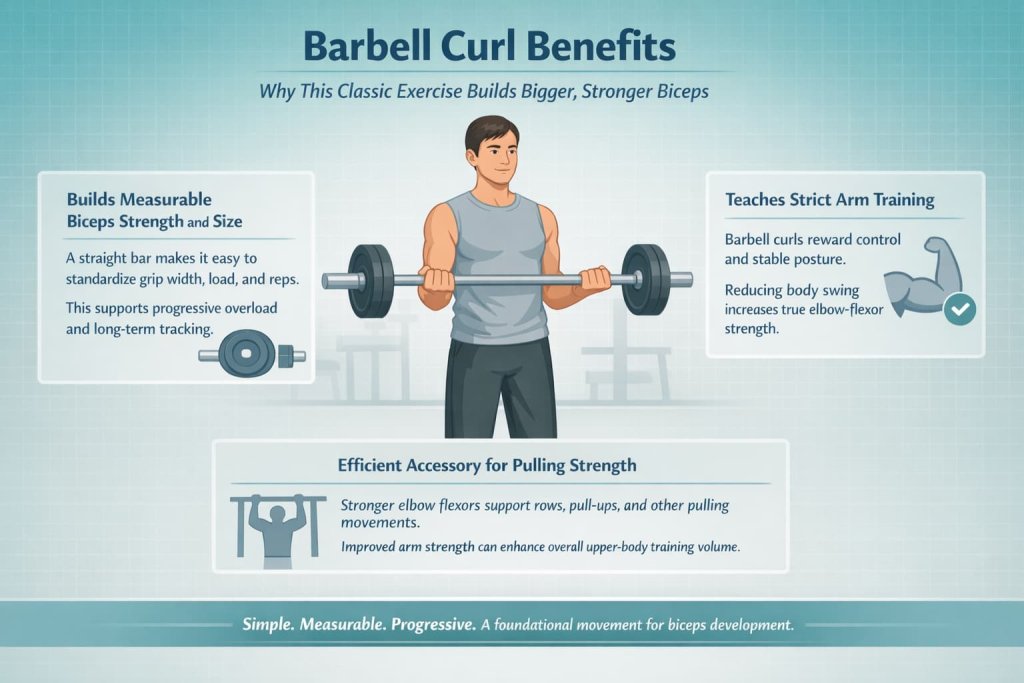
Teaches “strict” arm training
Barbell curls reward control. If you can curl a bar without swinging, you’re building real elbow-flexor strength—not just momentum.
Efficient accessory work for pulling strength
Stronger elbow flexors can support pulling volume in programs that include rows, pull-ups, and other back work.
Common barbell curl mistakes and how to fix them
Mistake 1: Swinging the weight
Why it happens: The load is too heavy or fatigue is high.
Fix: Drop the weight 10–20%, slow the tempo, and stop 1–2 reps before your form breaks.
Mistake 2: Elbows drifting forward
Why it happens: You’re turning the curl into a front-delt movement.
Fix: Think “triceps lightly touch my sides” and keep your chest tall.
Mistake 3: Bending the wrists back
Why it happens: Grip is weak or bar path is off.
Fix: Keep wrists stacked and squeeze the bar like you’re trying to leave fingerprints in it.
Mistake 4: Cutting the range of motion
Why it happens: The load is too heavy or you’re rushing.
Fix: Use a full, controlled range you can repeat consistently. If fully straight elbows irritate something, use a slightly shorter range and build up gradually.
Barbell curl grip width: does it matter?
Yes. Grip width can influence what feels hardest and how the load distributes across the elbow flexors. Research comparing grip widths during barbell curls suggests biceps activation can change as hand spacing changes, which supports using grip width as a practical tool when you’re chasing a specific “feel” or trying to manage joint comfort, as discussed in Saeterbakken et al. in the International Journal of Environmental Research and Public Health.
Practical takeaway:
- Shoulder-width is a strong default for most lifters.
- Slightly wider may feel more “biceps-heavy” for some people, but don’t force it if wrists or elbows complain.
- Slightly narrower can feel easier on some joints and may change the sticking point.
Barbell curl sets and reps for size and strength
Here’s a simple, evidence-based way to program barbell curls:
For muscle growth (hypertrophy)
A large research review suggests a practical “sweet spot” for hypertrophy is using moderate loads for roughly 8–12 reps (often described as about 60–80% of 1RM) while taking sets close to fatigue with good form, as summarized in a Schoenfeld-led paper available through PubMed Central.
- 2–4 sets of 8–12 reps
- Rest 60–120 seconds
- Add weight when you hit the top end of the rep range with clean form
For strength emphasis
General resistance training recommendations commonly used in fitness education suggest beginners and intermediates often build a base with multiple sets in moderate rep ranges, then shift toward heavier sets with longer rest when prioritizing strength, as outlined in ACSM-based guidance shared by Prescription to Get Active.
- 3–5 sets of 4–8 reps (heavier, stricter)
- Rest 2–3 minutes
- Keep reps crisp—no swinging
Simple weekly plan (easy and effective)
- 2 days per week: Barbell curl + one variation
- Day A: Barbell curl 3×8–12, Reverse curl 2×10–15
- Day B: Strict barbell curl 4×6–10, EZ-bar curl 2×10–12
How to progress your barbell curl safely
Use the “double progression” method
- Pick a rep range (example: 8–12).
- Keep the same weight until you can do all sets at 12 reps with good form.
- Then increase the weight slightly and repeat.
This approach matches the “form first, then load” mindset emphasized in safe lifting technique guidance from Mayo Clinic Sports Medicine.
Who should do barbell curls (and who should modify them)?
Great fit if you
- Want a simple biceps builder you can load and track
- Prefer a stable, repeatable movement pattern
- Need accessory arm work to complement a pulling program
Modify if you
- Have wrist discomfort with a straight bar (try EZ-bar or dumbbells)
- Feel elbow pain when fully extending (use a slightly shorter range and lighter load)
- Can’t stop swinging (use strict curls, preacher curls, or lighter weight)
If pain is sharp, worsening, or persistent, it’s smart to get guidance from a qualified professional.
People also ask about barbell curls
Are barbell curls better than dumbbell curls?
Barbell curls are easier to load and standardize. Dumbbells allow more freedom at the wrist and shoulder and can feel better for some joints. Many programs use both.
Should you curl heavy or light for biceps?
Both can work, but consistent hypertrophy results are commonly supported with moderate loads across a wide range of reps when sets are challenging and form stays clean, as summarized in the hypertrophy review on PubMed Central.
How often should you do barbell curls?
Most people do well with 2–3 biceps-focused sessions per week total (including curls and pulling work), adjusting based on soreness and recovery.
FAQ
1) What is the best grip for a barbell curl?
Start with a shoulder-width underhand grip. If wrists feel strained, try an EZ-bar or dumbbells.
2) Should I keep my elbows pinned to my sides?
Keep them close and stable for most reps. Small natural movement is fine, but big elbow drift usually reduces biceps focus.
3) How many sets of barbell curls should I do per workout?
A common range is 2–4 working sets, depending on how much other pulling and arm work you’re doing.
4) Why do I feel barbell curls more in my forearms?
Grip fatigue and wrist position can shift stress to forearms. Lighten the load, keep wrists neutral, and consider straps only if your goal is biceps focus and your grip is the limiting factor.
5) Are strict curls worth it?
Yes. Strict curls improve biceps tension and reduce momentum, making them a great “form anchor” even if the weight is lighter.
6) Is 8–12 reps good for biceps growth?
It’s one of the most consistently practical ranges for hypertrophy when sets are challenging and technique stays clean, as explained in the hypertrophy review on PubMed Central.
7) Can beginners do barbell curls?
Yes—start light, learn control, and progress slowly using a rep range like 8–12 with clean form.
Conclusion
The barbell curl is a simple, high-value exercise for building bigger, stronger biceps—if you keep it strict, control the lowering phase, and progress gradually. Start with a clean shoulder-width grip, avoid swinging, and use a proven rep range like 8–12 for steady growth.
References
- Ratamess NA, Alvar BA, Evetoch TK, et al. Progression models in resistance training for healthy adults (ACSM position stand). Medicine & Science in Sports & Exercise. 2009. (Accessed February 26, 2026). PubMed
- Marcolin G, Panizzolo FA, Petrone N, et al. Differences in electromyographic activity while performing three curl variants. 2018. (Accessed February 26, 2026). PubMed Central (NIH)