
Chair yoga exercises for men are a safe, low-impact way to improve flexibility and reduce everyday stiffness without needing to get on the floor. Using a sturdy chair for support can make movements feel more stable and approachable, especially if you sit a lot, feel tight in your hips/hamstrings/upper back, or are easing back into fitness.
In this guide, you’ll get 8 chair yoga moves (with simple cues), a beginner-friendly weekly plan, and key safety tips so you can move better and feel looser—starting today.
Who chair yoga is best for
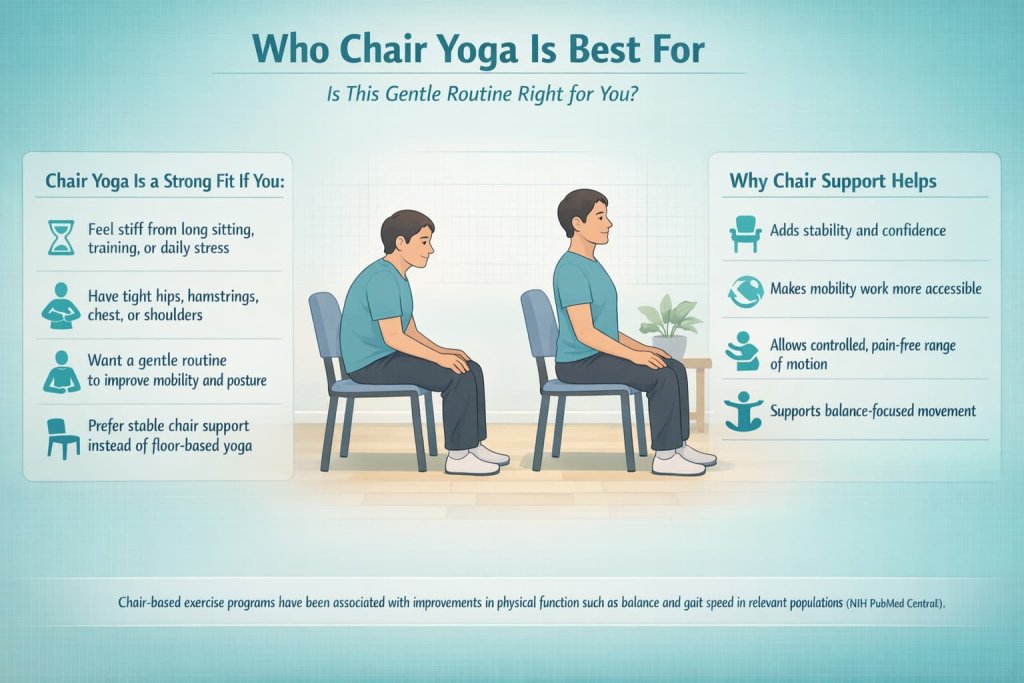
Chair yoga is a strong fit if you:
- Feel stiff from long sitting, training, or daily stress
- Have tight hips, hamstrings, chest, or shoulders
- Want a gentle routine that still improves mobility and posture
- Prefer a stable setup (chair support) instead of floor-based yoga
Research on chair-based exercise (a broad category that includes chair yoga-style programs) suggests it can support physical function measures like balance and gait speed in relevant populations, which helps explain why chair-supported movement is often used as a practical entry point for mobility work, as summarized in NIH PubMed Central.
Safety checklist before you start
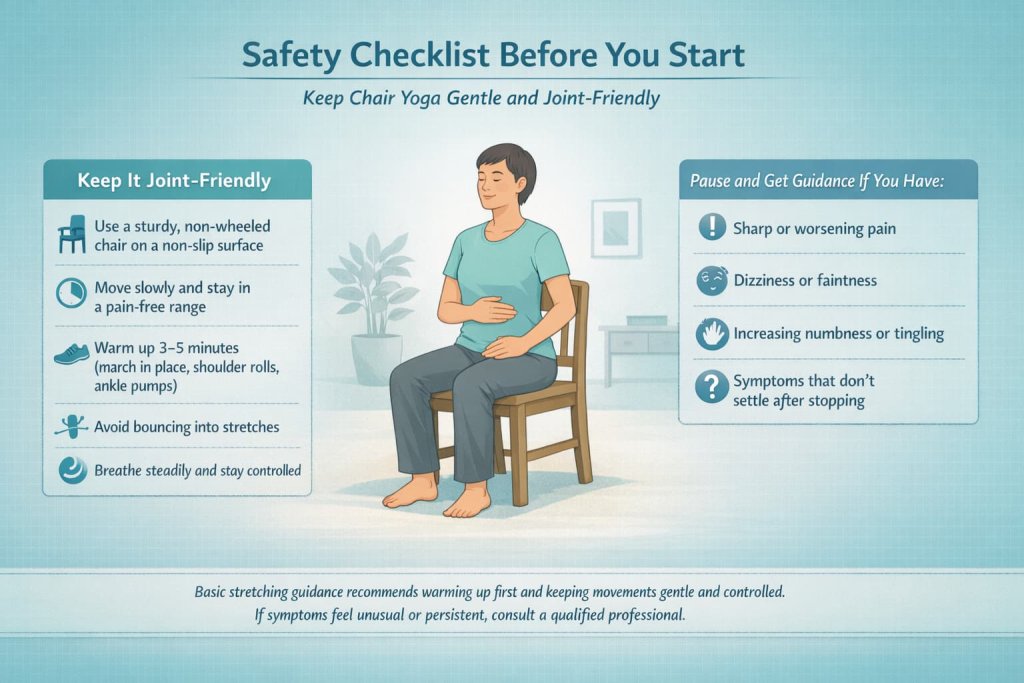
To keep this joint-friendly:
- Use a sturdy, non-wheeled chair on a non-slip surface
- Move slowly and stay in a pain-free range (a light stretch sensation is fine)
- Warm up 3–5 minutes (march in place, shoulder rolls, easy ankle pumps)
- Avoid bouncing into a stretch, and breathe steadily—basic stretching guidance from Mayo Clinic recommends warming up first and keeping stretches gentle and controlled
Stop and talk to a qualified professional if you get sharp pain, dizziness, numbness/tingling that increases, or symptoms that don’t settle after you stop.
8 Best chair yoga exercises for men
Chair yoga exercises for men are an easy, low-impact way to loosen tight hips, hamstrings, and shoulders while improving posture. Do these 8 moves for 10–15 minutes a few times per week to reduce stiffness and move more comfortably.
1) Seated Mountain Posture With Breath
How to do it:
- Sit tall near the front of the chair, feet flat and hip-width
- Lengthen your spine, relax shoulders down and back
- Inhale through your nose for 3–4 seconds
- Exhale slowly for 4–6 seconds while keeping ribs stacked over hips
- Repeat 6–10 breaths
Why it works: This resets posture, improves ribcage movement, and helps you stop “slumping” so the rest of the routine feels smoother.
Muscles worked: Deep core stabilizers, spinal postural muscles, diaphragm.
Trainer Tip: Think “tall spine, soft shoulders.” If your neck tenses, lighten the effort and slow the exhale.
2) Seated Cat-Cow
How to do it:
- Hands on thighs, sit tall
- Inhale: gently lift chest and tip pelvis slightly forward (cow)
- Exhale: round upper back and tuck pelvis slightly (cat)
- Move slowly for 6–10 reps
Why it works: Restores spinal flexion/extension—great if your mid-back feels stiff from desk time.
Muscles worked: Spinal erectors, deep core, upper-back stabilizers.
Trainer Tip: Keep the movement smooth and comfortable; avoid forcing your lower back.
3) Seated Side Bend Reach
How to do it:
- Sit tall, left hand holds the chair seat for support
- Reach right arm up and gently lean left (no twisting)
- Hold 20–30 seconds while breathing
- Switch sides and repeat
Why it works: Targets side-body tightness (lats/obliques) that can pull your posture forward and limit overhead motion.
Muscles worked: Lats, obliques, quadratus lumborum (side waist).
Trainer Tip: Don’t collapse forward—keep chest open and ribs stacked.
4) Seated Spinal Twist (Gentle)
How to do it:
- Sit tall, feet flat
- Place right hand on left thigh, left hand lightly on chair back
- Inhale to lengthen spine
- Exhale and rotate gently to the left
- Hold 15–25 seconds, then switch sides
Why it works: Improves comfortable rotation for daily movement (turning, reaching) without stressing the lower back.
Muscles worked: Obliques, spinal rotators, mid-back muscles.
Trainer Tip: Twist from your upper back, not by yanking with your arms.
5) Seated Figure-4 Hip Stretch
How to do it:
- Sit tall; place right ankle over left thigh (near the knee)
- Flex the right foot (toes toward shin) to support the knee
- Hinge forward slightly with a flat back until you feel a stretch
- Hold 20–40 seconds, switch sides
Why it works: Opens external hip rotators (often tight in men who sit a lot or lift heavy).
Muscles worked: Glutes (especially deep rotators), piriformis region, hip capsule.
Trainer Tip: If your knee sits high, keep your hinge small and focus on steady breathing.
6) Seated Hamstring Stretch (Straight-Leg)
How to do it:
- Extend one leg forward with heel on the floor, toes up
- Sit tall and hinge forward from the hips (don’t round your back)
- Hold 20–40 seconds, switch sides
Why it works: Helps reduce “posterior chain” tightness that can contribute to stiff hips and a rounded posture.
Muscles worked: Hamstrings, calves (mild), low-back stabilizers (isometric).
Trainer Tip: Keep your spine long; reaching your chest forward matters more than touching your toes.
7) Seated Chest Opener (Clasp or Towel)
How to do it:
- Sit tall; clasp hands behind your back (or hold a towel)
- Gently draw shoulders back and lift your chest
- Hold 20–30 seconds while breathing
- Release and repeat once more
Why it works: Counters tight pecs and forward shoulders from screens, driving, and pressing workouts.
Muscles worked: Chest stretch (pec major/minor), upper back (mid traps/rhomboids) lightly active.
Trainer Tip: Keep ribs down—avoid over-arching your lower back.
8) Supported Chair Warrior (Hip Flexor Opener)
How to do it:
- Stand behind the chair and hold the backrest lightly
- Step one foot back into a short lunge stance
- Bend the front knee slightly; keep back heel lifted
- Tuck pelvis slightly and squeeze the back glute
- Hold 20–30 seconds, switch sides
Why it works: Opens hip flexors and builds stable leg positioning—useful if your hips feel “stuck” from sitting.
Muscles worked: Hip flexors (stretch), glutes (activation), quads, calves.
Trainer Tip: Make the stance shorter if you feel knee pressure; focus on glute squeeze and tall posture.
Benefits of Chair Yoga Exercises for Men to Boost Flexibility and Reduce Stiffness
Chair yoga exercises for men can help you move more comfortably by loosening tight hips, hamstrings, chest, and upper back—common “stiff areas” from sitting and strength training. Because the chair adds support, it’s easier to focus on breathing, posture, and controlled range of motion. Harvard Health Publishing notes chair yoga can provide many yoga benefits with a lower risk of falling.
Key benefits may include:
- Better hip and hamstring flexibility
- Improved upper-back and shoulder mobility
- Less “desk posture” tightness in chest and neck
- Easier spinal movement (bend, extend, rotate gently)
- Better body awareness and breathing control
When to Avoid Chair Yoga and Talk to a Professional
Skip chair yoga and get guidance if symptoms are sharp, new, or worsening—or if you have a condition that makes stretching/twisting unsafe. Mayo Clinic recommends keeping stretching gentle and stopping if you feel pain.
Talk to a professional first if you have:
- Sharp pain, dizziness, faintness, or chest pain
- Numbness/tingling or weakness that increases with movement
- Recent surgery or a recent injury (back, hip, knee, shoulder)
- Severe balance problems or frequent falls
- Uncontrolled blood pressure or a medical restriction on exercise
Beginner-friendly chair yoga plan for men (10–15 minutes)
Do this 3 days per week (or daily if it feels great):
- Seated Mountain Posture With Breath: 6–10 breaths
- Seated Cat-Cow: 6–10 reps
- Seated Side Bend Reach: 20–30 sec each side
- Seated Spinal Twist: 15–25 sec each side
- Figure-4 Hip Stretch: 20–40 sec each side
- Hamstring Stretch: 20–40 sec each side
- Chest Opener: 20–30 sec
- Supported Chair Warrior: 20–30 sec each side
Progression idea (week 2+): add 1 extra round of cat-cow + twists, or extend holds by 10 seconds.
Common mistakes men make with chair yoga
- Forcing range of motion instead of using a gentle stretch sensation
- Rounding the lower back in hamstring stretches (hinge from hips instead)
- Holding the breath (especially during twists and hip stretches)
- Using a rolling chair or leaning too hard into the chair back
- Moving fast to “get it done” (slow is the point)
People also ask
Is chair yoga actually effective for men?
Yes—consistent chair yoga can improve mobility, posture, and flexibility over time. It’s also easy to scale because the chair adds support and stability.
How often should men do chair yoga for flexibility?
Aim for 2–4 days per week to start. If you respond well, short daily sessions can work—just keep intensity gentle and avoid pushing into pain.
Can chair yoga help with stiffness from sitting all day?
It may help by moving the spine, opening the hips, and stretching the chest/hamstrings—areas commonly affected by prolonged sitting.
FAQ
What kind of chair is best for chair yoga?
A sturdy, non-wheeled chair on a non-slip surface is best. Avoid chairs that swivel or roll.
Should chair yoga be done barefoot or with shoes?
Either works. Barefoot helps foot awareness, but supportive shoes are fine if you feel more stable.
How long does it take to notice results?
Many people feel looser right after a session. More noticeable flexibility changes often take a few weeks of consistent practice.
Can men who lift weights do chair yoga?
Yes. It can complement lifting by improving hip, spine, and shoulder mobility—especially if you train heavy or sit a lot.
What if a pose hurts my knee or back?
Stop that movement, shorten the range, and try a gentler variation. If pain persists, get guidance from a qualified professional.
Is chair yoga good for men over 40 or over 50?
It can be an excellent option because it’s low-impact and easy to scale—focus on smooth movement, breathing, and safe positions.
Conclusion
Chair yoga exercises for men are a practical way to build flexibility, improve posture, and reduce stiffness—without complicated setups or floor work. Pick the 8-move routine above, do it 3 times per week for 10–15 minutes, and progress slowly with longer holds or an extra round.
References
- Youkhana, S., Dean, C. M., Wolff, M., Sherrington, C., & Tiedemann, A. (2019). Yoga-based exercise improves health-related quality of life and physical function in older adults: A systematic review and meta-analysis. International Journal of Behavioral Nutrition and Physical Activity
- National Library of Medicine. (2019). Yoga-based exercise improves health-related quality of life and physical function in older adults: PubMed record. PubMed
- American Council on Exercise. (2015, June 18). Chair yoga poses: 7 poses for better balance. ACE Fitness
- American Heart Association News. (2024, August 7). How much and how often should people stretch? American Heart Association
- Centers for Disease Control and Prevention. (2025, December 4). Physical activity guidelines for older adults. CDC