
Flexibility exercises at home can safely improve your range of motion, reduce stiffness, and help you move more comfortably without any equipment. Regular flexibility training supports joint health, posture, and everyday movement—especially if you sit for long hours or feel tight in common areas like the hips, back, and shoulders.
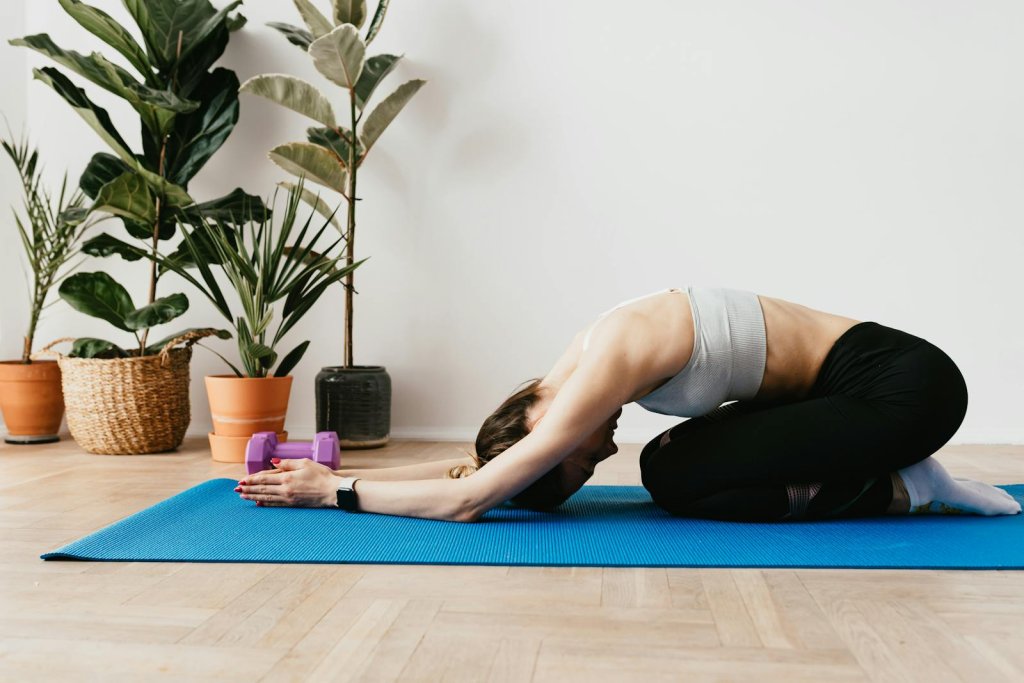
In this guide, you’ll learn exactly how to practice flexibility exercises at home, how often to stretch, and a complete list of 25 simple stretches you can use to build a full-body routine that fits into real life.
What Are Flexibility Exercises?
Flexibility exercises are movements designed to lengthen muscles and improve joint range of motion. They are usually performed slowly, with control, and without momentum.
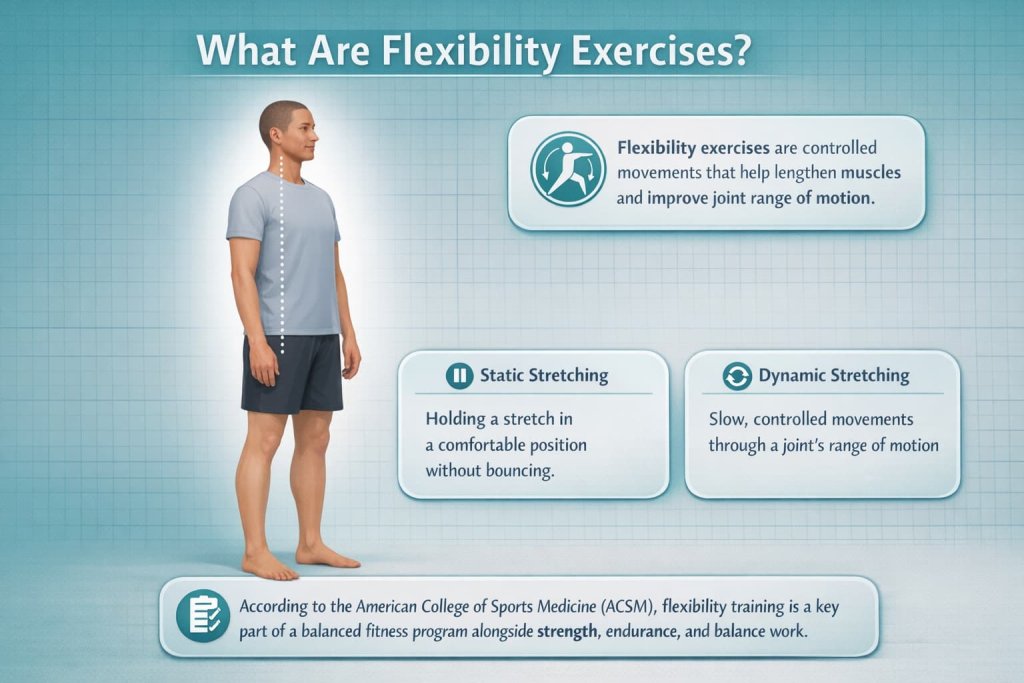
Common types include:
- Static stretching – holding a stretch in a comfortable position
- Dynamic stretching – controlled movements through a range of motion
According to the American College of Sports Medicine (ACSM), flexibility training is a key component of a balanced fitness program alongside strength, endurance, and balance work.
Why Flexibility Exercises at Home Matter
Practicing flexibility exercises at home may help support:
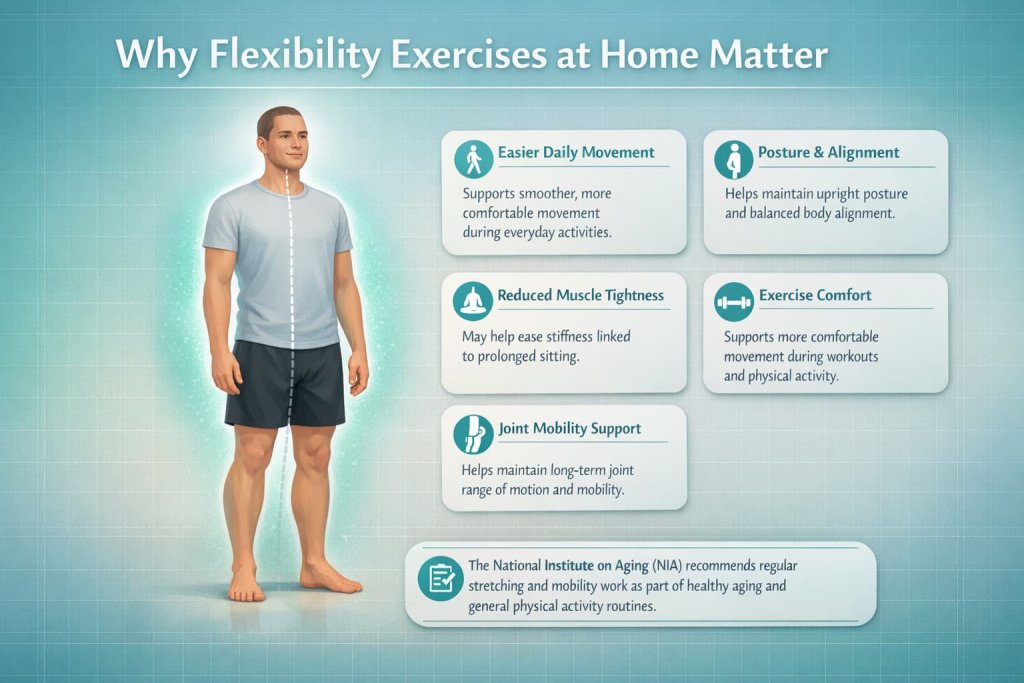
- Easier movement during daily activities
- Better posture and alignment
- Reduced muscle tightness from prolonged sitting
- Improved comfort during exercise
- Long-term joint health and mobility
The National Institute on Aging (NIA) recommend regular stretching and mobility work as part of healthy aging and general physical activity routines.
25 Flexibility Exercises You Can Do at Home
Improve your mobility, posture, and everyday movement with these 25 flexibility exercises you can do at home—no equipment required. This full-body list focuses on gentle, controlled stretches to help reduce stiffness and support comfortable movement at any age.
Neck and Upper Body Flexibility
1. Neck Side Bend
Why it works:
This stretch gently lengthens the muscles on the sides of the neck, which often become tight from prolonged sitting, screen use, and forward-head posture. Improving side-to-side neck flexibility may help support comfort and ease of head movement during daily activities.
Muscles worked:
Upper trapezius, levator scapulae, scalenes
How to do it:
- Sit or stand tall with shoulders relaxed
- Slowly tilt your head toward one shoulder
- Keep both shoulders level and down
- Hold the stretch, then return to center
- Repeat on the opposite side
Trainer Tip:
Think of “lengthening” the neck rather than collapsing into the stretch. The movement should feel gentle and controlled.
2. Neck Rotation
Why it works:
Neck rotation improves cervical mobility and helps maintain comfortable head turning for driving, walking, and daily tasks. Slow rotations also promote awareness of neck movement without excessive strain.
Muscles worked:
Sternocleidomastoid, upper trapezius, deep cervical rotators
How to do it:
- Sit or stand upright
- Slowly turn your head to one side as if looking over your shoulder
- Keep chin level and shoulders relaxed
- Return to center and switch sides
Trainer Tip:
Move within a pain-free range and avoid forcing the turn at the end position.
3. Upper Trapezius Stretch
Why it works:
This stretch targets a common tension area in the neck and shoulders. It may help reduce stiffness caused by stress, desk work, or repetitive upper-body movements.
Muscles worked:
Upper trapezius, levator scapulae
How to do it:
- Sit tall and let one arm rest by your side
- Tilt your head away from that arm
- Gently place your opposite hand on the side of your head
- Apply light pressure to deepen the stretch
- Switch sides
Trainer Tip:
Use only gentle hand pressure—this is not a forceful stretch.
4. Chest Opener Stretch
Why it works:
Opening the chest helps counteract rounded shoulders and forward posture. This stretch supports better upper-body alignment and easier breathing mechanics.
Muscles worked:
Pectoralis major, pectoralis minor, anterior deltoids
How to do it:
- Stand tall with feet hip-width apart
- Clasp your hands behind your back
- Gently lift your arms while opening your chest
- Keep your neck long and shoulders down
Trainer Tip:
Avoid arching your lower back—focus on opening through the chest, not the spine.
Shoulders and Arms
5. Cross-Body Shoulder Stretch
Why it works:
This stretch targets the back of the shoulder, which often becomes tight with pushing exercises and prolonged sitting. It supports shoulder comfort and balanced mobility.
Muscles worked:
Posterior deltoid, upper trapezius, rotator cuff (assistive)
How to do it:
- Bring one arm across your chest
- Use the opposite arm to support it close to your body
- Keep shoulders relaxed and down
- Switch sides after holding
Trainer Tip:
If you feel shoulder pinching, lower the arm slightly and reduce pressure.
6. Overhead Triceps Stretch
Why it works:
This stretch lengthens the triceps and surrounding shoulder tissues, which helps maintain comfortable overhead arm movement.
Muscles worked:
Triceps brachii, latissimus dorsi (secondary)
How to do it:
- Raise one arm overhead
- Bend the elbow so the hand reaches down your back
- Use the opposite hand to gently press the elbow back
- Switch arms after holding
Trainer Tip:
Keep your ribs down and avoid flaring the chest forward.
7. Arm Circles
Why it works:
Arm circles gently move the shoulder joint through its range of motion, supporting shoulder lubrication and dynamic flexibility.
Muscles worked:
Deltoids, rotator cuff, upper trapezius
How to do it:
- Stand tall with arms extended out to the sides
- Make slow, controlled circles forward
- Reverse direction after several repetitions
Trainer Tip:
Small, controlled circles are more effective than fast, swinging motions.
Upper and Mid-Back Flexibility
8. Cat–Cow Stretch
Why it works:
This spinal mobility exercise alternates between flexion and extension, helping the spine move smoothly and comfortably.
Muscles worked:
Erector spinae, abdominals, spinal stabilizers
How to do it:
- Start on hands and knees
- Inhale and gently arch your back
- Exhale and round your spine upward
- Move slowly between positions
Trainer Tip:
Let your breathing guide the movement for better control and relaxation.
9. Child’s Pose
Why it works:
Child’s Pose gently stretches the back, hips, and shoulders while encouraging relaxation and controlled breathing.
Muscles worked:
Latissimus dorsi, erector spinae, gluteals
How to do it:
- Kneel on the floor and sit hips back toward heels
- Reach arms forward on the floor
- Relax your head and neck
Trainer Tip:
Place a pillow under your hips or chest if you need extra comfort.
10. Seated Spinal Twist
Why it works:
This stretch supports rotational mobility of the spine, which is important for functional movements like turning and reaching.
Muscles worked:
Obliques, spinal rotators, erector spinae
How to do it:
- Sit tall with legs crossed or extended
- Rotate your torso gently to one side
- Keep both hips grounded
- Repeat on the other side
Trainer Tip:
Twist from the upper back, not the lower back.
Hip Flexibility
11. Hip Flexor Stretch
Why it works:
Hip flexors often tighten with prolonged sitting. Stretching them may help support upright posture and easier walking mechanics.
Muscles worked:
Iliopsoas, rectus femoris
How to do it:
- Step one foot forward into a split stance
- Bend the front knee slightly
- Shift hips forward gently
- Switch sides
Trainer Tip:
Squeeze the glutes lightly to avoid arching your lower back.
12. Butterfly Stretch
Why it works:
This stretch opens the hips and inner thighs, supporting seated comfort and lower-body mobility.
Muscles worked:
Hip adductors, gracilis
How to do it:
- Sit with soles of feet together
- Hold ankles or feet
- Gently lower knees toward the floor
Trainer Tip:
Sit on a cushion if your hips feel tight or uncomfortable.
13. Figure-4 Hip Stretch
Why it works:
This stretch targets the outer hips and glutes, which play a key role in hip stability and movement control.
Muscles worked:
Gluteus maximus, gluteus medius, piriformis
How to do it:
- Sit or lie down
- Cross one ankle over the opposite knee
- Gently lean forward or pull legs toward you
- Switch sides
Trainer Tip:
If your knee feels stressed, reduce the depth of the stretch.
14. Standing Hip Circles
Why it works:
Hip circles gently move the hip joint through multiple directions, supporting joint awareness and mobility.
Muscles worked:
Hip flexors, gluteals, deep hip rotators
How to do it:
- Stand tall and hold onto support if needed
- Lift one knee slightly
- Make slow circles with the knee
- Switch directions and sides
Trainer Tip:
Move slowly to keep tension low and control high.
Hamstrings and Glutes
15. Standing Forward Fold
Why it works:
This stretch lengthens the back of the legs and lower back, helping relieve posterior chain tightness.
Muscles worked:
Hamstrings, gluteals, spinal extensors
How to do it:
- Stand with feet hip-width apart
- Hinge at the hips
- Let your upper body relax downward
Trainer Tip:
Bend your knees slightly to protect the lower back.
16. Seated Hamstring Stretch
Why it works:
Seated stretching allows better control and reduces strain compared to standing versions.
Muscles worked:
Hamstrings, calves (secondary)
How to do it:
- Sit tall with one leg extended
- Lean forward from the hips
- Keep spine neutral
- Switch legs
Trainer Tip:
Focus on hinging forward rather than rounding your back.
17. Supine Hamstring Stretch
Why it works:
Lying on your back removes spinal load and allows isolated hamstring stretching.
Muscles worked:
Hamstrings, gluteals (secondary)
How to do it:
- Lie on your back
- Lift one leg upward
- Hold behind thigh or calf
- Switch sides
Trainer Tip:
Use a towel or strap if reaching your leg is difficult.
Quadriceps and Front Thigh
18. Standing Quad Stretch
Why it works:
Stretching the quads helps balance knee mechanics and supports walking and stair climbing.
Muscles worked:
Quadriceps femoris
How to do it:
- Stand tall and hold onto support
- Pull one heel toward your glutes
- Keep knees close together
- Switch sides
Trainer Tip:
Keep hips tucked slightly to enhance the stretch safely.
19. Side-Lying Quad Stretch
Why it works:
This version reduces balance demands and allows a more relaxed stretch.
Muscles worked:
Quadriceps femoris
How to do it:
- Lie on one side
- Bend top knee and grab ankle
- Pull heel gently toward glutes
- Switch sides
Trainer Tip:
Keep your hips stacked to avoid twisting.
Calves and Ankles
20. Wall Calf Stretch
Why it works:
Calf flexibility supports ankle movement, walking efficiency, and balance.
Muscles worked:
Gastrocnemius, soleus
How to do it:
- Place hands on a wall
- Step one foot back
- Press heel into the floor
- Switch sides
Trainer Tip:
Slight knee bend targets the deeper soleus muscle.
21. Seated Ankle Flex and Point
Why it works:
This movement improves ankle range of motion and circulation.
Muscles worked:
Tibialis anterior, calf muscles
How to do it:
- Sit comfortably
- Point toes away
- Pull toes back toward you
- Repeat slowly
Trainer Tip:
Move through the full range without forcing end positions.
22. Ankle Circles
Why it works:
Ankle circles promote joint lubrication and control in multiple directions.
Muscles worked:
Ankle stabilizers, foot muscles
How to do it:
- Lift one foot off the floor
- Rotate ankle in slow circles
- Switch directions and sides
Trainer Tip:
Keep the movement smooth and controlled.
Full-Body Flexibility
23. Side Body Stretch
Why it works:
This stretch lengthens the side torso and supports overhead mobility.
Muscles worked:
Obliques, latissimus dorsi
How to do it:
- Stand tall
- Reach one arm overhead
- Lean gently to the opposite side
- Switch sides
Trainer Tip:
Avoid twisting—keep shoulders stacked.
24. Standing Reach and Stretch
Why it works:
This movement promotes full-body lengthening and posture awareness.
Muscles worked:
Spinal extensors, shoulders, calves
How to do it:
- Stand tall
- Reach both arms overhead
- Gently lengthen upward
Trainer Tip:
Imagine growing taller rather than leaning back.
25. Gentle Stretch Flow
Why it works:
Combining multiple stretches into a slow flow encourages smooth transitions and relaxed movement.
Muscles worked:
Multiple muscle groups throughout the body
How to do it:
- Move slowly between arm reaches
- Add a forward fold
- Include side bends
- Continue for 1–2 minutes
Trainer Tip:
Let your breathing set the pace for the flow.
How Often Should You Do Flexibility Exercises?
Most health and fitness organizations recommend:
- 2–4 days per week for general flexibility
- Holding each stretch 20–30 seconds
- Repeating each stretch 2–4 times
- Stretching after a light warm-up or physical activity
Stretching should create gentle tension, not pain. Never force a position.
Sample At-Home Flexibility Routine (10–15 Minutes)
- Upper body stretches: 5 minutes
- Hip and leg stretches: 5–7 minutes
- Full-body flow: 3–5 minutes
This short routine can be done in the morning, after workouts, or before bed.
Safety Guidelines for Stretching at Home
Before starting these flexibility exercises at home, keep these safety tips in mind:
- Warm up with light movement first (walking, marching, arm swings)
- Move slowly and breathe normally
- Avoid bouncing or jerking motions
- Stop if you feel sharp or increasing pain
- Modify or skip stretches if you have joint conditions or recent injuries
Frequently Asked Questions
Are flexibility exercises at home effective?
Yes. Consistent stretching at home can improve mobility and reduce stiffness when done correctly and regularly.
Should I stretch every day?
Daily gentle stretching is generally safe for most people, especially if intensity stays moderate.
Is flexibility the same as mobility?
No. Flexibility refers to muscle length, while mobility includes joint control through a range of motion.
How long does it take to see results?
Many people notice reduced stiffness within 2–3 weeks of consistent practice.
Can seniors do these exercises?
Yes, with modifications. Organizations like the NIA and CDC encourage gentle stretching for older adults.
Is stretching before exercise okay?
Dynamic stretching is better before exercise. Save longer static stretches for after workouts.
Conclusion
You don’t need a gym, equipment, or complicated routines to move better. These flexibility exercises at home provide a simple, effective way to support mobility, posture, and comfort at any age. Start slowly, stay consistent, and listen to your body as you build a habit that supports long-term movement health.