
Oblique exercises for seniors are safe, side-core movements that build trunk stability and support better balance when done with controlled, low-impact form. Training your obliques (the muscles along the sides of your waist) can help you stay steadier during walking, turning, reaching, and getting up from a chair.
For healthy aging, most adults 65+ should aim for weekly activity that includes aerobic work, strength training, and balance-focused movement, as outlined by the CDC. This guide gives you 9 senior-friendly oblique exercises with clear steps, regressions, and safety tips.
What oblique muscles do for seniors
Your obliques help you:
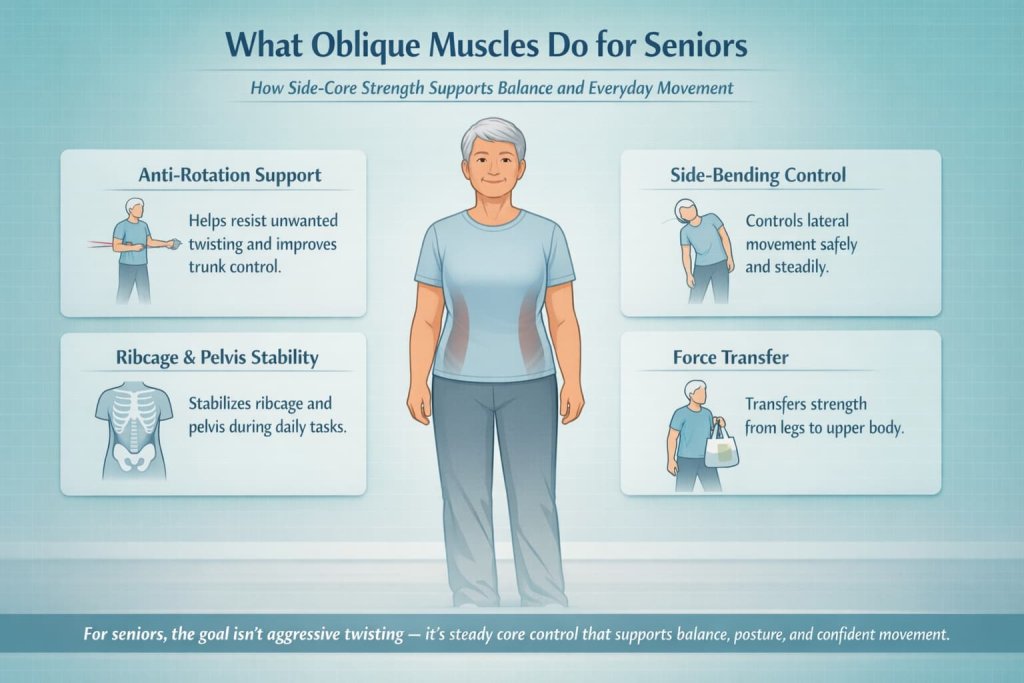
- Resist unwanted twisting (anti-rotation)
- Control side-bending (lateral flexion)
- Stabilize your ribcage and pelvis during daily movement
- Transfer force from legs to upper body (reaching, carrying, stairs)
For seniors, the goal is usually not “hard twisting.” It’s steady core control that supports balance and posture.
Benefits of oblique exercises for seniors
Consistent, appropriate oblique training may help you:
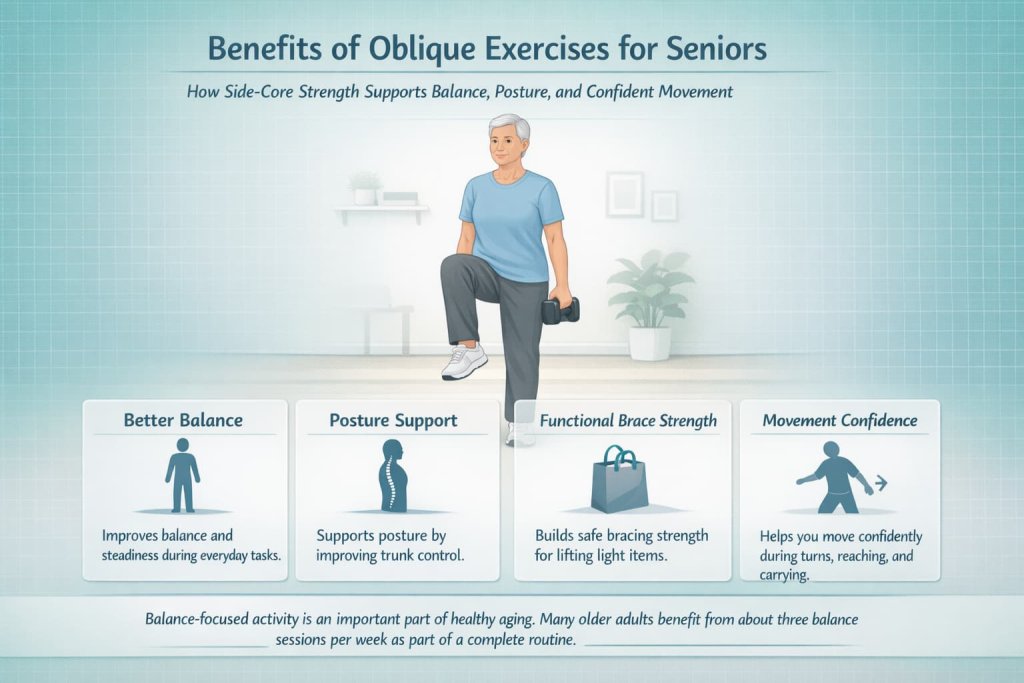
- Improve balance and steadiness during everyday tasks
- Support posture by improving trunk control
- Build “brace strength” for lifting light objects safely
- Move with more confidence during turns, reaching, and carrying
The National Institute on Aging highlights balance-focused activity as an important part of healthy aging and fall prevention, and many older adults do well with about three balance sessions per week as part of a broader routine.
Safety tips before starting oblique exercises for seniors
Use these rules to keep your routine senior-friendly:
- Work near a wall, counter, or sturdy chair for support
- Keep reps slow and controlled (no fast twisting)
- Stay in a pain-free range (stop if pain, dizziness, or numbness increases)
- Breathe steadily (exhale during effort, avoid breath-holding)
- Start with short holds (5–15 seconds) and low reps (6–10)
If you have osteoporosis, recent surgery, severe back pain, or frequent dizziness, consider asking a clinician what movements to avoid and what to prioritize; the CDC STEADI fall-prevention framework can help guide safer decisions.
9 Best Oblique Exercises for Seniors
Strengthen your side core safely with these beginner-friendly oblique exercises designed for seniors. They help improve balance, posture, and everyday stability with low-impact, supported movements.
1. Seated Oblique Bracing (Chair Side Brace)
How to do it:
- Sit tall on a sturdy chair, feet flat, hands on thighs
- Inhale gently to prepare
- Exhale and “brace” your side-core as if tightening a belt
- Keep ribs stacked over hips (no leaning)
- Hold 5–15 seconds, relax, repeat
Why it works:
This teaches safe, low-load core control and helps you feel your obliques without twisting, making it a great starting point for seniors who want stability first.
Muscles worked:
Internal obliques, external obliques, transverse abdominis.
Trainer Tip:
Think “tall spine + firm sides,” not “suck in hard.”
2. Seated Side Lean (Small Range)
How to do it:
- Sit tall, feet flat, hands lightly on the chair seat
- Slowly lean your torso 1–3 inches to the right (no collapsing)
- Return to center
- Repeat on the left
Why it works:
It builds controlled side-bending strength in a supported position, which can translate well to better control during reaching, turning, and walking.
Muscles worked:
Obliques, quadratus lumborum (assist), spinal stabilizers.
Trainer Tip:
Keep both sit bones heavy on the chair and move slowly.
3. Standing Suitcase Hold (Counter Support)
How to do it:
- Stand next to a counter and hold it lightly with one hand
- Hold a light weight in the opposite hand (or a water bottle)
- Stand tall and resist leaning toward the weight
- Hold 10–20 seconds, then switch sides
Why it works:
This is a simple anti-side-bend drill that strengthens the obliques for upright posture and real-life tasks like carrying groceries or a bag.
Muscles worked:
Obliques, transverse abdominis, grip/forearm (assist).
Trainer Tip:
Start very light. Even 2–5 lb can be enough at first.
4. Standing Pallof Press (Band Anti-Rotation)
How to do it:
- Anchor a resistance band to a sturdy point at chest height
- Stand sideways to the anchor, feet hip-width
- Hold the band at chest level and brace your core
- Press arms straight out slowly, then return
- Do 6–10 reps per side
Why it works:
Anti-rotation training helps your core resist twisting, which is often a safer and more useful oblique pattern for seniors than repeated trunk rotation.
Muscles worked:
Obliques, transverse abdominis, deep trunk stabilizers.
Trainer Tip:
Keep shoulders relaxed and don’t let the band pull you into rotation.
5. Supported Standing Knee Lift (March and Brace)
How to do it:
- Hold a counter with both hands for stability
- Brace your core gently
- Lift one knee to a comfortable height, then lower slowly
- Alternate for 8–12 total reps
Why it works:
Marching challenges balance and trunk control at the same time, and your obliques help prevent side-to-side shifting as you move on one leg.
Muscles worked:
Obliques, hip flexors, glutes (stabilizers).
Trainer Tip:
Exhale as the knee lifts to cue natural core engagement.
6. Side Plank (Wall Version)
How to do it:
- Stand side-on to a wall, forearm on the wall at shoulder height
- Step feet slightly away so your body forms a straight line
- Press forearm into the wall and brace your side-core
- Hold 10–20 seconds per side
Why it works:
This builds side-plank strength without floor work, which makes it more accessible while still training obliques for posture and stability.
Muscles worked:
Obliques, serratus anterior (assist), shoulder stabilizers.
Trainer Tip:
Keep hips under shoulders—avoid rotating your torso.
7. Side Plank (Bed or Couch Version)
How to do it:
- Place your forearm on a sturdy bed/couch edge, body sideways
- Keep knees slightly bent if needed
- Brace and hold a straight line from shoulders to hips
- Hold 10–20 seconds per side
Why it works:
You get strong oblique activation with less load than a full floor side plank, making it a smart middle step between wall and floor versions.
Muscles worked:
Obliques, glute medius (stabilizer), trunk stabilizers.
Trainer Tip:
If you feel shoulder discomfort, return to the wall version.
8. Seated Band Row With Brace (Anti-Rotation Focus)
How to do it:
- Sit tall, band anchored in front of you
- Before pulling, brace your core gently
- Row elbows back, pause, then return slowly
- Do 8–12 reps
Why it works:
Your core resists rotation and keeps you upright while your upper back works, creating a practical posture-and-stability combo that matches the controlled core training approach described by the Mayo Clinic.
Muscles worked:
Obliques (stabilizing), mid-back, lats.
Trainer Tip:
If you sway or twist, use lighter band tension and slow down.
9. Farmer Carry March (Very Light, Supported Start)
How to do it:
- Hold a light weight in each hand (or one hand to start)
- Stand tall near a counter or wall if needed
- March slowly for 10–20 steps
- Rest and repeat
Why it works:
Carries and marching are functional drills where the obliques stabilize your trunk while you move, supporting balance, posture, and gait control.
Muscles worked:
Obliques, transverse abdominis, grip, glutes.
Trainer Tip:
Start with no weight and master the marching pattern first, then add light load.
How to use these oblique exercises for seniors
Beginner plan (2–3 days per week)
- Pick 4–6 exercises
- Do 1–2 sets
- Use 6–10 reps or 10–20 second holds
- Rest 30–60 seconds between sets
Progression (after 2–4 weeks)
- Add a set, then add time (holds), then add resistance last
- Keep form strict before you make it harder
Example rotation:
- Day 1: Seated Bracing, Seated Side Lean, Pallof Press, Supported Knee Lift
- Day 2: Suitcase Hold, Wall Side Plank, Heel Tap + Reach, Seated Band Row
When to Avoid Oblique Exercises and Talk to a Professional
Stop and get guidance if you have:
- Sharp or worsening back/hip pain
- Dizziness, chest pain, or unusual shortness of breath
- New numbness, tingling, or weakness
- Recent fall, surgery, or symptoms that make standing unsafe even with support
Common mistakes to avoid
- Twisting fast to “feel it more”
- Holding your breath during effort
- Leaning your trunk instead of bracing
- Using too much resistance too soon
- Skipping support tools (chair/counter) when balance is limited
People-also-ask questions about oblique exercises for seniors
Are twisting oblique exercises safe for seniors?
Often, anti-rotation and controlled side-bending are safer starting points than fast or deep twisting. If twisting bothers your back or causes dizziness, avoid it and use stability-focused options.
How often should seniors train obliques?
Most seniors do well with 2–3 sessions per week, especially when combined with balance work and overall strength training.
Do oblique exercises help balance in older adults?
They can help support balance by improving trunk control, which plays a role in steadier walking, turning, and reaching.
FAQ
1) What are the safest oblique exercises for seniors at home?
Seated bracing, wall side plank holds, Pallof presses with a light band, and suitcase holds with a very light weight are typically safe starting points.
2) Should seniors avoid side bends?
Not necessarily. Small-range, controlled side leans can be helpful. Avoid forcing range or bending into pain.
3) Can seniors do side planks?
Yes, but many seniors should start with wall or bed/couch versions instead of floor side planks.
4) What if I have lower back pain?
Choose anti-rotation options (like Pallof press), keep ranges small, and stop any move that increases symptoms. Consider professional guidance if pain persists.
5) How long should oblique holds be for seniors?
Start with 5–15 seconds, and build toward 20–30 seconds with good form before adding resistance.
6) Do I need equipment?
No. Many moves are bodyweight or chair-supported. A light resistance band and a water bottle can expand options.
7) When should I stop and get medical advice?
Stop and seek advice if you have chest pain, fainting, new or worsening numbness/tingling, severe dizziness, or sharp/spreading pain.
Conclusion
Oblique exercises for seniors work best when they’re stable, controlled, and balance-friendly. Start with bracing, anti-rotation, and supported standing moves, then progress slowly as your confidence improves. If you want, I can turn these into a simple 2–3 day weekly plan (beginner, intermediate, or chair-only) based on your equipment.