
The crunch exercise is a classic core movement that primarily targets the rectus abdominis and helps build controlled abdominal strength when performed with proper form. Understanding how to do crunches correctly matters because poor technique can reduce effectiveness and increase unnecessary strain on the neck or lower back.

In this guide, you’ll learn correct form, muscles worked, benefits, variations, safety guidelines, and when crunches make sense in a balanced core routine—using evidence-based, fitness-education best practices.
What Is the Crunch Exercise?
The crunch exercise is a bodyweight abdominal movement where you flex the spine slightly to lift your head, shoulders, and upper back off the floor while keeping the lower back supported. Unlike sit-ups, crunches focus on small, controlled spinal flexion rather than full trunk movement.
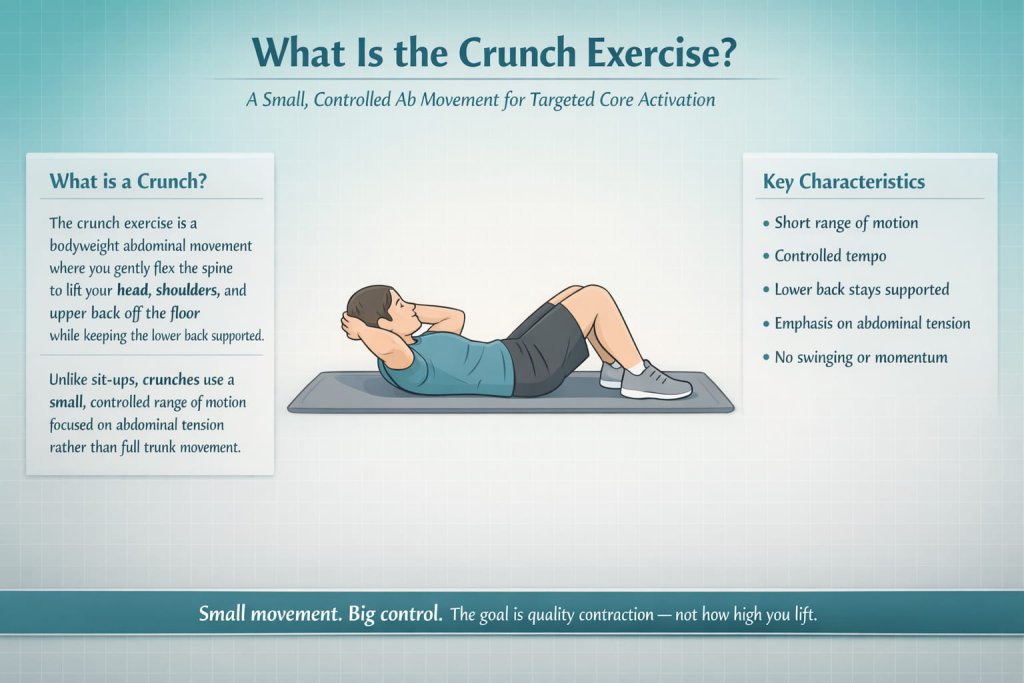
Key characteristics:
- Short range of motion
- Controlled tempo
- Emphasis on abdominal tension, not momentum
How to Do the Crunch Exercise Correctly
Setup
- Lie on your back with knees bent and feet flat on the floor
- Feet about hip-width apart
- Cross arms over your chest or place fingertips lightly behind ears
- Keep the neck neutral and eyes facing upward
Execution
- Brace your core as if tightening a belt around your waist
- Exhale and lift your head, shoulders, and upper back off the floor
- Think “rib cage toward pelvis,” not chin to chest
- Pause briefly at the top
- Lower slowly with control until shoulders touch the floor
Key form cues
- Keep the lower back gently pressed into the floor
- Avoid pulling on the neck
- Move slowly—no jerking or momentum
Muscles Worked in the Crunch Exercise
The crunch exercise mainly targets the superficial abdominal muscles responsible for trunk flexion and core control.
Primary muscle
- Rectus abdominis – produces spinal flexion and abdominal bracing
Secondary contributors
- Internal and external obliques – assist with trunk stabilization
- Transverse abdominis – supports abdominal tension and spinal stability
Benefits of the Crunch Exercise
Adding crunches to a well-rounded program may help support:
- Improved abdominal strength and endurance
- Better awareness of core bracing and spinal control
- Low-equipment, beginner-friendly core training
- Short, efficient workouts at home or in the gym
Crunches are especially useful when the goal is targeted abdominal activation rather than full-body or anti-movement core training.
Crunch Exercise vs Sit-Ups
Although often confused, crunches and sit-ups are different exercises.
| Crunch Exercise | Sit-Up |
|---|---|
| Partial spinal flexion | Full trunk movement |
| Lower spinal load | Higher spinal load |
| Focus on abs | Involves hip flexors more |
| Better control for beginners | More advanced and demanding |
Crunch Exercise Variations
Easier Options
Why it works:
Reducing the range of motion and leverage lowers spinal loading and neck strain. This helps beginners focus on abdominal engagement and breathing control rather than height or speed of movement.
How to do it:
- Lift only the head and upper shoulders slightly off the floor
- Keep arms crossed over the chest to limit neck involvement
- Maintain the lower back gently pressed into the floor
- Perform slow, controlled repetitions with a short pause at the top
Trainer tip:
Think about drawing the ribs toward the pelvis. If you feel the neck working more than the abs, reduce the lift height further.
More Challenging Options
Why it works:
Increasing time under tension or leverage raises abdominal demand while still keeping movement controlled. These variations improve ab strength and endurance without turning the exercise into a sit-up.
How to do it:
- Hold the top position for 2–3 seconds on each rep
- Lower slowly for 3–4 seconds to increase eccentric control
- Perform crunches on a stability ball to increase range of motion and balance demands
Trainer tip:
Only progress if you can maintain abdominal tension and keep the lower back stable against the floor or ball throughout the set. Quality reps matter more than difficulty.
How Often Should You Do Crunch Exercises?
According to ACSM resistance-training guidelines, core strengthening can be performed 2–3 times per week, allowing rest between sessions.
General recommendation:
- 2–4 sets
- 8–15 controlled reps
- Emphasis on quality, not quantity
Crunches should be part of a balanced core program, alongside anti-extension, anti-rotation, and hip-stability exercises.
Breathing and Core Bracing During Crunches
Proper breathing and core bracing are essential for making the crunch exercise effective and safe. They help improve abdominal engagement while reducing unnecessary strain on the neck and lower back.
Breathing guidance:
Exhale slowly as you lift into the crunch. This natural exhale encourages deeper activation of the abdominal muscles and helps prevent breath-holding. Inhale as you lower back down with control.
Core bracing cues:
Before initiating the movement, gently tighten your abdominal muscles as if preparing to cough or brace for a light impact. This creates stability through the trunk without flattening or forcing the lower back into the floor.
Key technique reminders:
- Keep the rib cage moving toward the pelvis, not the chin toward the chest
- Maintain light tension in the abs throughout the entire repetition
- Avoid holding your breath or pushing the stomach outward
Using consistent breathing and controlled bracing supports better form, smoother movement, and more efficient abdominal engagement during crunches.
Common Crunch Exercise Mistakes
- Pulling on the neck with the hands
- Rushing through repetitions
- Turning the crunch into a sit-up
- Arching the lower back off the floor
- Holding the breath
Correcting these mistakes improves both safety and results.
Who Should Avoid or Modify the Crunch Exercise
Crunches may need modification or replacement if you have:
- Ongoing neck pain or cervical issues
- Certain lower-back conditions
- Pelvic floor dysfunction
- Discomfort during spinal flexion
In these cases, exercises like planks, dead bugs, or McGill curl-ups may be more appropriate.
Frequently Asked Questions About the Crunch Exercis
Are crunches effective for abs?
Yes. Crunches effectively target the rectus abdominis when performed with proper form and controlled tempo.
Do crunches burn belly fat?
Crunches strengthen abdominal muscles but do not directly reduce body fat. Fat loss depends on overall calorie balance and activity level.
Are crunches bad for your back?
When done correctly, crunches involve limited spinal motion and may be tolerated by many people. Poor form or excessive volume increases risk.
How many crunches should I do?
Quality matters more than quantity. Start with 8–12 controlled reps per set and progress gradually.
Are crunches better than planks?
They serve different purposes. Crunches train spinal flexion strength; planks train anti-extension stability. Both can be useful.
Can beginners do crunch exercises?
Yes, with reduced range of motion and proper cues.
Conclusion
The crunch exercise remains a valuable core-strengthening tool when performed with correct technique and used appropriately. By focusing on controlled movement, proper breathing, and smart progression, crunches can support abdominal strength as part of a balanced, evidence-based training program. If comfort or spinal health is a concern, choose modified or alternative core exercises that better suit your needs.
References
- Harvard Health Publishing – Want a stronger core? Skip the sit-ups Harvard Health
- PubMed – Axler & McGill (1997): Low back loads over a variety of abdominal exercises PubMed
- Physical Therapy (OUP) – Vera-Garcia et al. (2000): Curl-ups on stable vs labile surfaces OUP Academic
- CDC – Adult Physical Activity Guidelines (includes muscle-strengthening 2+ days/week) CDC