
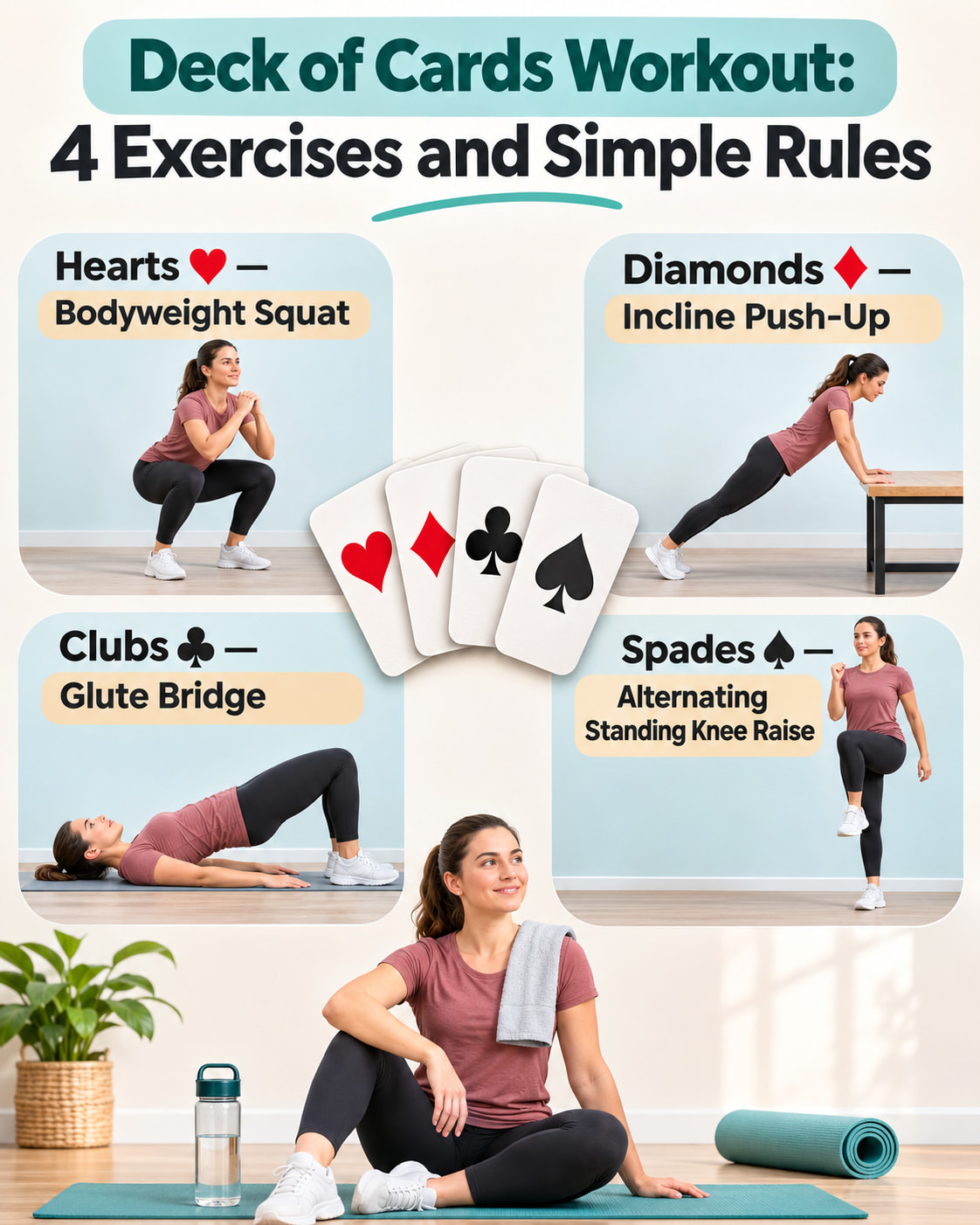
A deck of cards workout uses each card’s suit to select an exercise and its value to set the number of repetitions. Assign four exercises, shuffle your cards, and work through them at a pace that lets you maintain good form.
This version uses bodyweight squats, incline push-ups, glute bridges, and alternating standing knee raises. You can start with just 12 cards and adjust the exercises to your ability. Completing all 52 cards is optional.
The key is choosing a manageable amount of work before you begin, then taking breaks whenever you need them.
What Is a Deck of Cards Workout?
A deck of cards workout is a flexible way to organize a circuit. Each suit represents one movement, and each card tells you how many repetitions to perform.
For example, if hearts represent squats, drawing the seven of hearts means doing seven squats.
The University of Maine Cooperative Extension describes this format as an activity you can adapt to your exercise choices and available time. Card values vary between versions, so decide your rules before starting and use them consistently.
The routine below is a sample for general fitness. Adjust it to your current ability and experience.
Deck of Cards Workout Rules
You need a deck of playing cards, a clear floor area, and a secure elevated surface for incline push-ups. A mat is optional for glute bridges. Make sure you can comfortably get down to and up from the floor.
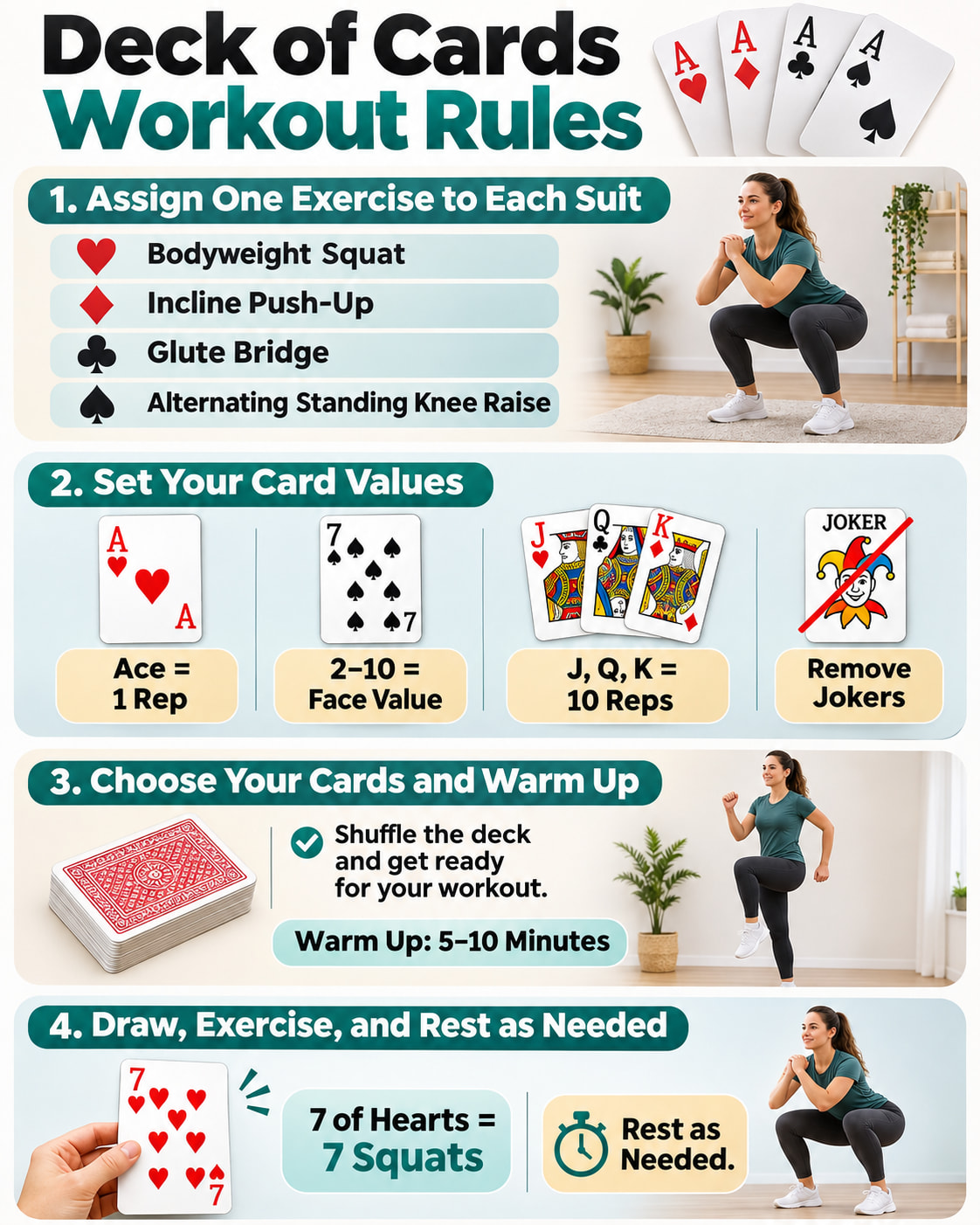
1. Assign One Exercise to Each Suit
Use the same assignments throughout the session:
| Suit | Exercise |
|---|---|
| Hearts | Bodyweight squat |
| Diamonds | Incline push-up |
| Clubs | Glute bridge |
| Spades | Alternating standing knee raise |
2. Set Your Card Values
This version uses the following values:
| Card | Repetitions |
|---|---|
| Ace | 1 |
| 2–10 | The number shown |
| Jack | 10 |
| Queen | 10 |
| King | 10 |
| Jokers | Remove before starting |
These ace and face-card values are also used in the University of New England’s card deck workout worksheet.
3. Choose Your Cards and Warm Up
If you are new to the format, use the 12-card starting option below. You can stop before finishing your chosen cards if the exercises become too difficult.
Before drawing your first card, spend about 5–10 minutes gradually warming up. Easy walking or marching, followed by comfortable practice repetitions, can help you prepare. The American Heart Association’s warm-up guidance recommends increasing activity gradually before a workout.
4. Draw, Exercise, and Rest as Needed
Shuffle your selected cards and place them face down. Draw one card, complete the corresponding exercise, and set the card aside.
For example:
- 7 of hearts: 7 squats.
- Queen of diamonds: 10 incline push-ups.
- Ace of clubs: 1 glute bridge.
- 8 of spades: 8 total alternating knee raises.
Rest whenever you need to. You can split a card’s repetitions into smaller groups or use an easier variation. If your form deteriorates, stop that set rather than forcing the remaining repetitions.
Repeated suits are possible. Drawing two push-up cards in a row does not mean you must perform them without a break.
4 Exercises for a Deck of Cards Workout
Learn the movements before using the cards to organize them. Keep each repetition controlled and use a comfortable range of motion.
1. Bodyweight Squat
Assigned suit: Hearts
- Stand with your feet around shoulder-width apart, adjusting your stance so it feels comfortable.
- Bend at your hips and knees to lower yourself. Keep your feet planted, your back neutral, and your knees moving in the same direction as your toes.
- Lower only as far as you can comfortably control, then stand back up.
One lowering-and-standing movement counts as one repetition.
Easier option: Use a supported mini-squat or slowly stand up from and sit back down on a stable chair. The chair should have no wheels and should not slide.
Avoid forcing a particular depth or rushing through the bottom of the movement. Mayo Clinic’s squat instructions emphasize controlled motion and stopping when form begins to suffer.
2. Incline Push-Up
Assigned suit: Diamonds
- Place your hands slightly wider than shoulder-width apart on a secure counter or stable bench that cannot slide or tip.
- Step your feet back and keep your body aligned from head to heels. Bend your elbows to lower your chest toward the surface without letting your hips sag.
- Press back to the starting position with control.
One lowering-and-pressing movement counts as one repetition.
Easier option: Use a wall or a higher hand position. Choose a height that lets you complete controlled repetitions without straining to finish.
Keep your elbows angled back from your torso rather than flared straight out to the sides. NASM’s exercise guidance explains that elevating the hands reduces the amount of body weight you press.
3. Glute Bridge
Assigned suit: Clubs
- Lie on your back with your knees bent and feet flat on the floor, approximately hip-width apart.
- Gently brace your abdomen and squeeze your glutes as you raise your hips.
- Stop before your lower back arches excessively, then lower your hips slowly.
One lifting-and-lowering movement counts as one repetition.
Easier option: Use a smaller comfortable lifting range or perform fewer repetitions.
Keep both feet planted. The goal is controlled movement through your hips; lifting as high as possible can encourage excessive back arching. This follows the technique described in the ACE glute bridge instructions.
4. Alternating Standing Knee Raise
Assigned suit: Spades
- Stand upright with your abdomen gently engaged.
- Lift one knee toward the opposite hand to a comfortable height, keeping your trunk controlled.
- Lower the foot and repeat with the other leg.
One knee lift and return counts as one repetition. The card value is the total across both legs.
For example, six repetitions means three lifts on each side. With an odd-numbered card, continue alternating legs when the next spade appears instead of always restarting with the same leg.
Easier option: Use lower marching steps and stable support if needed. You do not need to jump or lift the knee to a fixed height.
The NHS describes alternating knee lifts with an upright posture and a slightly bent supporting leg.
Beginner Deck of Cards Workout: Start With 12 Cards
For a short practice session, take out the 2, 3, and 4 from each suit. Put the other cards aside and shuffle your selected 12 cards.
| Exercise | Cards used | Total repetitions |
|---|---|---|
| Bodyweight squat | 2, 3, and 4 of hearts | 9 |
| Incline push-up | 2, 3, and 4 of diamonds | 9 |
| Glute bridge | 2, 3, and 4 of clubs | 9 |
| Alternating standing knee raise | 2, 3, and 4 of spades | 9 total lifts |
| Whole session | 12 cards | 36 repetitions |
This is an optional starting example, not a required minimum. Use easier variations, fewer cards, or extra rest when necessary.
Selecting cards from every suit ensures that all four exercises appear. Simply drawing 12 random cards from a full deck may produce an uneven mix.
When this version feels manageable and you recover well, add a few cards or make one exercise slightly more challenging. Change one aspect at a time so you can judge how it feels.
Why a Full Deck Is a Bigger Workout
Under this article’s rules, each suit contains:
- 54 repetitions from cards 2–10.
- 30 repetitions from the jack, queen, and king.
- 1 repetition from the ace.
That adds up to 85 repetitions per exercise and 340 repetitions across the full deck.
Those are arithmetic totals, not recommended training targets. Eighty-five incline push-ups may be far more than a beginner needs or can perform comfortably. Repetitions from different exercises also do not represent equal amounts of physical effort.
How Long Should a Deck of Cards Workout Take?
There is no required completion time. The number of cards, exercise difficulty, movement speed, and rest periods all affect session length.
You can finish after your selected cards or use a personal time limit. For example, you might allow 10 minutes for drawing cards and exercising, with warm-up and cool-down time separate. That is a scheduling option, not a target for completing the whole deck.
When you finish, gradually reduce your activity with easy walking or marching. Avoid turning the workout into a race.
Benefits and Limits of a Deck of Cards Workout
The format is convenient because you can choose the exercises, shorten the session, and use familiar household space. Shuffling also changes the exercise order, which you may find more engaging.
The ACSM’s 2026 resistance training guidance, published March, 2026, supports bodyweight and home-based resistance training. It emphasizes individualized programs and regular participation, and it does not require training every set to muscular failure.
That guidance supports adaptable exercise programming. It does not establish that using cards produces better results than another workout format.
This particular routine also has limits:
- It has no dedicated upper-body pulling movement, so it does not cover every major muscle group equally.
- Standing knee raises do not automatically make the session moderate-intensity aerobic exercise.
- Random exercise order does not provide a systematic progression plan.
Use the routine as one option within a broader activity schedule. The CDC’s adult activity recommendations include at least 150 minutes of moderate-intensity aerobic activity, or 75 minutes of vigorous activity, each week, plus muscle-strengthening activity on at least two days that covers all major muscle groups.
Common Deck of Cards Workout Mistakes
Starting With Too Many Cards
Choose a manageable starting amount. Completing a full deck is optional, even when the individual card values look small.
Letting the Cards Override Your Form
A card tells you the planned repetitions. It does not determine what you can perform well that day. Pause, reduce the repetitions, or use an easier variation when needed.
Doubling Alternating Repetitions
For this routine, a ten of spades means ten total knee raises. Counting ten on each leg would double the intended amount.
Assuming Different Suits Guarantee Recovery
Squats and bridges both involve the hips and legs. Changing suits does not necessarily give the working muscles a complete break.
Allow recovery between demanding sessions using the same muscles. Mayo Clinic’s strength-training guidance, dated June, 2026, recommends a full day between exercising the same muscle group.
Continuing Through Pain
Stop an exercise if it causes pain or you feel unwell. If you have an injury, a chronic health condition, or concerns about whether these movements are suitable, get individualized guidance before starting.
Frequently Asked Questions
Can Beginners Do a Deck of Cards Workout?
Yes, when the movements and workload match their ability. The 12-card example offers a short starting option. Use wall push-ups, supported squats, or fewer repetitions if needed, and rest between cards.
Can I Change the Four Exercises?
Yes. Choose movements you already know how to perform, assign one to each suit, and adjust the workload to match them. If you introduce a timed hold, define its duration separately so the card values remain clear.
Do Jokers Have to Mean Burpees?
No. Jokers are optional, and this version removes them. You do not need a bonus exercise to make the workout useful.
Is a Deck of Cards Workout HIIT?
Not automatically. High-intensity interval training involves demanding work intervals and recovery periods. Shuffling cards does not establish those conditions, and this sample can be performed at a controlled, comfortable pace.
Can a Deck of Cards Workout Build Muscle?
Appropriately challenging resistance exercise can support muscle growth. However, results depend on the training stimulus, consistency, progression, and recovery. A short introductory circuit may mainly help you practice movements and establish a routine.
How Many Calories Does a Deck of Cards Workout Burn?
There is no single reliable calorie figure for “one deck.” The cards do not specify exercise difficulty, workout duration, or rest time. Avoid treating the number of cards completed as a calorie estimate.
Conclusion
A deck of cards workout gives you a simple way to organize four exercises and vary their order. Choose your card values, count repetitions consistently, and take the breaks you need.
Start with the 2, 3, and 4 from each suit, practice controlled movement, and adjust the next session based on how well you performed and recovered.
References
- University of Maine Cooperative Extension: Motivation and Deck of Cards Workout
- National Institute for Fitness and Sport: Plan a Fun Workout with a Deck of Cards
- University of New England: Total Body Card Deck Workout
- Mayo Clinic: Squat Exercise
- NASM: Incline Push-Up
- American Council on Exercise: Glute Bridge Exercise
- NHS: Strength Exercises