
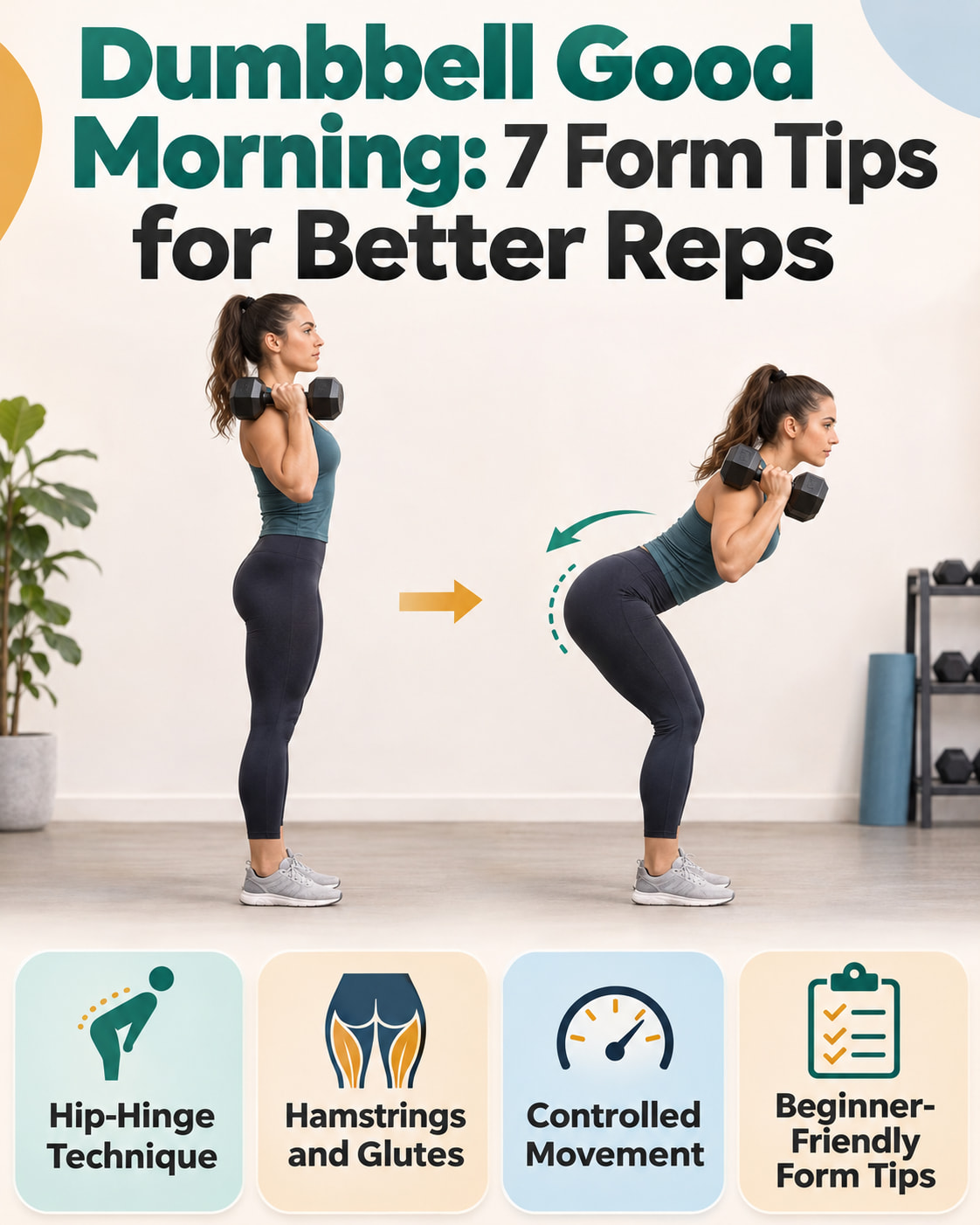
The dumbbell good morning is a hip-hinge exercise that works your hamstrings and glutes while your trunk muscles help keep your back steady. To perform it, secure light dumbbells at your shoulders, slightly bend your knees, push your hips backward, and return smoothly to standing.
The key is controlling the hinge before increasing the weight. These seven tips explain the setup, movement, and common mistakes so you can make each repetition more consistent.
What Is a Dumbbell Good Morning?
A good morning involves tipping your torso forward by bending at the hips, then extending the hips to stand upright. Your knees remain slightly bent throughout the movement.
This guide uses two dumbbells supported at the shoulders. Keeping the weights in that position distinguishes this version from a dumbbell Romanian deadlift, where the weights hang from your hands.
The main muscle roles are:
| Muscle group | Main role |
|---|---|
| Hamstrings | Help control the lowering phase and extend the hips as you stand. |
| Glutes | Help move the hips forward during the return to standing. |
| Spinal erectors | Help maintain your back position against the resistance. |
| Other trunk muscles | Help brace and stabilize your torso. |
NASM’s good morning guide describes these general movement principles and muscle involvement using the barbell version.
7 Dumbbell Good Morning Form Tips for Better Reps
1. Practice the Hip Hinge Before Adding Weight
Start with a few repetitions without dumbbells. Stand comfortably, soften your knees, and move your hips backward while allowing your torso to incline forward.
A light dowel can provide useful feedback. In ACE’s hip-hinge drill, the dowel runs along your back and touches three places:
- The back of your head.
- Your upper back, between your shoulder blades.
- Your sacrum, at the back of your pelvis.
Practice hinging while maintaining gentle contact at those points. Keep the movement small enough to control.
If you struggle with the unloaded movement, continue practicing or ask a qualified trainer to check your technique before adding resistance.
2. Keep the Dumbbells Secure at Your Shoulders
Choose two light dumbbells of equal weight that you can position and remove under control.
Place one lengthwise over each shoulder, with one end in front and the other behind. Keep your hands on the handles throughout the set. The weights should rest comfortably on your shoulders, away from your neck.
PureGym’s dumbbell good morning guide demonstrates this setup.
If the position is uncomfortable, return to an unloaded hinge or consider a dumbbell Romanian deadlift, which holds the weights lower. Choose a load appropriate to that exercise.
3. Keep a Soft Bend in Your Knees
Stand with your feet approximately hip-width apart and establish a slight knee bend before lowering.
Keep that bend relatively consistent as your hips move backward. You do not need perfectly motionless knees, but avoid bending them progressively more as you descend.
Two useful checks are:
- Your knees remain softly bent rather than locked.
- Your hips travel backward without dropping into a deep squat.
If each repetition becomes more squat-like, reduce the weight or shorten the movement while you regain control.
4. Brace Your Trunk and Keep Your Spine Steady
Gently tighten your abdominal muscles before starting. Maintain that support as you lower and return to standing.
Aim to preserve your natural spinal curves. Avoid deliberately rounding your lower back or forcing it into a large arch. Your head should follow the angle of your torso, so your gaze naturally moves toward the floor as you hinge.
Continue breathing. For light practice sets, inhale as you lower and exhale as you return to standing.
Mayo Clinic’s weight-training guidance, updated January, 2026, recommends controlled movement, continued breathing, and reducing the load or repetitions when good form becomes difficult to maintain.
5. Push Your Hips Back as You Lower
Begin the descent by moving your hips backward. Your torso inclines forward as a result of that hip movement.
Think about reaching your hips toward the space behind you while keeping your feet grounded. Let the dumbbells move with your upper body without shifting their position on your shoulders.
If you mainly feel yourself dropping your chest while your hips barely move, pause and reset. Rehearse a smaller unloaded hinge, then try again.
A useful check is whether you can repeat the same smooth movement without rushing into the bottom position.
6. Stop at a Depth You Can Control
Lower until you feel comfortable tension in your hamstrings while maintaining your balance and torso position.
Your torso does not have to reach parallel to the floor. Stop sooner if going farther makes you lose control, substantially change your back position, or shift the dumbbells.
For example, if the first part of the hinge feels steady but the final few inches become difficult to control, end the repetition before that point.
Use a comfortable range and avoid forcing a stronger stretch. Pain is a reason to stop, even if you have not reached your intended depth.
7. Return Smoothly and Finish Standing Tall
Bring your hips forward to reverse the hinge and return to a comfortable standing position.
Keep the dumbbells steady and avoid bouncing out of the bottom. Finish with your torso upright rather than pushing your hips past your normal standing position or leaning backward.
Briefly reset your balance and breathing before the next repetition.
The final rep should resemble the first. If you need momentum, lose your shoulder setup, or repeatedly change your back position, end the set.
How Much Weight Should You Use for Dumbbell Good Mornings?
Choose resistance based on control. You should be able to place the dumbbells on your shoulders, complete the movement smoothly, and remove them without struggling.
Your squat or Romanian deadlift weight is not a starting-weight target for this exercise. Begin light and assess the good morning on its own.
A Simple Starting Routine
After practicing the unloaded hinge, the following can serve as an introductory example:
| Training detail | Starting example |
|---|---|
| Sets | 1–2 |
| Repetitions | 8–12 per set |
| Effort | Finish while you could still perform several controlled repetitions. |
| Rest | Rest long enough to repeat the same technique comfortably. |
| Progression | Increase resistance gradually once the current range and repetitions feel repeatable. |
This is a general starting option, not a tested formula specific to dumbbell good mornings. Adjust it to your experience and overall workload.
If you cannot maintain the movement, use less weight, fewer repetitions, or an unloaded version. When progressing, choose a small increase and reassess your control before adding more.
Where They Fit in Your Workout
Dumbbell good mornings can fit into a lower-body or full-body strength session. Consider the other hamstring, glute, and back exercises you already perform when deciding how much to add.
The ACSM resistance-training update, published March, 2026, emphasizes consistent training of all major muscle groups at least twice weekly and tailoring training to individual goals. That recommendation applies to your overall routine; it does not require doing good mornings at every session.
Dumbbell Good Morning vs. Romanian Deadlift
Both exercises use a hip hinge and involve the hamstrings, glutes, and trunk. The clearest practical difference is where you hold the resistance.
| Feature | Dumbbell good morning | Dumbbell Romanian deadlift |
|---|---|---|
| Weight position | Supported at the shoulders. | Held in the hands with the arms extended. |
| Movement of the weights | Move with your torso. | Travel downward close to your legs. |
| Setup consideration | Requires a comfortable, secure shoulder position. | Requires holding the dumbbells throughout the set. |
A dumbbell RDL may be a useful option if you dislike resting weights on your shoulders. Select resistance separately for each exercise, since changing the weight position changes the task.
Neither movement needs to be forced into a program. Choose an option you can perform comfortably and consistently.
When to Stop or Get Help
Warm up with about 5–10 minutes of walking or another comfortable aerobic activity, then rehearse the hinge before adding weight.
During a set, hamstring tension and muscular effort can occur. Stop if you experience pain, lose control of the dumbbells, or cannot maintain the intended movement.
A qualified trainer can help with setup, hinging, and choosing resistance. If pain persists, or you have an existing injury or condition that makes you unsure about the exercise, seek individualized guidance from a healthcare professional.
Good mornings should not be used as a self-directed solution for unexplained back pain.
Frequently Asked Questions
Can Beginners Do Dumbbell Good Mornings?
Beginners can work toward them by learning an unloaded hip hinge first. Add light dumbbells only when you can repeat the movement and hold the shoulder position comfortably. A trainer can help if the setup feels awkward.
Are Dumbbell Good Mornings Good for Glutes?
They involve the glutes as the hips extend during the return to standing. They also involve the hamstrings and back muscles, so they are one option within a broader lower-body routine.
How Heavy Should Dumbbells Be for Good Mornings?
Use weights you can position, steady, and move with control. There is no single starting weight that suits everyone. If the load changes your technique or makes the shoulder setup difficult, reduce it.
How Far Should You Bend During a Dumbbell Good Morning?
Stop where you feel comfortable hamstring tension while maintaining control. Reaching parallel is optional. Your available range may be shorter, especially while learning the hinge.
Can You Do Dumbbell Good Mornings Every Day?
Daily loaded practice is usually unnecessary. Allow recovery between sessions that challenge the same muscles, and consider the rest of your strength routine. Brief unloaded technique practice creates a different demand from a challenging weighted workout.
Should You Feel Dumbbell Good Mornings in Your Lower Back?
Your spinal erectors work to support your torso, so some muscular effort there can occur. Pain is a reason to stop. If discomfort keeps returning, get guidance instead of adding weight or pushing through it.
Conclusion
Build your dumbbell good morning around a controlled hip hinge, secure shoulder position, and comfortable range of motion. Start with unloaded practice, then add light resistance when the movement feels repeatable.
At your next strength session, focus on a few consistent repetitions. Increase the challenge gradually as your control improves.
References
- American Council on Exercise. Hip Hinge.
- PureGym. Dumbbell Good Mornings.
- National Academy of Sports Medicine. Good Mornings.
- National Academy of Sports Medicine. Dumbbell Romanian Deadlift.
- Mayo Clinic. Weight Training: Do’s and Don’ts of Proper Technique.
- American College of Sports Medicine. 2026 Resistance Training Guidelines Update.
- Ross, S., Comfort, P., and McMahon, J. J. The Good Morning—Exercise Technique and Exercise Selection Principles.