
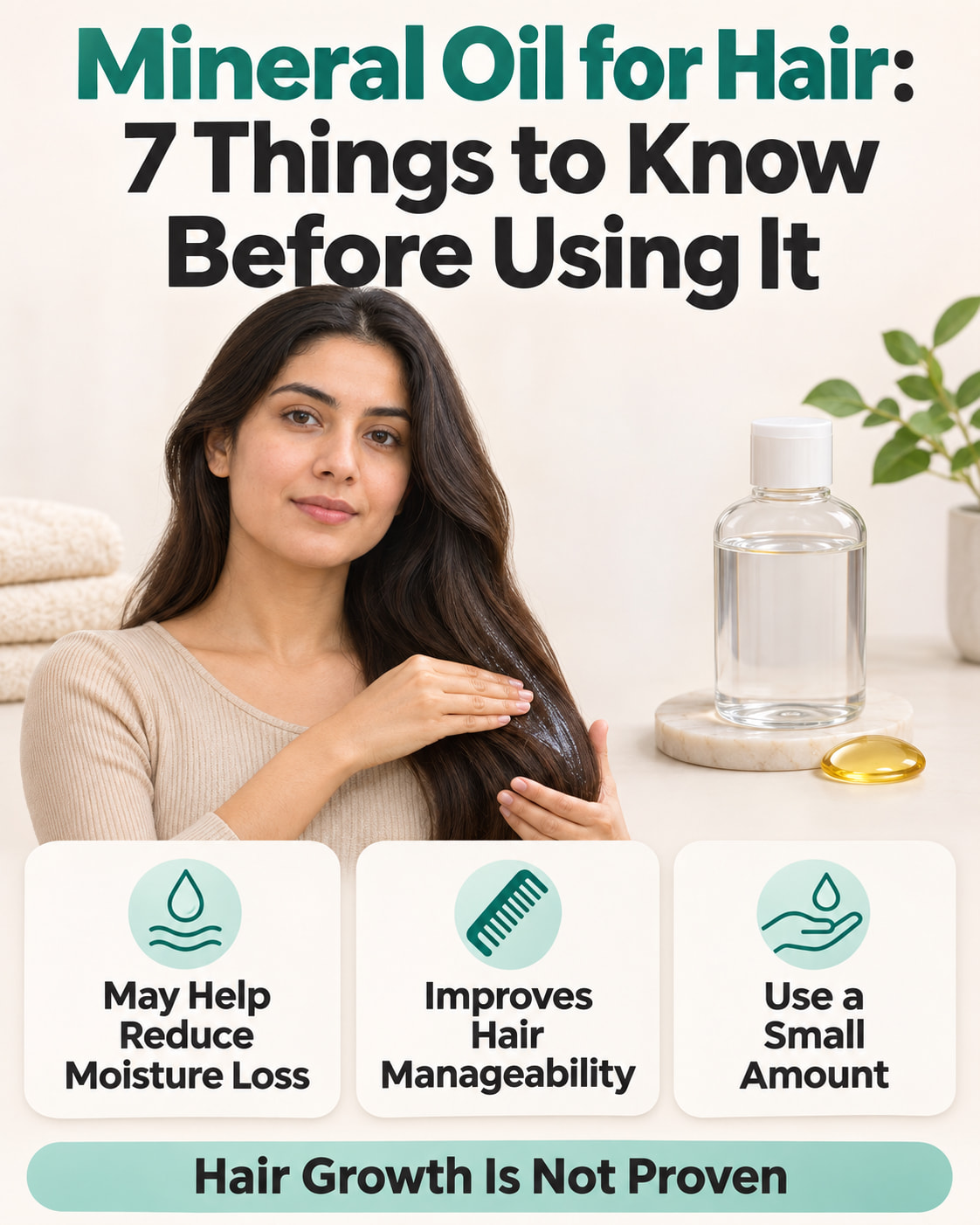
Mineral oil for hair may help reduce moisture loss, improve softness, and make strands easier to manage. It works mainly by forming a protective coating on the hair’s surface. However, it has not been proven to stimulate hair growth, repair damaged hair, or prevent hair loss.
Mineral oil is a common ingredient in hair oils, conditioners, and other personal care products. Although it is generally considered safe when properly refined and used as directed, the results depend on your hair type, the product’s formula, and how much you apply.
Before adding mineral oil to your routine, here are seven important things to know about its benefits, limitations, possible side effects, and proper use.
1. Mineral Oil for Hair Is a Cosmetic Ingredient Derived From Petroleum
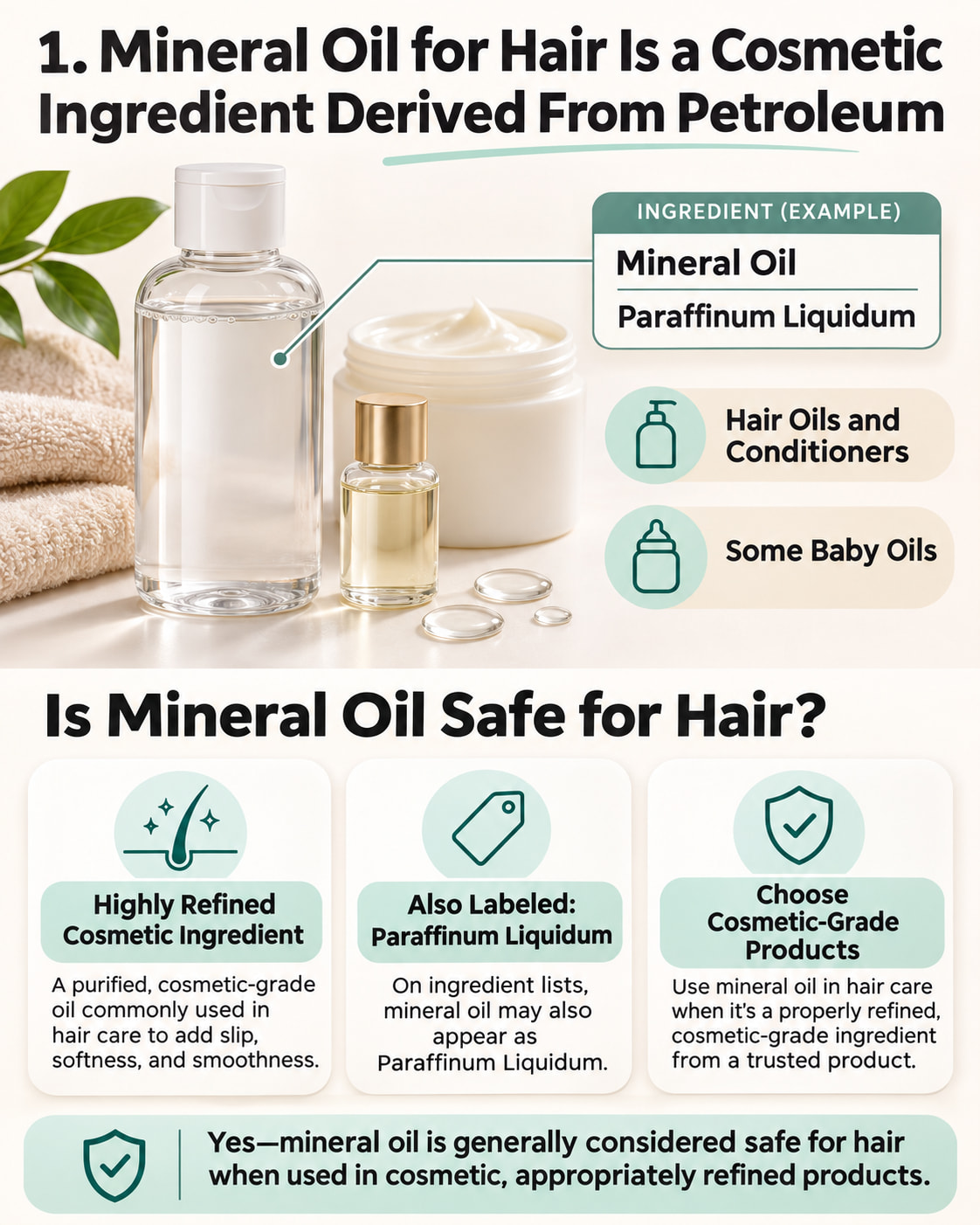
Mineral oil is a clear, usually odorless liquid obtained from petroleum through refining. It contains a mixture of hydrocarbons and is widely used in cosmetic products because it provides lubrication and forms a protective coating.
On ingredient labels, mineral oil may appear as Mineral Oil or Paraffinum Liquidum.
You may find it in:
- Hair oils and conditioning products
- Some leave-in conditioners and styling formulas
- Baby oils
- Skin moisturizers and lotions
- Certain scalp-care products
Is Mineral Oil Safe for Hair?
Highly refined, cosmetic-grade mineral oil is generally considered safe for use on hair and skin when used as intended.
The German Federal Institute for Risk Assessment (BfR) concluded in its updated 2018 assessment that health risks from skin exposure to appropriately refined mineral oils in cosmetics were not expected based on available evidence.
This assessment applies to mineral oils meeting relevant purity requirements, not untreated industrial petroleum products.
You can read the BfR’s mineral oil safety guidance for more details.
What to remember: Choose mineral oil specifically intended for cosmetic use. Never substitute automotive, industrial, or other noncosmetic oils.
2. Mineral Oil May Help Reduce Moisture Loss and Improve Hair Softness
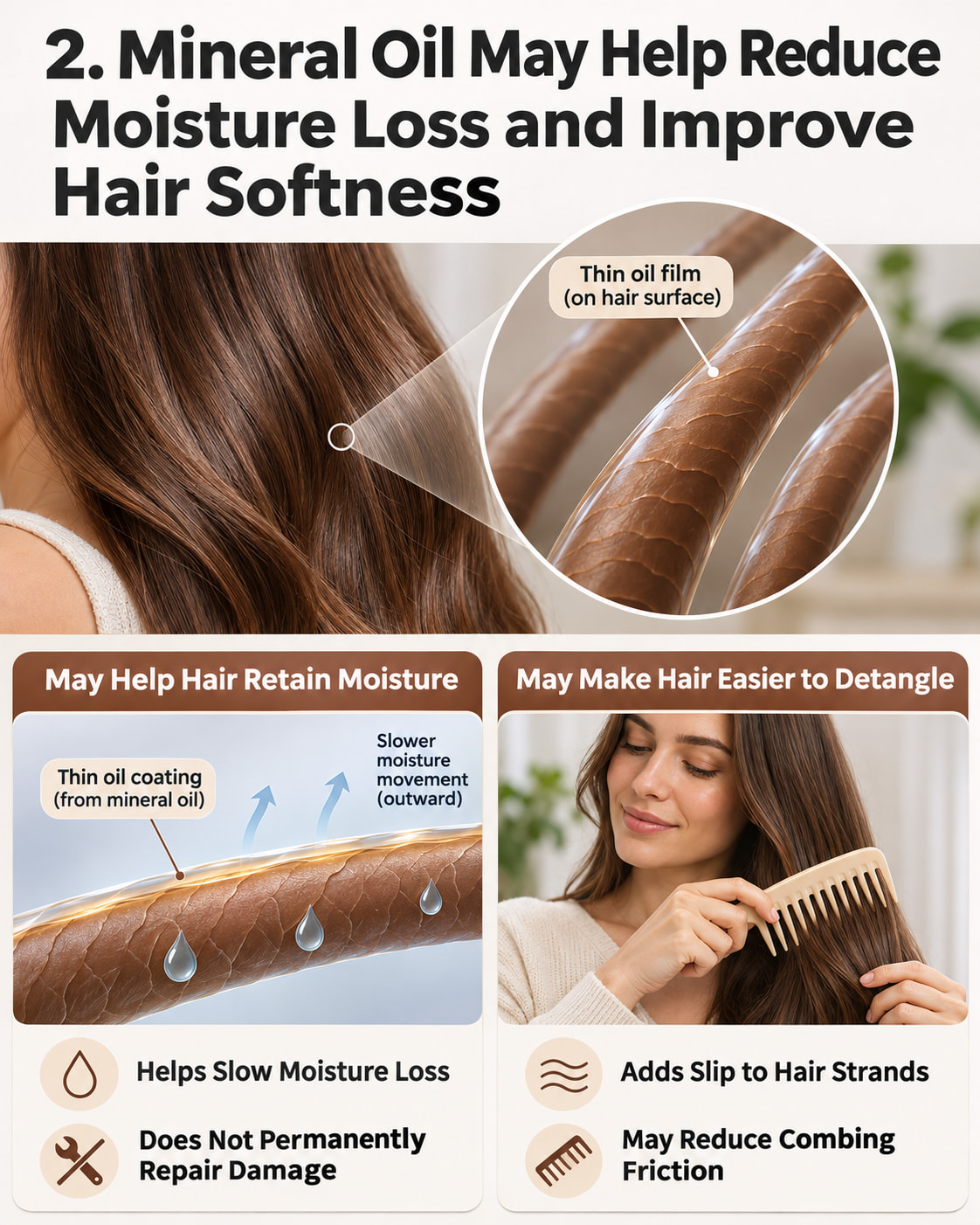
One of the main benefits of mineral oil for hair is its ability to form a thin, lubricating layer around individual strands.
This coating may help hair feel smoother, reduce friction during grooming, and slow the movement of moisture out of the hair fiber.
May Help Hair Retain Moisture
Mineral oil does not supply water to hair. Instead, its coating can slow moisture movement.
A 2007 study published in the Journal of Cosmetic Science examined how different oils affected water-vapor absorption and release in human hair.
The researchers found that oil-treated hair had lower moisture diffusion rates than untreated hair. The coating slowed moisture loss, although water vapor could still move into the fibers.
These findings support mineral oil’s potential moisture-retention benefits, but they come from laboratory testing rather than long-term trials of everyday hair routines.
Read the 2007 hair moisture study.
May Make Hair Easier to Detangle
Mineral oil can also provide slip, allowing strands to move past one another more easily.
This may be helpful if your hair feels:
- Rough or difficult to comb
- Dry along the lengths and ends
- Prone to tangling
- Frizzy after washing
Reducing friction during grooming may help limit mechanical stress, especially when combined with gentle brushing and conditioning.
However, mineral oil does not permanently repair split ends or reverse existing structural damage.
Practical tip: Apply a very small amount to slightly damp hair after conditioning. Concentrate on the lengths and ends rather than automatically coating your entire scalp.
3. Mineral Oil Does Not Protect Hair Protein the Same Way Coconut Oil Does
Mineral oil and coconut oil are both used in hair care, but they do not provide identical benefits.
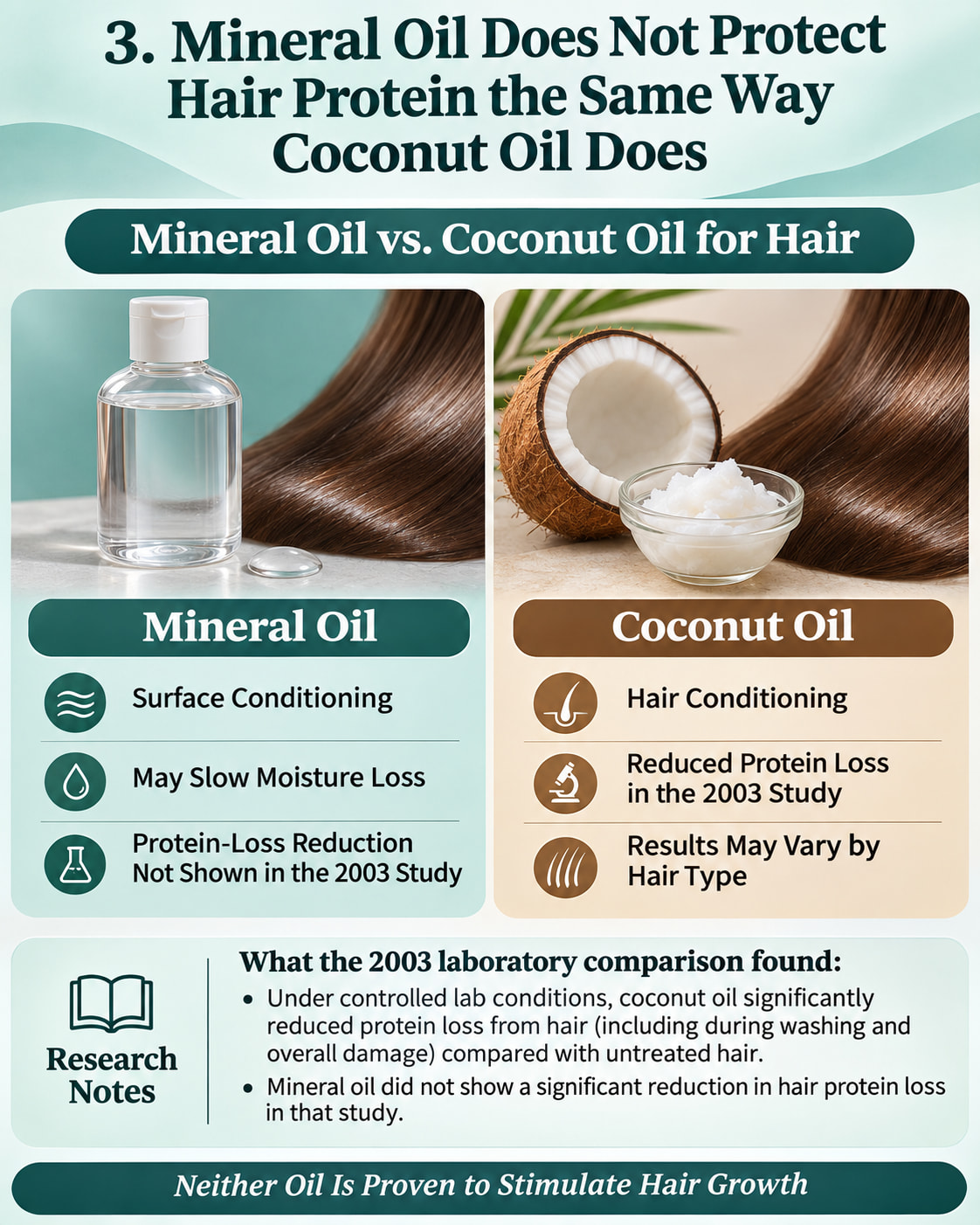
Mineral oil primarily acts as a conditioning lubricant. Coconut oil has stronger direct research evidence for reducing protein loss from hair.
A 2003 study in the Journal of Cosmetic Science compared coconut oil, mineral oil, and sunflower oil on damaged and undamaged hair.
Researchers found that coconut oil significantly reduced hair protein loss when used before or after washing. Mineral oil and sunflower oil did not produce the same protective effect under the tested conditions.
The difference may relate partly to how each oil interacts with the hair fiber.
You can review the 2003 comparative hair-oil study.
Mineral Oil vs. Coconut Oil for Hair
| Feature | Mineral Oil | Coconut Oil |
|---|---|---|
| Main cosmetic role | Surface lubrication and conditioning | Conditioning and hair-fiber protection |
| Moisture loss | May help slow moisture loss | May also influence moisture movement |
| Hair protein loss | Did not significantly reduce it in the 2003 study | Reduced it in the 2003 study |
| Hair growth | Not proven to stimulate growth | Not established as a hair-growth solution |
| Potential drawback | Can feel heavy if overused | Can also feel greasy or unsuitable for some hair |
There is also some disagreement in laboratory research about how much mineral oil can penetrate the hair fiber under different conditions. Its surface-conditioning role is better established than claims about deep penetration.
Which should you choose?
If you want lightweight application in very small amounts or prefer a mineral-oil-based conditioner, mineral oil may suit your routine.
If your main concern is protecting hair proteins during washing and grooming, coconut oil has stronger comparative laboratory evidence.
Neither oil is guaranteed to work equally well for everyone.
4. Mineral Oil Has No Proven Hair-Growth Benefits
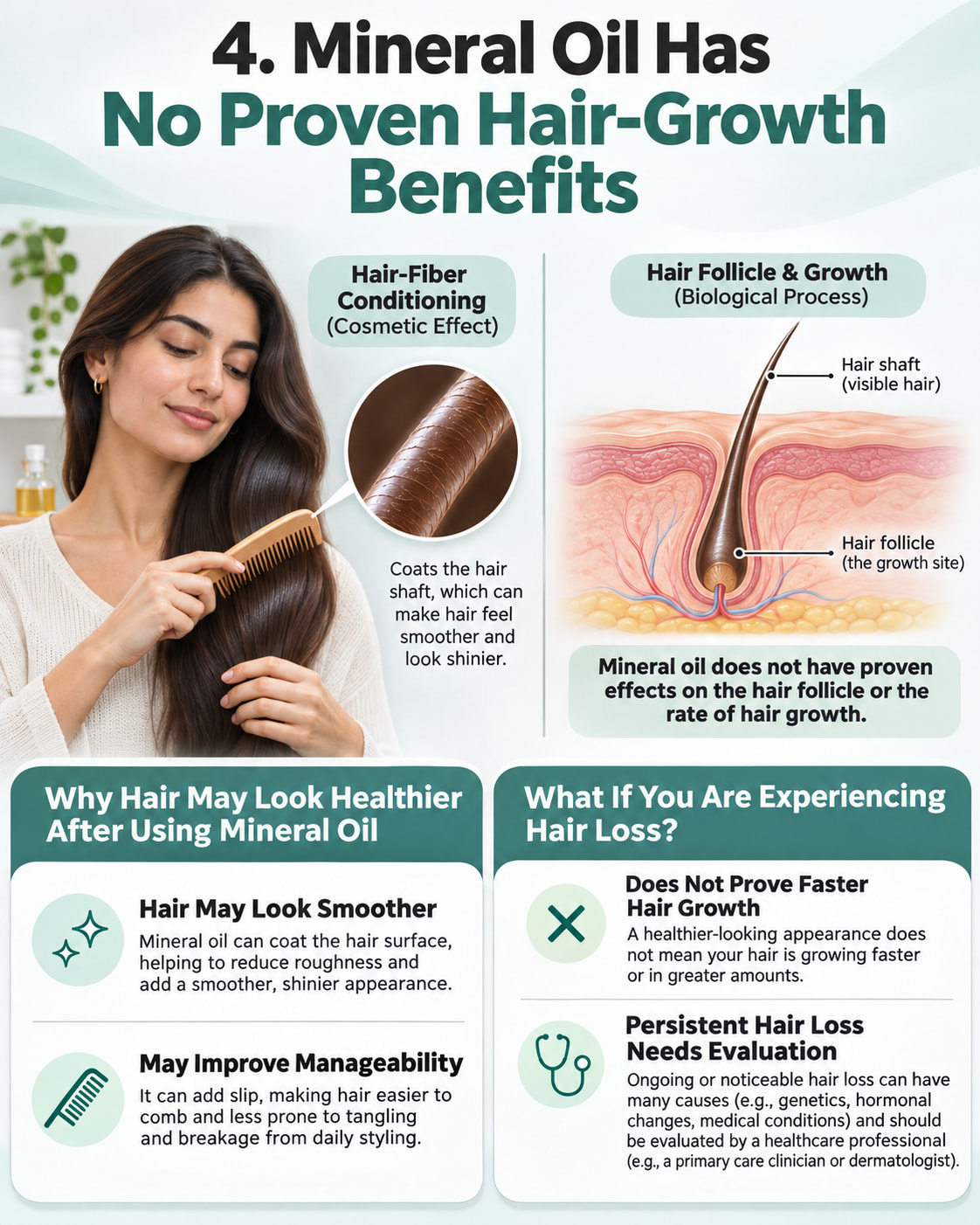
Does mineral oil help hair grow faster?
There is no convincing clinical evidence that applying mineral oil to your hair or scalp increases hair growth, creates new hair follicles, or reverses hair loss.
Most research on mineral oil focuses on the physical properties of existing hair, including moisture movement, lubrication, and mechanical strength.
These are different from the biological processes responsible for hair growth.
Why Hair May Look Healthier After Using Mineral Oil
Mineral oil can make strands appear smoother and shinier by coating their surfaces.
If your hair tangles less and becomes easier to manage, you may also experience less grooming-related damage.
However, it is important to distinguish between:
- Hair growth: New hair produced by follicles.
- Hair retention: Keeping existing strands from breaking.
- Hair appearance: Making hair look smoother, shinier, or less frizzy.
An oil that improves appearance does not necessarily increase growth.
What If You Are Experiencing Hair Loss?
Hair thinning or excessive shedding can have many causes, including hormonal changes, hereditary conditions, nutritional deficiencies, and certain medical conditions.
Mineral oil should not replace an appropriate evaluation of unexplained hair loss.
Consider consulting a dermatologist if you notice persistent shedding, a widening part, sudden hair loss, or new bald patches.
5. Mineral Oil May Work Better for Some Hair Types Than Others
Mineral oil is not automatically suitable for every hair type.
Its usefulness often depends on how much you apply and whether your hair already feels dry, oily, fine, or heavily conditioned.
Dry, Coarse, or Curly Hair
People with dry, coarse, or tightly curled hair may appreciate the slip and conditioning effect of a small amount of mineral oil.
It may help:
- Smooth rough-feeling ends
- Reduce friction during detangling
- Maintain a softer feel between washes
- Improve the appearance of flyaways
However, mineral oil is not a substitute for a suitable conditioner, and applying more does not necessarily improve results.
Fine or Oily Hair
Fine hair can become weighed down when too much oil is applied.
If your hair already becomes greasy quickly, adding mineral oil may make it look flat or oily.
Start with the smallest practical amount, focusing on the ends. Skip it if your hair feels heavy or looks greasy afterward.
Color-Treated or Heat-Damaged Hair
Mineral oil may temporarily improve the feel and appearance of dry, processed strands.
However, it cannot restore damaged hair proteins or reverse damage caused by bleaching and high temperatures.
It should also not be considered a replacement for a properly formulated heat-protectant product.
Bottom line: Choose mineral oil based on how your hair responds, not solely on whether your hair is straight, curly, fine, or thick.
6. Mineral Oil Can Cause Greasiness, Buildup, or Skin Reactions
Although cosmetic-grade mineral oil is generally well tolerated, it can have drawbacks.
Greasy Hair and Product Buildup
Applying too much mineral oil may leave the hair looking oily or feeling coated.
Repeated application without adequate cleansing can also contribute to product residue.
You may notice:
- Hair that feels heavier than usual
- Reduced volume
- A greasy appearance near the roots
- Strands that feel coated after styling
These effects are usually related to product use and can often be managed by applying less and shampooing appropriately.
Hairline Breakouts
Some oily hair products can contribute to acne around the forehead, temples, and hairline.
The American Academy of Dermatology’s guidance on hair-product breakouts explains that oils from certain hair-care formulas can transfer to the skin and contribute to clogged pores.
This does not mean pure mineral oil necessarily causes acne in everyone. The complete product formula and your individual skin response matter.
If you are prone to breakouts, avoid spreading oily products across your forehead and hairline.
Irritation or Allergic Reactions
Mineral oil is generally considered well tolerated, but reactions are possible.
A case report published online in June 2026 in Dermatitis described allergic contact dermatitis associated with mineral oil in a pediatric patient.
Such reports do not establish how frequently reactions occur. Other ingredients, including fragrance, can also cause irritation.
Stop using a product if it causes itching, redness, swelling, or a new rash. Seek medical advice for persistent or significant reactions.
Important: Mineral oil is not a proven solution for dandruff, scalp infections, or other underlying scalp conditions.
7. How to Use Mineral Oil for Hair Safely
You do not need an elaborate routine to try mineral oil.
The key is to use a cosmetic-grade product, apply a small amount, and adjust based on your hair’s response.
Step 1: Choose the Right Product
Select a mineral oil product intended for cosmetic use, preferably one labeled for hair or skin.
Read the ingredient list and application instructions.
If you have sensitive skin, a fragrance-free product may be preferable.
Step 2: Check for Skin Sensitivity
Before applying a new product widely, test a small amount on a limited area of skin.
For general skin-care product testing, the American Academy of Dermatology recommends applying the product to a small test area twice daily for 7–10 days, following the product’s usual contact time.
If redness, itching, or swelling develops, stop using it.
A home-use test cannot rule out every possible allergy.
Step 3: Start With a Very Small Amount
Place a drop or two in your palms as an initial practical example, not a medically established dose.
Rub your hands together to distribute the oil.
Use less for fine or short hair, and adjust cautiously if your hair is longer or thicker.
Step 4: Apply to the Lengths and Ends
Gently smooth the oil over areas that feel dry or rough.
You can try applying it to slightly damp hair after washing and conditioning.
Avoid saturating the roots, particularly if your scalp is naturally oily or acne-prone.
Step 5: Distribute Gently
Use your fingers or a suitable wide-tooth comb to spread the product.
Avoid pulling aggressively through tangles.
The goal is a light coating, not soaking the hair.
Step 6: Observe the Results
Notice how your hair looks and feels after application.
If it feels smoother and manageable without appearing greasy, the amount may suit your needs.
If it looks flat, sticky, or excessively shiny, reduce the quantity or stop using it.
Step 7: Wash According to Your Hair’s Needs
Continue shampooing and conditioning based on your hair type and how quickly it becomes dirty or oily.
The American Academy of Dermatology recommends concentrating shampoo on the scalp to remove accumulated oil, dirt, and product residue.
There is no scientifically established schedule requiring everyone to use mineral oil daily or weekly. Use it only as often as your hair benefits from it.
Common Mistakes to Avoid When Using Mineral Oil for Hair
A few simple mistakes can reduce its usefulness.
- Using too much: Excess oil can make strands look greasy and weighed down.
- Applying it instead of conditioner: Mineral oil can slow moisture movement but does not provide all the benefits of a complete conditioning formula.
- Expecting hair regrowth: It is a cosmetic ingredient, not a proven hair-growth product.
- Ignoring scalp sensitivity: Stop using products that cause new irritation or breakouts.
- Skipping regular cleansing: Remove product residue as needed to keep your hair and scalp comfortable.
- Using noncosmetic mineral oil: Choose appropriately refined, labeled products intended for personal care.
A small amount used appropriately is generally more practical than applying large quantities in hopes of achieving faster results.
Frequently Asked Questions About Mineral Oil for Hair
1. Is Mineral Oil Good or Bad for Your Hair?
Mineral oil is not inherently bad for hair. Cosmetic-grade mineral oil may improve softness, lubrication, and moisture retention when used appropriately.
However, it does not repair damaged hair or stimulate new growth. Your results depend on your hair type and how much you apply.
2. Does Mineral Oil Make Hair Grow Faster?
No convincing clinical evidence shows that mineral oil makes hair grow faster or increases hair density.
It may improve the appearance and manageability of existing strands, but that is different from stimulating hair follicles.
3. Can Mineral Oil Cause Hair Loss?
There is no convincing evidence that normal use of appropriately refined cosmetic mineral oil directly causes hair loss.
However, an irritating hair product or aggressive grooming practices can contribute to scalp discomfort or hair problems. Persistent shedding or thinning should be evaluated rather than automatically blamed on mineral oil.
4. Can You Apply Mineral Oil Directly to Your Scalp?
You can apply a cosmetic product containing mineral oil to the scalp if its directions permit scalp use and you tolerate it.
However, direct application is not necessary to obtain its hair-conditioning benefits. If your scalp is oily, acne-prone, irritated, or flaky, consider avoiding scalp application until you understand the cause of the symptoms.
5. Can You Leave Mineral Oil in Your Hair Overnight?
Some mineral-oil-containing products can be left on the hair, depending on their instructions.
However, there is no established evidence that leaving plain mineral oil on overnight provides better results than shorter application.
If you try a leave-on product, use a small amount and discontinue it if you experience discomfort or troublesome residue.
6. Is Mineral Oil Better Than Coconut Oil for Hair?
Neither oil is universally better.
Mineral oil may help with lubrication and moisture retention, while coconut oil has stronger research support for reducing hair protein loss.
The best option depends on your hair’s needs, your preferred texture, and how well you tolerate the product.
7. Is Baby Oil the Same as Mineral Oil?
Some baby oils use mineral oil as their main ingredient, but the products are not necessarily identical.
Baby oil may also contain fragrance or other ingredients. Always check the label.
If you want to try baby oil on your hair, select a product intended for cosmetic use and avoid it if any ingredient causes irritation.
Conclusion
Mineral oil for hair can be a useful conditioning option when your goal is smoother strands, less friction, and slower moisture loss. However, it is not a proven solution for hair growth, damaged follicles, or underlying scalp problems.
The best approach is simple: choose cosmetic-grade mineral oil, start with a small amount, focus on the areas that need conditioning, and pay attention to how your hair responds.
If mineral oil makes your hair feel softer without creating greasiness or irritation, it may be worth keeping in your routine. If not, a different conditioner or hair oil may be a better choice.
This content is for informational purposes only and not medical advice.
References
- German Federal Institute for Risk Assessment (BfR), 2018. Highly refined mineral oils in cosmetics: Safety assessment.
- Keis K, Huemmer CL, Kamath YK, 2007. Effect of oil films on moisture vapor absorption on human hair — Journal of Cosmetic Science.
- Rele AS, Mohile RB, 2003. Effect of mineral oil, sunflower oil, and coconut oil on prevention of hair damage — Journal of Cosmetic Science.
- Fregonesi A, et al., 2009. Brazilian oils and butters: Effects on human hair physicochemical properties — Journal of Cosmetic Science.
- Srivastav A, Dandekar P, Jain R, 2019. Penetration study of oils and their formulations into human hair using confocal microscopy — Journal of Cosmetic Dermatology.
- Kaushik V, Chogale R, Mhaskar S, 2021. Mineral oil and coconut oil effects on hair physical properties — Journal of Cosmetic Dermatology.