
Diastasis recti exercises are controlled core movements designed to improve abdominal muscle coordination, support linea alba tension, and rebuild functional core strength without excessive strain.
Understanding how to exercise safely with diastasis recti is important because the condition affects posture, lifting mechanics, breathing, and everyday movement—especially during postpartum recovery.
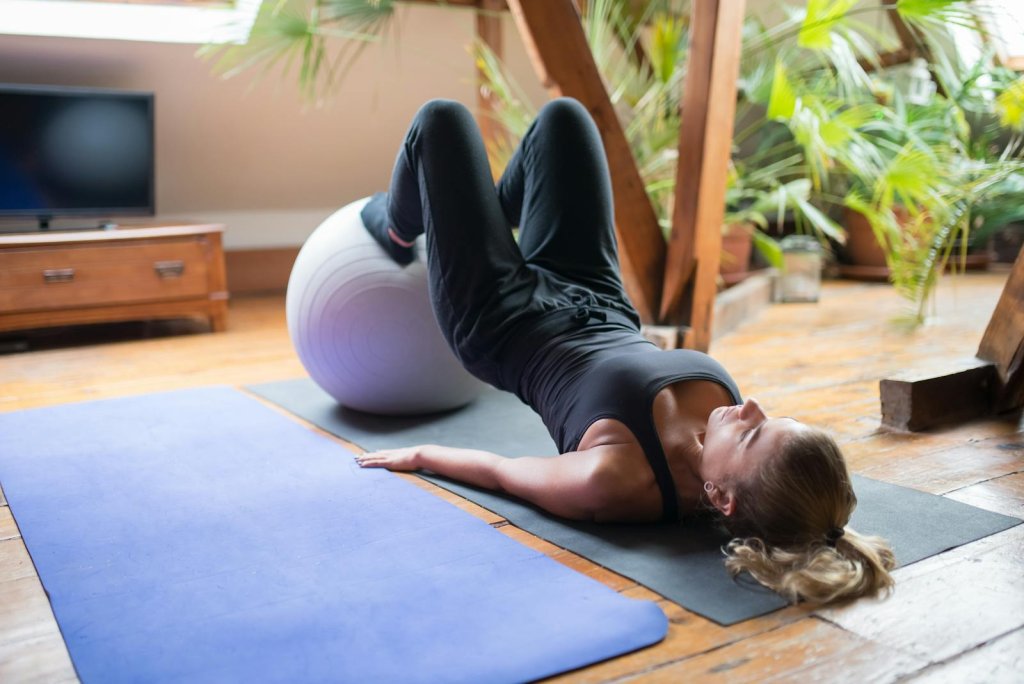
When done correctly, the right exercises may help improve core control, reduce abdominal bulging or “doming,” and support long-term strength. Most programs focus on breathing, deep core activation, slow progression, and symptom-free movement rather than forcing the abdominal gap to “close.”
What Is Diastasis Recti?
Diastasis recti, also called diastasis rectus abdominis (DRA), is a separation between the left and right sides of the rectus abdominis muscle along the linea alba.
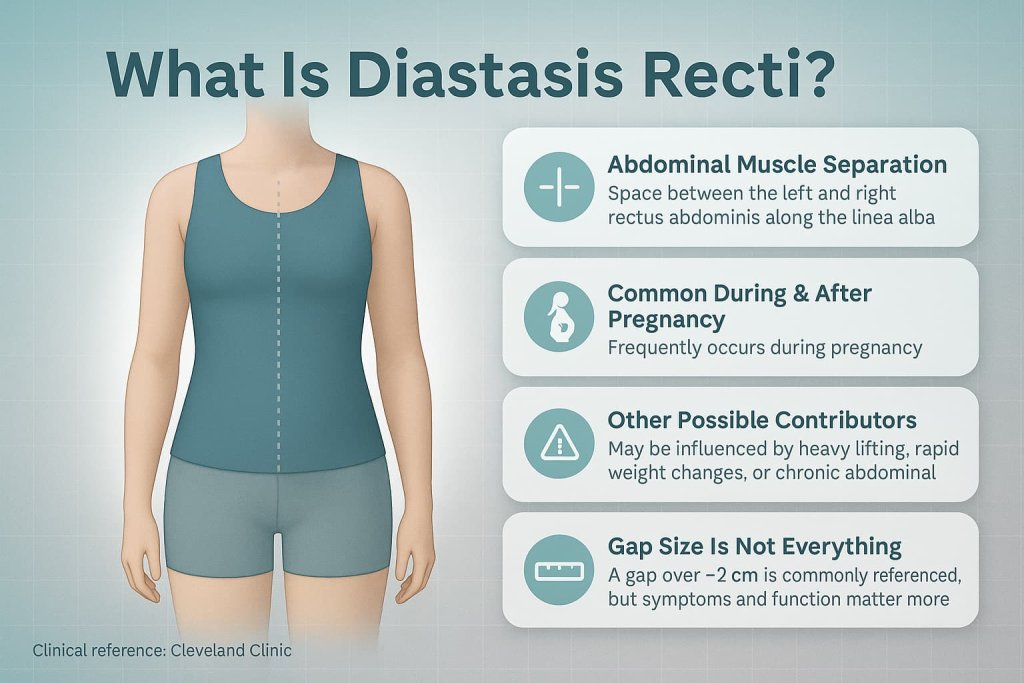
It is most common during and after pregnancy but can also occur due to:
- Repeated heavy lifting with poor core control
- Rapid weight changes
- Chronic abdominal pressure
- Poor breathing and posture mechanics
According to the Cleveland Clinic, a separation wider than approximately 2 cm is commonly considered diastasis recti, although symptoms and function matter more than the number alone.
Can Exercises Help Diastasis Recti?
Yes—exercise is considered a first-line, conservative approach for managing diastasis recti.
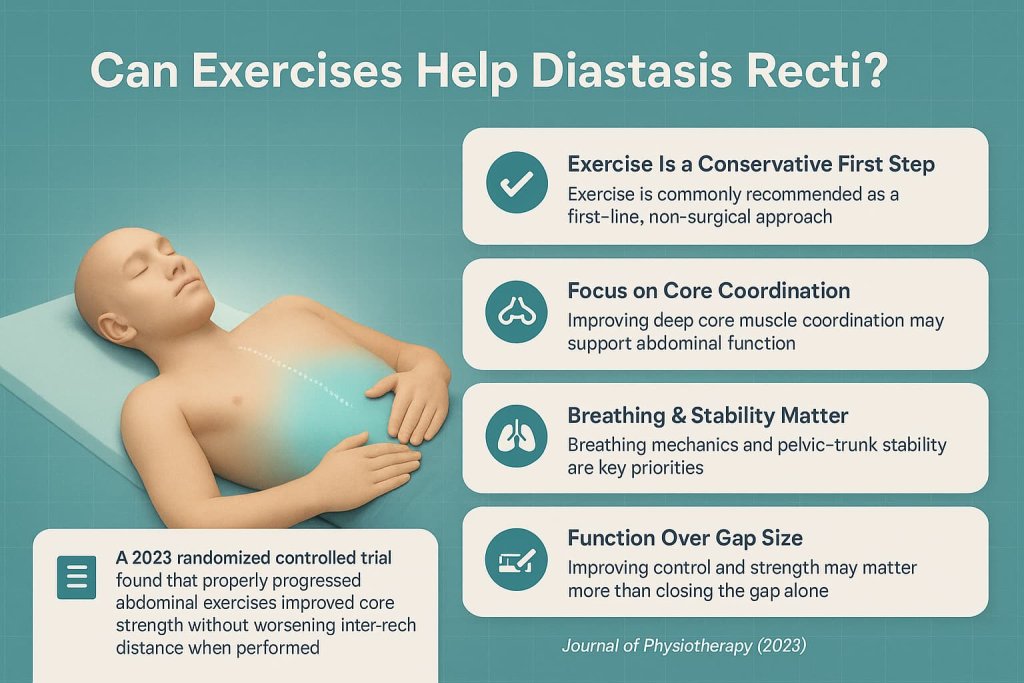
Clinical research suggests that improving:
- Deep core muscle coordination
- Breathing mechanics
- Pelvic and trunk stability
may be more important than focusing solely on closing the gap.
A 2023 randomized controlled trial published in Journal of Physiotherapy found that properly progressed abdominal exercises did not worsen inter-recti distance and improved core strength when performed with correct technique and breathing.
12 Best Diastasis Recti Exercises
12 Best Diastasis Recti Exercises focus on gentle, controlled movements that support deep core activation and pressure management. When performed with proper breathing and technique, these exercises may help improve core stability and functional strength without unnecessary strain.
1. Diaphragmatic Breathing
Why it works:
Diaphragmatic breathing helps regulate intra-abdominal pressure, which is essential for managing diastasis recti safely. By coordinating breathing with gentle abdominal engagement, it supports the deep core system without placing strain on the linea alba.
Muscles worked:
Diaphragm, transverse abdominis, pelvic floor
How to do it:
- Lie on your back with knees bent and feet flat
- Place one hand on your chest and one on your belly
- Inhale slowly through your nose, allowing the rib cage to expand
- Keep the chest relatively still while the belly softens
- Exhale through your mouth and gently draw the abdomen inward
Trainer tip:
Focus on control, not force. The abdominal draw-in should feel gentle and supportive, not tense.
2. Transverse Abdominis Bracing
Why it works:
This exercise activates the transverse abdominis, the body’s natural “corset” muscle. Improving its activation helps support the abdominal wall and spine without spinal movement or excessive pressure.
Muscles worked:
Transverse abdominis, deep spinal stabilizers
How to do it:
- Lie on your back or sit upright with a neutral spine
- Inhale to prepare
- Exhale and gently draw the lower abdomen inward
- Hold the tension while breathing normally
Trainer tip:
Imagine zipping up snug jeans rather than pulling your stomach in as hard as possible.
3. Pelvic Tilts
Why it works:
Pelvic tilts improve awareness and control of pelvic positioning, helping coordinate the lower abdominals with breathing and spinal movement. This supports safer core engagement during daily activities.
Muscles worked:
Lower abdominals, pelvic floor, glutes
How to do it:
- Lie on your back with knees bent
- Inhale in a neutral spine position
- Exhale and gently tilt the pelvis to flatten the lower back
- Inhale and return to neutral
Trainer tip:
Move slowly and smoothly. Avoid pushing through the feet or over-squeezing the glutes.
4. Heel Slides
Why it works:
Heel slides challenge core stability while one leg moves, teaching the abdominals to control pelvic motion without visible abdominal bulging.
Muscles worked:
Transverse abdominis, hip flexors
How to do it:
- Lie on your back with knees bent
- Gently brace your core
- Slide one heel away along the floor
- Slide it back to the starting position
- Alternate sides
Trainer tip:
If the abdomen domes or the pelvis shifts, reduce the range of motion.
5. Bent-Knee Fallouts
Why it works:
This exercise trains the deep core to resist unwanted pelvic rotation, which is essential for walking, climbing stairs, and lifting.
Muscles worked:
Deep abdominals, hip stabilizers
How to do it:
- Lie on your back with knees bent and feet flat
- Lightly brace the core
- Slowly allow one knee to fall outward
- Bring it back to center with control
Trainer tip:
Keep both hip bones level—move only as far as you can maintain control.
6. Glute Bridge
Why it works:
The glute bridge links hip strength with core stability, helping reduce reliance on the abdominal wall during lifting and standing tasks.
Muscles worked:
Glutes, hamstrings, deep core
How to do it:
- Lie on your back with feet hip-width apart
- Exhale and gently brace the core
- Lift hips until the body forms a straight line
- Lower slowly back to the floor
Trainer tip:
Avoid arching the lower back at the top—keep ribs stacked over the pelvis.
7. Marching Bridge
Why it works:
Adding a single-leg challenge increases demand on core stabilization while maintaining a supported position.
Muscles worked:
Glutes, transverse abdominis
How to do it:
- Lift into a standard bridge position
- Keep hips level
- Slowly lift one foot a few inches
- Lower and switch sides
Trainer tip:
If the pelvis drops or the abdomen bulges, return to standard bridges.
8. Quadruped Arm Lift
Why it works:
This movement trains spinal and core stability with minimal abdominal pressure, making it a safe progression for diastasis recti.
Muscles worked:
Core stabilizers, shoulders
How to do it:
- Start on hands and knees
- Brace the core lightly
- Lift one arm forward or slightly out
- Lower with control
Trainer tip:
Imagine balancing a glass of water on your back—no shifting or tilting.
9. Quadruped Leg Lift
Why it works:
Lifting one leg challenges pelvic control and glute activation while the core maintains alignment.
Muscles worked:
Glutes, deep core
How to do it:
- Begin on all fours
- Brace the core gently
- Lift one leg straight back
- Keep hips square and level
Trainer tip:
Lift only as high as you can without arching the lower back.
10. Bird Dog
Why it works:
Bird dog integrates cross-body coordination, which improves functional core stability for everyday movement.
Muscles worked:
Core stabilizers, glutes, upper back
How to do it:
- Start on hands and knees
- Extend opposite arm and leg
- Hold briefly with steady breathing
- Return and switch sides
Trainer tip:
Quality matters more than duration—short, controlled holds are best.
11. Side-Lying Core Activation
Why it works:
Side-lying positions reduce gravitational load on the abdominal wall while safely engaging the obliques and deep core.
Muscles worked:
Obliques, transverse abdominis
How to do it:
- Lie on your side with knees bent
- Exhale and gently brace the core
- Lift the head or top arm slightly
- Lower with control
Trainer tip:
Avoid rolling backward or gripping through the neck.
12. Supported Modified Plank
Why it works:
This exercise introduces controlled load through the core while allowing adjustments that reduce abdominal strain.
Muscles worked:
Core stabilizers, shoulders
How to do it:
- Use knees or an elevated surface
- Maintain a neutral spine
- Brace gently and breathe steadily
- Stop immediately if bulging appears
Trainer tip:
Progress height and duration gradually—never sacrifice control for time.
How to Use This Diastasis Recti Exercise List
This exercise list is designed to be used progressively, starting with foundational movements and gradually building complexity as control improves.
General usage recommendations:
- Begin with breathing and deep core activation exercises
- Perform exercises slowly, focusing on control rather than fatigue
- Start with 1–2 sets of each exercise
- Aim for 6–10 controlled repetitions per movement, unless otherwise noted
- Rest as needed between exercises
Progress only when:
- You can maintain steady breathing
- There is no abdominal bulging or doming
- Pelvic and spinal alignment remain stable
These exercises may be performed 3–4 times per week, depending on comfort and recovery. Gentle activation exercises, such as breathing and bracing, may be done more frequently.
This list supports core control and functional strength but is not intended to replace individualized rehabilitation when symptoms persist.
Safety Guidelines Before You Start
Before beginning diastasis recti exercises, follow these evidence-based guidelines:
- Avoid abdominal bulging, doming, or coning
- Breathe continuously; avoid breath holding
- Move slowly and with control
- Stop any exercise that causes pain, pressure, or visible bulging
- Progress difficulty gradually
Exercises to Avoid or Modify With Diastasis Recti
Some exercises may increase intra-abdominal pressure or place excessive strain on the linea alba, especially in the early stages of recovery or when core control is limited.
Exercises commonly avoided or modified include:
- Traditional sit-ups and crunches
- Double leg lifts or scissors
- Full planks and push-ups performed without modification
- Boat pose or V-sit positions
- Aggressive twisting or rotational movements
- Heavy lifting without proper bracing and breathing
It’s important to note that these movements are not inherently “bad,” but they may need to be postponed or modified until adequate core control is developed.
Many professionals emphasize that how an exercise is performed matters more than the exercise itself. Proper progression, breathing, and load management are key.
When to See a Healthcare or Pelvic Health Professional
While exercise may help support core function, some situations require professional assessment and individualized guidance.
Consider consulting a healthcare provider or pelvic health physiotherapist if you experience:
- Persistent or worsening abdominal bulging during daily activities
- Pain in the abdomen, lower back, hips, or pelvis
- Pelvic floor symptoms such as leaking, heaviness, or pressure
- Difficulty activating or controlling core muscles
- No noticeable improvement after several weeks of consistent, controlled exercise
A qualified professional can assess movement patterns, breathing mechanics, and overall function, and provide personalized recommendations based on your needs.
Exercises Commonly Avoided Early On
Many professionals recommend avoiding these until sufficient control is developed:
- Traditional sit-ups and crunches
- Double leg lifts
- Full planks or push-ups
- Boat pose
- Aggressive twisting movements
The American Council on Exercise (ACE) emphasizes progressive loading and proper breathing rather than blanket exercise bans.
When to See a Professional
Consult a pelvic health physiotherapist or qualified clinician if you experience:
- Persistent pain
- Pelvic floor symptoms
- Significant abdominal bulging
- No improvement after consistent training
Frequently Asked Questions
How long does it take to improve diastasis recti with exercises?
Many people notice improved control within 6–12 weeks, but timelines vary.
Can men have diastasis recti?
Yes. It can occur in men due to heavy lifting, obesity, or poor core mechanics.
Do belly bands fix diastasis recti?
Support garments may help posture but do not replace exercise.
Is closing the gap the goal?
Function, control, and symptom reduction matter more than gap size.
Can I exercise every day?
Gentle activation can be done daily; strength work is usually 3–4 times per week.
Are crunches always bad?
Not always. Some evidence suggests properly progressed curl-ups may be safe later in recovery.
Conclusion
Diastasis recti exercises focus on control, breathing, and gradual strength building, not force or intensity. When performed correctly, they may help support core function, posture, and confidence in daily movement.
If you are unsure where to start, begin with breathing and deep core activation, progress slowly, and seek professional guidance when needed.
References
- NHS — Your post-pregnancy body (Separated stomach muscles guidance)
- Milton Keynes University Hospital NHS — Diastasis recti following pregnancy (patient leaflet)
- ACOG — Exercise After Pregnancy (FAQ)
- CDC — Pregnant and Postpartum Activity: An Overview
- Canadian Society for Exercise Physiology (CSEP) — Postpartum 24-Hour Movement Guidelines
- Skoura A, et al. (2024) — Diastasis Recti Abdominis Rehabilitation in the Postpartum Period: A Scoping Review (free full text)
- Gluppe SB, et al. (2023) — Curl-up exercises improve abdominal muscle strength without worsening inter-recti distance (PubMed)