
The best dumbbell pullover alternatives include straight-arm cable pulldowns, resistance-band pulldowns, machine pullovers, lat pulldowns, pull-ups, bench presses, cable chest flyes, push-ups, and machine chest presses.
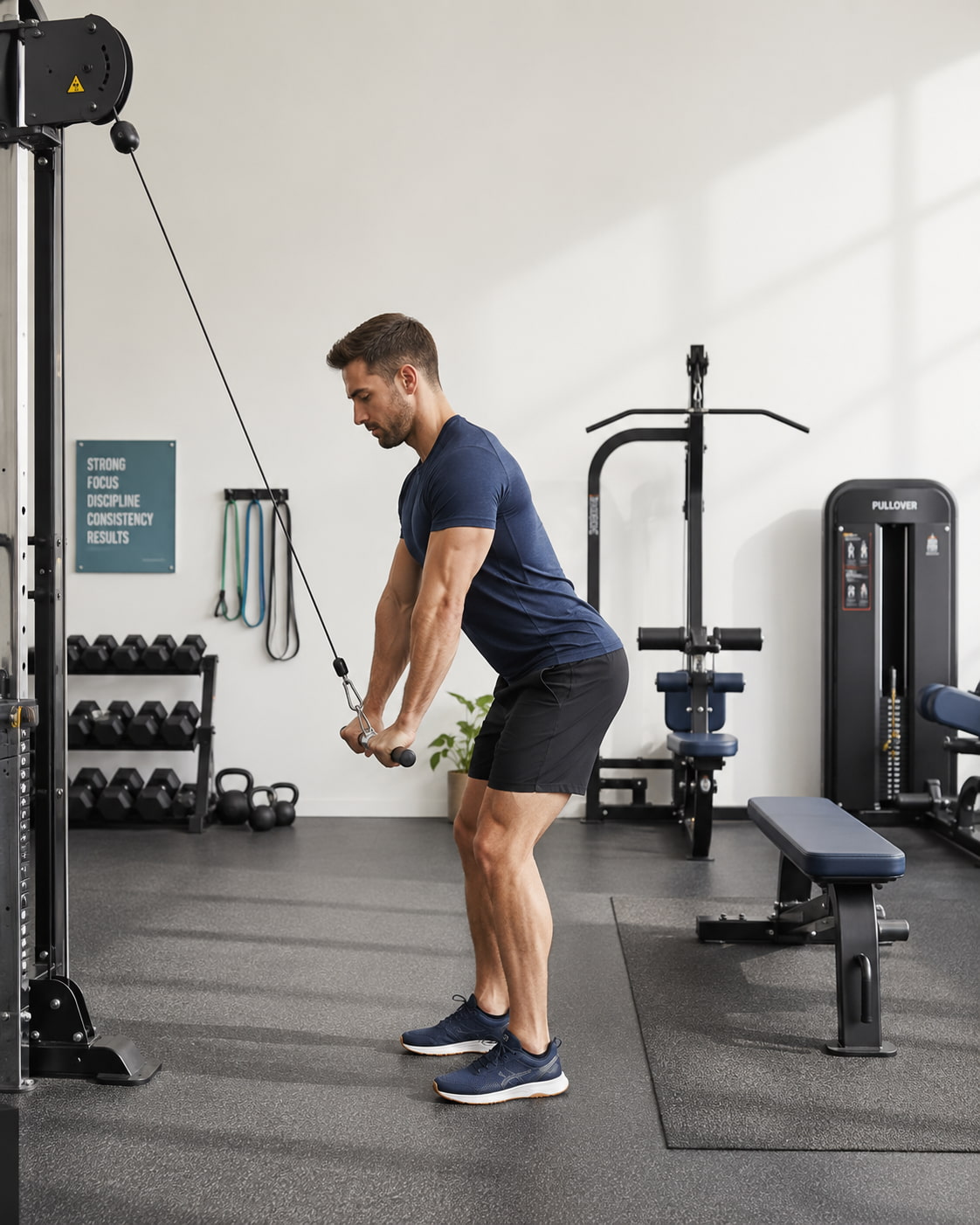
The right replacement depends on why you perform pullovers. Some exercises closely reproduce the overhead pulling motion, while others train your lats or chest through a different movement pattern.
This guide compares nine practical dumbbell pullover alternatives for home and gym workouts. You will learn what each exercise targets, how to perform it, and how to choose the best option for your training goal.
What Makes a Good Dumbbell Pullover Alternative?
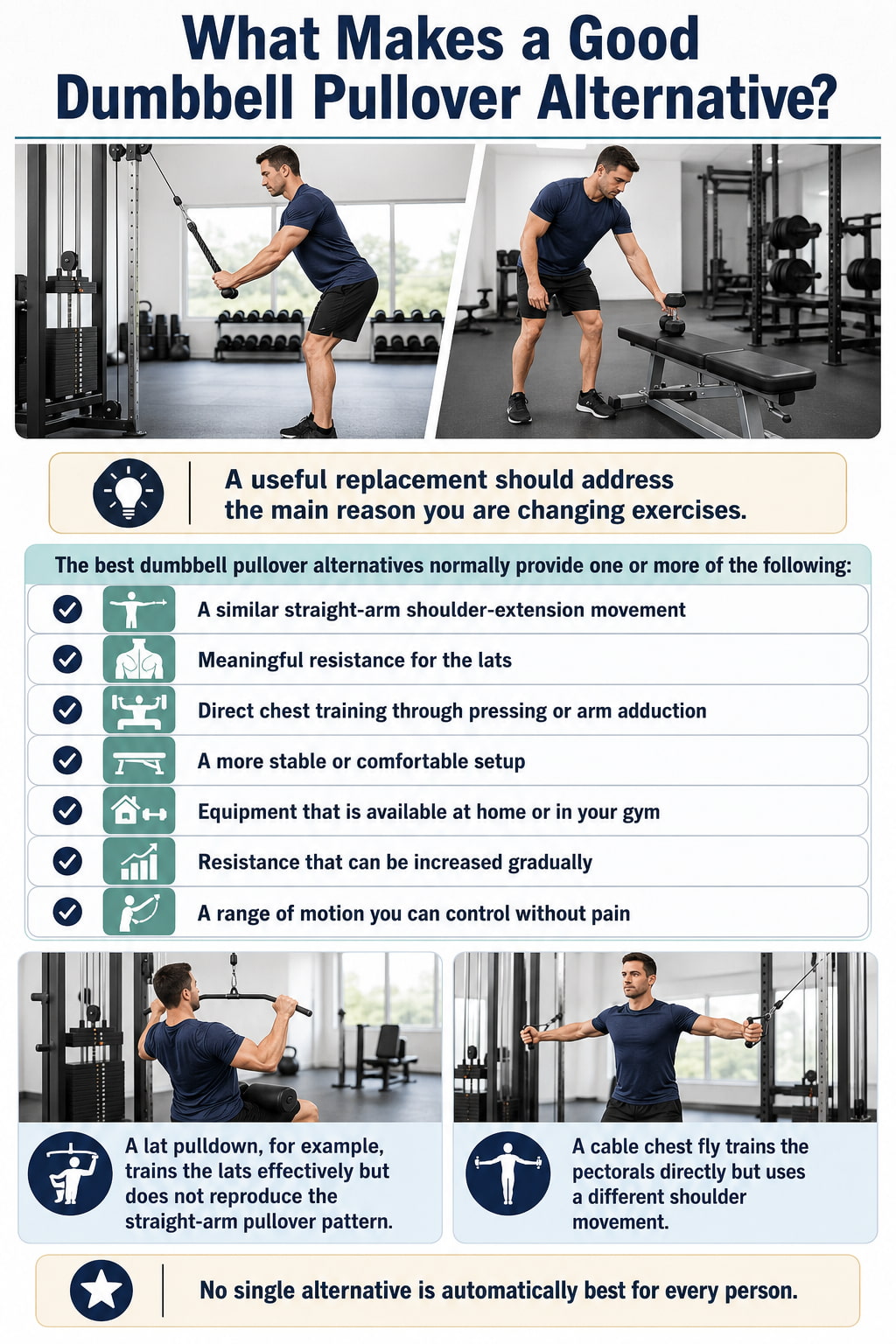
A useful replacement should address the main reason you are changing exercises.
The best dumbbell pullover alternatives normally provide one or more of the following:
- A similar straight-arm shoulder-extension movement
- Meaningful resistance for the lats
- Direct chest training through pressing or arm adduction
- A more stable or comfortable setup
- Equipment that is available at home or in your gym
- Resistance that can be increased gradually
- A range of motion you can control without pain
A lat pulldown, for example, trains the lats effectively but does not reproduce the straight-arm pullover pattern. A cable chest fly trains the pectorals directly but uses a different shoulder movement.
No single alternative is automatically best for every person.
Dumbbell Pullover Alternatives at a Glance
| Exercise | Main emphasis | Equipment | Movement similarity | Best for |
|---|---|---|---|---|
| Straight-arm cable pulldown | Lats and serratus | Cable machine | Very high | Closest overall gym alternative |
| Resistance-band straight-arm pulldown | Lats and serratus | Resistance band | High | Home workouts |
| Machine pullover | Lats, chest, and serratus | Pullover machine | Very high | Stable, guided resistance |
| Seated lat pulldown | Lats and upper back | Pulldown machine | Moderate | Progressive lat training |
| Pull-up or assisted pull-up | Lats, upper back, and arms | Pull-up bar or machine | Moderate | Bodyweight back strength |
| Barbell bench press | Chest and triceps | Barbell, rack, and bench | Low | Chest strength |
| Cable chest fly | Chest | Cable machine | Low | Chest isolation |
| Push-up | Chest, triceps, and shoulders | No equipment | Low | Home and bodyweight training |
| Machine chest press | Chest and triceps | Chest-press machine | Low | Stable chest training |
9 Best Dumbbell Pullover Alternatives
Dumbbell pullover alternatives can help you train your lats and chest with cables, machines, resistance bands, bodyweight, or free weights. The nine exercises below offer practical options for different equipment, experience levels, and training goals.
1. Straight-Arm Cable Pulldown
Why it works: The straight-arm cable pulldown is the closest overall dumbbell pullover alternative for most gym users. Both exercises move the arms from an overhead position toward the torso while keeping the elbows mostly fixed. The cable also provides continuous resistance and allows you to adjust the load in small increments.
Muscles worked: The exercise primarily targets the latissimus dorsi. The teres major, serratus anterior, long head of the triceps, abdominal muscles, and other trunk stabilizers assist.
How to do it:
- Attach a straight bar or rope to a high cable pulley.
- Stand facing the machine with your feet about hip-width apart.
- Hold the attachment with your arms extended and elbows slightly bent.
- Brace your core and lean forward slightly from the hips.
- Pull the attachment toward your thighs without turning the movement into a triceps pushdown.
- Pause briefly near your legs.
- Return slowly until your arms are overhead again.
Trainer Tip: Keep the elbow angle nearly unchanged throughout the repetition. Start with two or three sets of 8 to 15 controlled reps rather than using a load that makes you swing your torso.
2. Resistance-Band Straight-Arm Pulldown
Why it works: This exercise follows a similar movement path to the cable version but requires only a resistance band and a secure overhead anchor. It is one of the most practical dumbbell pullover alternatives for home workouts, travel, or limited-equipment training.
Muscles worked: The main muscles are the lats, teres major, serratus anterior, and long head of the triceps. Your abdominals and glutes help prevent your torso from arching or rocking.
How to do it:
- Secure a resistance band to a stable point above your head.
- Face the anchor and hold one end of the band in each hand.
- Step backward until the band has light tension.
- Extend your arms overhead with a slight elbow bend.
- Brace your torso and pull your hands toward your thighs.
- Squeeze briefly at the bottom.
- Return overhead under control.
Trainer Tip: Inspect the band and anchor before every session. Increase the challenge by using a stronger band or standing farther from the anchor, but do not stretch the band beyond its intended capacity.
3. Machine Pullover
Why it works: A pullover machine reproduces the general shoulder-extension pattern while supporting your torso and guiding the movement. The machine may make it easier to focus on the pulling action without holding a dumbbell over your face or controlling a free weight through a long arc.
Muscles worked: Machine pullovers mainly train the lats, with assistance from the teres major, serratus anterior, pectorals, and long head of the triceps. The exact muscle emphasis varies according to the machine’s design and your setup.
How to do it:
- Adjust the seat so the machine’s pivot aligns comfortably with your shoulder joint.
- Sit with your back supported and feet planted.
- Place your elbows or upper arms against the pads.
- Brace your torso and pull the lever forward and downward.
- Stop when you reach a strong but comfortable contraction.
- Return slowly until your shoulders reach a manageable overhead position.
Trainer Tip: Do not allow the weight stack to pull your shoulders abruptly backward. Use a controlled range rather than forcing a deeper stretch to complete each repetition.
4. Seated Lat Pulldown
Why it works: The seated lat pulldown does not keep the arms straight, but it provides a stable and easily adjustable way to strengthen the lats. It is a strong choice when your main reason for performing dumbbell pullovers is back development rather than reproducing the exact pullover motion.
Muscles worked: Lat pulldowns primarily work the latissimus dorsi. The teres major, rhomboids, trapezius, rear deltoids, biceps, brachialis, forearms, and core also contribute.
How to do it:
- Sit at the pulldown station and secure your thighs under the pad.
- Grasp the bar slightly wider than shoulder width.
- Brace your core and lean back only slightly.
- Begin by drawing your shoulder blades down.
- Pull the bar toward your upper chest while driving your elbows downward.
- Pause without forcing the bar lower.
- Extend your arms slowly to return to the start.
Trainer Tip: Avoid turning the exercise into a backward row. The American Council on Exercise recommends maintaining a braced torso and avoiding excessive backward lean or lower-back arching.
5. Pull-Up or Assisted Pull-Up
Why it works: Pull-ups train the lats through a large vertical pulling range while requiring you to control your body weight. An assisted pull-up machine or resistance band can reduce the difficulty, making the movement accessible before you can perform full unassisted reps.
Muscles worked: Pull-ups work the lats, teres major, trapezius, rhomboids, rear deltoids, biceps, brachialis, forearms, and core.
How to do it:
- Hold a secure pull-up bar with a comfortable overhand or neutral grip.
- Begin with your arms extended and your body controlled.
- Brace your abdomen and keep your legs still.
- Draw your shoulders down before bending your elbows.
- Pull until your upper chest approaches the bar or you reach your controlled range.
- Lower slowly until your arms are extended again.
Trainer Tip: Use enough assistance to complete smooth repetitions without kicking or swinging. Assisted reps performed with control are more useful than partial unassisted reps that rely on momentum.
6. Barbell Bench Press
Why it works: The bench press is not a close movement match, but it is a stronger direct option when chest strength is your priority. It lets you use more resistance than most pullover variations and is straightforward to progress over time.
Muscles worked: The main muscles are the pectoralis major, anterior deltoids, and triceps. The upper back, forearms, and core help stabilize the bar and body.
How to do it:
- Lie on a flat bench with your eyes beneath the bar.
- Plant your feet and keep your upper back supported.
- Grip the bar slightly wider than shoulder width.
- Unrack it with your wrists stacked over your forearms.
- Lower the bar toward your mid-to-lower chest under control.
- Keep your elbows at a comfortable angle from your torso.
- Press the bar upward until your arms are extended.
Trainer Tip: Use safety arms or a competent spotter when training with challenging loads. Beginners should learn the setup and bar path with a light bar before adding substantial weight.
7. Cable Chest Fly
Why it works: The cable chest fly directly trains the pectorals by bringing the upper arms inward across the body. Although it does not copy the pullover movement, it is useful when you want a chest-focused alternative with more isolation than a press.
Muscles worked: Cable flyes primarily work the pectoralis major. The anterior deltoids, biceps, serratus anterior, and trunk stabilizers assist.
How to do it:
- Set the cable handles around chest or shoulder height.
- Stand between the pulleys with one handle in each hand.
- Step forward into a stable staggered stance.
- Hold your arms open with a soft bend in the elbows.
- Bring your hands together in front of your chest.
- Pause without allowing your shoulders to roll forward.
- Open your arms slowly until you feel a comfortable chest stretch.
Trainer Tip: Maintain the same slight elbow bend throughout the movement. If your elbows bend and straighten significantly, the exercise becomes less consistent and may place unnecessary stress on the arms.
8. Push-Up
Why it works: Push-ups provide a practical chest-focused dumbbell pullover substitute without requiring a bench, dumbbell, or machine. They can be made easier by placing the hands on a raised surface or harder by adding resistance or changing the tempo.
Muscles worked: Push-ups mainly target the chest, triceps, and anterior deltoids. The serratus anterior, abdominal muscles, glutes, and other trunk stabilizers help maintain body position.
How to do it:
- Place your hands slightly wider than shoulder width.
- Extend your legs so your body forms a straight line.
- Brace your abdomen and squeeze your glutes.
- Lower your chest toward the floor while keeping your elbows at a comfortable angle.
- Stop before your hips sag or your shoulders lose control.
- Push the floor away to return to the starting position.
Trainer Tip: Use an incline push-up against a bench, counter, or sturdy bar when floor push-ups are too difficult. Choose an elevation that lets you complete every rep with a stable torso.
9. Machine Chest Press
Why it works: The machine chest press offers a stable, guided pressing movement for readers who want to replace pullovers with more direct chest training. It is easy to adjust, requires less balance than free-weight pressing, and allows gradual load increases.
Muscles worked: The machine chest press mainly works the pectoralis major, triceps, and anterior deltoids. The serratus anterior and upper-back muscles assist with shoulder control.
How to do it:
- Adjust the seat so the handles are near mid-chest level.
- Sit with your back supported and feet planted.
- Hold the handles with your wrists in a neutral, stacked position.
- Brace your torso and press the handles forward.
- Stop just before forcefully locking your elbows.
- Return slowly until your upper arms reach a comfortable position.
Trainer Tip: Do not let the handles pull your elbows too far behind your torso. Adjust the starting position or limit the range if the machine creates an uncomfortable shoulder stretch.
Which Dumbbell Pullover Alternative Should You Choose?
Use your primary goal to narrow the list.
Best Overall Alternative
Choose the straight-arm cable pulldown. It provides a similar straight-arm shoulder-extension movement and makes the resistance easy to control and progress.
Best Home Alternative
Choose the resistance-band straight-arm pulldown. It needs little space and does not require a bench or cable machine.
Best Alternative for Lats
Choose the seated lat pulldown if you want stable, adjustable resistance. Choose an assisted pull-up if you prefer bodyweight training.
Best Alternative for Chest Strength
Choose the barbell bench press or machine chest press. Both allow more direct pressing and progressive resistance.
Best Alternative for Chest Isolation
Choose the cable chest fly. It emphasizes bringing the upper arms across the torso rather than pressing with the triceps.
Best Alternative Without Equipment
Choose the push-up. Adjust the height of your hands to match your current strength.
Closest Guided Alternative
Choose the machine pullover when your gym has one and you want to preserve the pullover pattern with additional support.
Can You Replace Dumbbell Pullovers Completely?
Yes. Dumbbell pullovers are optional rather than essential.
Your lats can be trained through pulldowns, pull-ups, rows, and straight-arm cable movements. Your chest can be trained through presses, flyes, and push-ups.
Removing dumbbell pullovers will not automatically leave a gap in your routine if your program already contains effective vertical pulling and chest-training exercises.
You may also use two exercises instead of searching for one perfect substitute. For example:
- Straight-arm cable pulldown for the lats
- Bench press or push-up for the chest
This combination trains the two major areas associated with pullovers more directly.
How to Program Dumbbell Pullover Alternatives
You do not need to perform all nine exercises in one workout. Choose one movement that matches your main goal.
A practical starting point is:
| Goal | Sets | Reps | Rest |
|---|---|---|---|
| General strength | 2–4 | 5–8 | 2–3 minutes |
| Muscle development | 2–4 | 8–15 | 60–120 seconds |
| Beginner technique | 1–3 | 8–12 | 60–120 seconds |
| Band or bodyweight endurance | 2–3 | 12–20 | 45–90 seconds |
Keep one to three controlled repetitions in reserve during most sets. Add resistance or repetitions gradually when you can complete the top of your target range without losing form.
The American College of Sports Medicine’s 2026 resistance-training guidance emphasizes consistency, individualization, and training major muscle groups at least twice weekly. It also notes that free weights, machines, resistance bands, bodyweight exercises, and home-based training can all produce meaningful improvements.
A simple upper-body workout could include:
- Lat pulldown: 3 sets of 8–12 reps
- Bench press: 3 sets of 6–10 reps
- Straight-arm cable pulldown: 2 sets of 10–15 reps
- Cable chest fly: 2 sets of 10–15 reps
The straight-arm pulldown and cable fly are optional accessories if the larger pulling and pressing exercises already provide enough training volume.
Common Mistakes When Choosing an Alternative
Choosing an Exercise Only Because It Feels Similar
An exercise can feel similar without matching your actual goal. Decide whether you want lat training, chest training, or the closest possible movement pattern.
Replacing One Exercise With Too Many Movements
You do not need several new exercises to replace one pullover. One well-chosen movement may be enough.
Forcing an Excessive Overhead Range
Do not chase a deeper stretch by allowing your ribs to flare or lower back to arch. Stop at the deepest position you can control.
Using Too Much Weight
Heavy resistance can turn straight-arm pulldowns into swinging movements and flyes into poorly controlled presses. Select a load that lets you keep the intended movement pattern.
Ignoring Shoulder Discomfort
An exercise is not suitable simply because it appears on an alternatives list. Reduce the range, lower the resistance, or choose another movement if you experience sharp or worsening pain.
Safety Tips Before You Start
- Warm up with several minutes of general movement and light practice sets.
- Check cables, resistance bands, benches, anchors, and machine adjustments.
- Begin with manageable resistance.
- Keep your ribs and pelvis controlled rather than excessively arching your back.
- Use a comfortable shoulder range instead of forcing the arms backward.
- Increase resistance only after you can repeat the movement consistently.
- Stop if you feel sharp, sudden, or worsening pain.
People with a current shoulder, chest, neck, or back injury, recent surgery, or medical restriction should ask an appropriate healthcare professional for individualized guidance before starting a new resistance-training exercise.
Frequently Asked Questions
What is the closest alternative to a dumbbell pullover?
The straight-arm cable pulldown is the closest widely available alternative. It moves the arms from an overhead position toward the thighs while keeping the elbows mostly fixed. A pullover machine is another close option when available.
What is the best dumbbell pullover alternative for lats?
The straight-arm cable pulldown is best for closely matching the pullover pattern. The seated lat pulldown may be better when your main goal is progressive lat strength and you do not need to reproduce the exact movement.
What is the best dumbbell pullover alternative for chest?
The bench press is a strong option for chest strength, while the cable chest fly provides more direct chest isolation. Push-ups are the most practical equipment-free choice.
Can I replace dumbbell pullovers with lat pulldowns?
Yes, especially when your main goal is training your lats. However, lat pulldowns bend the elbows and involve the biceps more than dumbbell pullovers or straight-arm pulldowns.
What can I do instead of dumbbell pullovers at home?
Resistance-band straight-arm pulldowns are the closest home alternative. Push-ups can replace the chest-training portion of the exercise. You can use both when you want to train the lats and chest.
Are dumbbell pullovers necessary for building lats?
No. You can develop your lats with pulldowns, pull-ups, rows, machine pullovers, and straight-arm cable or band exercises. Consistent progressive training matters more than including one specific movement.
Are dumbbell pullovers safe for shoulders?
They may be comfortable for some people, but they require controlled overhead shoulder motion. Use a manageable load and stop the range before your ribs flare, back arches excessively, or shoulders become uncomfortable. People with existing shoulder problems may need an alternative or professional guidance.
Conclusion
Dumbbell pullovers are useful, but they are not essential for developing your lats or chest.
Choose the straight-arm cable pulldown, resistance-band pulldown, or machine pullover when you want a similar movement. Choose a lat pulldown or pull-up for more direct back training. Choose a bench press, cable fly, push-up, or machine press when chest development is your priority.
Start with one alternative that fits your equipment and goals. Practice it with a controlled range, then gradually increase the resistance or repetitions as your technique improves.
This content is for informational purposes only and not medical advice.
References
- American College of Sports Medicine: 2026 Resistance Training Guidelines
- National Strength and Conditioning Association: Resistance Training Pulls and Rows
- American Council on Exercise: Seated Lat Pulldown
- PubMed: Effects of the Pullover Exercise on the Pectoralis Major and Latissimus Dorsi
- PubMed Central: Differences Between Pullover and Pulldown Exercises