
The farmers walk exercise is a loaded carry that builds total-body strength by training your grip, core, legs, and posture at the same time. It involves walking while holding weights at your sides, forcing your body to stay stable under load.
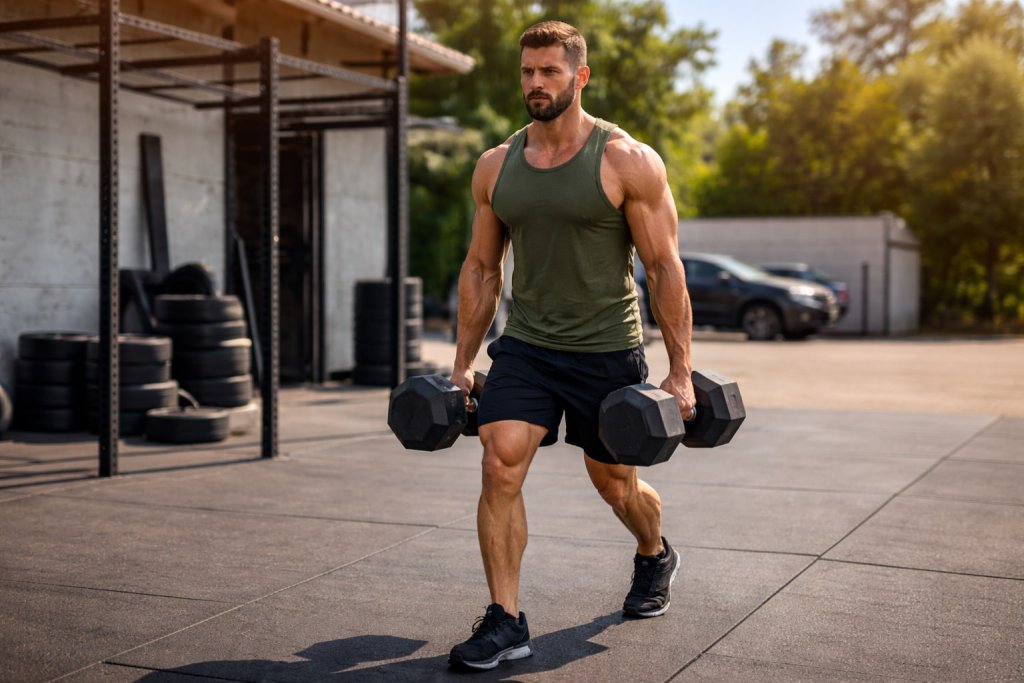
Understanding this exercise matters because it targets real-world strength qualities—carrying, bracing, and walking—that many traditional gym exercises miss.
This guide explains what the farmers walk exercise is, how it works, the muscles involved, how to do it safely, and how to program it effectively.
What Is the Farmers Walk Exercise?
The farmers walk exercise—often called the farmer’s carry—is a loaded walking movement where you hold weights (such as dumbbells, kettlebells, or trap bars) in each hand and walk for distance or time.
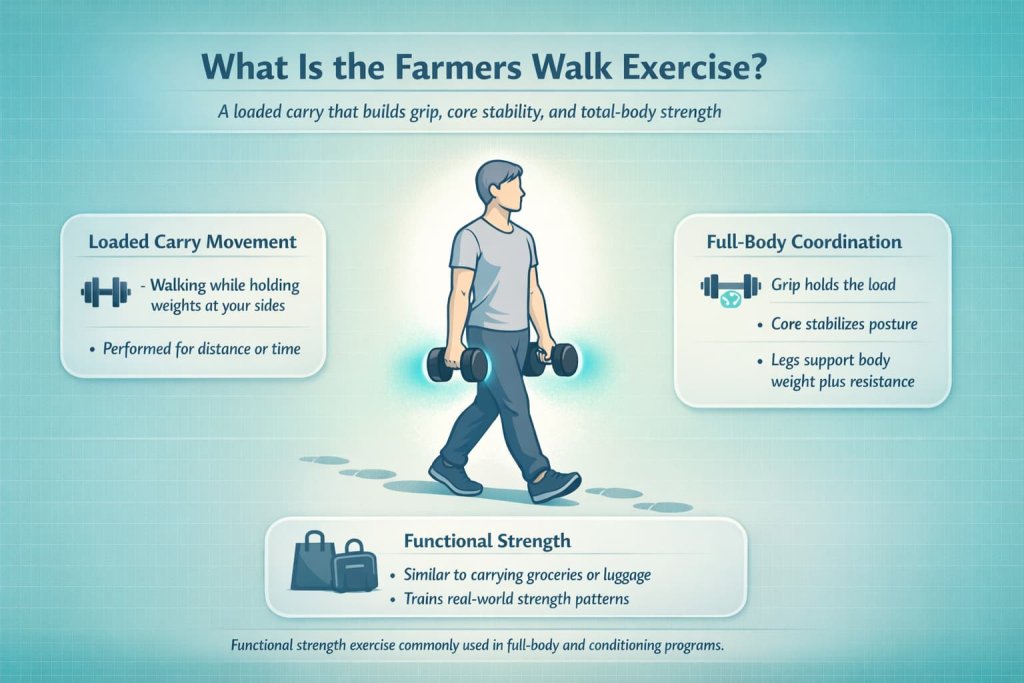
Unlike machine-based exercises, the farmers walk requires your entire body to work together. As you walk, your grip must hold the load, your core must brace to prevent leaning, and your legs must repeatedly support your body weight plus the added resistance.
Because it closely resembles everyday tasks like carrying groceries or luggage, the farmers walk is widely categorized as a functional strength exercise.
How to Do the Farmers Walk Exercise Properly
How to Do It
- Place two weights on the floor beside you.
- Stand tall and grip the weights firmly.
- Lift the weights using a controlled hinge or squat.
- Walk forward with short, steady steps.
- Keep your chest up and shoulders relaxed.
- Continue for a set distance or time, then set the weights down safely.
Move slowly and under control—speed is not the goal.
Why the Farmers Walk Exercise Is So Effective
Builds Grip Strength Under Fatigue
Holding heavy weights while walking places continuous demand on the forearms and hands. Research consistently shows that grip strength is a strong indicator of overall muscular fitness and functional capacity.
Trains Core Stability During Movement
Unlike static core exercises, the farmers walk challenges your trunk muscles while you are moving. Your core works to resist side-bending and rotation with every step, reinforcing bracing patterns used in daily life and sports.
Supports Posture and Load Control
Carrying weight at your sides encourages an upright posture with the shoulders down and back. Over time, this can improve awareness of spinal alignment under load.
Develops Real-World Strength
Walking while carrying weight mimics real tasks, making the farmers walk highly transferable to everyday activities and occupational demands.
Muscles Worked in the Farmers Walk Exercise
The farmers walk exercise activates multiple muscle groups simultaneously, including:
- Forearms and hand muscles (grip endurance)
- Upper back and shoulders (load control and posture)
- Core muscles, including abdominals and spinal stabilizers
- Glutes, quadriceps, hamstrings, and calves (walking under load)
Because the movement requires coordination rather than isolation, muscle activation is spread across the entire kinetic chain.
Common Mistakes to Avoid With the Farmers Walk Exercise
Many people reduce the effectiveness of the farmers walk by making avoidable errors, such as leaning to one side, taking rushed steps, or shrugging the shoulders upward. These habits shift stress away from the intended muscles and may increase discomfort.
Another common mistake is choosing weights that are too heavy too soon. Load should challenge your grip and posture without breaking form.
How to Program the Farmers Walk Exercise
The farmers walk exercise works well as a finisher, a core stability drill, or part of a full-body strength routine.
General programming guidelines include:
- Distance: 20–40 meters per set
- Time: 20–45 seconds per set
- Sets: 2–4 total
- Frequency: 1–3 times per week
The American College of Sports Medicine recommends that adults perform muscle-strengthening activities at least two days per week, and loaded carries can be one component of that broader program.
Safety Guidelines Before Doing the Farmers Walk Exercise
Although the farmers walk exercise looks simple, it places sustained load on the grip, spine, and lower body. Following basic safety principles helps reduce unnecessary strain.
- Start with a manageable weight that allows upright posture
- Keep your chest tall, shoulders relaxed, and core gently braced
- Walk with slow, controlled steps
- Use flat, non-slippery surfaces with clear walking space
- End the set if grip weakens or posture breaks down
Gradual progression and consistent form are especially important for beginners or those returning after time away from training.
How to Progress the Farmers Walk Exercise Safely
Safe progression emphasizes control before load to avoid excessive stress on the lower back or shoulders.
- Increase carry time or distance before adding weight
- Add load in small, gradual increments
- Reduce rest time to build endurance without heavier weights
- Introduce one-sided carries only after pain-free mastery
Advanced variations should be used selectively, not as a default progression.
Who Should Avoid or Modify the Farmers Walk Exercise
Some individuals may need to modify or avoid loaded carries based on their condition.
- Active hand, wrist, elbow, shoulder, or lower-back pain
- Balance difficulties or recent surgery
- Difficulty maintaining posture under light load
Modifications such as lighter weights, shorter distances, or single-arm carries may help. If discomfort persists or symptoms worsen, consultation with a qualified fitness professional or healthcare provider is recommended.
Who Should Be Cautious With the Farmers Walk Exercise?
People with unresolved hand, wrist, shoulder, or lower-back pain should approach loaded carries carefully. Reducing load, shortening distance, or using one-sided carries may be appropriate modifications.
If pain worsens or persists, professional guidance from a qualified trainer or healthcare provider is advised.
Frequently Asked Questions About the Farmers Walk Exercise
Is the farmers walk exercise good for beginners?
Yes, beginners can start with light weights and short distances. The movement is simple, but load selection is key.
How heavy should the weights be?
Choose a load that challenges your grip while allowing you to maintain upright posture for the full distance or time.
Does the farmers walk build muscle?
It supports strength and muscular endurance, especially in the grip, core, and lower body, when combined with progressive loading.
Can I do farmers walks every day?
Daily loaded carries are not necessary. Most people benefit from 1–3 sessions per week with recovery days in between.
Are kettlebells or dumbbells better?
Both work well. Dumbbells are widely accessible, while kettlebells may feel more comfortable for longer carries.
Is the farmers walk better than core isolation exercises?
It trains the core differently—through stability during movement—rather than replacing traditional core exercises entirely.
Conclusion
The farmers walk exercise is a simple yet powerful movement that builds grip strength, core stability, posture, and full-body coordination. By challenging your body to carry load while walking, it develops strength that translates directly to everyday life.
If your goal is practical, total-body strength with minimal equipment, adding the farmers walk exercise to your routine is a smart and effective choice.
References
- CDC Adult Physical Activity Guidelines (Muscle-Strengthening 2+ Days/Week)
- The Quantification of Muscle Activation During the Loaded Carry Movement Pattern (2024, PMC)
- NSCA: Increase Hip and Trunk Stability With Loaded Carries (NSCA Coach)
- NSCA TSAC Report: Resistance Exercise Considerations for Load Carriage (PDF)
- Mayo Clinic: Weight Training Do’s and Don’ts of Proper Technique
- Systematic Review: Thresholds of Handgrip Strength and All-Cause Mortality (2022, PubMed)