
The flutter kicks exercise is a bodyweight core movement that strengthens the abdominal muscles by keeping them under continuous tension while the legs alternate in a controlled kicking motion. It is widely used in fitness training because it challenges core endurance, requires no equipment, and can be adapted for different fitness levels.

Understanding how to perform flutter kicks correctly is important because proper form determines whether the exercise actually targets your abs—or shifts stress to your lower back. In this guide, you’ll learn how the flutter kicks exercise works, which muscles it trains, how to do it safely, and how to use it effectively in your workouts.
What Is the Flutter Kicks Exercise?
The flutter kicks exercise is performed lying on your back with both legs extended while you alternate small up-and-down kicks. The goal is to keep your core braced and your lower back controlled against the floor throughout the movement.
This exercise is commonly included in:
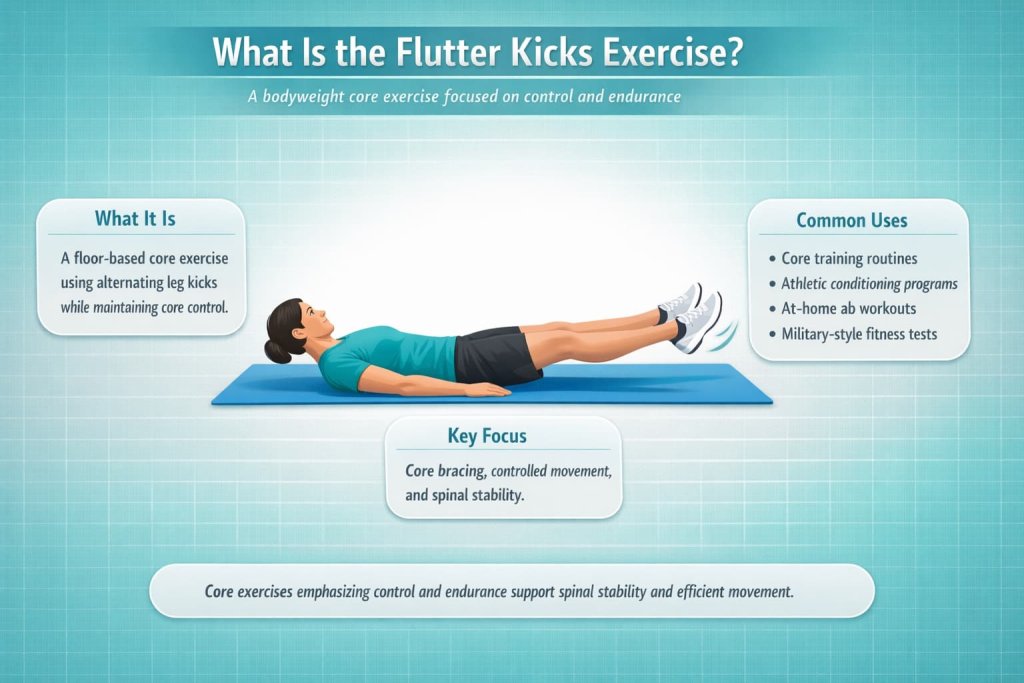
- Core training routines
- Athletic conditioning programs
- At-home ab workouts
- Military-style fitness tests
According to guidance from organizations such as the Mayo Clinic, core exercises that emphasize control and endurance play a key role in supporting spinal stability and overall movement efficiency.
How to Do the Flutter Kicks Exercise Correctly
How to do it:
- Lie on your back with legs extended and arms at your sides
- Gently brace your core as if tightening a belt around your waist
- Lift both legs a few inches off the floor
- Alternate small, controlled kicks up and down
- Keep your lower back stable against the floor
- Continue for the desired time or repetitions
Trainer Tip:
If you feel your lower back lifting or straining, raise your legs higher or shorten the set. Quality control is more important than speed.
Flutter Kicks Exercise Muscles Worked
The flutter kicks exercise primarily targets the muscles responsible for trunk stability while the legs remain elevated.
Primary muscles involved
- Rectus abdominis
- Transverse abdominis
Secondary muscles involved
- Hip flexors
- Quadriceps
Because the legs stay off the floor, the abdominal muscles must stay continuously engaged to prevent the lower back from arching. This sustained tension is what makes flutter kicks especially challenging for core endurance.
Benefits of the Flutter Kicks Exercise
Builds Core Endurance
Flutter kicks keep the abs under constant tension, which helps develop muscular endurance rather than short bursts of strength.
Supports Trunk Stability
Core endurance supports posture and spinal control during everyday activities and exercise. The American Council on Exercise notes that endurance-based core training helps the torso resist unwanted movement.
No Equipment Required
You can perform flutter kicks anywhere—at home, in the gym, or while traveling—making them easy to add to any routine.
Easy to Progress or Modify
By adjusting leg height, tempo, or duration, flutter kicks can be scaled for beginners or made more challenging for advanced exercisers.
Common Mistakes to Avoid With Flutter Kicks
Arching the Lower Back
This is the most common error. An excessive arch reduces abdominal activation and may increase discomfort.
Kicking Too High or Too Fast
Large, fast kicks shift work away from the core and reduce control.
Holding the Breath
Controlled breathing helps maintain core engagement and reduces unnecessary tension.
Are Flutter Kicks Good for Fat Loss?
Flutter kicks strengthen the abdominal muscles, but it’s important to be clear: no exercise can target fat loss in one specific area. Health resources such as Harvard Health Publishing explain that fat loss occurs through overall calorie balance, not spot reduction.
Flutter kicks may support a fat-loss program when combined with:
- Full-body strength training
- Cardiovascular exercise
- Consistent nutrition habits
Who Should Be Careful With Flutter Kicks?
You should approach flutter kicks cautiously if you:
- Have existing lower back pain
- Have a spinal condition
- Feel discomfort despite proper modifications
In these cases, organizations like the American Academy of Orthopaedic Surgeons recommend choosing core exercises that match individual tolerance and seeking professional guidance when needed.
Proper Breathing and Core Engagement During Flutter Kicks
- Breathe steadily and avoid holding your breath
- Exhale gently as the legs alternate; inhale with control
- Keep the rib cage down and pelvis stable
- Lightly brace the abs to support the lower back
Proper breathing helps maintain abdominal tension and reduces unnecessary strain on the lower back during flutter kicks.
Flutter Kicks Exercise Modifications and Progressions
Easier options
- Raise the legs higher off the floor
- Slightly bend the knees
- Place hands under the hips for support
- Shorten the set duration
More challenging options
- Lower the legs closer to the floor with control
- Slow the kicking tempo
- Increase time under tension
- Add brief pauses with legs elevated
How Often Should You Do the Flutter Kicks Exercise?
- Perform flutter kicks 2 to 4 times per week
- Allow rest between intense core workouts
- Stop or modify if lower-back discomfort occurs
Quality form and recovery are more important than doing flutter kicks every day.
How to Add Flutter Kicks to Your Workout
Flutter kicks are best used as a core finisher or accessory exercise.
Common programming options:
- 2–4 sets of 20–40 seconds
- Superset with planks or dead bugs
- Include in circuit-style workouts
Focus on maintaining control rather than extending the duration at the expense of form.
Frequently Asked Questions About the Flutter Kicks Exercise
Are flutter kicks safe for beginners?
Yes, when performed with proper form and modifications such as higher leg position or bent knees.
Do flutter kicks work lower abs?
Flutter kicks engage the entire abdominal wall. You cannot isolate “lower abs,” but this exercise strongly challenges that region.
How long should I do flutter kicks?
Most people benefit from 20–40 second sets performed with good control.
Can flutter kicks hurt your back?
They can cause discomfort if the lower back arches excessively. Proper form and modifications reduce this risk.
Are flutter kicks better than crunches?
They train the core differently. Flutter kicks emphasize endurance, while crunches focus on trunk flexion strength.
Can seniors do flutter kicks?
Some seniors may benefit from modified versions, but alternatives like bent-knee core exercises are often more appropriate.
Conclusion
The flutter kicks exercise is a simple but demanding way to build core endurance and abdominal strength without equipment. When performed correctly, it challenges the abs through sustained tension and controlled movement. Focus on proper form, use smart progressions, and combine flutter kicks with full-body training for the best results.
If you want stronger, more defined abs, start by mastering control—not speed—and make flutter kicks part of a balanced fitness routine.
References
- Mayo Clinic: Exercises to Improve Your Core Strength (Mayo Clinic)
- Mayo Clinic: Why You Should Strengthen Your Core Muscles (Mayo Clinic)
- AAOS OrthoInfo: Spine Conditioning Program (OrthoInfo)
- AAOS OrthoInfo: Spine Conditioning Program PDF.
- Harvard Health: Taking Aim at Belly Fat.
- CDC: Adult Activity Guidelines Overview.
- Core Stability Training for Injury Prevention (PMC)