
Forward lunges are a lower-body exercise that strengthens your legs (especially your quads and glutes) while also training balance and core stability. They’re worth learning because they build single-leg strength that carries over to walking, stairs, sports, and everyday stability—and they’re easy to scale from bodyweight to loaded variations.
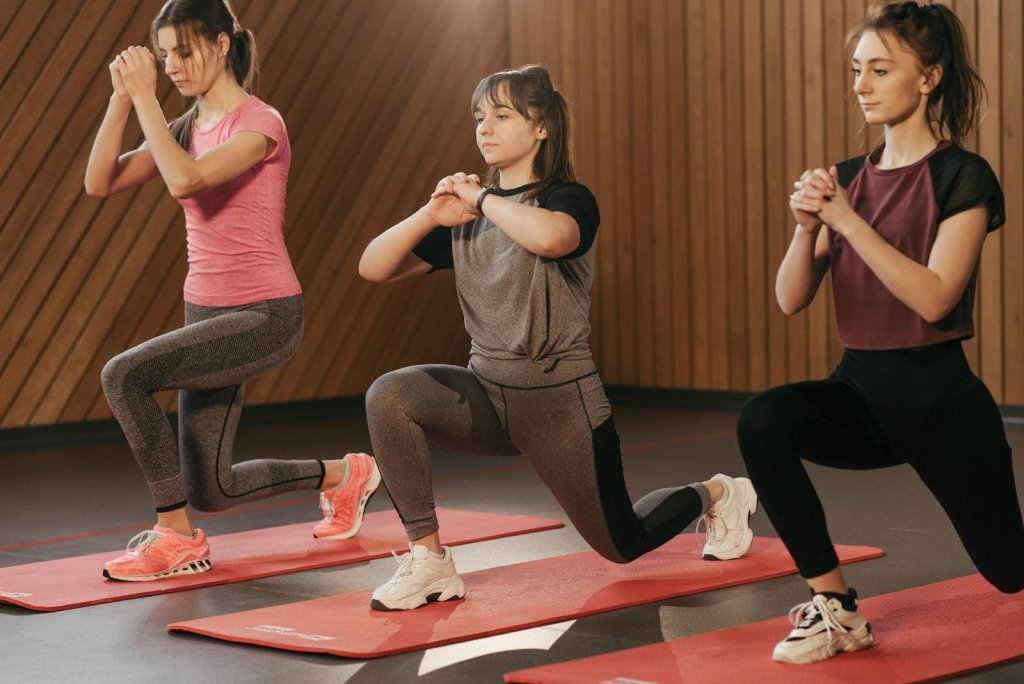
What Are Forward Lunges?
A forward lunge is a step-forward lunge variation where you take a controlled step forward, lower until both knees bend, then push through the front leg to return to standing. Unlike walking lunges (continuous steps), forward lunges usually return to the start position each rep, which can feel more stable for beginners.
How to Do Forward Lunges With Proper Form
Use this as your “default” forward lunge setup. If your goal is safer, more controlled reps, prioritize slow tempo and clean alignment before adding load.
How to do it:
- Stand tall with feet hip-width, ribs stacked over pelvis.
- Step forward far enough that you can lower with control (not a tiny step).
- Lower straight down until both knees bend comfortably (often near 90 degrees).
- Keep your front foot flat and your weight mostly in the front heel/midfoot.
- Keep your front knee tracking in line with your toes (avoid caving inward).
- Lightly tap or hover the back knee near the floor (no slam).
- Push through the front leg to return to standing.
- Repeat on the other side.
Trainer Tip: Think “down, not forward.” Most form problems happen when you dive your torso forward instead of lowering under control.
Forward Lunge Variations and When to Use Them
Pick the variation that matches your goal and your current control. The smartest progression is bodyweight → goblet → dumbbells → front rack, because each step adds either load or stability demand without forcing you to “jump” levels too fast.
1. Bodyweight Forward Lunge
Why it works: Bodyweight forward lunges let you practice the most important skill first: controlling your knee, hip, and trunk alignment during a step-forward pattern. Because the load is lighter, you can focus on clean reps, consistent depth, and balance without compensating.
How to do it:
- Stand tall with feet hip-width and brace your core lightly.
- Step forward to a comfortable distance (not too short).
- Lower straight down with control until your front thigh is close to parallel (as comfort allows).
- Keep the front foot flat and the front knee tracking in line with toes.
- Tap or hover the back knee near the floor (no dropping).
- Push through the front heel/midfoot to return to standing.
- Repeat for reps, then switch sides.
Trainer Tip: If balance is the limiter, use a fingertip support on a wall or chair. Keep it light—just enough to steady you while your legs do the work.
2. Goblet Forward Lunge (Hold One Dumbbell/Kettlebell at Chest)
Why it works: The goblet hold acts like a built-in posture coach. Holding the weight at your chest encourages a taller torso and better bracing, which often improves control and makes the movement feel smoother—especially for beginners moving beyond bodyweight.
How to do it:
- Hold one dumbbell/kettlebell at chest height with elbows angled down.
- Stand tall, ribs stacked over pelvis, and brace your core.
- Step forward and lower under control, keeping the weight close to your body.
- Keep the front knee aligned with toes and the front foot planted.
- Push through the front heel/midfoot to return to the start.
- Keep your torso steady—avoid tipping forward as you stand.
Trainer Tip: Think “zipper up”—keep your chest proud and your sternum lifted slightly while staying braced, not over-arched.
3. Dumbbell Forward Lunge (Weights at Sides)
Why it works: Dumbbells at your sides increase the challenge without forcing the torso upright like goblet does. This variation builds grip strength and total-body stability and can feel more “athletic,” but it also demands better balance because the load hangs lower and can pull you off-center.
How to do it:
- Hold a dumbbell in each hand at your sides, shoulders relaxed (don’t shrug).
- Stand tall and brace your core.
- Step forward and lower slowly, keeping the dumbbells close to your legs.
- Keep your hips square and your front knee tracking with your toes.
- Push through the front heel/midfoot to stand back up.
- Reset your stance fully before the next rep to keep reps consistent.
Trainer Tip: If the dumbbells “swing,” your reps are too fast. Slow down the descent and pause for 1 second near the bottom to remove momentum.
4. Front Rack Forward Lunge (Advanced)
Why it works: Front rack loading (barbell or two kettlebells/dumbbells in front rack) raises the stability demand on your core and upper back, and it punishes sloppy posture fast. It’s excellent for strength and bracing, but only after you’ve mastered alignment and control with simpler variations.
How to do it:
- Set the weight in a secure front rack (elbows slightly forward, chest tall).
- Brace your core and keep your torso stacked—avoid flaring ribs.
- Step forward under control and lower straight down.
- Keep the front foot planted and the knee aligned with toes.
- Drive through the front heel/midfoot to return to standing.
- Reset your posture before each rep (don’t rush the next step).
Trainer Tip: Use a “quiet torso” rule: if your chest drops or elbows fall, the load is too heavy. Reduce weight and keep every rep identical.
Forward Lunges Muscles Worked
Forward lunges mainly target the big lower-body muscles, plus smaller stabilizers that help you stay steady.
Primary muscles:
- Quadriceps (front thigh)
- Gluteus maximus (main glute muscle)
- Hamstrings
Secondary/support muscles:
- Calves (gastrocnemius/soleus)
- Core and hip stabilizers (help prevent wobbling and trunk tipping)
The NSCA highlights lunges for strengthening the glutes, hamstrings, quads, and calves while also improving balance and core control.
Forward Lunges Benefits
Forward lunges are popular because they train strength and control at the same time.
Key benefits:
- Builds single-leg strength (helps reduce “dominant side” imbalance)
- Improves balance and coordination
- Trains hip and knee control (useful for athletic movement and daily life)
- Adds core bracing practice without needing fancy equipment
- Easy to progress (bodyweight → goblet → dumbbells → barbell)
Quick Form Checklist (Use This Every Set)
If you want forward lunges to feel strong and stable, run this checklist before each set.
- Chest tall, head neutral (don’t crane the neck)
- Front foot stays planted (no heel pop)
- Front knee tracks with toes (no inward collapse)
- Hips stay square (avoid twisting)
- Controlled lowering and smooth push back to start
Common Forward Lunge Mistakes (And Simple Fixes)
Here’s what usually goes wrong—and what to change right away.
| Mistake | What it can feel like | Quick fix |
|---|---|---|
| Step is too short | Knee drifts far forward, shaky balance | Take a slightly longer step so you can lower “down” |
| Front knee caves inward | Unstable, discomfort at knee | Press knee gently outward to match toe line |
| Heel lifts on the front foot | Quad burn only, less glute | Shift weight to heel/midfoot, slow the descent |
| Torso dives forward | Low-back fatigue, wobbly reps | Shorten range and keep ribs stacked over pelvis |
| Pushing off the back foot | You “bounce” instead of lifting with front leg | Treat back leg as a kickstand—front leg does the work |
How to Make Forward Lunges Easier
If forward lunges feel too wobbly, you can still train the same pattern.
Options:
- Shorten range of motion (partial depth)
- Hold onto a wall/chair lightly for balance
- Do a split squat (no stepping) to build strength first
- Reduce speed (3 seconds down, 1 second up)
How to Make Forward Lunges Harder (Without Jumping)
Progress one variable at a time.
Try:
- Add load (goblet first, then dumbbells)
- Add tempo (slow descent + pause at the bottom)
- Increase reps per side
- Add a 1–2 second hold near the bottom position
- Use a deficit (front foot on a low plate) only if mobility and control are solid
How Many Reps and Sets Should You Do?
A practical starting point for most people is 2–3 sets of 8–12 reps per leg, focusing on control and consistent depth. The Cleveland Clinic uses this general rep-and-set range as a guideline for lunges.
Good starting frequency:
- 2–3 days per week (with at least one rest day between hard lower-body sessions)
Rest times:
- 45–90 seconds for bodyweight or light load
- 90–150 seconds for heavier sets
Where Forward Lunges Fit in a Workout
Forward lunges work well in these spots:
- After your warm-up, as a main lower-body move
- After squats/hinges, as a unilateral “accessory” for balance and symmetry
- In circuits (bodyweight or light goblet) for conditioning
Simple examples:
- Strength-focused: squats or deadlifts → forward lunges → glute bridge → calf raises
- Beginner: step-ups → forward lunges → band row → plank
Who Should Avoid or Get Guidance First
Forward lunges are generally safe when done with control, but it’s smart to modify or get professional guidance if you have:
- Recent surgery or a current injury affecting the hip, knee, ankle, or back
- Significant balance issues or frequent falls
- Pain that sharpens, worsens, or lingers after you stop
If you’re unsure, consider starting with a more stable option (like split squats) and discussing the best progression with a qualified fitness or healthcare professional. For older adults or anyone concerned about lunge safety, Harvard Health offers practical considerations on choosing safer variations.
FAQs About Forward Lunges
Are forward lunges bad for your knees?
Forward lunges are not automatically “bad” for knees. Most knee issues come from poor alignment (knee collapsing inward), stepping too short, or moving too fast. Use controlled reps, keep the knee tracking with toes, and adjust range as needed.
What’s the difference between forward lunges and reverse lunges?
Forward lunges step forward into the rep, which can feel more balance-demanding. Reverse lunges step back, which many people find more stable and knee-friendly because the front leg stays planted longer.
Should my knee go past my toes in a forward lunge?
Some forward knee travel can be normal depending on your body and step length. What matters more is control, a planted foot, and the knee tracking in line with the toes—without pain.
How do I feel forward lunges more in my glutes?
Take a slightly longer step, keep your front heel planted, and push through the heel/midfoot as you stand. Avoid letting the front knee collapse inward.
How deep should I go?
Go as deep as you can while staying controlled and aligned. Many people aim for a position where both knees are comfortably bent, but depth varies based on mobility and comfort.
Can beginners do forward lunges?
Yes—but beginners should start with bodyweight, slow reps, and support (like a wall touch) if needed. Split squats are also a great stepping-stone.
How often should I train forward lunges?
Most people do well with 2–3 sessions per week, depending on total lower-body training volume and recovery.
Conclusion
Forward lunges are a simple, high-value move: they build leg strength, balance, and stability with minimal equipment, and they scale easily as you get stronger. Start with clean bodyweight reps, use the form checklist every set, then progress to a goblet or dumbbell forward lunge when your balance and control feel consistent.
References
- Ratamess, N. A., et al. (2009). ACSM Position Stand: Progression Models in Resistance Training for Healthy Adults
- Riemann, B. L., et al. (2012). Biomechanical Analysis of the Anterior Lunge During 4 External Load Conditions (Journal of Athletic Training, PubMed Central)
- van Rossom, S., et al. (2018). Knee Joint Loading in Healthy Adults During Functional Exercises (Journal of Orthopaedic & Sports Physical Therapy)