
Functional core exercises are moves that train your midsection to resist unwanted motion (arching, twisting, side-bending) so you can move stronger and stay more stable in real life and sports. That’s why the best “functional core” work looks more like controlled planks, carries, anti-rotation presses, and crawls than endless crunches.
Understanding this matters because your core’s main job is force transfer and control—helping your hips and shoulders work together for lifting, running, throwing, and everyday tasks. The approach below follows widely used “anti-movement” categories and common progressions discussed by the American Council on Exercise (ACE) and programming guidance from the National Academy of Sports Medicine (NASM).
What makes a core exercise “functional”
A functional core exercise typically checks at least one of these boxes:
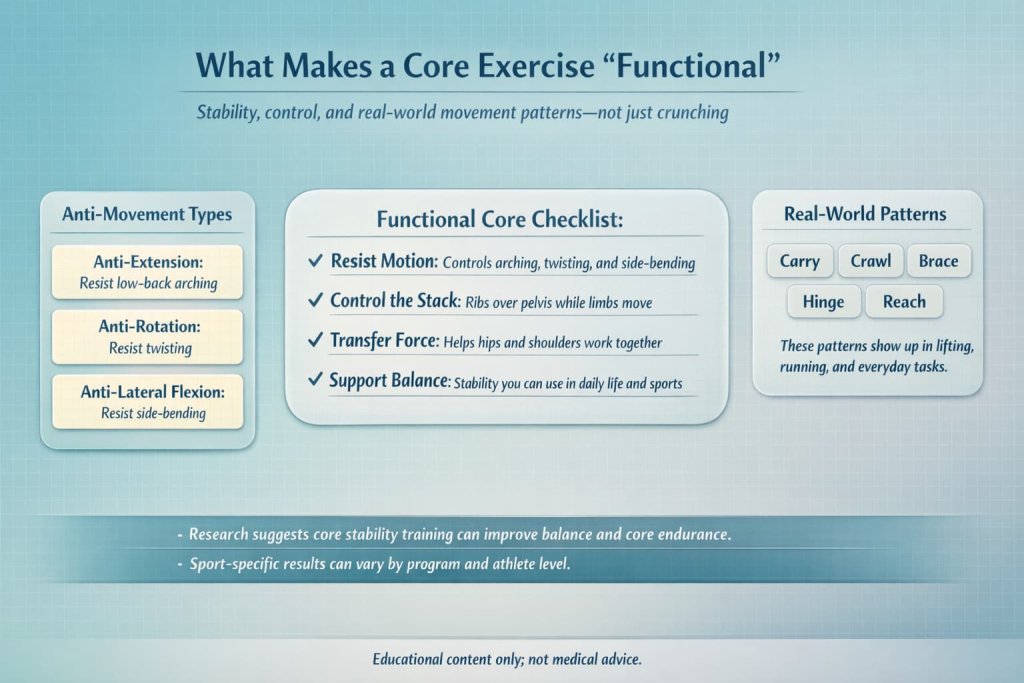
- Trains you to resist movement (anti-extension, anti-rotation, anti-lateral flexion)
- Keeps the spine and pelvis controlled while arms/legs move
- Looks like real-life patterns: carry, crawl, brace, hinge, reach
- Builds balance and stability you can use outside the gym
Research summaries also suggest core-focused training can improve foundational athletic qualities like balance and core endurance, though sport-specific outcomes can vary by program and athlete level. For example, a 2025 meta-analysis indexed on ScienceDirect reported meaningful balance improvements in soccer players after core stability training.
12 best functional core exercises
Build a stronger, more stable core with these functional moves that train anti-rotation, anti-extension, and balance control.
Perfect for better lifting, steadier posture, and real-world strength without relying on crunches.
1) Dead Bug
How to do it:
- Lie on your back, knees bent 90°, arms straight up
- Exhale and gently brace (ribs down, low back lightly touching the floor)
- Slowly lower one heel toward the floor while reaching the opposite arm back
- Pause briefly, then return and switch sides
- Keep motion smooth and controlled
Why it works:
Dead bugs are a top-tier anti-extension drill. You train your core to keep your trunk stable while your arms and legs move—exactly what “functional core” means.
Muscles worked:
Deep core (including transverse abdominis), rectus abdominis, obliques, hip flexors (lightly), plus stabilizers around the pelvis.
Trainer Tip:
If your back arches, shorten the range (tap heel instead of lowering fully) and slow down.
2) Forearm Plank
How to do it:
- Set forearms under shoulders, legs straight
- Squeeze glutes and keep ribs stacked over pelvis
- Hold 15–40 seconds with calm breathing
- Stop before form breaks
Why it works:
A plank is “functional” when it teaches full-body tension and spinal control without excessive arching.
Muscles worked:
Abs, obliques, deep core, glutes, shoulder stabilizers.
Trainer Tip:
Think “long spine” instead of “butt high.” Your body should look like a strong, straight line.
3) Plank Shoulder Tap (Anti-rotation)
How to do it:
- Start in a high plank (hands under shoulders)
- Widen feet slightly for balance
- Tap one shoulder without shifting hips
- Alternate slowly for 6–12 taps per side
Why it works:
Your core resists rotation while one arm lifts. This builds real-world stability for pushing, carrying, and sport movement.
Muscles worked:
Obliques, deep core, serratus anterior, shoulders.
Trainer Tip:
Go slower than you think. If your hips sway, widen your stance or elevate hands to a bench.
4) Bird Dog
How to do it:
- Get on all fours: hands under shoulders, knees under hips
- Brace lightly and keep hips square
- Reach one arm forward and the opposite leg back
- Pause 2–3 seconds, return, switch sides
Why it works:
Bird dogs train trunk stability with limb movement—great for coordination, posture, and control.
Muscles worked:
Deep core, spinal stabilizers, glutes, rear shoulders.
Trainer Tip:
Don’t chase height. Keep the leg level and pelvis steady.
5) Side Plank
How to do it:
- Elbow under shoulder, legs straight (or bottom knee bent to scale down)
- Lift hips so body forms a straight line
- Hold 15–30 seconds per side
Why it works:
Side planks are a classic anti-lateral flexion drill—your core resists collapsing sideways, which supports balance and single-leg control.
Muscles worked:
Obliques, quadratus lumborum, glute medius, shoulder stabilizers.
Trainer Tip:
Push the floor away and keep ribs stacked—avoid twisting your chest toward the floor.
6) Pallof Press (Band or Cable)
How to do it:
- Stand sideways to a band/cable at chest height
- Hold handle at your chest, feet shoulder-width
- Press arms straight out, resisting rotation
- Pause 1–2 seconds, return slowly
- Do 8–12 reps per side
Why it works:
This is one of the most practical anti-rotation exercises—your trunk learns to stay square under sideways pull.
Muscles worked:
Obliques, deep core, abs, glute stabilizers.
Trainer Tip:
If you’re wobbling, step farther from the anchor only after you can control the press.
7) Half-Kneeling Pallof Press
How to do it:
- Set one knee down, the other foot forward (half-kneeling)
- Squeeze the down-side glute and keep ribs down
- Press the band/cable out and resist rotation
- Do 6–10 controlled reps per side
Why it works:
Half-kneeling reduces cheating and exposes hip and trunk control issues—excellent for building functional stability before standing and moving drills.
Muscles worked:
Obliques, deep core, glutes, hip stabilizers.
Trainer Tip:
Stay tall—don’t lean away from the cable to “win” the rep.
8) Suitcase Carry
How to do it:
- Hold one dumbbell or kettlebell at your side
- Stand tall, shoulders level, ribs stacked
- Walk 20–40 yards (or 20–45 seconds)
- Switch sides
Why it works:
Carrying a load on one side forces your body to resist side-bending and rotation—highly functional for daily life.
Muscles worked:
Obliques, deep core, quadratus lumborum, grip, glutes.
Trainer Tip:
Walk slow and quiet. If your torso leans, reduce weight and tighten your “tall posture.”
9) Farmer’s Carry
How to do it:
- Hold weights in both hands
- Brace lightly and walk 20–60 yards
- Maintain steady breathing and posture
Why it works:
Farmer’s carries build full-body stiffness and posture under load—one of the most “real-life” strength patterns you can train.
Muscles worked:
Core stabilizers, grip, upper back, glutes, quads.
Trainer Tip:
Don’t rush. Tall posture and control matter more than speed.
10) Bear Crawl (Forward or Backward)
How to do it:
- Start on all fours, then lift knees 1–2 inches off the floor
- Keep back flat and hips steady
- Crawl slowly 6–12 steps forward, then back
Why it works:
Crawls challenge the core to stabilize while you move through space—great for coordination, shoulder stability, and athletic control.
Muscles worked:
Deep core, obliques, shoulders, serratus anterior, hip stabilizers.
Trainer Tip:
If hips sway, shorten steps and slow down.
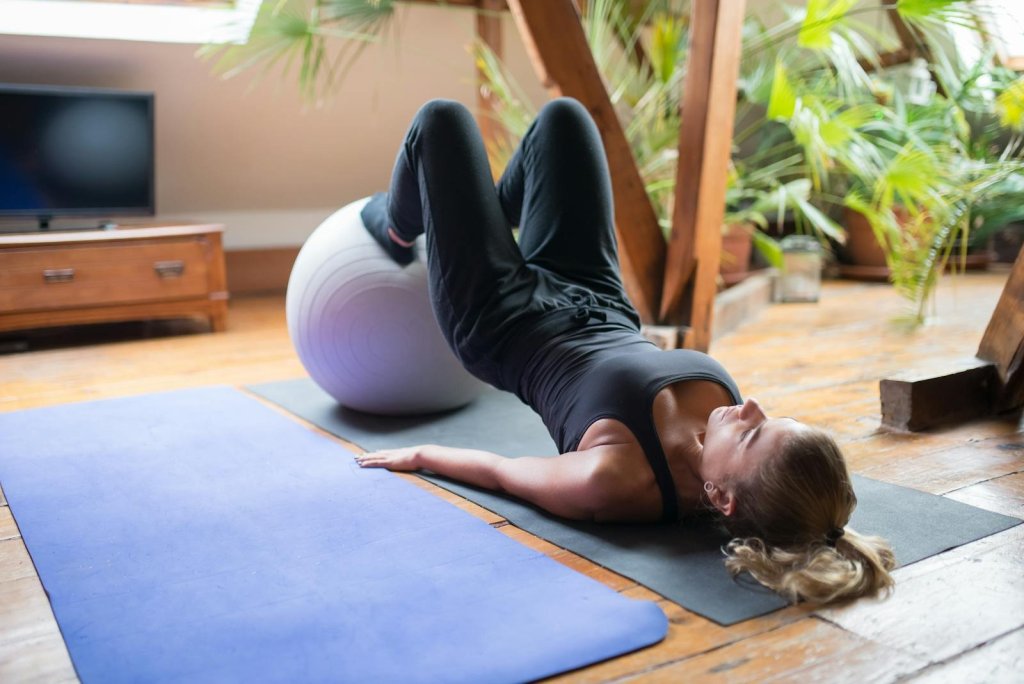
11) Glute Bridge March
How to do it:
- Lie on your back, knees bent, feet flat
- Lift hips into a strong bridge (ribs down)
- Slowly lift one knee toward your chest without dropping hips
- Alternate for 6–10 reps per side
Why it works:
You train pelvic stability and anti-rotation control while one leg moves—very functional for walking, running, and single-leg strength.
Muscles worked:
Glutes, hamstrings, deep core, obliques.
Trainer Tip:
Keep both hip bones level like headlights pointing straight up.
12) Stability Ball Rollout (Advanced Anti-extension)
How to do it:
- Kneel with forearms on a stability ball
- Brace gently (ribs down) and squeeze glutes
- Roll the ball forward a few inches
- Pause, then pull back with control
- Keep it slow and pain-free
Why it works:
Rollouts increase the lever and challenge your ability to resist spinal extension—excellent when you’re ready for a harder anti-extension move.
Muscles worked:
Abs, deep core, lats (stabilizing), shoulders.
Trainer Tip:
Progress range gradually. If your low back arches, you rolled too far.
A simple 2–3 day functional core plan
Pick 4–6 moves per session:
- 1 anti-extension: Dead bug or plank
- 1 anti-rotation: Pallof press or plank shoulder taps
- 1 anti-lateral flexion: Side plank or suitcase carry
- 1 integrated pattern: Bird dog, bear crawl, bridge march
- Optional loaded finisher: Farmer’s carry
Programming tip: place core work after your warm-up and before heavy lifting when you want the trunk “on,” but avoid exhausting it if you’re going to lift heavy or do complex movements right after.
Benefits of Functional Core Exercises for Strength and Balance
Functional core training builds stability and control, not just “ab muscles.” That carries over to lifting, sports, and everyday movement.
- Stronger bracing for lifts: Better trunk control for squats, hinges, presses, and pulls
- Improved balance: Helps you stay steady on one leg and during direction changes
- Better force transfer: Moves power efficiently between hips and shoulders
- More stable posture: Keeps ribs and pelvis stacked under load and fatigue
- Smoother movement: Less twisting, swaying, and “energy leaks”
- Better coordination: Improves control while arms and legs move (dead bug, bird dog)
How to choose the right functional core exercises
Use this simple progression rule:
- Start with control first (breathing, bracing, stable positions)
- Add range next (longer lever, reach, marching, crawling)
- Add load last (bands, cables, carries, heavier implements)
If you feel your low back taking over, your hips twisting, or you can’t breathe smoothly, you’re likely progressing too fast.
Quick safety checklist before you start
- Aim for steady breathing (no breath-holding or straining)
- Keep discomfort muscular, not sharp
- Stop if you notice numbness, tingling, dizziness, or pain that travels
- If you’re postpartum, have a hernia, recent surgery, or a spine/hip condition, consider checking with a qualified clinician before loading heavy carries or rollouts
Common mistakes that reduce results
- Going too hard too soon (especially rollouts and long planks)
- Letting the low back arch (turns “core” work into back stress)
- Rushing reps (speed hides instability)
- Holding your breath (reduces control and endurance)
Who Should Avoid or Modify These Exercises
Most people can do these safely with good form and gradual progression. But scale down or get guidance if you have any of the following:
- Sharp or worsening pain during core work
- Numbness, tingling, radiating pain, or weakness
- Recent surgery (abdomen, spine, hip, pelvis) without clearance
- Known or suspected hernia or bulging/pressure that worsens with bracing
- Pregnant or postpartum and bracing increases heaviness, pain, or doming/bulging
- Uncontrolled blood pressure or frequent breath-holding/straining
- Acute back flare-up that gets worse with planks, rollouts, or heavy carries
Easy modifications (safer swaps)
- Long plank → short holds (10–15 sec) or incline plank
- Rollout → micro-rollouts or dead bug
- Shoulder taps → wider stance or hands-elevated taps
- Heavy carries → lighter weight + shorter distance
FAQs
Are functional core exercises better than crunches?
They’re often a better match for strength, posture, balance, and athletic transfer because they train stability and control—though crunch variations can still have a place if they’re pain-free and programmed well.
How often should I train functional core exercises?
Most people do well with 2–4 short sessions per week (8–15 minutes), plus carries/crawls sprinkled into warm-ups.
What’s the best functional core exercise for balance?
Side planks, suitcase carries, and Pallof presses are strong options because they challenge anti-lateral flexion and anti-rotation—key components of staying upright and stable.
Should I feel functional core exercises in my lower back?
You should mostly feel abs/obliques and steady tension. If your low back is working more than your core, scale down the exercise or shorten range.
Can beginners do functional core training?
Yes. Start with dead bugs, bird dogs, modified side planks, and light carries. Master control first, then progress.
Do functional core exercises help athletic performance?
Evidence summaries available through the National Library of Medicine (PubMed Central) suggest core stability training can improve foundational qualities like balance and trunk endurance, while sport-specific improvements can vary depending on the program and athlete level.
Conclusion
Functional core exercises work best when they train your body to stay stable while you move—not just when you “feel the burn.” Start with control-based drills, progress slowly, and use carries and anti-rotation work to build real-world strength and balance.
References
- American Council on Exercise (ACE). (2015). 7 Exercises to Create an Anti-Rotation Progression Sequence. American Council on Exercise (ACE)
- Rodríguez, S., et al. (2025). Effects of core stability training on physical performance in soccer players: Systematic review and meta-analysis. PubMed
- Šćepanović, T., et al. (2020). Short-term core strengthening program improves performance outcomes (core endurance/balance-related measures). PubMed Central (PMC), U.S. National Library of Medicine
- Cleveland Clinic. (2021). Plank Exercises: What They Do for Your Body. Cleveland Clinic