
The hang power clean is an Olympic-lift variation that builds explosive power by lifting a barbell from a “hang” position (usually mid-thigh) and catching it in a strong front rack with a partial squat. Learning the hang power clean matters because small technique details (balance, bar path, and fast elbows) can make the lift feel smoother, safer, and more effective for athletic performance.
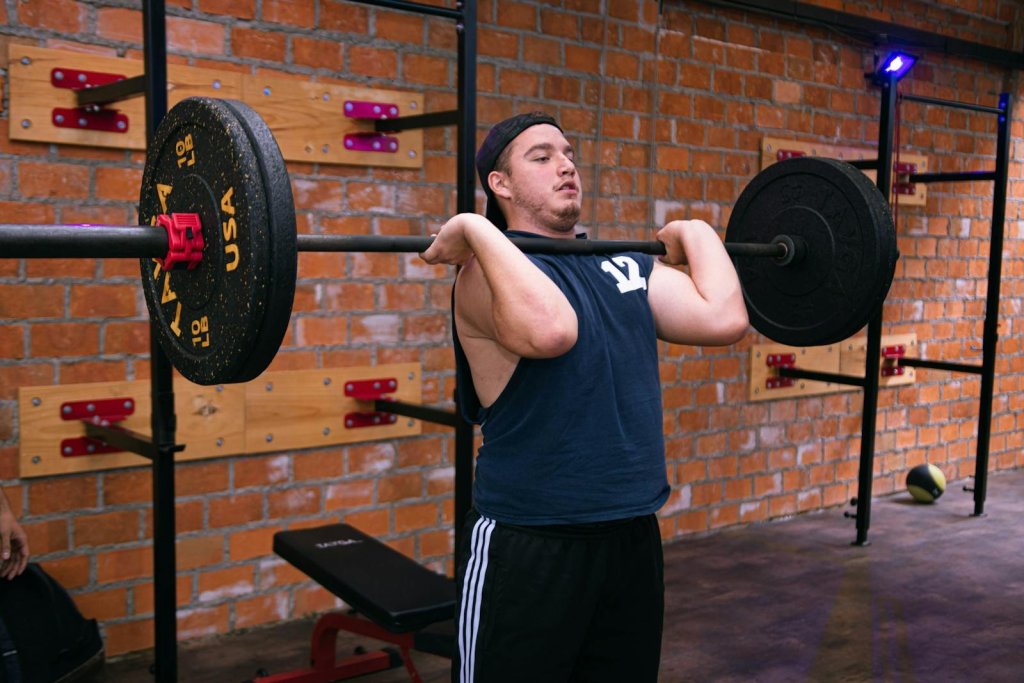
A reliable way to learn it is to master the setup, keep the bar close, finish a powerful hip-and-leg drive, and catch with a stable rack position—then progress load gradually. The National Strength and Conditioning Association (NSCA) explains that the hang version is often less technically demanding than cleaning from the floor because it removes the floor start and first pull.
What Is a Hang Power Clean
A hang power clean starts with the bar already in your hands at the hang position (above the knee to mid-thigh). From there, you:
- Dip into your hang position with control
- Explode upward with legs and hips
- Pull yourself under quickly
- Catch the bar on the shoulders (front rack) in a partial squat (the “power” catch)
Hang Power Clean Technique Breakdown
How to do it:
- Start standing tall with the bar in your hands (use a clean grip)
- Brace your core and set your back tight
- Slide the bar down your thighs to the hang position (mid-thigh is common)
- Slight knee bend, shoulders slightly over the bar, bar close to the body
- Drive hard through legs and hips to stand explosively
- Keep the bar close as you finish tall
- Pull yourself under fast and whip elbows through
- Catch the bar on the shoulders in a partial squat (power position)
- Stand fully, then lower the bar under control for the next rep
Trainer Tip: If the bar swings away from you, the catch often feels unstable. Tighten your lats, brush the bar up the body, and stay balanced over midfoot.
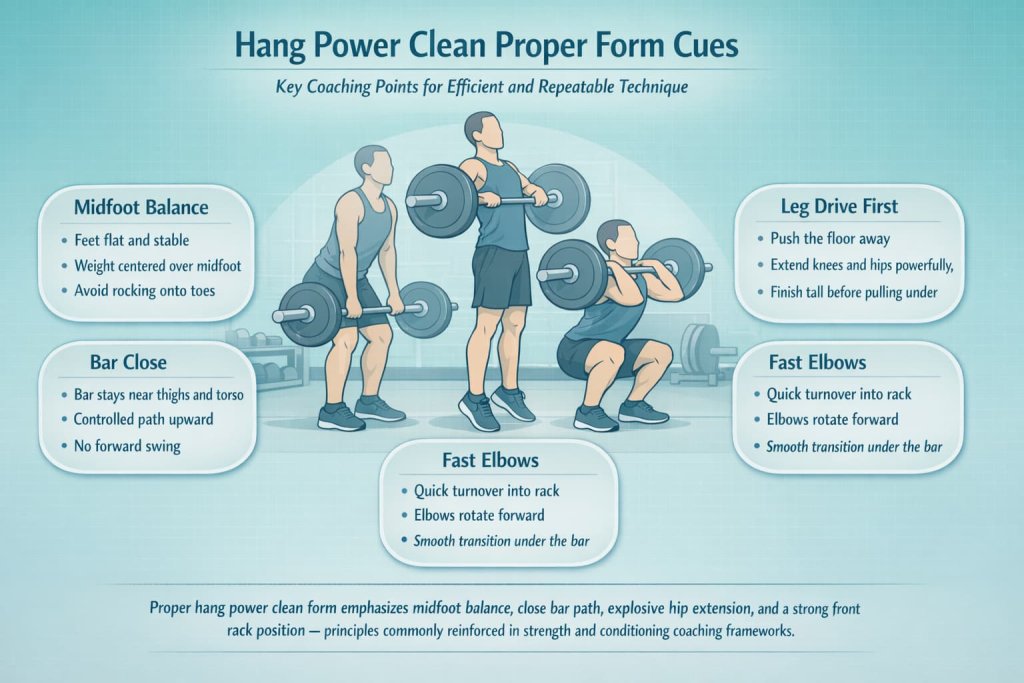
Hang Power Clean Proper Form Cues
Use these cues to keep the lift efficient and repeatable:
- Stay balanced over midfoot (avoid rocking to the toes)
- Keep the bar close to your thighs and torso
- Drive the floor away with your legs, then finish with hips
- Think “jump tall,” then “fast elbows” into the rack
- Catch with your chest up and elbows high enough to support the bar
Technical guidance from the NSCA and practical coaching frameworks from Catalyst Athletics both emphasize bar proximity, balance, and a strong rack position as key performance factors.
Muscles Worked in the Hang Power Clean
The hang power clean is a total-body lift. Main contributors include:
- Glutes and hamstrings (hip drive)
- Quads (leg drive and catch support)
- Calves (finishing extension)
- Upper back and traps (keeping the bar close and supporting turnover)
- Core and trunk (bracing and posture)
- Shoulders and arms (guiding the bar and securing the rack)
Coaching breakdowns describe the lift as a coordinated lower-body power movement supported by strong trunk stability and upper-back engagement.
Hang Power Clean Benefits
Builds explosive power and athletic carryover
The hang start puts you directly into the most explosive phase of the lift. The NSCA highlights that hang derivatives are frequently used in strength and conditioning programs to develop rapid force production.
Reinforces strong positions and coordination
Because you must control the bar into the hang and then reverse direction quickly, the lift challenges timing, balance, posture, and full-body coordination.
Research-supported performance improvements
A controlled study published on PubMed Central (PMC) found that short-term training emphasizing hang clean or hang snatch variations produced meaningful improvements in strength, power, and speed measures in collegiate athletes, supporting the use of hang derivatives in athletic programs.
Common Hang Power Clean Mistakes and Fixes
Early arm pull
Keep arms long until you fully extend through the legs and hips. Think “legs first, arms second.”
Swinging the bar away
Maintain lat tension and keep the bar close throughout the pull.
Jumping forward or catching on toes
Start balanced and finish tall. Jumping forward often means the bar drifted away from your center of mass.
Slow elbows in the catch
Practice fast turnover drills and front rack speed work. Quick elbow movement is essential for a secure catch.
Collapsing the chest in the catch
Reduce load and improve front rack mobility and front squat strength before progressing.
Who Should Avoid or Modify Hang Power Cleans
The hang power clean is a technical, explosive lift and may not be suitable for everyone.
You should avoid or modify it if you:
- Have shoulder, wrist, or elbow pain
- Lack front rack mobility
- Cannot maintain a neutral spine under load
- Are recovering from recent injury or surgery
- Are new to strength training without coaching
In these cases, start with simpler progressions or seek guidance from a qualified coach or healthcare professional to reduce injury risk and train safely.
Safety and Who Should Be Cautious
The hang power clean is a fast, technical lift. It may not be ideal if you lack front rack mobility, have uncontrolled shoulder or wrist discomfort, or struggle to brace and maintain neutral posture under load.
Practical safety rules:
- Learn with a qualified coach if possible
- Start with a PVC pipe, empty bar, or light load
- Use bumper plates and a safe training area when appropriate
- Stop if you feel sharp or unusual pain
Educational materials from CrossFit emphasize scalable loading and proper equipment when learning Olympic lift variations.
How to Program the Hang Power Clean
For power development, keep reps low and movement speed high.
Common starting ranges:
- Beginners: 3–5 sets of 2–3 reps (light to moderate load)
- Intermediate: 4–6 sets of 1–3 reps (moderate load, high speed)
- Technique focus day: lighter triples emphasizing position and control
If bar speed slows or technique breaks down, end the set. Power training depends on high-quality, explosive reps.
Hang Power Clean vs Power Clean
- Hang power clean: starts from hang, emphasizes explosive extension and fast turnover
- Power clean (from floor): includes the floor start and first pull, often more technically demanding
The NSCA notes that hang variations are often used as teaching tools before progressing to lifts from the floor.
FAQ
Is the hang power clean good for beginners?
Yes. Hang variations are commonly used first because they simplify the lift by removing the floor start and allow athletes to focus on explosive mechanics.
What hang position should I start from?
Mid-thigh is common. A higher hang position may be easier when first learning the dip-and-drive pattern.
Should I use straps for hang power cleans?
Most lifters learn without straps to build grip strength. Straps may be used in specific training contexts under supervision.
Do I need to squat deep to make it a “power” clean?
No. A power clean is caught above full squat depth. If you catch very low, it resembles a squat clean.
What’s the most important cue for a better catch?
Fast elbows into a stable front rack with the bar resting on the shoulders—not held in the hands.
How heavy should I go?
Choose a load that allows you to move explosively with clean technique. If reps feel slow or unstable, reduce the weight.
Can hang power cleans improve sports performance?
Hang clean derivatives are commonly used in athletic programming to train rapid force production, and research published on PubMed Central (PMC) supports their role in improving performance markers when properly programmed.
Conclusion
The hang power clean is one of the most effective total-body power exercises when performed with proper technique. Focus on balance, a close bar path, explosive leg drive, and fast elbows into a secure rack. Start light, master the mechanics, and progress gradually to build strength and athletic explosiveness safely.
References
- PubMed Central (PMC) — Ayers et al. (2016) Hang Cleans vs Hang Snatches Study
- PubMed — Ayers et al. (2016) Abstract Record
- PubMed Central (PMC) — Suchomel et al. (2017) Power-Time Curve Comparison
- Journal of Strength and Conditioning Research (JSCR) — Suchomel et al. (2014) Power Development Comparison