
The five best hip thrust variations are the barbell, dumbbell, Smith machine, B-stance, and single-leg hip thrust. Each trains hip extension, but the ideal choice depends on your equipment, experience, stability, and ability to maintain proper form.
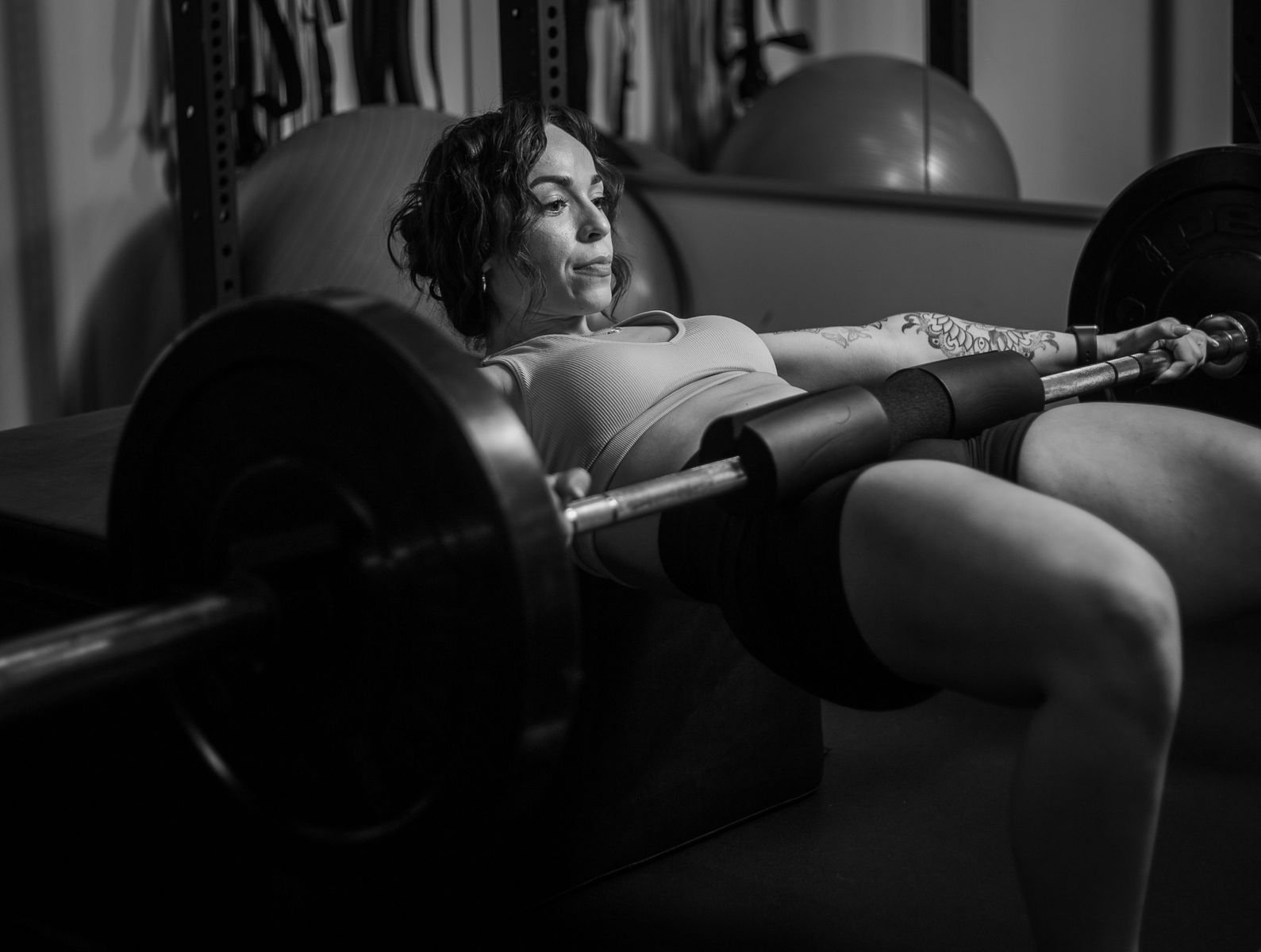
Hip thrusts primarily strengthen the gluteus maximus while also involving the hamstrings, adductors, and surrounding stabilizing muscles. Current research supports hip thrusts as an effective glute-building exercise, but they work best as part of a balanced lower-body program that also includes squats, hinges, and unilateral movements.
This guide explains how to perform five useful hip thrust variations, what each one is best for, and how to include them in your workouts.
Hip Thrust Variations at a Glance
| Hip thrust variation | Best for | Equipment |
|---|---|---|
| Barbell hip thrust | Progressive overload and strength | Barbell, plates, bench, pad |
| Dumbbell hip thrust | Beginners and simple setups | Dumbbell and bench |
| Smith machine hip thrust | Stable, controlled loading | Smith machine and bench |
| B-stance hip thrust | Supported single-leg emphasis | Bodyweight, dumbbell, or barbell |
| Single-leg hip thrust | Unilateral strength and pelvic control | Bench and optional weight |
No variation is automatically best for everyone. Choose one that lets you use a controlled range of motion and progressively increase the challenge without losing your position.
5 Best Hip Thrust Variations
These five hip thrust variations offer practical ways to build glute strength, improve hip extension, and match different equipment or skill levels. Choose the option that lets you maintain controlled form and progress safely over time.
1. Barbell Hip Thrust
Why it works: The barbell hip thrust makes progressive overload straightforward because you can increase the resistance in small, measurable amounts. It is a practical choice for lifters who have learned the basic movement and want to build hip-extension strength.
Muscles worked: The gluteus maximus performs most of the hip extension. The hamstrings, adductors, quadriceps, and trunk muscles provide assistance and stability.
How to do it:
- Sit on the floor with your upper back against a stable bench.
- Roll a loaded barbell over your legs and position it across your hip crease.
- Place a thick bar pad between the bar and your hips.
- Set your feet approximately hip-width apart.
- Brace your midsection and keep your chin slightly tucked.
- Drive through your whole foot to raise your hips.
- Stop when your hips are fully extended and your torso is approximately parallel to the floor.
- Contract your glutes without arching your lower back.
- Lower the bar slowly and repeat.
Trainer Tip: Adjust your foot position so your shins are close to vertical at the top. Feet that are too close may increase knee involvement, while feet that are too far away may make the hamstrings dominate.
2. Dumbbell Hip Thrust
Why it works: The dumbbell hip thrust provides external resistance without the longer setup required for a barbell. It is useful for beginners, home workouts, crowded gyms, and higher-repetition accessory work.
Muscles worked: This variation primarily trains the gluteus maximus, with assistance from the hamstrings, adductors, quadriceps, and core muscles.
How to do it:
- Sit in front of a stable bench with a dumbbell beside you.
- Place your upper back against the edge of the bench.
- Position the dumbbell horizontally across your hip crease.
- Hold both ends of the dumbbell to keep it secure.
- Plant your feet about hip-width apart.
- Brace your core and drive your hips upward.
- Pause briefly while contracting your glutes.
- Lower your hips under control.
- Repeat without bouncing at the bottom.
Trainer Tip: Place a folded mat or pad under the dumbbell if it feels uncomfortable. Do not hold the weight on your stomach or allow it to slide toward your ribs.
The American Council on Exercise uses a similar elevated glute-bridge setup, instructing exercisers to press through feet placed roughly hip-width apart while controlling the weight over the hips.
3. Smith Machine Hip Thrust
Why it works: The Smith machine guides the bar along a fixed path, removing the need to balance and roll a free barbell into position. This can make setup more consistent and allow you to concentrate on controlled hip extension.
Muscles worked: The Smith machine hip thrust trains the gluteus maximus while the hamstrings, adductors, quadriceps, and core assist the movement.
How to do it:
- Place a stable bench inside the Smith machine.
- Position the bench so the bar lines up comfortably with your hip crease.
- Sit beneath the bar and place a pad around it.
- Set your upper back against the bench.
- Plant your feet about hip-width apart.
- Unrack the bar while keeping your torso braced.
- Lower your hips slowly.
- Drive through your feet and extend your hips.
- Contract your glutes at the top without leaning backward.
- Rerack the bar carefully after completing the set.
Trainer Tip: Test the machine with an empty bar before adding weight. Smith machines have different rail angles, so the bench and foot position that work on one machine may not work on another.
The guided path is a practical advantage, but it does not prove that Smith machine hip thrusts produce more strength or muscle growth than free-weight versions.
4. B-Stance Hip Thrust
Why it works: The B-stance hip thrust places most of the workload on one leg while the other foot provides light support. It is a useful transition between a standard two-leg hip thrust and a strict single-leg variation.
Muscles worked: The working-side gluteus maximus produces most of the hip extension. The hamstrings, adductors, gluteus medius, and core help control the pelvis.
How to do it:
- Set up against a bench as you would for a normal hip thrust.
- Place one foot firmly on the floor as the working leg.
- Move the other foot slightly forward.
- Keep only the heel of the support foot lightly planted.
- Shift most of your pressure into the working foot.
- Lower your hips while keeping your pelvis level.
- Drive through the working foot to extend your hips.
- Complete all repetitions before changing sides.
Trainer Tip: Treat the forward foot as a kickstand. If you push equally through both feet, the movement becomes a regular two-leg hip thrust rather than a true B-stance variation.
This exercise can help you give one side more training attention, but it should not be described as automatically correcting strength or muscle imbalances.
5. Single-Leg Hip Thrust
Why it works: Lifting one foot increases the relative challenge for the working leg without requiring a heavy external load. It also demands more pelvic stability than a standard bilateral hip thrust.
Muscles worked: The working-side gluteus maximus is the main mover. The hamstrings, adductors, gluteus medius, and trunk stabilizers help keep the hips level.
How to do it:
- Sit with your upper back supported against a stable bench.
- Plant one foot firmly on the floor.
- Lift the opposite foot and bend that knee comfortably.
- Brace your core and keep your pelvis facing forward.
- Push through the planted foot to raise your hips.
- Stop before your lower back begins to arch.
- Pause briefly at the top.
- Lower your hips slowly.
- Complete the set before switching legs.
Trainer Tip: Use a shorter range of motion if your pelvis rotates or one hip drops. A controlled partial repetition is more useful than lifting higher with poor alignment.
The single-leg version is not automatically better for glute growth. Balance or hamstring fatigue may limit the set before the glutes receive enough resistance, so heavier bilateral hip thrusts may remain more practical for progressive overload.
How to Choose the Right Hip Thrust Variation
Choose your variation according to your current ability and training goal.
For Beginners
Start with bodyweight glute bridges or light dumbbell hip thrusts. Learn to move through the hips without arching your lower back before adding substantial resistance.
For Building Strength
The barbell or Smith machine hip thrust is generally easiest to load progressively. Record the resistance and repetitions so you can make gradual improvements.
For Home Workouts
Use a dumbbell, resistance band, B-stance setup, or bodyweight single-leg hip thrust. Make sure any bench, sofa edge, or platform you use is stable and cannot slide.
For Training Each Side Separately
Choose the B-stance variation first. Progress to single-leg hip thrusts when you can keep your pelvis level and complete each repetition without twisting.
For More Stable Heavy Sets
The Smith machine may be helpful because you do not have to manage a free-moving bar. However, the machine’s fixed path must feel comfortable for your body.
Proper Hip Thrust Form
Good hip thrust form is more important than the amount of weight used.
Use a Stable Upper-Back Support
The bench should be secure and approximately low enough to let your upper back rotate comfortably around its edge. Do not use a platform that slides or tips when you apply force.
Keep Your Ribs and Pelvis Controlled
Brace your abdomen before lifting. At the top, contract your glutes while keeping your ribs from flaring upward. Your hips should reach extension without excessive lower-back arching.
Drive Through the Whole Foot
Keep your heel and forefoot in contact with the ground. Rising onto your toes makes the movement less stable and can make it harder to produce consistent force.
Control the Lowering Phase
Do not drop the weight or bounce out of the bottom. Lowering under control helps you maintain your setup and prepare for the next repetition.
Use a Comfortable Range of Motion
Lower your hips as far as you can without losing control. More movement is not always better if it causes your lower back to round excessively or the weight to shift.
Common Hip Thrust Mistakes
Hyperextending the Lower Back
Finishing the movement by leaning backward places unnecessary motion through the spine. End the repetition when your hips are extended and your glutes are contracted.
Using Too Much Weight
A load is too heavy when you cannot reach a consistent top position, control the descent, or keep the bar stable.
Placing the Feet Incorrectly
Experiment with small changes in foot position. Your feet should allow you to drive through the floor without the heels lifting or the hamstrings cramping excessively.
Letting the Knees Collapse Inward
Keep your knees tracking generally in the same direction as your toes. A resistance band can provide a useful cue, but it is not required for the exercise to be effective.
Throwing the Head Back
Keep your head and neck relatively neutral. Looking forward or keeping the chin gently tucked may help prevent the ribs from flaring.
Using an Improvised Machine Setup
Do not modify a machine for hip thrusts unless it is designed or approved for that use. ACE warns that exercise machines have intended movement paths, and using them in an unintended way may introduce avoidable safety problems.
Hip Thrust Sets and Reps
There is no single repetition range that everyone must use. Match the load and volume to your experience and goal.
| Training goal | Sets and reps | Rest |
|---|---|---|
| Learning technique | 2–3 sets of 10–15 reps | 60–90 seconds |
| General muscle development | 3–4 sets of 8–15 reps | 60–120 seconds |
| Strength emphasis | 3–5 sets of 5–8 reps | 2–3 minutes |
| Single-leg control | 2–3 sets of 8–12 reps per side | 60–90 seconds |
These are starting guidelines rather than strict rules. End the set when you can no longer maintain your normal range of motion and pelvic control.
The American College of Sports Medicine’s 2026 resistance-training update emphasizes that consistency matters more than an unnecessarily complicated program. It recommends training all major muscle groups at least twice weekly and adjusting variables such as load and volume to the individual’s goal.
How Often Should You Do Hip Thrusts?
Most people can include a hip thrust variation one to three times per week, depending on their overall lower-body volume and recovery.
You do not need to perform hip thrusts in every leg workout. They can be alternated with:
- Squats
- Romanian deadlifts
- Step-ups
- Split squats
- Lunges
- Back extensions
- Cable pull-throughs
A 2023 randomized trial found that nine weeks of hip thrust and back-squat training produced similar gluteal growth in previously untrained participants. Squats produced more thigh-muscle growth, while strength improvements favored the exercise that participants practiced. This supports using several movement patterns rather than expecting one exercise to provide every lower-body benefit.
How to Add Hip Thrust Variations to a Workout
Place heavy barbell or Smith machine hip thrusts near the beginning or middle of your workout, when you have enough energy to use stable technique.
Lighter dumbbell, B-stance, and single-leg variations often work well later in the session.
Example Glute-Focused Workout
- Squat: 3 sets of 6–10 repetitions
- Barbell hip thrust: 3 sets of 8–12 repetitions
- Romanian deadlift: 3 sets of 8–12 repetitions
- B-stance hip thrust: 2 sets of 10–12 repetitions per side
Example Beginner Workout
- Goblet squat: 2–3 sets of 8–12 repetitions
- Dumbbell hip thrust: 2–3 sets of 10–15 repetitions
- Step-up: 2 sets of 8–10 repetitions per side
- Calf raise: 2 sets of 12–15 repetitions
You do not need to use multiple hip thrust variations in the same workout. One well-performed version is usually enough, especially when your program already contains other glute exercises.
Frequently Asked Questions
Which hip thrust variation is best for glute growth?
The barbell hip thrust is a practical choice because it allows measurable progressive overload. However, muscle growth depends on consistent training, sufficient total volume, effort, nutrition, and recovery—not simply the variation selected.
Are Smith machine hip thrusts as effective as barbell hip thrusts?
Both can provide meaningful resistance to hip extension. There is not enough direct long-term research to declare one universally superior. Choose the version that feels comfortable and allows consistent progression.
Are single-leg hip thrusts better than regular hip thrusts?
Single-leg hip thrusts create a greater per-leg and stability challenge, but they are harder to load heavily. Standard hip thrusts are generally better suited to heavier progressive overload, while single-leg versions are useful for unilateral training.
What is the difference between B-stance and single-leg hip thrusts?
A B-stance hip thrust keeps both feet in contact with the floor, although one foot performs most of the work. A single-leg hip thrust removes one foot completely, creating a larger balance and pelvic-control demand.
Why do I feel hip thrusts in my hamstrings?
Your feet may be too far from your hips, or your hamstrings may be working harder to assist hip extension. Move your feet slightly closer and reduce the load. Stop if the sensation becomes painful or feels like a strain.
Should I use a resistance band during hip thrusts?
A band around the thighs can cue you to keep your knees from collapsing inward. Some short-term research has found changes in glute muscle activity with banded variations, but this does not prove that bands produce greater long-term muscle growth.
How heavy should hip thrusts be?
Use a resistance that lets you complete every repetition with a stable bench, controlled lowering phase, and full hip extension without arching your lower back. Add weight gradually once you reach the top of your target repetition range with consistent form.
Conclusion
Hip thrust variations let you train the same basic hip-extension pattern with different equipment and stability demands. The barbell version is ideal for progressive overload, the dumbbell version simplifies setup, and the Smith machine provides a guided bar path. B-stance and single-leg hip thrusts add unilateral emphasis and a greater pelvic-control challenge.
Choose one variation that matches your current ability, practice it consistently, and increase the resistance or repetitions gradually. Combine hip thrusts with squats, hinges, and single-leg exercises for more complete lower-body training.
References
- American College of Sports Medicine: 2026 Resistance Training Guidelines
- Frontiers in Physiology: Resistance Training and Gluteus Maximus Hypertrophy
- PubMed: Hip Thrust and Back Squat Training Comparison
- American Council on Exercise: Elevated Glute Bridge
- American Council on Exercise: Understanding the Barbell Hip Thrust