
Knee strengthening exercises at home are simple, controlled movements that build the muscles supporting your knee joint, helping improve stability and reduce everyday knee discomfort. Strengthening the quadriceps, hamstrings, glutes, and calves helps your knees absorb load more effectively during walking, stairs, and daily tasks.
Understanding how to strengthen your knees at home matters because weak supporting muscles can increase joint stress and reduce confidence in movement. The exercises below are low-impact, equipment-free, and widely recommended by orthopedic and public-health guidance as a safe foundation for knee health when performed with good form.
What Are Knee Strengthening Exercises at Home?
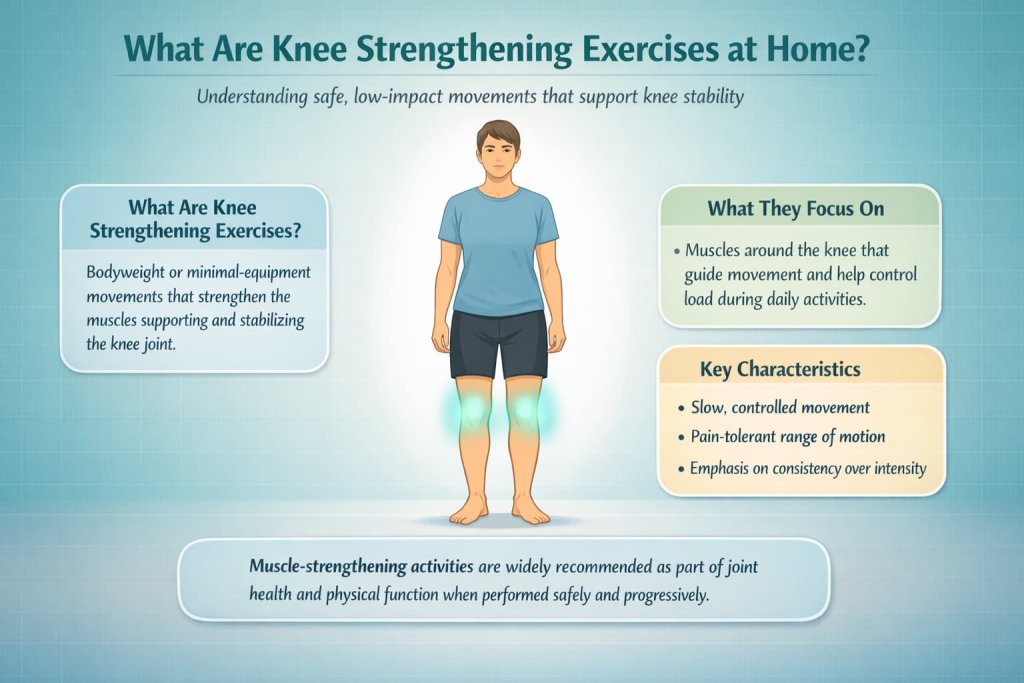
Knee strengthening exercises at home are bodyweight or minimal-equipment movements designed to improve strength in the muscles that stabilize the knee joint. Rather than stressing the joint itself, these exercises focus on the surrounding muscle groups that guide knee motion and control load.
Most home programs emphasize:
- Slow, controlled movement
- Pain-tolerant ranges of motion
- Consistent practice over intensity
Organizations such as the American Academy of Orthopaedic Surgeons and the Centers for Disease Control and Prevention recognize muscle-strengthening activity as an important part of joint health and physical function.
10 Best Knee Strengthening Exercises at Home
These exercises are commonly used in home programs and physical therapy settings. Move slowly and stay within a comfortable range.
1. Straight Leg Raises
How to do it:
- Lie on your back with one knee bent and the other leg straight
- Tighten the thigh of the straight leg by pressing the knee gently toward the floor
- Slowly lift the straight leg until it reaches the height of the bent knee
- Hold for 1–2 seconds
- Lower the leg back down with control
- Repeat on both sides
Why it works:
Straight leg raises strengthen the quadriceps without placing bending stress on the knee joint. This makes them especially useful when knee flexion is uncomfortable, allowing muscle activation while keeping joint load low.
Muscles worked:
Quadriceps, hip flexors, deep knee stabilizers.
Trainer Tip:
If your lower back arches during the lift, reduce the height of the leg and focus on controlled tension rather than height.
2. Chair Sit-to-Stands
How to do it:
- Sit near the front edge of a chair with feet hip-width apart
- Place feet flat on the floor with knees aligned over toes
- Lean slightly forward through the hips
- Press through your heels to stand up
- Slowly lower yourself back to the chair
- Repeat with steady control
Why it works:
This movement strengthens the knee and hip muscles in a functional pattern used for daily activities like standing up, sitting down, and climbing stairs.
Muscles worked:
Quadriceps, glutes, hamstrings, calves.
Trainer Tip:
Use a higher chair or light hand support if needed at first, then gradually reduce assistance as strength improves.
3. Wall-Supported Mini Squats
How to do it:
- Stand with your back against a wall and feet slightly forward
- Keep feet hip-width apart
- Slowly bend your knees a small amount
- Hold the position for 3–5 seconds
- Push through your heels to return to standing
- Repeat with controlled depth
Why it works:
Mini squats strengthen the thighs and hips while limiting knee range of motion, reducing excessive joint stress compared to deeper squats.
Muscles worked:
Quadriceps, glutes, hamstrings.
Trainer Tip:
Only squat as low as feels comfortable—depth is less important than slow, controlled movement.
4. Step-Ups
How to do it:
- Stand facing a low step or stair
- Place one foot fully on the step
- Press through the heel to lift your body up
- Straighten the standing leg fully
- Step back down slowly
- Repeat before switching sides
Why it works:
Step-ups train knee strength and control in a stair-like pattern, improving confidence and coordination during everyday movements.
Muscles worked:
Quadriceps, glutes, hamstrings, calves.
Trainer Tip:
Start with a low step and increase height gradually as strength and balance improve.
5. Standing Hamstring Curls
How to do it:
- Stand upright holding a chair for balance
- Keep thighs aligned and knees close together
- Bend one knee, bringing your heel toward your glutes
- Pause briefly at the top
- Lower the leg slowly
- Repeat on both sides
Why it works:
Strengthening the hamstrings helps balance forces around the knee, supporting smoother joint movement and reducing excessive strain on the front of the knee.
Muscles worked:
Hamstrings, glutes.
Trainer Tip:
Avoid swinging the leg—controlled movement improves muscle activation and joint stability.
6. Seated Knee Extensions
How to do it:
- Sit upright in a chair with feet flat on the floor
- Slowly straighten one knee until the leg is fully extended
- Hold for 1–2 seconds
- Lower the foot back to the floor with control
- Repeat on both sides
Why it works:
This exercise isolates the quadriceps while keeping the body supported, making it ideal for early strengthening or knee-sensitive individuals.
Muscles worked:
Quadriceps.
Trainer Tip:
If the movement feels too easy, increase the hold time at the top rather than adding speed.
7. Glute Bridges
How to do it:
- Lie on your back with knees bent and feet flat on the floor
- Place arms by your sides
- Press through your heels
- Lift your hips until your body forms a straight line from shoulders to knees
- Squeeze the glutes briefly
- Lower the hips slowly
Why it works:
Strong glutes help control thigh position and reduce unwanted knee movement, supporting better alignment during walking and standing.
Muscles worked:
Glutes, hamstrings, core stabilizers.
Trainer Tip:
Avoid arching your lower back—focus on lifting through the hips, not the spine.
8. Standing Calf Raises
How to do it:
- Stand upright holding a chair or wall for balance
- Keep feet hip-width apart
- Slowly rise onto your toes
- Hold briefly at the top
- Lower your heels back down with control
- Repeat steadily
Why it works:
Calf strength supports ankle and knee stability, improving balance and walking efficiency.
Muscles worked:
Gastrocnemius, soleus (calf muscles).
Trainer Tip:
Perform the movement slowly—fast bouncing reduces effectiveness and control.
9. Side-Lying Leg Raises
How to do it:
- Lie on your side with legs straight and stacked
- Keep hips and shoulders aligned
- Lift the top leg upward slowly
- Keep toes facing forward
- Lower the leg with control
- Repeat on both sides
Why it works:
Hip abductor strength helps prevent excessive inward knee movement, which is important for knee alignment and stability.
Muscles worked:
Gluteus medius, hip stabilizers.
Trainer Tip:
Small, controlled lifts are more effective than lifting the leg high with poor form.
10. Terminal Knee Extensions (Band Optional)
How to do it:
- Stand upright with one knee slightly bent
- If using a band, anchor it behind the knee
- Slowly straighten the knee fully
- Hold briefly at full extension
- Return to the starting position with control
- Repeat on both sides
Why it works:
Terminal knee extensions strengthen the quadriceps in the final phase of knee straightening, which supports walking and standing stability.
Muscles worked:
Quadriceps, knee stabilizers.
Trainer Tip:
Focus on fully straightening the knee without locking it forcefully at the end.
How Often Should You Do Knee Strengthening Exercises at Home?
Most evidence-based programs suggest:
- 2–3 sets of 8–12 repetitions per exercise
- 2–4 days per week, depending on comfort and recovery
The AAOS Knee Conditioning Program is often used as a reference for safe progression and consistency.
Who Should Do Knee Strengthening Exercises at Home
Knee strengthening exercises at home are appropriate for many people who want to improve knee support, stability, and confidence during everyday movement. These exercises are commonly suitable for:
- Beginners starting a fitness routine
- Older adults aiming to maintain mobility and independence
- People who experience mild knee discomfort during walking, stairs, or prolonged sitting
- Individuals returning to movement after periods of inactivity
- Anyone looking to support knee stability through low-impact, controlled exercise
When performed slowly and within a comfortable range, these exercises are widely used in home programs and physical therapy settings to support functional strength.
Who Should Be Cautious or Seek Professional Guidance
Some individuals should approach knee strengthening exercises at home with extra caution or seek guidance from a qualified healthcare or movement professional before starting. This includes people who:
- Have had a recent knee injury, surgery, or fracture
- Experience severe, persistent, or worsening knee pain
- Notice knee locking, catching, giving way, or significant swelling
- Have diagnosed joint or neurological conditions that affect balance or movement control
- Are unsure whether an exercise is appropriate for their specific situation
Seeking professional guidance can help ensure exercises are adapted safely and matched to individual needs.
Common Mistakes to Avoid During Knee Strengthening Exercises
Avoiding common mistakes helps ensure knee strengthening exercises at home remain effective and safe. Frequent errors include:
- Rushing through repetitions instead of moving slowly and with control
- Allowing the knees to collapse inward during standing exercises
- Using excessive depth or resistance too soon
- Ignoring discomfort signals and pushing through sharp pain
- Skipping rest days and performing strengthening exercises every day without recovery
Focusing on quality of movement, proper alignment, and gradual progression supports better long-term results.
Safety Tips for Knee Strengthening at Home
- Move slowly and avoid sudden or jerky motions
- Stop any exercise that causes sharp or worsening pain
- Keep knees aligned over toes during standing exercises
- Breathe normally and avoid holding your breath
If knee pain is persistent or worsening, consult a qualified healthcare professional before progressing.
Who Can Benefit Most From These Exercises?
Knee strengthening exercises at home are commonly used by:
- Beginners starting a fitness routine
- Older adults aiming to maintain mobility
- People with mild knee discomfort during daily activities
- Individuals returning to movement after inactivity
Frequently Asked Questions
Can knee strengthening exercises at home help knee pain?
They may help support knee stability and movement by strengthening surrounding muscles, which can reduce stress on the joint.
Do I need equipment for knee strengthening at home?
No. Most knee strengthening exercises at home use bodyweight or simple household support like a chair or wall.
How long before I notice results?
Many people notice improved strength or confidence in movement within 4–6 weeks of consistent practice.
Are these exercises safe for seniors?
Yes, when performed slowly and within a comfortable range, these exercises are commonly recommended for older adults.
Should I do knee exercises every day?
Light exercises can be done daily, but strengthening sessions are usually spaced with rest days to allow recovery.
What if my knee hurts during an exercise?
Stop the movement, reduce the range, or skip that exercise. Pain should not increase during strengthening work.
Conclusion
Knee strengthening exercises at home offer a practical, accessible way to support knee stability, mobility, and daily function without special equipment. By focusing on slow, controlled movements and consistent practice, you can build stronger supporting muscles and move with greater confidence.
If you’re ready to improve your knee strength safely, start with a few of these exercises today and progress gradually.
References
- AAOS Knee Conditioning Program PDF (Printable Home Exercises)
- Arthritis UK Exercises for the Knees (Includes sit-to-stands, step-ups, leg raises)
- NHS Inform Exercises for Knee Problems (Home-friendly knee exercise examples)
- WHO Guidelines on Physical Activity and Sedentary Behaviour (2020)
- Mayo Clinic Guide to Basic Stretches (Warm-up and flexibility basics)
- Cochrane Evidence: Exercise for Knee Osteoarthritis (Updated 2024)