
Patellar tendonitis exercises focus on gradually strengthening the knee and surrounding muscles to support the patellar tendon and improve load tolerance. Understanding how to exercise correctly is important because this condition—often called patellar tendinopathy or jumper’s knee—is usually related to how the tendon handles repeated stress, not simply inflammation.

Well-chosen exercises can help improve knee function, support daily movement, and guide a safe return to activity when progressed appropriately. Many medical and sports medicine organizations generally emphasize progressive loading, symptom monitoring, and consistency over prolonged complete rest.
What Is Patellar Tendonitis?
Patellar tendonitis refers to pain and sensitivity in the patellar tendon, which connects the kneecap (patella) to the shinbone (tibia). It commonly develops from repetitive jumping, squatting, running, or sudden increases in training load.
Common features include:
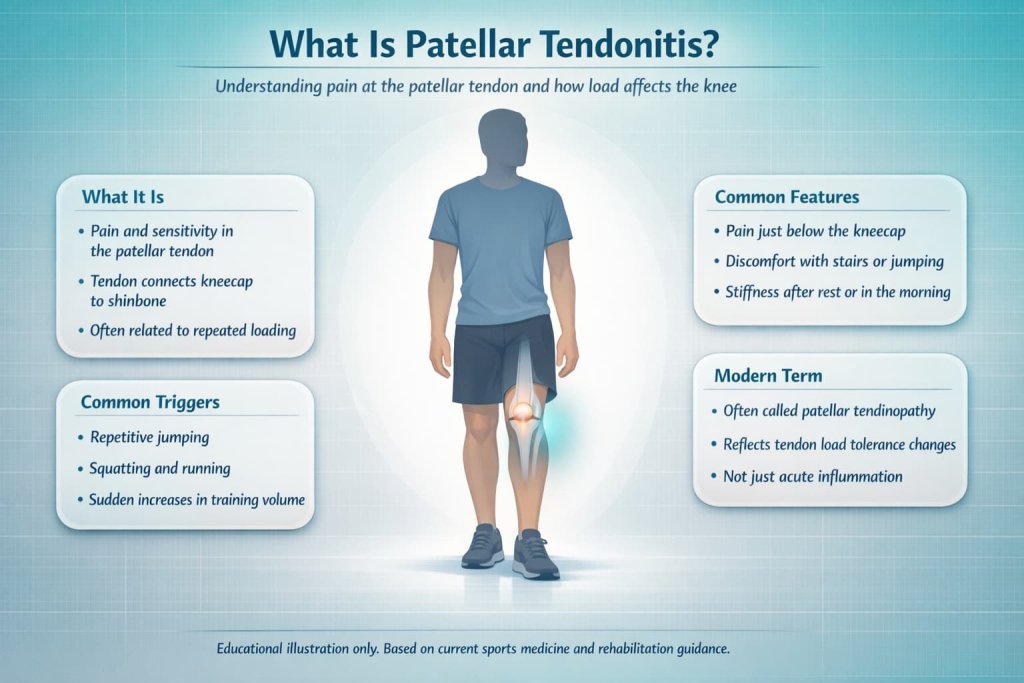
- Pain just below the kneecap
- Discomfort during stairs, squats, or jumping
- Stiffness after rest or first thing in the morning
Current clinical literature increasingly uses the term patellar tendinopathy, reflecting changes in tendon structure and load tolerance rather than acute inflammation alone.
10 Best Patellar Tendonitis Exercises
These exercises focus on controlled, progressive strengthening to support the patellar tendon and surrounding muscles.
They are commonly used in rehabilitation programs to improve knee load tolerance, stability, and daily function when performed with proper form and progression.
1. Isometric Wall Sit
How to do it
- Stand with your back flat against a wall
- Slide down until your knees are bent to a comfortable angle (not painful)
- Keep feet hip-width apart and weight evenly distributed
- Hold the position while breathing normally
- Stop if sharp pain develops
Why it works
Isometric wall sits load the quadriceps and patellar tendon without joint movement. This type of static contraction is often used early in rehab because it may help reduce pain sensitivity and allow the tendon to tolerate load without excessive strain. It can also prepare the knee for more dynamic strengthening later.
Trainer Tip
Start with short holds (20–30 seconds) and gradually increase duration. Pain during the hold should stay manageable and settle shortly after finishing.
2. Straight Leg Raise
How to do it
- Lie on your back with one knee bent and foot flat on the floor
- Keep the other leg straight with toes pointing upward
- Tighten the thigh muscle and lift the straight leg slowly
- Pause briefly at the top
- Lower the leg with control
Why it works
Straight leg raises activate the quadriceps without bending the knee, which limits compressive stress on the patellar tendon. This makes it useful when knee flexion is uncomfortable but strengthening is still needed.
Trainer Tip
Focus on keeping the lifted leg straight and controlled. If the lower back arches, reduce the height of the lift.
3. Slow Bodyweight Squat
How to do it
- Stand with feet shoulder-width apart
- Sit back and lower into a squat slowly
- Keep the chest upright and knees tracking over toes
- Pause briefly at the bottom if comfortable
- Rise back up with control
Why it works
Slow squats expose the patellar tendon to controlled loading, which is key for improving tendon tolerance. The slow tempo reduces sudden forces while still challenging the knee extensors.
Trainer Tip
Tempo matters more than depth. A shallow, slow squat is often more effective and safer than forcing depth too early.
4. Decline Squat (If Tolerated)
How to do it
- Stand on a slight decline board or wedge
- Keep heels elevated and feet shoulder-width apart
- Lower into a squat slowly
- Push up evenly through both legs
- Maintain steady control throughout
Why it works
Decline squats increase the load placed on the patellar tendon, making them useful in later stages of rehabilitation when higher tendon demand is appropriate.
Trainer Tip
Only introduce this exercise when standard squats are well tolerated. Keep the movement slow and pain within an acceptable range.
5. Step-Ups
How to do it
- Stand facing a low platform or stair
- Step up with one foot and straighten the knee fully
- Bring the other foot up or tap lightly
- Step down slowly with control
- Repeat on both sides
Why it works
Step-ups mimic daily activities such as climbing stairs. They strengthen the knee in a functional pattern while encouraging controlled loading through the patellar tendon.
Trainer Tip
Use a lower step height at first. Control the lowering phase, as this often places more demand on the tendon.
6. Spanish Squat
How to do it
- Anchor a strap or resistance band behind the knees
- Step back to create tension in the band
- Sit back into a squat with an upright torso
- Hold the position or perform slow repetitions
- Keep heels planted throughout
Why it works
The Spanish squat shifts load toward the quadriceps while reducing forward knee stress for some individuals. It allows meaningful tendon loading in a more supported position.
Trainer Tip
This exercise is often used for pain-modulated loading. Adjust band tension so the movement feels challenging but controlled.
7. Terminal Knee Extension
How to do it
- Anchor a resistance band behind the knee
- Start with the knee slightly bent
- Straighten the knee against band resistance
- Pause briefly at full extension
- Return slowly to the starting position
Why it works
Terminal knee extensions improve quadriceps control near full knee extension, a range commonly used during walking and standing. This helps support knee stability without deep bending.
Trainer Tip
Move slowly and avoid snapping the knee into lockout. Smooth control is more important than heavy resistance.
8. Hip Bridge
How to do it
- Lie on your back with knees bent and feet flat on the floor
- Press through the heels and lift the hips upward
- Squeeze the glutes at the top
- Hold briefly
- Lower slowly back down
Why it works
Strong hip muscles help distribute forces more evenly through the lower body, potentially reducing excessive load on the knee and patellar tendon during movement.
Trainer Tip
Keep ribs down and avoid arching the lower back. Quality hip extension matters more than height.
9. Single-Leg Balance
How to do it
- Stand on one leg with the knee slightly bent
- Keep the torso upright
- Hold balance for 20–30 seconds
- Progress by adding arm movement or surface changes
Why it works
Balance training improves neuromuscular control around the knee and hip, helping the body manage forces more efficiently during daily and athletic tasks.
Trainer Tip
Start near a wall or chair for support. Balance quality is more important than duration.
10. Calf Raises
How to do it
- Stand tall with feet hip-width apart
- Rise slowly onto the balls of your feet
- Pause briefly at the top
- Lower back down with control
- Use support if needed
Why it works
The calves help absorb and transfer force during walking, running, and jumping. Improving calf strength can reduce stress transmitted to the knee and patellar tendon.
Trainer Tip
Slow, controlled lowering is especially valuable. Progress to single-leg calf raises when tolerated.
Why Exercise Matters for Patellar Tendonitis
Exercise is a cornerstone of non-surgical management. While exercise does not “repair” the tendon overnight, it may help by:
- Supporting gradual tendon loading and adaptation
- Improving quadriceps and hip strength
- Enhancing knee control during daily and sports activities
- Reducing excessive stress on the patellar tendon over time
Sports medicine guidance from organizations such as the British Journal of Sports Medicine consistently supports progressive strengthening programs over prolonged rest.
How Often Should You Do Patellar Tendonitis Exercises?
General guidance suggests:
- Strength exercises: 3–4 days per week
- Isometric exercises: may be used daily if tolerated
- Progress load gradually over weeks, not days
Clinical frameworks referenced by the Journal of Orthopaedic & Sports Physical Therapy emphasize consistency and patience.
Safety Guidelines Before Starting Patellar Tendonitis Exercises
Before beginning, keep these principles in mind:
- Mild discomfort during exercise can be acceptable, but sharp pain is not
- Symptoms should settle back to baseline within 24 hours
- Progress volume and intensity slowly
- Avoid sudden spikes in jumping or high-impact activity
If pain worsens or function declines, consult a qualified healthcare professional.
Common Mistakes to Avoid
- Resting completely for long periods
- Increasing load too quickly
- Ignoring hip and calf strength
- Pushing through sharp or worsening pain
When to Seek Professional Guidance
Consult a physical therapist or sports medicine professional if:
- Pain persists beyond several weeks
- Daily activities become difficult
- You plan to return to jumping or high-impact sports
Frequently Asked Questions
Can exercises help patellar tendonitis?
Exercises are commonly used to support knee strength and function and may help improve load tolerance when progressed appropriately.
Should I stop sports completely?
Temporary modification is often recommended, but complete rest is usually discouraged unless advised by a professional.
Are eccentric exercises necessary?
Eccentric and slow heavy resistance exercises are both commonly used; the best approach depends on symptoms and stage.
How long does improvement take?
Many people notice gradual changes over weeks, but tendon adaptation often takes several months.
Is pain during exercise okay?
Mild discomfort may be acceptable, but pain should remain controlled and settle within 24 hours.
Can beginners do these exercises?
Yes, most exercises can be modified for beginners with appropriate guidance.
Conclusion
Patellar tendonitis exercises play a key role in building knee strength, improving movement confidence, and supporting long-term tendon health. A structured, progressive approach—guided by symptoms and consistency—offers the best chance for sustainable improvement. If you’re unsure where to start, working with a qualified professional can help tailor these exercises to your needs.
This content is for informational purposes only and not medical advice.
References
- Mayo Clinic: Patellar tendinitis Diagnosis and treatment
- Mayo Clinic: Patellar tendinitis Symptoms and causes
- JOSPT: Patellar Tendinopathy Clinical Diagnosis, Load Management, and Advice
- BJSM: Progressive tendon-loading vs eccentric-only rehab (Randomized clinical trial)
- BJSM: Isometric exercise analgesia in patellar tendinopathy
- PMC: Rehabilitation of patellar tendinopathy (review article)
- NHS RUH Bath: Patellar tendinopathy advice leaflet (PDF)
- Johns Hopkins Medicine: Patellar Tendonitis (Jumper’s Knee)