
Quad tendonitis exercises focus on gradually strengthening the quadriceps tendon to improve knee function while minimizing pain flare-ups.
Understanding how to load the tendon safely is important because inappropriate rest or overly aggressive exercise can delay recovery. A structured, progressive approach helps the tendon adapt over time and supports safer walking, squatting, and daily activities.
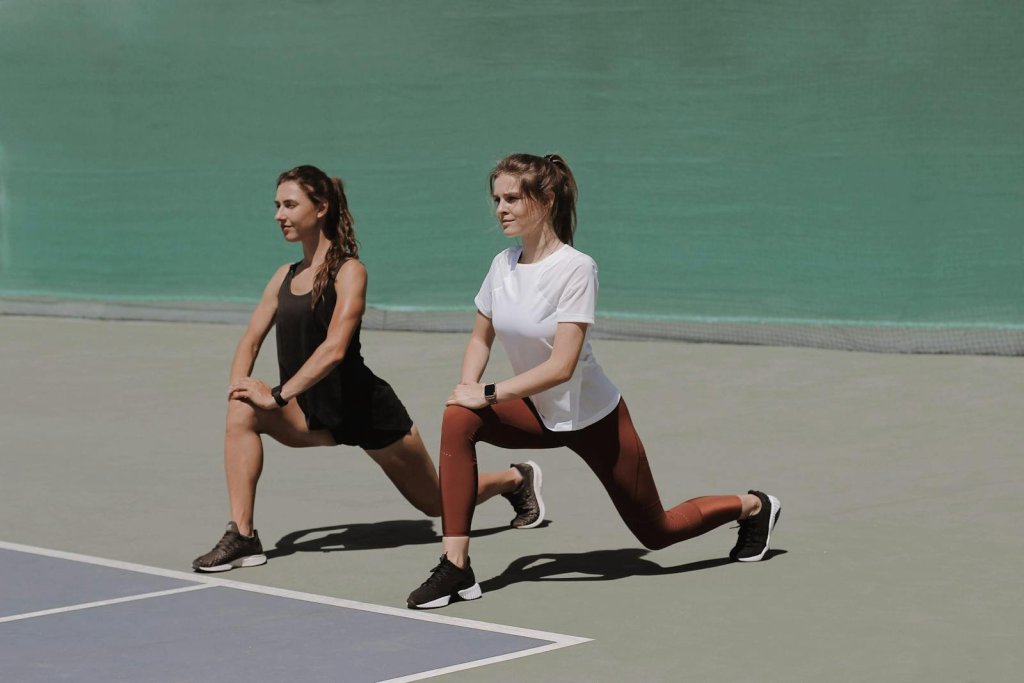
This guide explains what quad tendonitis exercises are, how to perform them safely, and how to progress from early pain-calming movements to strength-building exercises—based on current rehab principles used by physical therapists and sports medicine professionals.
What Are Quad Tendonitis Exercises?
Quad tendonitis exercises are controlled movements designed to improve the load tolerance of the quadriceps tendon, which connects the quadriceps muscles to the kneecap. In clinical settings, this condition is often referred to as quadriceps tendinopathy, reflecting changes in tendon structure and capacity rather than inflammation alone.
These exercises typically aim to:
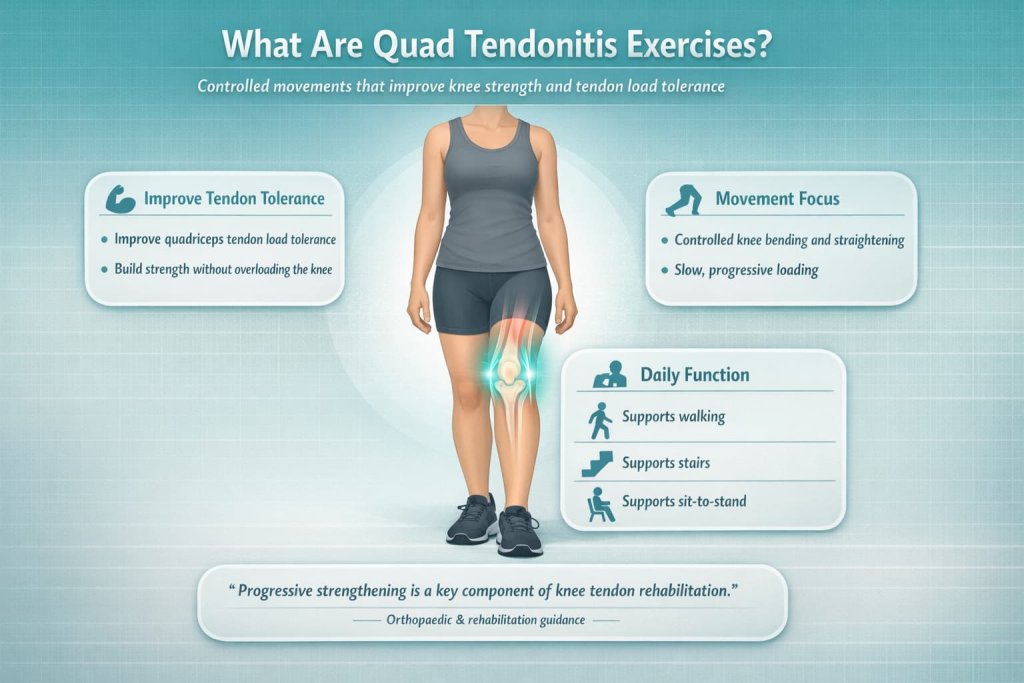
- Gradually strengthen the quadriceps without overloading the knee
- Improve knee control during bending and straightening
- Support daily tasks such as walking, stairs, and sit-to-stand movements
Guidance from organizations such as the American Academy of Orthopaedic Surgeons suggests that appropriately progressed strengthening is a key component of knee tendon rehabilitation.
10 Best Quad Tendonitis Exercises
These exercises are designed to gradually reduce knee pain while rebuilding quadriceps strength and tendon load tolerance. They progress from low-stress isometrics to functional strengthening to support daily movement and long-term knee health.
1. Isometric Quad Set
How to do it
- Sit or lie on your back with the affected leg fully straight
- Place a rolled towel under the knee if needed for comfort
- Tighten the thigh muscles by pressing the knee downward
- Hold the contraction for 5–10 seconds without lifting the heel
- Fully relax before the next repetition
- Perform 8–12 repetitions, 1–3 sets
Why it works
Isometric loading allows the quadriceps tendon to experience controlled tension without joint movement. This type of loading is often better tolerated in early, pain-sensitive stages and may help reduce pain inhibition while maintaining muscle activation.
Muscles worked
Quadriceps (especially vastus medialis and rectus femoris)
Trainer Tip
Aim for steady, moderate tension rather than squeezing as hard as possible—pain should stay mild and settle shortly after finishing.
2. Straight Leg Raise
How to do it
- Lie on your back with one knee bent and the affected leg straight
- Tighten the thigh of the straight leg before lifting
- Raise the straight leg until it reaches the height of the opposite knee
- Keep the knee fully straight throughout the movement
- Lower slowly and with control
- Perform 8–12 repetitions, 2–3 sets
Why it works
This exercise strengthens the quadriceps while minimizing knee joint movement, making it useful for building early strength without excessive tendon compression.
Muscles worked
Quadriceps, hip flexors
Trainer Tip
If the knee starts to bend as you lift, lower the height or reduce repetitions to maintain proper quad engagement.
3. Short-Arc Quad Extension
How to do it
- Lie on your back with a rolled towel or bolster under the knee
- Start with the knee slightly bent over the support
- Straighten the knee by lifting the foot upward
- Pause briefly at the top
- Lower slowly back to the starting position
- Perform 10–15 repetitions, 2–3 sets
Why it works
Short-arc movement introduces gentle knee extension loading while limiting range, which helps reintroduce tendon stress in a controlled, knee-friendly manner.
Muscles worked
Quadriceps
Trainer Tip
Focus on smooth motion—avoid snapping the knee straight or using momentum.
4. Sit-to-Stand (Chair Squat)
How to do it
- Sit on a sturdy chair with feet hip- to shoulder-width apart
- Keep the chest upright and weight evenly distributed
- Push through your feet to stand up
- Slowly lower yourself back to the chair with control
- Perform 8–12 repetitions, 2–3 sets
Why it works
This functional movement strengthens the quadriceps through a range commonly used in daily life, helping improve tolerance for activities like standing, walking, and stairs.
Muscles worked
Quadriceps, glutes
Trainer Tip
Use a higher chair or arm support if pain increases during the lowering phase.
5. Wall Sit Hold
How to do it
- Stand with your back flat against a wall
- Walk your feet slightly forward
- Slide down until the knees are gently bent (not deep)
- Hold the position for 20–45 seconds
- Stand back up slowly
- Repeat 2–4 holds
Why it works
Wall sits apply sustained isometric load to the quadriceps at a fixed knee angle, which can help improve tendon load tolerance without repetitive movement.
Muscles worked
Quadriceps
Trainer Tip
Stay within a pain-tolerable knee bend—deeper angles can be added later as tolerance improves.
6. Heel-Elevated Squat
How to do it
- Place heels on a small wedge, weight plate, or folded towel
- Stand with feet shoulder-width apart
- Keep the torso upright
- Lower into a slow, controlled squat
- Push through the mid-foot to stand back up
- Perform 6–10 repetitions, 2–3 sets
Why it works
Heel elevation shifts demand toward the quadriceps, allowing targeted tendon loading while maintaining balance and control.
Muscles worked
Quadriceps, glutes
Trainer Tip
Begin with shallow depth and increase range only if symptoms remain stable afterward.
7. Split Squat
How to do it
- Stand in a staggered stance with the affected leg in front
- Keep the torso upright and hips square
- Lower the back knee toward the floor
- Push through the front foot to return to standing
- Perform 6–10 repetitions per side, 2–3 sets
Why it works
Split squats train the quadriceps one side at a time, helping address strength asymmetries and improve knee control during unilateral tasks.
Muscles worked
Quadriceps, glutes
Trainer Tip
If pain increases, shorten the stance or limit depth rather than adding load.
8. Step-Up
How to do it
- Stand in front of a low step or box
- Place the affected foot on the step
- Press through the heel to straighten the knee and step up
- Control the descent back down
- Perform 8–12 repetitions, 2–3 sets
Why it works
Step-ups replicate stair climbing mechanics, gradually preparing the tendon for real-world knee-loading tasks.
Muscles worked
Quadriceps, glutes
Trainer Tip
Increase step height only after you can control both the upward and downward phases comfortably.
9. Slow-Tempo Leg Press
How to do it
- Sit in the leg press machine with feet shoulder-width apart
- Use light to moderate resistance
- Press the platform away over 3–4 seconds
- Lower the weight back just as slowly
- Perform 6–10 repetitions, 2–3 sets
Why it works
Slow resistance training increases time under tension, which supports gradual tendon adaptation and strength gains.
Muscles worked
Quadriceps, glutes
Trainer Tip
Stop short of full knee lockout to maintain continuous tension on the quadriceps.
10. Decline Squat (Advanced)
How to do it
- Stand on a slight decline board or wedge
- Keep feet shoulder-width apart
- Lower into a slow, controlled squat
- Maintain balance and upright posture
- Return to standing with control
- Perform 6–8 repetitions, 2–3 sets
Why it works
Decline squats increase quadriceps tendon loading and are commonly used in later rehab stages to build higher load tolerance.
Muscles worked
Quadriceps
Trainer Tip
Only introduce this exercise after earlier movements are pain-tolerable and recovery between sessions is consistent.
How Often to Perform Quad Tendonitis Exercises
Most rehab programs recommend performing quad tendonitis exercises 2–4 times per week, allowing rest days between sessions. Gradual progression in load and volume is more important than daily intensity.
Understanding Pain and Load Tolerance in Quad Tendonitis
Quad tendonitis is closely linked to how much load the quadriceps tendon can currently tolerate rather than inflammation alone.
Key points to understand:
- Tendons adapt slowly to repeated, controlled loading
- Mild discomfort during exercise may be acceptable
- Pain should return to baseline within 24 hours
- Sudden increases in intensity or volume can overload the tendon
- Progress is measured by improved function, not pain elimination alone
Gradual, consistent loading helps build tendon tolerance over time.
Safety Guidelines Before Starting Quad Tendonitis Exercises
Before beginning these exercises, keep the following principles in mind:
- Start with low to moderate intensity and increase gradually
- Avoid sudden spikes in training volume or resistance
- Mild discomfort during exercise may be acceptable, but pain should settle within 24 hours
- Stop and reassess if swelling or sharp pain increases
If you are unsure how much pain is acceptable, consulting a qualified professional such as a physical therapist is recommended.
How to Know If an Exercise Is Too Much
An exercise may be exceeding safe limits if the tendon cannot recover between sessions.
Warning signs include:
- Pain that steadily increases during the workout
- Symptoms that worsen the next day
- New or increasing knee swelling or stiffness
- Reduced ability to walk, squat, or use stairs afterward
If these occur, reduce load, range, or volume rather than stopping all activity.
Who Should Be Cautious or Modify These Exercises
Some individuals may need modified programming or professional guidance.
Extra caution is recommended for those who:
- Recently had knee or quadriceps tendon surgery
- Have sudden, traumatic knee injuries
- Experience knee instability or frequent giving way
- Have medical conditions affecting tendon health
- Feel sharp or rapidly worsening pain during basic movements
Professional guidance can help ensure safe progression when these factors are present.
Common Mistakes During Quad Tendonitis Rehab
- Advancing load too quickly
- Ignoring pain increases that last more than 24 hours
- Skipping early-stage exercises and jumping to advanced movements
- Training through sharp or worsening pain
When to Seek Medical or Physical Therapy Guidance
Consider professional guidance if:
- Pain persists beyond several weeks
- Swelling or knee instability increases
- Daily activities become more difficult despite exercise
A licensed physical therapist can tailor progression and monitor symptoms safely.
Frequently Asked Questions
Can quad tendonitis exercises be done at home?
Yes, many early and mid-stage exercises require minimal equipment.
Is pain during exercise normal?
Mild discomfort may be acceptable, but pain should not significantly worsen afterward.
How long does quad tendonitis rehab take?
Improvement often takes weeks to months, depending on severity and consistency.
Should I stop sports completely?
Often, activity modification—not complete rest—is recommended.
Are stretching exercises enough?
Stretching alone is usually insufficient; strengthening is key.
Can beginners do these exercises?
Yes, when started at an appropriate level.
Conclusion
Quad tendonitis exercises play an important role in reducing knee pain and restoring strength when performed with proper progression and patience. By starting with controlled movements and gradually increasing load, you can support tendon health and improve daily function safely.
If you’re unsure where to begin, start with early-stage exercises and progress gradually—or seek guidance from a qualified professional.
References
- Patellar Tendinitis: Diagnosis and Treatment — Mayo Clinic
- Is tendon pathology a continuum? A pathology model to explain the clinical presentation of load-induced tendinopathy — Cook & Purdam, British Journal of Sports Medicine (2009)
- Patellar Tendinopathy: Clinical Diagnosis, Load Management, and Advice for Challenging Case Presentations — Malliaras et al., JOSPT (2015)
- Isometric exercise induces analgesia and reduces inhibition in patellar tendinopathy — Rio et al., BJSM (2015)
- Corticosteroid injections, eccentric decline squat training and heavy slow resistance training in patellar tendinopathy: a randomized controlled trial — Kongsgaard et al. (2009)
- Continued sports activity, using a pain-monitoring model, during rehabilitation in patients with Achilles tendinopathy: a randomized controlled study — Silbernagel et al. (2007)
- Clinical Management of Patellar Tendinopathy — Rosen et al. (2021 review; PubMed Central)