
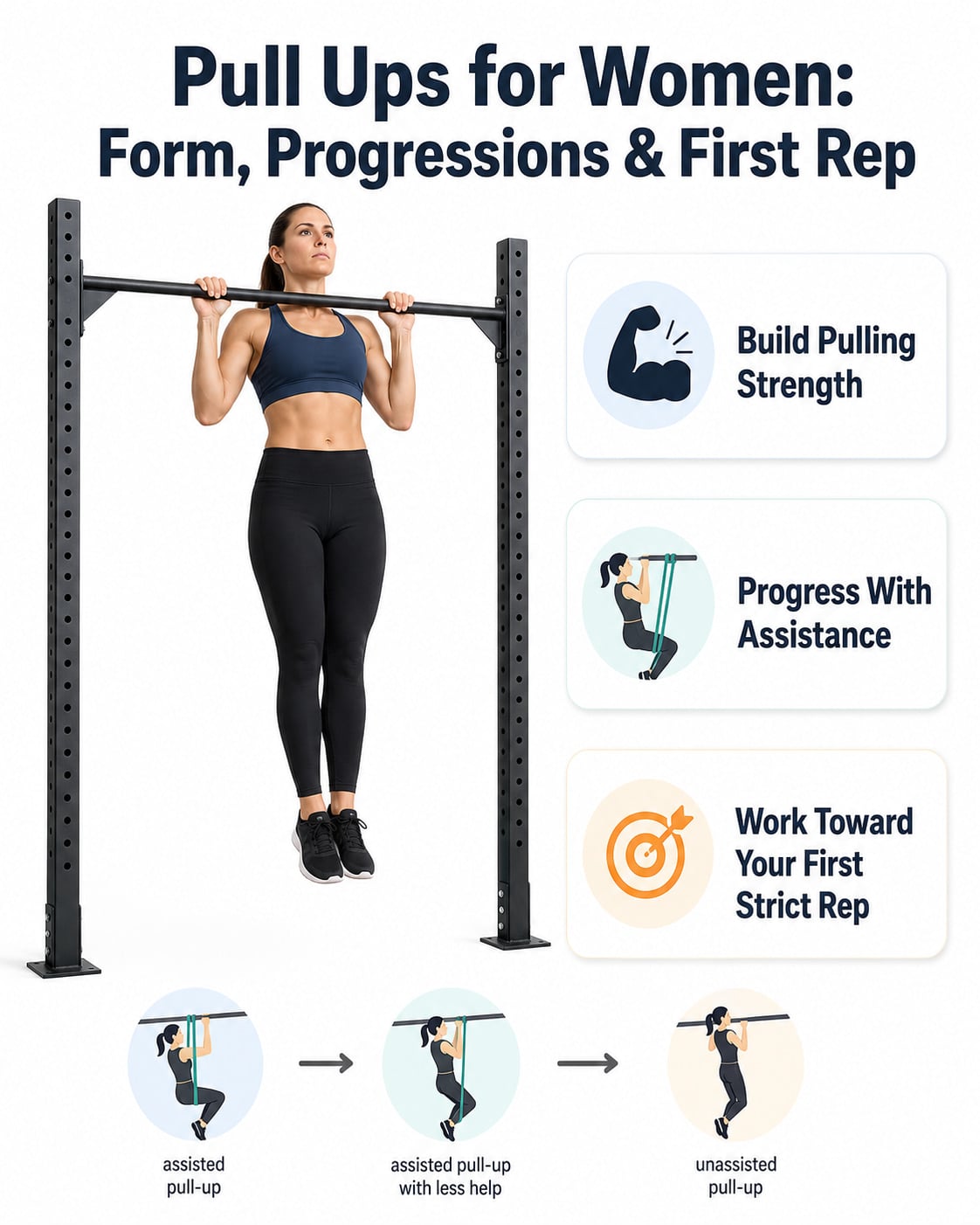
Yes—many women can learn a strict pull-up by progressively developing upper-back strength, arm strength, grip endurance, shoulder-blade control, and pull-up technique. Pull ups for women may feel difficult at first because every repetition requires you to lift nearly your entire body weight, but assisted repetitions, rows, hangs, and controlled negatives can help you reach your first clean rep.
You do not need to follow a complicated program or complete a pull-up by a specific deadline. Start with a variation you can control, practice two or three times per week, and gradually use less assistance.
| Question | Practical starting point |
|---|---|
| How often should you train? | 2–3 nonconsecutive days per week |
| What should you practice first? | Hangs, rows, scapular pull-ups, and assisted pull-ups |
| How many assisted reps? | 3 sets of 4–8 controlled reps |
| When should you reduce assistance? | After reaching the top of the rep range with clean form |
| How long will the first rep take? | It varies from several weeks to several months |
| What counts as a strict rep? | Straight elbows at the bottom, chin above the bar, no kicking |
Can Women Do Pull-Ups?
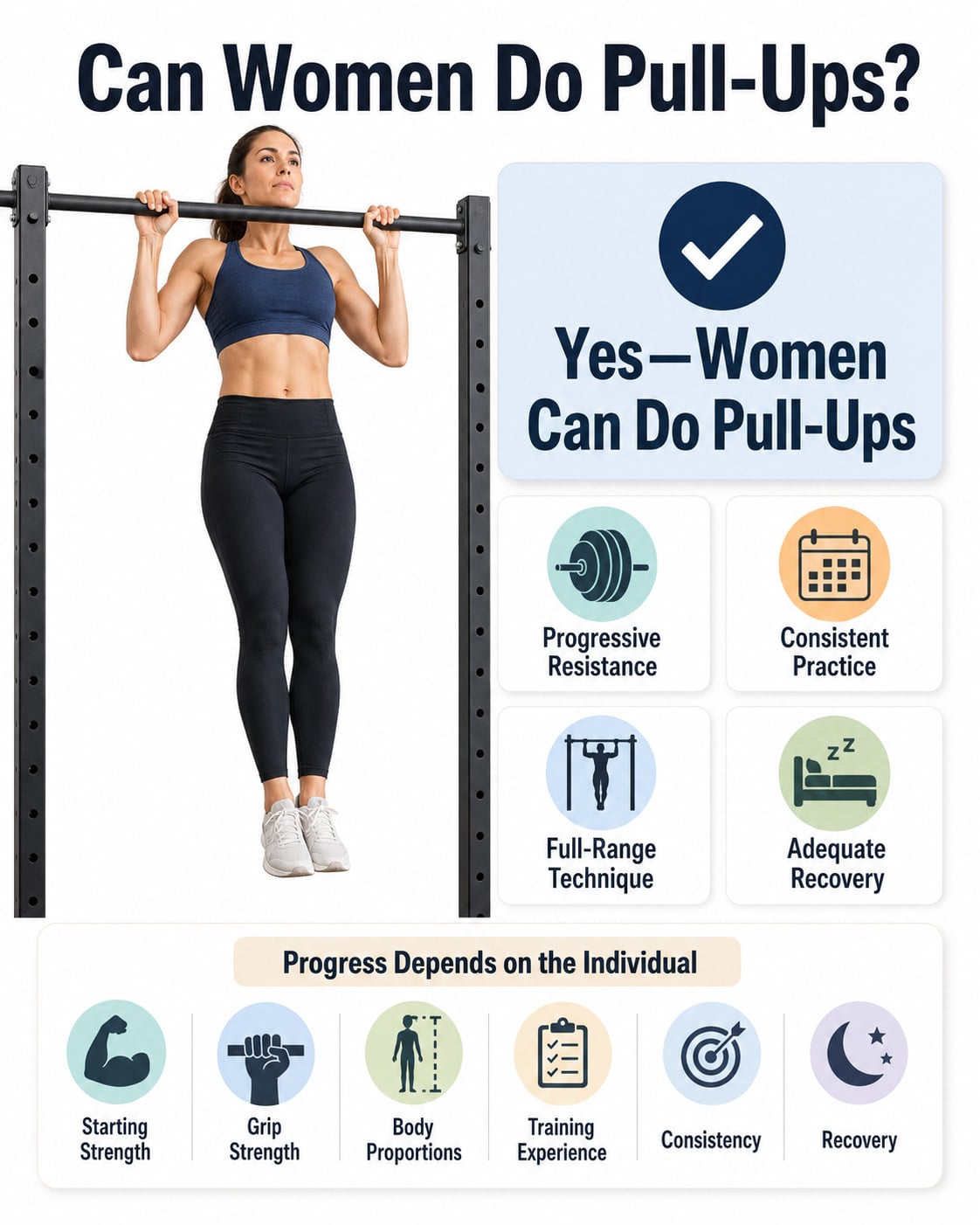
Women can perform pull-ups, and there is no separate “women’s version” of the movement. The same basic principles—progressive resistance, consistent practice, full-range technique, and adequate recovery—apply to everyone.
Research also does not support the idea that women respond poorly to strength training. A systematic review of resistance-training adaptations found similar relative muscle-growth and lower-body strength improvements in women and men. Women showed larger relative upper-body strength gains in the studies included in that particular analysis.
A separate 12-week study involving college-age women found that training improved upper-body strength and body composition. The participants who successfully performed a pull-up had greater absolute strength and better strength relative to body mass and fat-free mass. The study also showed why fixed promises can be misleading: becoming stronger does not guarantee that everyone will complete a pull-up within the same number of weeks.
Your starting point matters more than your sex. Previous training, grip strength, body proportions, available equipment, injury history, consistency, and recovery can all affect how quickly you progress.
Why Pull-Ups Can Be Harder for Many Women
A pull-up is a relative-strength exercise. You are not moving a weight selected from a rack; you are lifting your body against gravity.
On average, women begin with less absolute upper-body muscle and pulling strength than men. That average difference may make the first repetition harder, but it does not limit how much an individual woman can improve.
Several factors influence pull-up performance:
- Upper-back and arm strength
- Grip endurance
- Shoulder-blade control
- Strength relative to body mass
- Arm length and other individual leverages
- Core and hip control
- Pull-up-specific practice
- Confidence while hanging from a bar
Body mass is part of the strength-to-mass equation, but losing weight is not a requirement for completing a pull-up. Building more pulling strength and improving movement efficiency are the most useful training goals.
Muscles Worked During Pull-Ups
Pull-ups train several upper-body muscles at the same time.
Primary working muscles
The latissimus dorsi, commonly called the lats, contribute much of the force needed to move your upper arms downward and pull your body toward the bar.
Supporting muscles
The movement also involves the:
- Biceps brachii
- Brachialis
- Brachioradialis
- Rhomboids
- Middle and lower trapezius
- Posterior deltoids
- Forearm and gripping muscles
- Rotator-cuff and shoulder-blade stabilizers
Your abdominal, lower-back, glute, and hip muscles help stabilize your body and limit swinging. The NASM pull-up progression guide similarly identifies the lats, rhomboids, trapezius, posterior deltoids, arm muscles, forearms, and core as important contributors.
Pull-Up vs. Chin-Up: What Is the Difference?
The main difference is your hand position.
| Exercise | Hand position | Common experience |
|---|---|---|
| Pull-up | Palms face away | Usually more demanding for beginners |
| Chin-up | Palms face toward you | Often feels easier because the biceps can contribute more |
| Neutral-grip pull-up | Palms face each other | Often comfortable for the wrists, elbows, and shoulders |
A chin-up may be the first unassisted variation you achieve. That is useful progress, even when your main goal is an overhand pull-up.
You can train chin-ups alongside pull-ups, but continue practicing an overhand assisted variation if you specifically want your first strict pull-up.
How to Do a Pull-Up With Proper Form
For this guide, a strict pull-up starts with straight elbows and finishes with your chin clearly above the bar. Your legs should remain controlled, without kicking or repeated swinging.
1. Set your grip
Hold the bar with your palms facing away. Begin with your hands around shoulder width or slightly wider.
Wrap your thumbs around the bar unless a different grip has been recommended for a specific reason. Use a secure step or box if the bar is too high to reach comfortably.
2. Establish a controlled hang
Straighten your elbows and allow your body to hang beneath the bar. Keep the position comfortable rather than forcing your shoulders into a painful end range.
Lightly brace your abdominal and glute muscles. Keep your ribs controlled and your legs still. You can keep your legs straight, bend your knees, or cross your ankles, depending on the available space.
3. Begin from the shoulders
Before bending your elbows aggressively, create tension around your shoulder blades. Think about making your neck long and moving your upper arms down toward your sides.
Do not try to lock your shoulder blades permanently in place. They should move naturally as your arms move.
4. Pull your body upward
Drive your elbows down toward your ribs. Keep your chest tall without dramatically arching your lower back.
Continue pulling until your chin passes the bar. Bring your body to the bar instead of stretching your neck forward to manufacture the finish.
5. Lower under control
Reverse the movement gradually. Keep your torso and legs controlled as your elbows straighten.
Finish the repetition in the same stable hanging position from which you started. Avoid dropping suddenly into the bottom.
6. Reset before the next rep
Take a brief moment to regain tension if necessary. Each repetition should begin from a stable position rather than from uncontrolled momentum.
Pull Ups for Women: The Best First-Rep Progressions
You do not have to master every exercise below before moving forward. Select the variation that challenges you while still allowing controlled technique.
As you improve, keep one easier strength exercise and add more pull-up-specific work.
1. Foot-Assisted Hang
Use this variation when supporting your full body weight is not yet comfortable.
Place a stable box beneath the bar. Hold the bar and keep one or both feet lightly supported while allowing your arms to carry as much weight as you can manage.
Starting target: 2–3 sets of 15–30 seconds.
Gradually use less pressure through your feet until you can hang without assistance.
2. Dead Hang
A dead hang develops grip tolerance and helps you become comfortable supporting your body from a bar.
Hold the bar with straight elbows, a braced trunk, and controlled shoulders. Stop before your grip suddenly fails.
Starting target: 2–3 sets of 10–30 seconds.
Long hang times are not mandatory. A controlled 20-second hang is more useful than a longer hold that causes pain or loss of shoulder position.
3. Scapular Pull-Up
A scapular pull-up teaches you to initiate the movement around your shoulders while keeping your elbows straight.
Begin in a hang. Without bending your elbows, move your shoulders away from your ears and lift your body slightly. Pause, then return slowly.
The movement will be small.
Starting target: 2–3 sets of 5–10 repetitions.
4. Inverted Row
An inverted row builds the back, arm, grip, and torso strength needed for pull-ups while allowing your feet to remain on the floor.
Lie beneath a securely fixed bar or use a suspension trainer. Keep your body firm and pull your lower chest or upper ribs toward the handles.
To make the exercise easier, bend your knees or move your feet farther from the anchor. To make it harder, straighten your legs or place your body closer to horizontal.
Starting target: 3 sets of 6–12 repetitions.
5. Lat Pulldown
The lat pulldown strengthens the same general vertical-pulling pattern while allowing you to choose the resistance.
Hold the bar with an overhand grip, keep your torso mostly upright, and pull the bar toward your upper chest. Avoid pulling it behind your neck.
Starting target: 3 sets of 6–10 controlled repetitions.
The lat pulldown is valuable, but it should not be your only exercise. A pull-up also requires grip endurance, body control, and confidence while hanging.
6. Foot-Assisted Pull-Up
Set a bar at a height that allows your feet to touch the floor or a box. Perform the full pull-up motion while using only enough leg assistance to complete each rep.
This is one of the most useful progressions because you can adjust the assistance immediately. Push less through your feet as you become stronger.
Starting target: 3 sets of 5–8 repetitions.
7. Machine-Assisted Pull-Up
An assisted pull-up machine lets you select a counterweight. More counterweight provides more assistance.
Use a level that allows full-range repetitions without swinging or straining your neck. When you can complete every set cleanly, reduce the assistance by the smallest available increment.
Starting target: 3 sets of 4–8 repetitions.
Record the assistance setting so you can measure progress.
8. Band-Assisted Pull-Up
Loop a resistance band securely around the bar and place a foot in the band. Inspect the band for cracks or damage before every session.
A thicker band generally provides more assistance. Because a band stretches more at the bottom, it usually helps most where the movement begins and less near the top.
Choose a band that allows you to move smoothly through the entire repetition. Switch to a thinner band once you can exceed the target range.
Starting target: 3 sets of 4–8 repetitions.
9. Chin-Over-Bar Hold
Use a box to reach the top position safely. Hold yourself with your chin above the bar, shoulders controlled, and body still.
Do not continue if the position causes shoulder or elbow pain.
Starting target: 2–3 holds of 5–15 seconds.
10. Negative Pull-Up
A negative pull-up focuses on the lowering phase.
Use a box to begin with your chin above the bar. Remove most of your foot support and lower yourself for approximately three to six seconds. Return to the top using the box rather than pulling yourself back up.
Starting target: 3 sets of 1–2 repetitions.
Negatives can create considerable soreness, especially when they are new. Keep the volume low and avoid turning every descent into a maximum-duration effort.
A Beginner Program for Your First Pull-Up
Train on two nonconsecutive days each week, such as Monday and Thursday. A third light practice day can be added later if you recover well.
The updated American College of Sports Medicine resistance-training guidance published in March 2026 emphasizes consistency, individualization, and training major muscle groups at least twice weekly. It also notes that bodyweight, elastic-band, machine, and home-based resistance training can all be effective; advanced techniques and constant training to failure are not necessary for most adults.
Day A: Assisted Strength
- Machine-, band-, or foot-assisted pull-up: 3 sets of 4–8 reps
- Inverted row: 3 sets of 8–12 reps
- Scapular pull-up: 2 sets of 5–10 reps
- Dead hang: 2 sets of 15–30 seconds
- Optional dumbbell or cable curl: 2 sets of 8–12 reps
Day B: Position and Lowering Control
- Chin-over-bar hold or negative pull-up: 3 sets
- Lat pulldown or foot-assisted pull-up: 3 sets of 6–10 reps
- One-arm dumbbell row: 3 sets of 8–12 reps per side
- Dead hang: 2 sets of 15–30 seconds
- Hollow-body hold or plank: 2 sets of 15–30 seconds
Rest approximately two to three minutes after assisted pull-ups, holds, and negatives. Rest 60–90 seconds after rows, curls, and trunk exercises.
Finish most sets while you could still perform one or two clean repetitions. Stop the set earlier when your grip, shoulder position, or body control breaks down.
How to Reduce Pull-Up Assistance
Progress should be gradual enough that you keep the same range of motion and technique.
Use this simple progression rule:
- Select assistance that allows 4–8 clean repetitions.
- Continue until you can complete all three sets at the top of the range.
- Repeat that performance during a second workout.
- Reduce the assistance by the smallest practical amount.
- Return to the lower end of the repetition range.
- Build back toward the top.
For a machine, reduce the counterweight by one small increment. For bands, switch to the next thinner band. For foot-assisted pull-ups, place less pressure through your feet or use a lower surface.
Do not reduce assistance when doing so forces you to kick, shorten the range, or push your chin forward.
When to Attempt Your First Unassisted Rep
You do not have to pass a formal test before attempting a pull-up. However, the following accomplishments suggest that you are getting close:
- A controlled 20–30-second hang
- Five to ten smooth scapular pull-ups
- Several full-range reps with light assistance
- Three controlled negatives lasting at least three to five seconds
- A stable chin-over-bar hold lasting five to ten seconds
- Stronger rows and pulldowns without torso swinging
These are practical indicators, not scientifically validated requirements. Some women will achieve a pull-up without meeting every target, while others may need more strength.
How to test the rep
Test near the beginning of your workout, after warming up but before fatiguing your back and arms.
- Perform one easy hang and a few scapular pull-ups.
- Complete one or two easy assisted repetitions.
- Rest for two or three minutes.
- Take a shoulder-width overhand grip.
- Brace your body and pull as strongly as possible without kicking.
- Stop once it becomes clear that the rep will not move.
Limit the test to one to three quality attempts. Continue with your assisted workout afterward.
Testing once per week is usually sufficient. Repeated unsuccessful attempts every day can create fatigue without adding enough productive training.
Why You May Be Stuck at the Bottom or Top
Where the repetition slows can provide a useful clue.
You cannot leave the bottom
Focus on:
- Scapular pull-ups
- Lightly assisted full-range reps
- Dead hangs
- Lat pulldowns
- Foot-assisted pull-ups that minimize leg drive
You rise halfway but cannot finish
Focus on:
- Chin-over-bar holds
- Controlled negatives
- Lightly assisted reps through the top range
- Rows
- Chin-ups
These are troubleshooting ideas, not precise diagnoses. Several muscles and technique factors contribute throughout the movement.
Common Pull-Up Mistakes
Using too much assistance
A very strong band or high machine counterweight may let you complete many easy repetitions without developing enough strength.
Use enough help to maintain form, but make the final repetitions challenging.
Testing instead of training
Repeatedly attempting a maximum pull-up does not provide the same useful volume as assisted repetitions, rows, and pulldowns.
Spend most sessions building strength. Test occasionally.
Kicking or swinging
Momentum can move your chin over the bar without demonstrating a strict pull-up. Brace your abdomen and glutes, and pause between repetitions if necessary.
Kipping is a separate skill used in some sports. It should not replace strict-strength development when your goal is a first controlled rep.
Reaching with your chin
Pushing your head forward may make the rep look complete while your body remains below the bar.
Keep your neck relatively neutral and bring your upper body upward.
Using an excessively wide grip
A very wide grip can shorten the range of motion and may feel uncomfortable without making the exercise more effective.
Research comparing pull-up techniques found differences in shoulder-blade movement and shoulder loading among standard, wide, and reverse-grip variations. Laboratory findings do not prove that one grip will cause an injury, but beginners have little reason to force an extreme hand position. Use a moderate grip that allows pain-free control.
Performing only partial repetitions
Half reps may let you record more repetitions, but they do not build control through the full movement.
Use more assistance when necessary so you can straighten your elbows at the bottom and complete the top position.
Doing too many negatives
Eccentric repetitions are useful but demanding. Excessive volume can leave your arms and back sore enough to interfere with the rest of your training.
Begin with three to six total negatives in a session.
Ignoring grip strength
Your back cannot demonstrate its strength if your hands release the bar first.
Include controlled hangs, rows, and carries. Chalk may help when permitted, but it does not replace grip training.
How Long Does It Take a Woman to Get Her First Pull-Up?
There is no reliable universal timeline.
A woman with previous strength-training experience may achieve a pull-up within several weeks. A complete beginner may need several months or longer. Progress can also slow temporarily because of missed training, equipment changes, illness, stress, poor sleep, or a change in body weight.
The 12-week study of college-age women mentioned earlier produced meaningful strength improvements, but not every participant completed a pull-up. That is an important reminder that a calendar cannot guarantee a specific performance result.
Track these improvements instead:
- Less machine assistance
- A thinner resistance band
- More full-range assisted reps
- Longer controlled negatives
- Longer hangs
- Stronger rows and pulldowns
- Less swinging
- Greater confidence beneath the bar
These are real signs that your program is working, even before the first unassisted repetition appears.
Pull-Up Safety Tips
Use a pull-up bar that is designed for the location and securely installed according to its instructions. Check doorframe bars before every session.
Use a stable box or step to reach the bar. Avoid repeatedly jumping to a bar that is difficult to reach.
Inspect resistance bands for tears, thinning, or cracking. Enter and leave the band slowly, and keep your face away from its possible recoil path.
Stop the exercise if you experience:
- Sharp or increasing shoulder pain
- Elbow or wrist pain
- Numbness or tingling
- A feeling that the shoulder is unstable
- Sudden loss of grip
- Dizziness or unusual shortness of breath
Muscular effort and temporary fatigue are expected. Sharp joint pain is not.
Consider working with a qualified exercise professional when you are unsure about your technique. Speak with an appropriate healthcare professional before starting or modifying training when you have an existing shoulder, elbow, wrist, neck, or neurological condition.
Frequently Asked Questions
Are pull-ups harder for women?
They can be harder initially because women, on average, have less absolute upper-body pulling strength. However, individual ability varies greatly, and women can make substantial strength gains with progressive training.
Are chin-ups easier than pull-ups for women?
Chin-ups often feel easier because the underhand grip allows greater biceps contribution. Some people also find neutral-grip pull-ups more comfortable. You can use either movement to develop strength while continuing to practice your target grip.
How often should women train pull-ups?
Two or three nonconsecutive sessions per week is a practical starting point. Begin with two sessions and add a third only when your shoulders, elbows, forearms, and grip recover well.
Are band-assisted pull-ups effective?
Yes. Bands allow you to practice the complete movement and can be used at home. Select a band that provides enough help for controlled reps but not so much that the set becomes easy.
Is an assisted pull-up machine better than a resistance band?
Neither is universally better. A machine makes assistance easier to measure and provides relatively consistent support. Bands are portable and affordable but provide more help near the bottom than the top. Use the option that lets you train through a controlled, pain-free range.
Do negative pull-ups help you get your first rep?
Negatives can help develop lowering strength and confidence at the top of the movement. Keep them controlled and low in volume because they can cause substantial soreness.
Can you learn pull-ups at home?
Yes. A secure pull-up bar, resistance band, and stable step can support hangs, scapular pull-ups, foot-assisted reps, band-assisted reps, holds, and negatives. Rows may also be performed with a properly anchored suspension trainer or other equipment designed for that purpose.
Conclusion
Your first pull-up does not require a perfect body type, an extreme workout, or a guaranteed 30-day challenge. It requires consistent practice at the right level.
Choose an assisted variation that allows four to eight clean repetitions. Train it two or three times per week, strengthen your back and grip, and reduce assistance gradually. Test an unassisted repetition occasionally rather than turning every workout into a maximum attempt.
Record your assistance level, repetitions, hang time, and negative duration. Small improvements in those measurements are the steps that eventually produce your first strict rep.
References
- American College of Sports Medicine: 2026 Resistance Training Guidelines
- Roberts BM, Nuckols G, and Krieger JW: Sex Differences in Resistance Training
- Flanagan SP and colleagues: Training College-Age Women to Perform the Pull-Up Exercise
- National Academy of Sports Medicine: How to Get Better at Pull-Ups
- Prinold JAI and Bull AMJ: Scapula Kinematics of Pull-Up Techniques