
The best resistance band exercises for beginners are the ones that strengthen all major muscles with simple movements, light resistance, and safe, controlled form.
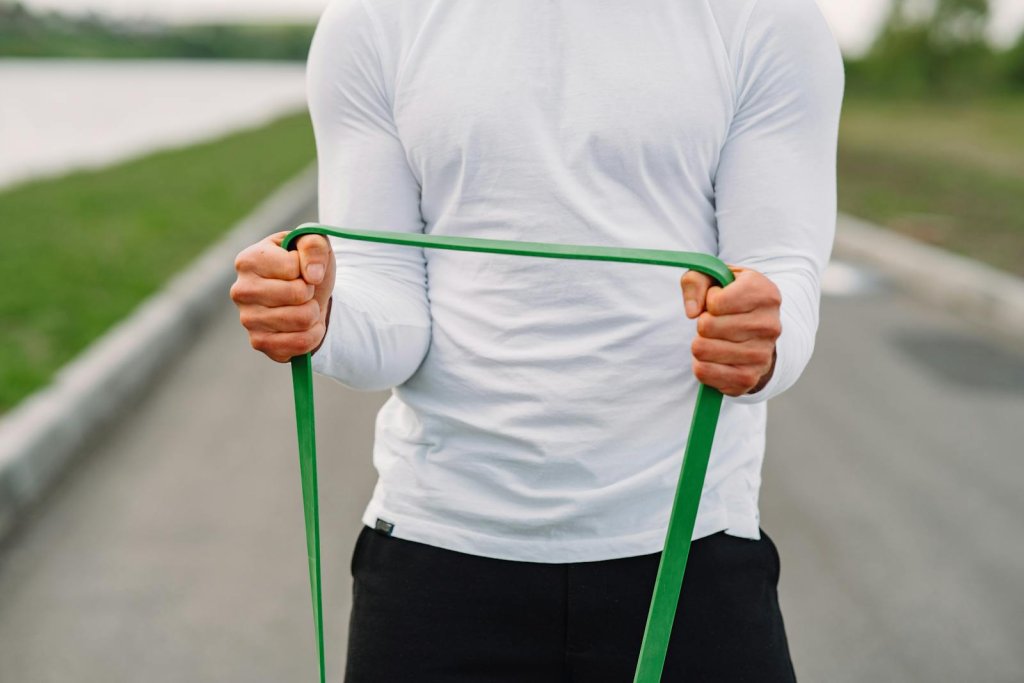
These exercises help you build strength, improve mobility, and train your entire body at home—even if you’re new to fitness.
Resistance bands are ideal for beginners because they’re joint-friendly, affordable, and easy to progress. With just one band, you can train legs, back, chest, shoulders, arms, and core without heavy equipment.
The 16 Best Resistance Band Exercises for Beginners
These beginner-friendly resistance band exercises strengthen every major muscle group using simple, controlled movements. Each one is easy to learn, joint-friendly, and perfect for building a strong foundation at home.
1. Banded Squat
Why it works:
The band increases hip activation, teaching beginners how to squat with proper knee alignment. It strengthens the quads, glutes, and hips while improving lower-body stability for daily movements like standing and climbing stairs.
Muscles worked:
Quads, glutes, hamstrings, hip stabilizers.
How to do it:
- Place a loop band above your knees.
- Stand with feet hip- to shoulder-width apart.
- Push hips back and bend knees to lower into a squat.
- Keep knees pressing gently outward against the band.
- Stand tall and repeat with controlled tempo.
Trainer Tip:
Brace your core and keep heels fully grounded to prevent your knees from collapsing inward.
2. Standing Band Row
Why it works:
This strengthens the major back muscles, helping beginners improve posture and counteract rounded shoulders from sitting.
Muscles worked:
Mid-back, lats, rhomboids, rear delts, biceps.
How to do it:
- Anchor the band at chest height.
- Hold the handles and step back until there is light tension.
- Pull elbows toward your ribs.
- Squeeze shoulder blades together at the end.
- Control the return.
Trainer Tip:
Keep shoulders down and chest open—avoid shrugging or arching your back.
3. Seated Row With Band
Why it works:
Sitting on the floor provides stability, making this an ideal beginner pull exercise. It helps build postural strength safely.
Muscles worked:
Lats, rhomboids, mid traps, biceps.
How to do it:
- Sit with legs extended.
- Loop the band around your feet.
- Hold the handles or ends of the band.
- Pull toward your torso while keeping your spine tall.
- Slowly return to the starting position.
Trainer Tip:
Imagine pulling from your back—not your arms—by initiating the movement with your shoulder blades.
4. Chest Press
Why it works:
A simple and controlled way for beginners to build pressing strength without weights, improving upper-body function.
Muscles worked:
Chest, front delts, triceps.
How to do it:
- Anchor the band behind you at chest level.
- Hold handles at chest height with elbows bent.
- Press forward until arms are extended.
- Return to the starting position with control.
Trainer Tip:
Keep elbows slightly below shoulder height to avoid shoulder strain.
5. Banded Glute Bridge
Why it works:
Activates and strengthens the glutes, helping stabilize the pelvis and reduce lower-back stress—excellent for beginners.
Muscles worked:
Glutes, hamstrings, deep core.
How to do it:
- Lie on your back with knees bent and band above your knees.
- Press knees slightly outward to keep the band tight.
- Drive through your heels and lift your hips.
- Pause, squeeze glutes hard, then lower slowly.
Trainer Tip:
Keep your ribs down and avoid arching your lower back.
6. Standing Hip Abduction
Why it works:
Strengthens hip abductors, improving balance, knee alignment, and hip stability—crucial for beginners.
Muscles worked:
Gluteus medius, hip stabilizers.
How to do it:
- Loop the band around your ankles.
- Stand tall while holding onto a chair if needed.
- Lift one leg sideways without leaning.
- Lower with control and switch sides.
Trainer Tip:
Keep toes pointed forward to target the correct muscles.
7. Banded Deadlift (Hip Hinge)
Why it works:
Teaches beginners how to hinge at the hips safely—a foundational movement for lifting objects.
Muscles worked:
Hamstrings, glutes, erector spinae.
How to do it:
- Stand on the band, holding handles with both hands.
- Push hips back, keeping your spine long.
- Stand tall by squeezing your glutes.
- Repeat with slow, controlled reps.
Trainer Tip:
Keep the band close to your body and avoid rounding your back.
8. Overhead Shoulder Press
Why it works:
Builds shoulder strength and improves overhead mobility in a controlled manner suitable for beginners.
Muscles worked:
Deltoids, triceps, upper chest, stabilizers.
How to do it:
- Stand on the band and hold handles at your shoulders.
- Press straight upward until arms are extended.
- Lower slowly under control.
Trainer Tip:
Keep ribs tucked and avoid leaning back to protect your spine.
9. Lateral Raise
Why it works:
Strengthens the side delts, improving shoulder shape, posture, and shoulder stability.
Muscles worked:
Lateral deltoids, upper traps (lightly).
How to do it:
- Stand on the band with arms at your sides.
- Raise arms outward until shoulder height.
- Lower with control.
Trainer Tip:
Keep elbows slightly bent and wrists neutral.
10. Banded Biceps Curl
Why it works:
Provides smooth resistance to help beginners learn muscle engagement without using momentum.
Muscles worked:
Biceps brachii, forearms.
How to do it:
- Stand on the band and hold the handles.
- Curl the handles upward toward your shoulders.
- Lower slowly, resisting the band’s pull.
Trainer Tip:
Keep elbows pinned to your sides to maximize biceps activation.
11. Triceps Pressdown (Door or High Anchor)
Why it works:
Strengthens the triceps, improving daily pushing tasks and overall arm strength.
Muscles worked:
Triceps (long, medial, and lateral heads).
How to do it:
- Anchor the band overhead.
- Hold handles with elbows bent.
- Press downward until arms are straight.
- Return slowly.
Trainer Tip:
Keep elbows fixed in place—only your forearms should move.
12. Face Pull
Why it works:
Corrects rounded posture and strengthens the upper back, making it essential for beginners.
Muscles worked:
Rear delts, traps, rhomboids, rotator cuff.
How to do it:
- Anchor the band at face level.
- Pull handles toward your forehead.
- Keep elbows high.
- Slowly return to start.
Trainer Tip:
Lead the movement with your elbows, not your hands.
13. Band Pull-Apart
Why it works:
Improves posture and shoulder stability using a simple movement easy for beginners.
Muscles worked:
Rear delts, traps, rhomboids.
How to do it:
- Hold the band straight out in front of you.
- Pull hands apart until arms open wide.
- Return with control.
Trainer Tip:
Keep shoulders down and avoid arching your back.
14. Pallof Press (Anti-Rotation Core)
Why it works:
Strengthens deep core stabilizers without bending or rotating your spine—safe for beginners.
Muscles worked:
Obliques, transverse abdominis, deep core.
How to do it:
- Anchor the band to your side.
- Hold the handle at your chest.
- Press your arms straight forward while resisting rotation.
- Bring hands back in.
- Switch sides.
Trainer Tip:
Keep hips and shoulders squared the entire time.
15. Standing Wood Chop
Why it works:
Teaches controlled rotational strength, helping beginners improve core power and movement coordination.
Muscles worked:
Obliques, core, shoulders, upper back.
How to do it:
- Anchor band low.
- Hold the handle with both hands.
- Pull diagonally upward across your body.
- Return slowly and repeat.
Trainer Tip:
Rotate from the torso—avoid pulling with just your arms.
16. Banded Leg Press (Seated)
Why it works:
Replicates a gym leg press safely at home, building leg strength without joint stress.
Muscles worked:
Quads, glutes, hamstrings.
How to do it:
- Sit with knees bent.
- Loop band around your feet and hold the ends.
- Press your feet forward until legs extend.
- Return with slow control.
Trainer Tip:
Keep your core firm to prevent leaning backward or rocking.
How Often Should Beginners Do Resistance Band Workouts?
According to ACSM guidelines:
- Train 2–3 days per week, with at least one rest day between sessions
- Aim for 8–12 reps per exercise (10–15 reps for older adults)
- Start with 1–2 sets and progress to 2–3 sets over time
- Include 8–10 total exercises targeting all major muscle groups
You can increase difficulty by using a stronger band, adding more reps, or slowing down the movement.
How to Do Resistance Band Exercises Safely
To keep your workout safe:
- Start with a light-resistance band
- Keep movements slow—avoid jerking or snapping
- Maintain a neutral spine (no arching or rounding)
- Anchor the band securely before pulling
- Exhale on the effort (pull/press), inhale on the return
- Stop if you feel sharp pain, numbness, or joint discomfort
- Check your band for tears or thinning before every session
If you have heart conditions, uncontrolled blood pressure, or are recovering from surgery, consult a medical professional before starting resistance training.
FAQ: Resistance Band Exercises for Beginners
1. Are resistance bands effective for building muscle?
Yes. Research shows resistance bands can build strength similar to free weights when exercises are performed with enough resistance.
2. Which band strength should beginners use?
Start with a light band (often yellow or light red) and progress gradually.
3. How many exercises should beginners do per session?
Aim for 8–10 total exercises covering all major muscle groups.
4. Do I need multiple bands?
One light and one medium band are usually enough for most beginners.
5. Can seniors do resistance band exercises?
Yes—bands are recommended for older adults because they’re low-impact and easy to control. Always follow safety guidelines.
6. How long does it take to see results?
Beginners typically see noticeable strength improvements in 3–6 weeks with consistent training.
Conclusion
Resistance bands are one of the safest and most effective ways for beginners to build full-body strength at home. By combining simple movements, controlled tension, and proper technique, you can train every major muscle group without heavy equipment. Start with light resistance, follow the progression guidelines, and build strength at a pace that feels comfortable and sustainable.
Ready to begin? Start with 5–6 exercises from the list above and train 2–3 days per week.
References
- Lopes JSS et al. (2019) – Effects of training with elastic resistance versus conventional resistance on muscular strength: A systematic review and meta-analysis. SAGE Open Medicine.
Supports your claim that resistance band training can build strength similar to traditional weights. - American College of Sports Medicine (ACSM) Position Stand (2009) – Progression models in resistance training for healthy adults. Medicine & Science in Sports & Exercise.
Core source for sets, reps, frequency, and progression guidelines you use for beginners. - Meng Y et al. (2025) – Effects of elastic band resistance training on lower limb muscle strength and balance in older adults: A systematic review and meta-analysis. Frontiers in Sports and Active Living.
Backs your statements on strength, balance, and safety of band training, especially for older or deconditioned beginners. - Saragih ID et al. (2022) – Effects of resistance band exercise for frail older adults: A systematic review and meta-analysis. Clinical Interventions in Aging.
Shows resistance band exercise can reduce frailty and improve function—great support for low-impact, beginner-friendly messaging. - Stanković D et al. (2025) – Effects of Elastic Band Training on Physical Performance in Team Sports: A Systematic Review and Meta-Analysis. Journal of Functional Morphology and Kinesiology.
Demonstrates bands also improve performance (strength, sprint, change of direction), reinforcing that bands are effective beyond rehab. - Andersen V et al. (2022) – Comparing the effects of variable and traditional resistance training on strength and muscle mass in young adults. Journal of Science and Medicine in Sport.
Supports your point that variable resistance (bands) can be as effective as traditional resistance for strength and hypertrophy. - National Institute on Aging (NIA) – Exercise and Physical Activity: Your Everyday Guide.
Authoritative guideline on exercise, safety, and strength training for older adults. - CDC – Growing Stronger: Strength Training for Older Adults.
Practical, evidence-based booklet with strength training recommendations, safety points, and sample routines you echo in your beginner programming.