
Scapular winging exercises help retrain your shoulder blade to stay flatter against the rib cage by strengthening key stabilizers such as the serratus anterior and trapezius.
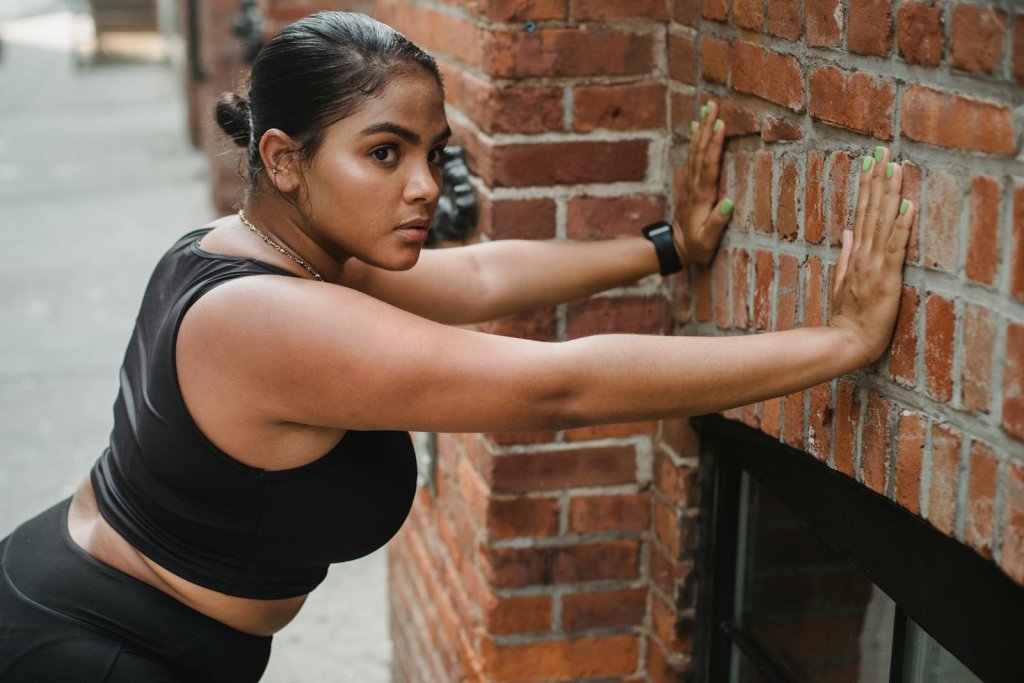
This is important because scapular winging can reduce shoulder strength, disrupt overhead movement, and affect posture.
Clinical guidance from the Cleveland Clinic explains that persistent winging may also be linked to nerve or muscle dysfunction, making targeted exercise and proper screening essential.
What is scapular winging
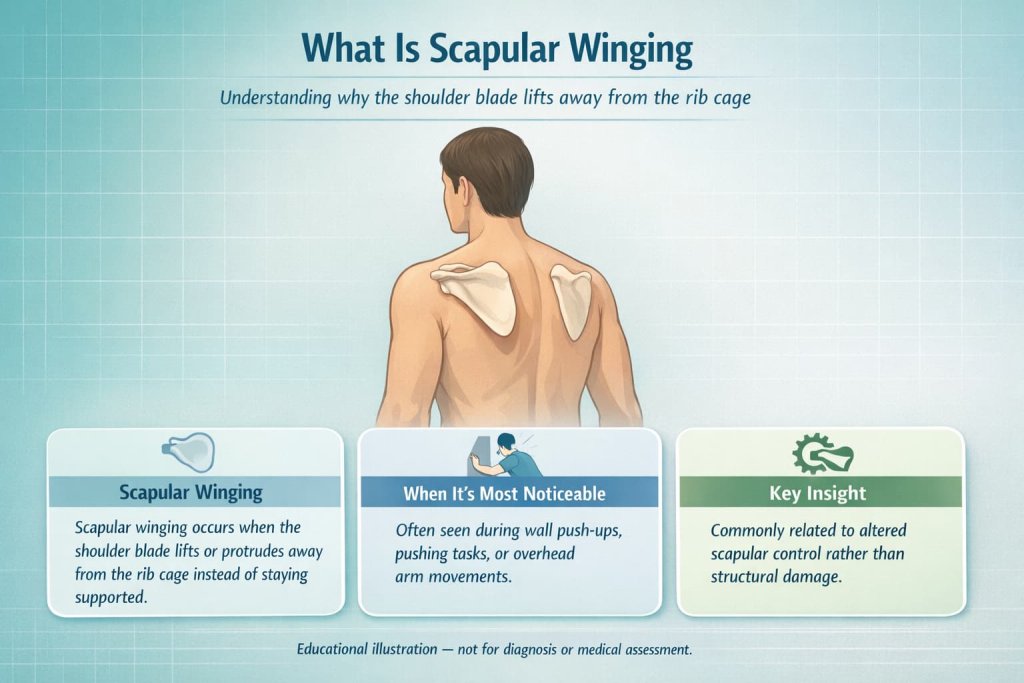
Scapular winging occurs when the shoulder blade lifts or protrues away from the rib cage instead of moving smoothly along it. It is often most noticeable during wall push-ups, pushing tasks, or arm elevation overhead, and may reflect altered scapular control rather than structural damage.
When to Be Careful Before Starting Scapular Winging Exercises
Scapular winging exercises are usually safe, but extra caution is important because winging can sometimes involve nerve or muscle injury. Guidance from the Cleveland Clinic recommends clinical evaluation when symptoms are persistent or worsening.
Use extra caution or seek professional input if you notice:
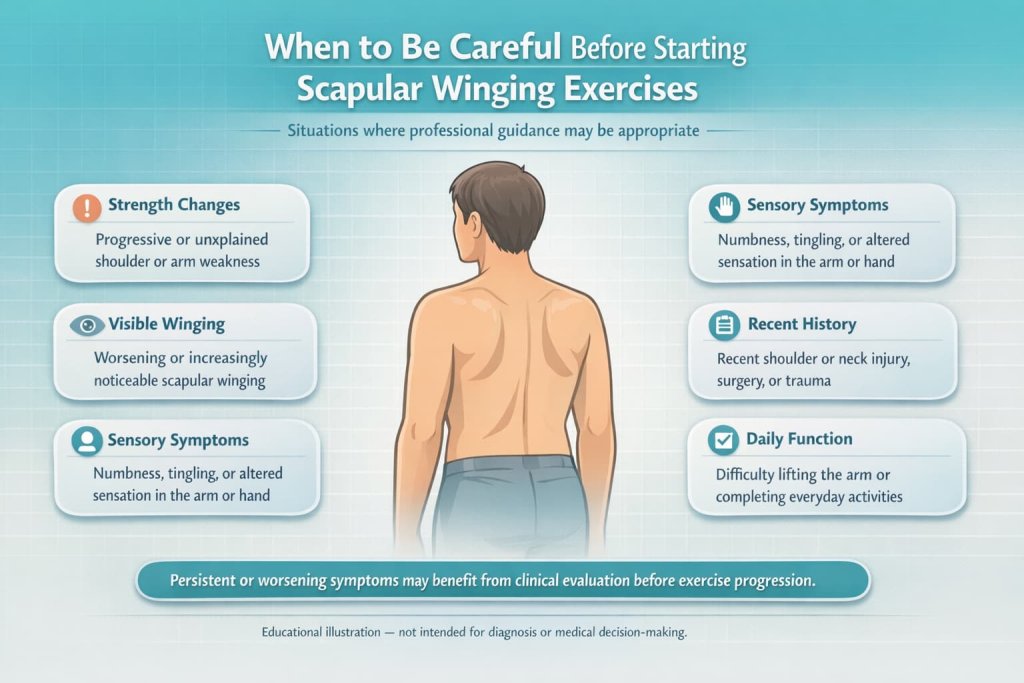
- Progressive or unexplained shoulder or arm weakness
- Worsening or visibly increasing scapular winging
- Numbness, tingling, or altered sensation in the arm or hand
- Recent shoulder or neck injury, surgery, or trauma
- Difficulty lifting the arm or performing daily activities
Common reasons scapular winging happens
Scapular winging does not have a single cause. Common contributors include:
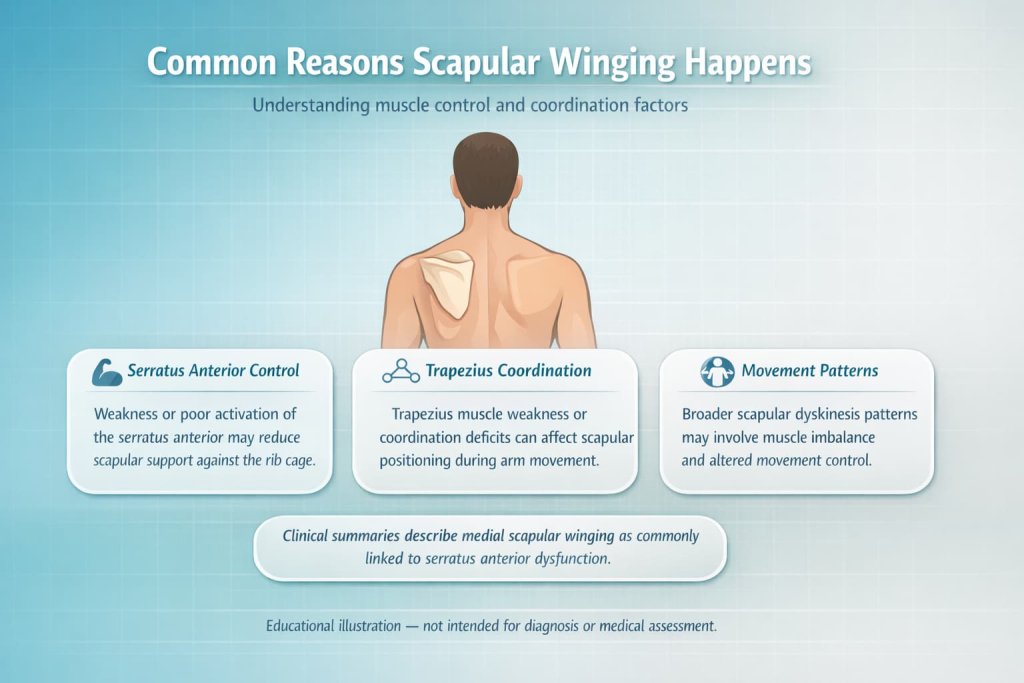
- Weakness or poor activation of the serratus anterior, sometimes associated with long thoracic nerve involvement
- Trapezius muscle weakness or coordination deficits, occasionally linked to spinal accessory nerve issues
- Broader scapular dyskinesis patterns involving muscle imbalance and movement-control deficits
Clinical summaries published in StatPearls via the NCBI Bookshelf note that medial scapular winging is most commonly associated with serratus anterior dysfunction and long thoracic nerve involvement.
8 Best Scapular Winging Exercises
These exercises focus on improving serratus anterior activation and coordinated scapular control to help the shoulder blade sit and move more smoothly against the rib cage. When performed consistently and with good technique, they may support better shoulder stability during pushing, reaching, and overhead movements.
1. Serratus Wall Slide
How to do it
- Stand facing a wall with forearms resting on the wall and elbows shoulder-width apart
- Gently press your forearms into the wall so the shoulder blades glide forward around the rib cage
- Slowly slide your forearms upward while keeping your ribs down and neck relaxed
- Pause briefly at the top without shrugging
- Return to the start position with controlled movement
Why it works
Wall slides emphasize serratus anterior activation while reinforcing upward rotation and smooth scapular motion during arm elevation. Research published in the Journal of Orthopaedic & Sports Physical Therapy shows wall slide variations can produce high serratus activation at shoulder height and above, which is critical for improving scapular control in winging patterns.
Muscles worked
Serratus anterior, lower trapezius (supporting), rotator cuff (supporting)
Trainer Tip
Think “reach the arms away” rather than “lift the shoulders.” If neck tension takes over, reduce the range and pressure.
2. Wall Push-Up Plus
How to do it
- Stand about an arm’s length from a wall with palms placed at chest height
- Perform a slow, controlled wall push-up
- At the top of the movement, keep elbows straight and push slightly farther to add the “plus”
- Hold that reach for one second
- Return smoothly and repeat
Why it works
The added “plus” phase increases serratus anterior demand, helping the shoulder blade stay anchored against the rib cage. This movement pattern reinforces scapular protraction control, which is often reduced in scapular winging.
Muscles worked
Serratus anterior, chest, triceps, core (supporting)
Trainer Tip
Move slowly and evenly. Speed often causes the shoulder blades to lose control.
3. Serratus Punch
How to do it
- Lie on your back holding a light dumbbell or resistance band with your arm pointing toward the ceiling
- Keep the elbow mostly straight
- Reach upward by lifting the shoulder blade slightly off the floor
- Slowly lower until the shoulder blade rests back down
- Repeat with smooth control
Why it works
This exercise isolates the protraction function of the serratus anterior and helps build awareness and control before progressing to more demanding weight-bearing movements.
Muscles worked
Serratus anterior, rotator cuff (supporting)
Trainer Tip
The movement should feel small and controlled. Avoid turning it into a shoulder press.
4. Quadruped Scapular Reach
How to do it
- Start on hands and knees with hands directly under shoulders
- Keep elbows straight and gently push the floor away
- Allow the shoulder blades to glide forward without rounding the spine
- Hold briefly, then return to a neutral position
- Repeat under control
Why it works
This variation increases load through the shoulder girdle while reinforcing serratus activation against body weight, making it an effective progression from wall-based drills.
Muscles worked
Serratus anterior, core stabilizers, triceps (supporting)
Trainer Tip
Focus on quality rather than range. Subtle movement with control is the goal.
5. Bear Plank Hold
How to do it
- Begin on hands and knees with toes tucked under
- Lift knees 1–2 inches off the floor
- Push the floor away slightly to maintain scapular control
- Hold while breathing steadily
- Lower knees and reset
Why it works
Bear planks challenge serratus anterior and trunk stability without requiring a full plank, making them useful for building endurance and control in scapular stabilizers.
Muscles worked
Serratus anterior, core, shoulder stabilizers
Trainer Tip
End the set as soon as scapular winging increases or form deteriorates.
6. Prone Y Raise
How to do it
- Lie face down on the floor or a bench
- Raise arms overhead into a Y shape with thumbs pointing upward
- Gently set the shoulder blades down without pinching
- Lift arms slightly, pause briefly, then lower slowly
- Keep the neck relaxed throughout
Why it works
Lower trapezius strengthening supports scapular upward rotation and posterior tilt, which are important for controlled arm elevation and reducing compensatory winging.
Muscles worked
Lower trapezius, mid trapezius (supporting), posterior shoulder
Trainer Tip
Use very light resistance or no weight. Precision matters more than load.
7. Side-Lying External Rotation
How to do it
- Lie on your side with the top elbow bent to 90 degrees and tucked against your ribs
- Hold a light dumbbell in the top hand
- Rotate the forearm upward while keeping the elbow in contact with your side
- Lower slowly with control
- Repeat evenly
Why it works
Rotator cuff strength supports scapular stability and shoulder mechanics. Many rehabilitation models pair scapular exercises with rotator cuff training to improve overall shoulder control.
Muscles worked
Rotator cuff (infraspinatus, teres minor), scapular stabilizers (supporting)
Trainer Tip
Keep ribs stacked and avoid rolling backward to maintain proper loading.
8. Prone Shoulder Extension
How to do it
- Lie face down with arms resting by your sides and palms facing inward
- Gently set the shoulder blades down without shrugging
- Lift arms a few inches off the floor
- Pause briefly, then lower slowly
- Reset between reps
Why it works
Prone extension patterns reinforce posterior shoulder strength and scapular support, helping improve control during pulling and posture-based activities.
Muscles worked
Posterior shoulder, mid trapezius, lower trapezius (supporting)
Trainer Tip
Keep the movement small and deliberate. Bigger lifts often shift work into the neck.
Quick safety check before you start
Exercises should feel controlled and muscular—not sharp, painful, or progressively weakening.
Seek medical or physical therapy evaluation if you notice:
- Worsening or visible progression of scapular winging
- New or increasing shoulder or arm weakness
- Numbness, tingling, or neck-related symptoms radiating into the arm
- Recent trauma, surgery, or sudden loss of shoulder function
Medical guidance from the Cleveland Clinic emphasizes that ongoing or worsening winging may require evaluation to rule out nerve-related causes before progressing exercise intensity.
How Scapular Winging Exercises Help Improve Shoulder Blade Stability
Scapular winging exercises focus on improving how the shoulder blade moves and stabilizes against the rib cage during daily and overhead movements.
These exercises may help by:
- Strengthening the serratus anterior to support the scapula against the rib cage
- Improving trapezius coordination for smoother upward rotation
- Reducing compensations such as shrugging or rib flaring
- Supporting better scapulothoracic rhythm during pushing and reaching
Exercise guidance summarized in the Journal of Orthopaedic & Sports Physical Therapy highlights targeted scapular strengthening as a key component of improving shoulder blade control.
How to use these scapular winging exercises
For most people:
- Perform exercises 3–5 days per week
- Begin with low-load control drills before adding resistance
- Stop each set 1–2 reps before form deteriorates
- Expect gradual improvements over 4–8 weeks
Train both sides, but add one extra set on the more affected side if asymmetry is present.
How Long Do Scapular Winging Exercises Take to Work?
Improvements from scapular winging exercises are typically gradual rather than immediate.
Many people notice:
- Better scapular control within 4–8 weeks of consistent practice
- Gradual reduction in visible winging with proper technique
- Improved comfort during pushing or overhead tasks
According to the Cleveland Clinic, recovery timelines vary depending on the underlying cause, especially when nerve-related factors are involved. If symptoms worsen or fail to improve, reassessment is recommended.
Common mistakes that limit progress
- Shrugging instead of stabilizing
- Using heavy resistance too early
- Letting the ribs flare excessively
- Rushing repetitions without control
FAQs
How long do scapular winging exercises take to work?
Many people notice better control within 4–8 weeks, although timelines vary depending on the underlying cause.
What muscles are most important for scapular winging?
The serratus anterior and trapezius muscles are the primary focus, often supported by rotator cuff strengthening.
Should push-ups be avoided with scapular winging?
Not always. Wall-based progressions are commonly used before advancing to floor push-ups.
Can scapular winging be nerve-related?
Yes. Clinical sources describe nerve involvement as a possible contributor, which is why worsening or persistent winging should be evaluated.
Conclusion
Scapular winging exercises are most effective when they emphasize control first and strength second. Wall-based drills, serratus-focused movements, and targeted trapezius strengthening can gradually improve shoulder blade stability and movement quality. If symptoms worsen or fail to improve, professional evaluation helps ensure you are addressing the correct underlying cause.
This content is for informational purposes only and not medical advice.
References
- NCBI Bookshelf (StatPearls) — Winging of the Scapula
- PubMed — Rehabilitation of Scapular Muscle Balance: Which Exercises to Prescribe? (Cools et al., 2007)
- British Journal of Sports Medicine — Scapular Dyskinesis Consensus Statement (Kibler et al., 2013)
- Cleveland Clinic Journal of Medicine — Scapular Winging Clinical Overview
- American Academy of Orthopaedic Surgeons (AAOS OrthoInfo) — Scapular (Shoulder Blade) Disorders
- International Journal of Sports Physical Therapy — Current Views of Scapular Dyskinesis and Clinical Relevance (Sciascia & Kibler, 2022)