
Side plank hip dips are a side-plank variation where you lower your hips a few inches toward the floor, then lift back up with control to build stronger obliques and better core stability.
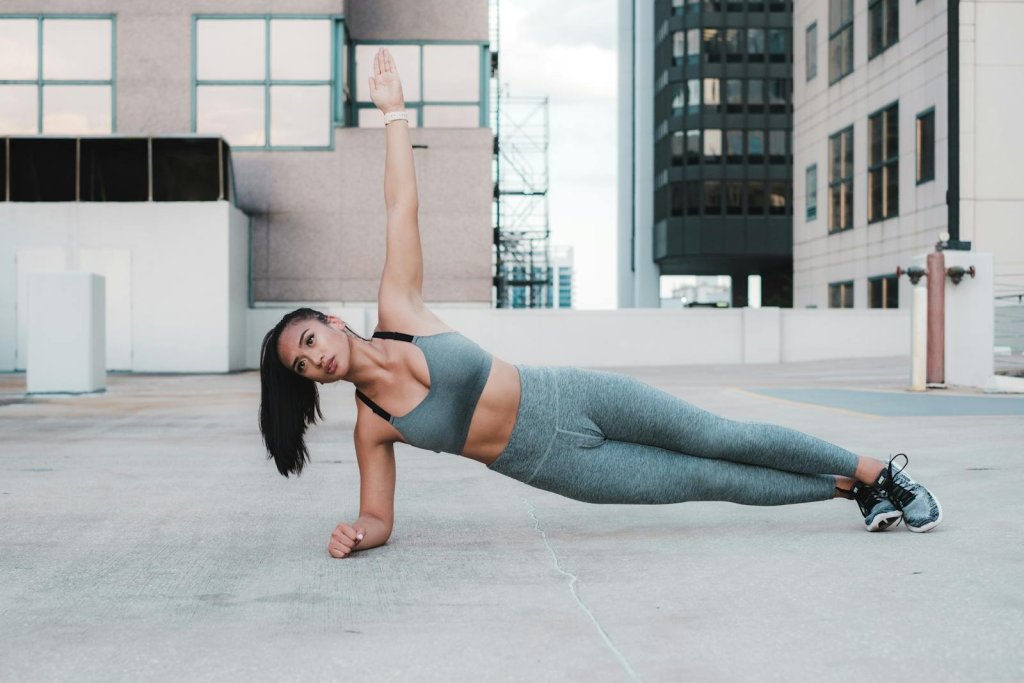
Learning proper form matters because side planks train the “side-body” core muscles that help stabilize your spine and improve balance in everyday movement, not just workouts. As the Mayo Clinic explains, side plank-style core work helps challenge stability by working the muscles along the side of your body.
What Are Side Plank Hip Dips
Side plank hip dips (sometimes called side plank hip lifts) take a standard side plank and add a small up-and-down hip motion.
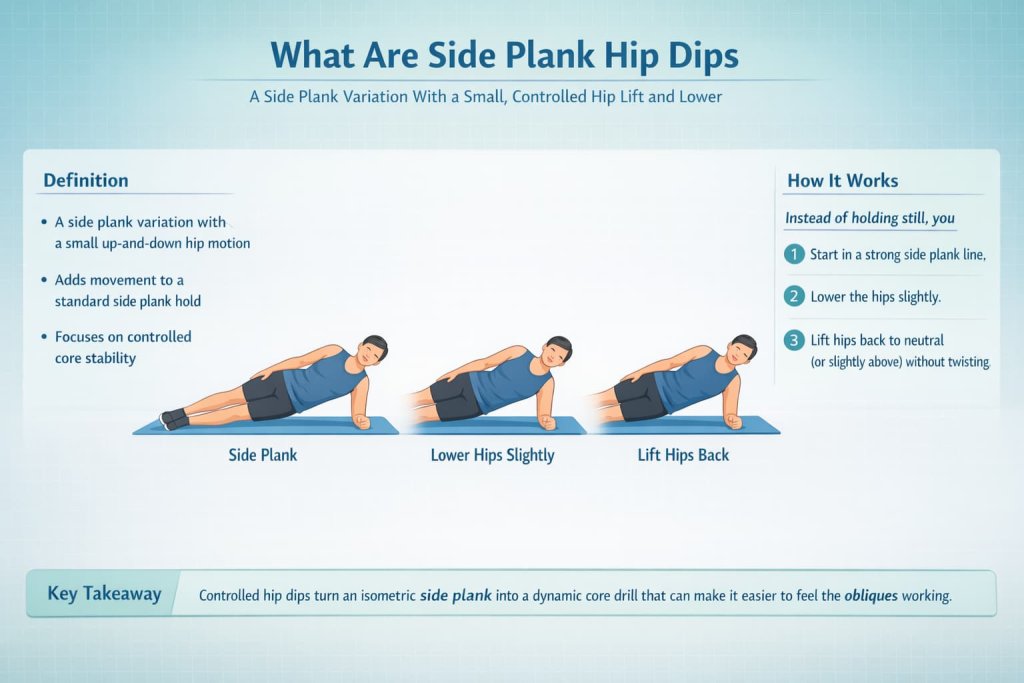
Instead of holding still, you:
- Start in a strong side plank line
- Lower the hips slightly
- Lift the hips back to neutral (or slightly above neutral) without twisting
This turns an isometric core drill into a controlled, dynamic one—often making it easier to “feel” the obliques working.
How to Do Side Plank Hip Dips Correctly
How to do it:
- Lie on your side with your forearm on the floor and your elbow directly under your shoulder.
- Stack your feet (harder) or stagger them (easier). Brace your glutes and core.
- Lift into a straight line from head to heels (or from head to knees if modified).
- Lower your hips a few inches toward the floor slowly (stay stacked, don’t rotate).
- Lift your hips back up by squeezing the obliques and glutes.
- Repeat all reps on one side, then switch.
Side Plank Hip Dips Benefits for Stronger Obliques
Side plank variations are popular because they combine core stability with hip and shoulder support.
Key benefits:
- Oblique strength and endurance (helps with side-bending control and trunk stiffness)
- Spinal stability (the side plank is often used to build lateral core stability)
- Better left-right balance (most people have a weaker side)
The Cleveland Clinic highlights that planks can improve core stability and can reveal side-to-side differences—useful when you’re trying to strengthen your weaker oblique side.
Muscles Worked in Side Plank Hip Dips
Primary muscles:
- External obliques
- Internal obliques
- Quadratus lumborum (deep “side core” stabilizer)
Strong supporting muscles:
- Gluteus medius and hip stabilizers (to keep the pelvis stacked)
- Shoulder stabilizers (to hold alignment)
EMG research on side plank variations has reported high activation in hip stabilizers (including gluteus medius) in certain side plank progressions, supporting why side plank patterns are often used for hip stability training too. (See the full text on NIH/PMC.)
Most Common Side Plank Hip Dip Mistakes
Letting the shoulder drift forward
If your shoulder rolls in front of your elbow, your shoulder joint takes more stress and your core does less.
Fix: Re-stack: elbow under shoulder, ribs down, neck neutral.
Twisting instead of dipping
Fix: Keep your chest “open,” hips stacked, and move only a few inches.
Dropping the hips too low
Going too low often causes spinal side-bending and loss of tension.
Fix: Use a smaller range and slower tempo.
Rushing the reps
Fast reps usually turn into momentum, not oblique work.
Fix: Slow down the lowering phase and pause briefly.
Beginner Modifications and Progressions
If you’re a beginner
Start with a modified side plank position (knees down) so you can keep your torso stacked without fighting balance.
Beginner-friendly options:
- Knees down hip dips
- Staggered feet hip dips (top foot slightly in front)
- Smaller range of motion
If you’re ready to progress
Harder options:
- Feet stacked hip dips
- Slower tempo (3 seconds down, 1 second up)
- Add a top-leg lift (advanced hip stability)
Sets, Reps, and Weekly Schedule
A simple, effective plan:
- Reps: 6–12 per side (controlled)
- Sets: 2–4 per side
- Rest: 30–60 seconds between sides/sets
- Weekly frequency: 2–4 days per week
If your form breaks before the target reps, stop the set. Quality matters more than volume.
Quick Safety Checklist
Use this quick check before and during your set:
- Elbow stacked under shoulder
- Neck neutral (no chin jut)
- Ribs stacked over pelvis
- Hips move up/down (not twisting)
- No sharp shoulder, back, or wrist pain
Who Should Be Careful With Side Plank Hip Dips
Be extra cautious (or choose an easier version) if you have:
- Recent shoulder injury or significant shoulder pain with weight-bearing
- Wrist/elbow discomfort in plank positions
- Low back pain that worsens with side-bending
- Balance limitations that make you feel unstable
If you’re unsure, consider getting form guidance from a qualified fitness professional or clinician.
Frequently Asked Questions
Are side plank hip dips better than a regular side plank?
They’re not “better,” just different. Hip dips add motion and can increase oblique time-under-tension, while a regular side plank is simpler for pure endurance and stability practice.
Should my hips touch the floor?
Not required. A small, controlled dip is usually enough. Touching the floor often encourages collapsing instead of controlling.
Where should I feel side plank hip dips?
Mostly along the side of your abdomen (obliques) and in the outer hip (glute med). You may also feel the supporting shoulder working.
How long does it take to see core strength improvements?
Many people notice better control within a few weeks when training 2–4 times per week, especially if they keep reps slow and consistent.
Can beginners do side plank hip dips?
Yes. Start with knees down or staggered feet, reduce the range, and focus on keeping the body stacked and steady.
Why does my shoulder hurt during hip dips?
Common reasons include poor stacking (elbow not under shoulder) or collapsing into the shoulder. If pain is sharp or persistent, stop and use a regression or seek professional guidance.
Conclusion
Side plank hip dips are a simple upgrade to the classic side plank that can build stronger obliques, improve side-to-side core balance, and develop better stability—when you keep the movement slow, stacked, and controlled. Add them 2–4 times per week, start with an easier version if needed, and prioritize perfect reps over more reps.
References
- American Council on Exercise (ACE). (n.d.). Side plank (modified).
- Harvard Health Publishing. (2021, February 1). Try this move for better core strength.
- Boren, K., Conrey, C., Le Coguic, J., Paprocki, L., Voight, M., & Robinson, T. K. (2011). Electromyographic analysis of gluteus medius and gluteus maximus during rehabilitation exercises.
- Boren, K., Conrey, C., Le Coguic, J., Paprocki, L., Voight, M., & Robinson, T. K. (2011). Electromyographic analysis of gluteus medius and gluteus maximus during rehabilitation exercises (Full text). International Journal of Sports Physical Therapy, 6(3), 206–223.
- Ekstrom, R. A., Donatelli, R. A., & Carp, K. C. (2007). Electromyographic analysis of core trunk, hip, and thigh muscles during 9 rehabilitation exercises. Journal of Orthopaedic & Sports Physical Therapy, 37(12), 754–762.