
Start this squat workout challenge with two sets of six controlled repetitions on three nonconsecutive days per week—or use the easier five-repetition option below. The goal is to practice consistently for 30 days, with recovery days included, rather than perform more squats every day.
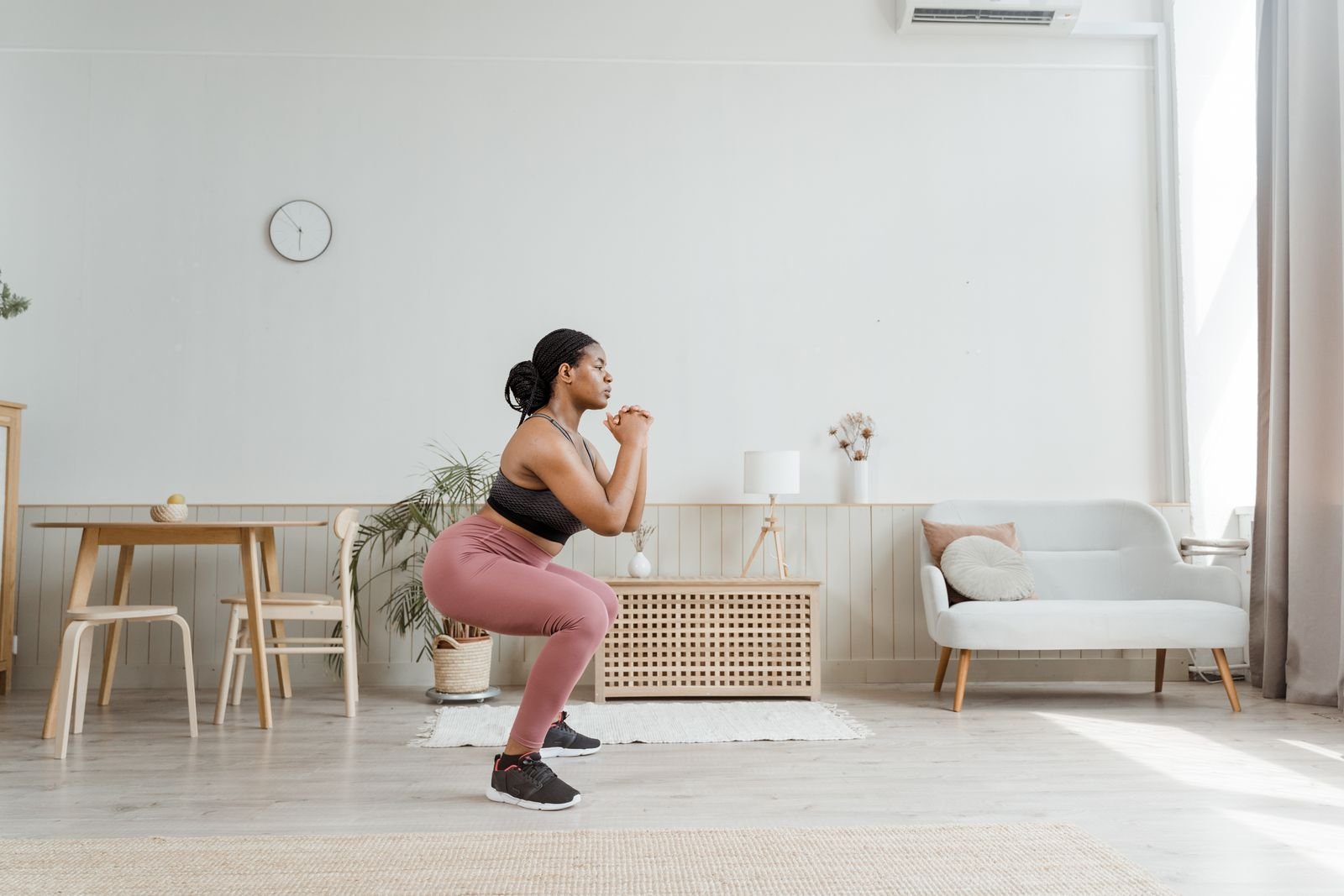
You do not need weights or a gym membership for this plan. Choose a manageable squat variation, follow the calendar, and increase repetitions only when you are ready.
The American College of Sports Medicine’s updated resistance-training guidance, announced March, 2026, supports bodyweight and home-based exercise. It also emphasizes adapting training to the individual rather than following rigid, one-size-fits-all rules.
Before You Start the Squat Workout Challenge
This is a general beginner routine for adults, not an injury-rehabilitation program. If you have a chronic condition, an unresolved injury, or concerns about exercising safely, discuss the plan with a healthcare professional first.
Clear enough floor space to move comfortably. For the chair-based options, use a solid chair without wheels that will not slide. Choose a seat height that allows your feet to rest flat on the floor.
You do not have to complete the full starting workout to participate. Begin with the easier option when necessary, and treat the calendar as a guide—not a test you must pass.
30-Day Squat Workout Challenge Plan
This is an original sample schedule informed by general resistance-training guidance. The exact calendar has not been clinically tested or endorsed by the organizations cited.
Choose one squat variation per session. You do not need to perform every variation described later in the article.
Two sets of six repetitions means doing six squats, resting, and then doing another six.
| Challenge period | Squat training days | Workout on each training day | Recovery days |
|---|---|---|---|
| Days 1–7 | 1, 3, and 5 | 2 sets of 6 repetitions | 2, 4, 6, and 7 |
| Days 8–14 | 8, 10, and 12 | 2 sets of 8 repetitions | 9, 11, 13, and 14 |
| Days 15–21 | 15, 17, and 19 | 2 sets of 10 repetitions | 16, 18, 20, and 21 |
| Days 22–28 | 22, 24, and 26 | 2 sets of 12 repetitions | 23, 25, 27, and 28 |
| Days 29–30 | 29 | Repeat your last comfortable workout, up to 2 sets of 12 | 30: rest and review |
The standard calendar includes 13 squat workouts. Day 29 is a final practice session, not a maximum-repetition test.
For this plan, start with approximately 60–90 seconds of rest between sets. Take longer when needed to regain comfortable breathing and control. This is a flexible starting interval, not a requirement to restart before you feel ready.
An Easier Starting Option
Begin with one set of five sit-to-stands or supported mini-squats on two nonconsecutive days per week. You can use the first two training days listed for each week and skip the third.
The NHS includes five repetitions as an introductory target for both movements. Stay at that level until it feels manageable rather than automatically following the main calendar’s increases.
When to Increase Repetitions
Move to the next week’s target only when your current sets remain controlled and you have recovered sufficiently for another session.
For this introductory challenge, finish each set while you still feel capable of a few more controlled repetitions. You do not need to reach muscular failure—the point where another repetition becomes impossible—to benefit from resistance training.
If your form deteriorates, reduce the repetitions rather than forcing the target.
For example, completing two sets of eight with good control is a reason to consider progressing. Struggling through eight by rushing or changing your movement is a reason to repeat that level or reduce it.
Repeating a week is an adjustment, not a failed challenge.
How to Do a Squat With Good Form
Before each session, warm up with 5–10 minutes of walking or another comfortable aerobic activity. This follows Mayo Clinic’s strength-training safety guidance.
For the standing bodyweight squat:
- Set your stance. Stand with your feet slightly wider than shoulder-width apart.
- Prepare your torso. Gently tighten your abdominal muscles and maintain the natural curve of your back.
- Lower slowly. Bend through your hips, knees, and ankles. Keep your knees aligned with your feet.
- Choose a comfortable depth. Stop where you can maintain control. Do not force yourself to match someone else’s squat depth.
- Stand smoothly. Return to the starting position without bouncing or rushing. Stop the set when you can no longer maintain your technique.
Breathe in while lowering and breathe out while standing. Avoid holding your breath.
The most important technique mistakes to avoid are forcing depth, letting your knees collapse inward, and continuing after your back position or movement control changes. Make the movement smaller or end the set instead.
Choose the Right Squat Variation
Use the version you can perform comfortably and consistently. The challenge does not require moving to an unsupported squat by a particular date.
Sit-to-Stand
Sit near the front of a stable chair with your feet flat and about hip-width apart. Lean forward slightly, stand up under control, and slowly return to the seat.
This movement and the supported mini-squat below are included in the NHS home strength exercises.
Supported Mini-Squat
Stand behind a stable chair and rest your hands on its back for support. Slowly bend your knees through a comfortable range, then return to standing.
Keep the movement small when necessary. The purpose of the support is stability, not to force a deeper squat.
Bodyweight Squat
Use the standing technique described above when you can control the movement without holding a support.
You can keep this same variation throughout the month. For this plan, changing variations is optional; increasing repetitions is already one way the calendar progresses.
Rest Days, Soreness, and When to Stop
Why Recovery Days Matter
Mayo Clinic recommends allowing one full day between training sessions for the same muscle group. That is why this squat workout challenge separates its training days.
On recovery days, skip the challenge’s squat sets. Easy walking is an option when comfortable, but avoid turning the day into another demanding leg workout—particularly when your muscles are sore.
What to Do About Muscle Soreness
Delayed onset muscle soreness can begin one to three days after unfamiliar or demanding exercise. However, soreness is not required for a productive workout.
If soreness changes how you walk or squat, postpone the next session rather than forcing it. Resume at a manageable level after symptoms settle. Seek medical advice when pain does not improve with rest or you suspect an injury.
Pain Is a Reason to Stop
Stop an exercise that causes pain. Pain that starts during a squat should not be dismissed as delayed muscle soreness.
Seek urgent medical advice for severe knee pain, inability to bear weight, major swelling, or a knee that locks or gives way. These are among the NHS warning signs for knee pain.
What Results Can You Expect From a Squat Workout Challenge?
Use the first month to work toward better movement control, manageable increases in repetitions, and a consistent routine.
Resistance training can improve strength, muscular endurance, muscle size, and physical function. However, the trials included in the 2026 ACSM position stand lasted 6–52 weeks. Those findings do not establish a guaranteed result from this specific 30-day calendar.
Track Performance, Not Just Appearance
After each workout, record your squat variation, completed sets and repetitions, and a brief note about how the session felt.
For example:
“Day 12: sit-to-stand, two sets of eight. Both sets controlled. Repeat this level next session.”
On Day 30, compare your notes with your first week. Look for changes in control, consistency, or the workload you can manage—not just whether you reached the highest number on the calendar.
Do Not Expect Targeted Fat Loss
A squat challenge is not a proven way to selectively remove thigh, buttock, or belly fat.
A systematic review and meta-analysis of localized fat reduction, published in a 2022 issue of Human Movement, included 13 studies and 1,158 participants. It found no localized fat-loss effect from training the nearby muscles.
Treat claims about guaranteed “slimmer thighs in 30 days” as marketing—not an established outcome of this plan.
How the Challenge Fits Into a Complete Workout Routine
Squats are one part of a fitness routine, not a replacement for all other exercise.
CDC guidance recommends at least two days of muscle-strengthening activity covering all major muscle groups, plus 150 minutes of moderate-intensity aerobic activity per week, or an equivalent amount of vigorous activity. Squats alone do not meet that complete recommendation. Build toward broader activity goals according to your ability.
If you already follow a strength program, count these squats as part of your existing leg training rather than automatically adding them on top.
After the challenge, a practical next step is to include your manageable squat variation in a balanced strength routine. Once the movement becomes easy, progression can involve a more challenging variation or gradually increased resistance—not simply an ever-growing daily repetition target.
Frequently Asked Questions
How Many Squats Should a Beginner Start With?
For this plan, the main starting target is two sets of six. The easier option is one set of five. These are adjustable starting points, not universal requirements.
Should You Do Squats Every Day During a 30-Day Challenge?
Not with this plan. It uses nonconsecutive training days and includes recovery days. Mayo Clinic recommends a full day of rest between sessions for the same muscle group.
Can You Complete the Squat Challenge Using a Chair?
Yes. In this plan, sit-to-stands count as your squat exercise. You can use that variation for the entire month without switching to unsupported squats.
What Happens if You Miss a Workout?
Resume at your last manageable level while preserving a recovery day between squat sessions. Do not double the next workout to catch up. Shift the calendar when necessary.
Will This Squat Challenge Reduce Belly or Thigh Fat?
It should not be presented as a targeted fat-loss program. Research on localized muscle training does not support promising fat loss from the specific area being exercised.
What Should You Do if the First Week Is Too Difficult?
Use the one-set, five-repetition option and a supported variation. Complete fewer repetitions when needed. Stop for pain, and get help from a qualified professional when you are unsure about your technique.
Conclusion
Use this squat workout challenge to establish a routine you can repeat—not to prove how much discomfort you can tolerate.
Choose your starting variation, complete a manageable first session, and record what you did. Let control and recovery guide your progress. Your next step is to mark Day 1 on your calendar and start at the level that fits you.
References
- American College of Sports Medicine: Updated resistance-training guidance
- ACSM position stand: Resistance training prescription for healthy adults
- CDC: Physical activity and muscle-strengthening recommendations for adults
- Mayo Clinic: Strength training and getting started
- Mayo Clinic: Strength-training technique and safety