
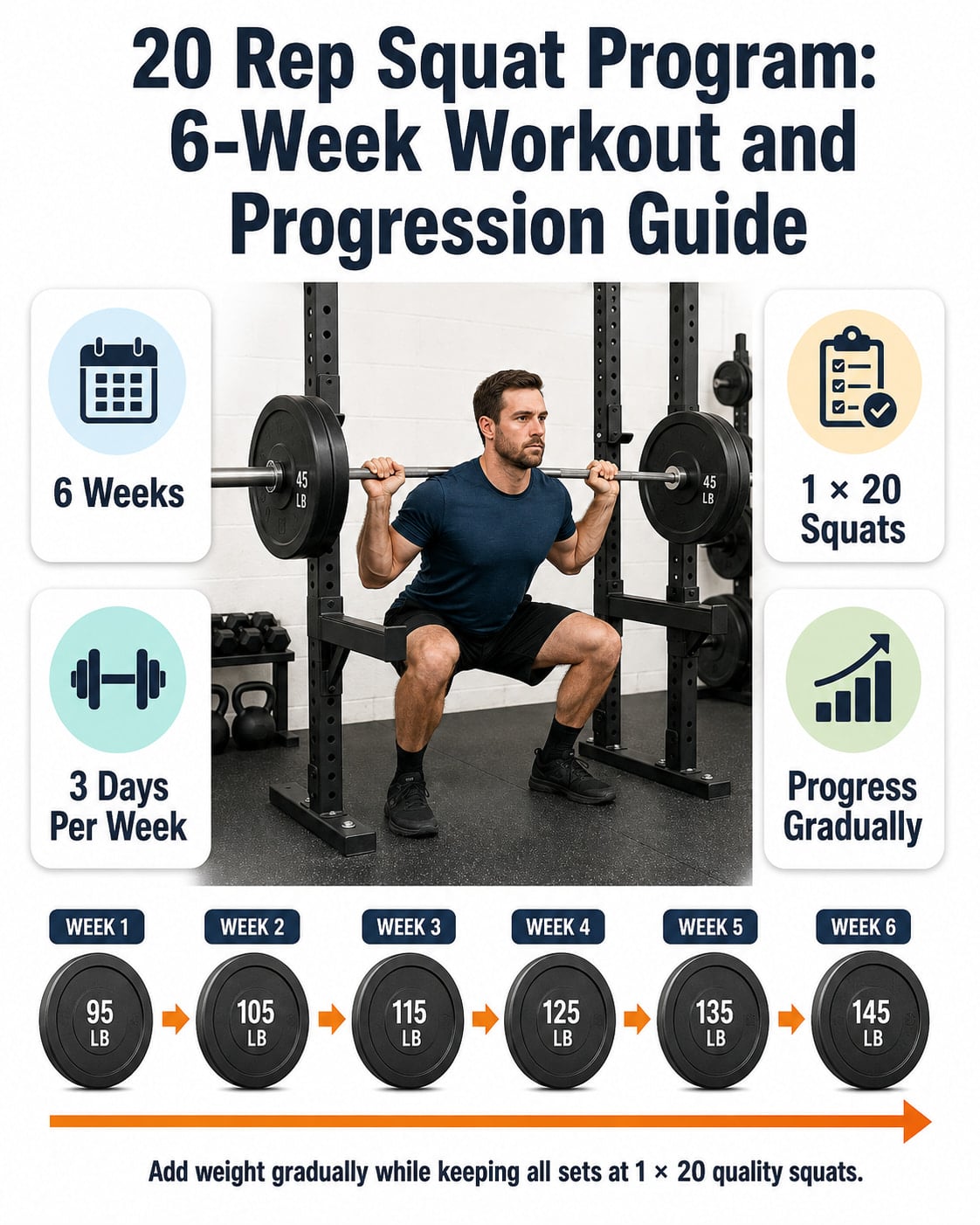
The 20 Rep Squat Program is a six-week squat-specialization routine built around one demanding set of 20 barbell back squats, usually performed two or three times per week. The classic version starts with a weight you would normally squat for 10 repetitions, uses controlled standing breaths to reach 20, and adds weight at the next workout.
That original approach is extremely demanding. Most first-time users should start with a lighter load, train inside a power rack, and increase the weight only after completing all 20 repetitions with consistent technique.
This guide gives you the complete six-week schedule, two full-body workouts, starting-weight guidance, progression rules, recovery advice, and clear instructions for handling missed repetitions.
| Program detail | Recommendation |
|---|---|
| Program length | 6 weeks |
| Main exercise | Barbell back squat |
| Squat work set | 1 set of 20 repetitions |
| Frequency | 3 nonconsecutive days per week |
| Total workouts | 18 |
| Standard progression | Add 2.5–5 pounds after a successful set |
| Experience level | Intermediate or experienced beginner |
| Primary goals | Muscle growth, squat endurance, and general strength |
| Essential equipment | Barbell, plates, power rack, and correctly positioned safeties |
What Is the 20 Rep Squat Program?
The 20 Rep Squat Program is often called the breathing squat program or Super Squats program. Its defining feature is one long set of 20 barbell back squats.
The first several repetitions may feel similar to a normal squat set. As fatigue increases, you remain standing with the bar on your back, take one or more controlled breaths, reset your brace, and perform the next repetition.
These standing breaths provide brief intraset recovery. That is what makes it possible to continue beyond the number of uninterrupted repetitions you would normally complete with the weight.
A publisher-hosted excerpt from IronMind’s Super Squats program describes the classic rules as follows:
- Perform one set of 20 squats.
- Start with a weight normally used for 10 repetitions.
- Add at least 5 pounds at every workout.
- Train two or three times per week.
- Keep the remaining workout simple.
- Support the training with plenty of food and rest.
The program’s simplicity is part of its appeal. However, simple does not mean easy. A properly loaded 20-rep squat set can be one of the most physically demanding parts of a resistance-training program.
Does the 20 Rep Squat Program Work?
The program can work, but its results depend on your starting load, technique, recovery, nutrition, and training experience.
It can support muscle growth
High-repetition resistance training can stimulate muscle growth when the set is sufficiently challenging. A 2021 network meta-analysis found that low-, moderate-, and high-load resistance training can all increase muscle size when performed with high effort.
Heavier loads generally produce greater improvements in one-repetition-maximum strength, while lighter and moderate loads remain useful for hypertrophy.
That means 20-rep squats can be productive for building the quadriceps, glutes, and other muscles involved in squatting. They are not the only effective method, and they have not been proven superior to well-designed conventional training.
It can improve squat endurance
Completing 20 controlled repetitions challenges local muscular endurance as well as your ability to maintain positioning under fatigue. Over six weeks, you may notice that moderate-weight squat sets feel more manageable.
It may increase strength
The program uses progressive overload, so some strength improvement is likely when you consistently add weight. However, the program is not designed specifically to maximize your one-repetition maximum.
The American College of Sports Medicine’s 2026 resistance-training guidelines report that maximal-strength improvements are generally optimized with heavier loads of around 80% of one-repetition maximum or more, typically for two or three sets per exercise. The same guidance notes that greater weekly volume—approximately 10 sets per muscle group—may be useful when maximizing hypertrophy is the priority.
The 20 Rep Squat Program is therefore best viewed as a short specialization block rather than the only training method you will ever need.
Who Should Try the 20 Rep Squat Program?
This program is most appropriate for someone who:
- Already knows how to perform a barbell back squat.
- Can maintain consistent depth and balance under fatigue.
- Has access to a power rack with safety pins or straps.
- Can train on nonconsecutive days.
- Is willing to reduce other demanding lower-body work temporarily.
- Wants a short muscle-building or squat-endurance challenge.
You do not need to be an advanced powerlifter. However, you should be comfortable squatting without needing frequent technique corrections.
Who should not start with 20-rep squats?
A different program is usually more appropriate when you:
- Are completely new to barbell squatting.
- Cannot maintain a stable squat without fatigue.
- Do not have access to rack safeties.
- Currently have knee, hip, back, or other pain that affects your squat.
- Experience chest discomfort, faintness, unexplained dizziness, unusual shortness of breath, or concerning palpitations during exercise.
- Have been advised to avoid vigorous resistance training without supervision.
The official 2025 PAR-Q+ physical activity screening questionnaire can help determine whether you should seek guidance from a healthcare practitioner or qualified exercise professional before increasing your activity level.
Why Safety Matters With High-Rep Squats
A 20-rep squat set is not simply leg training. It can also create substantial breathing and cardiovascular demands.
A 2025 study compared squat sessions using sets of 10, 20, and 30 repetitions at the same relative load in 15 healthy, resistance-trained men. Heart rate, cardiac output, oxygen consumption, and several other physiological responses increased during the higher-repetition conditions.
The study used three sets on a Smith machine, so it did not test the exact program in this article. However, it shows why high-repetition squats should be treated as vigorous exercise rather than a casual conditioning drill. You can read the study through the National Library of Medicine.
Always perform your work set inside a power rack. Position the safety pins or straps slightly below the bottom of your normal squat so they can catch the bar if you cannot stand up.
A spotter may provide additional support, but a spotter should not replace correctly positioned rack safeties.
How to Choose Your Starting Weight
Your starting weight determines whether the program becomes productive or immediately unmanageable.
The classic starting-weight method
The original method instructs you to load the weight you normally squat for 10 repetitions and complete 20 breathing repetitions.
A true 10-repetition maximum is approximately the heaviest load you can lift 10 times without being able to complete an 11th clean repetition. Turning that into a 20-rep set requires standing pauses and considerable effort.
This version is aggressive. It is better suited to experienced lifters who understand their limits and know how their technique changes under fatigue.
The recommended starting method for your first cycle
For your first 20 Rep Squat Program, choose a weight that allows you to complete 20 controlled repetitions while leaving approximately two or three technically sound repetitions in reserve.
The final repetitions should be challenging, but you should not need to:
- Shorten your normal depth.
- Shift heavily onto your toes.
- Collapse through your torso.
- Allow your knees to lose control.
- Take extremely long pauses between every repetition.
- Rely on a spotter to finish the set.
It is better to start 10 pounds too light than 5 pounds too heavy. The planned progression will make the set substantially harder within a few workouts.
A simple starting-weight test
Use this process several days before starting Week 1:
- Complete your normal squat warm-up.
- Select a weight you believe you can squat for at least 20 clean repetitions.
- Perform 20 repetitions while keeping your depth and technique consistent.
- Evaluate the set after racking the bar.
Use that weight for Workout 1 when the set was challenging but controlled. Reduce it by 5% to 10% when you barely completed the set or your technique deteriorated.
How to Warm Up for 20-Rep Squats
Your warm-up should prepare you for the work set without tiring your legs.
A practical warm-up might look like this:
| Warm-up stage | Example |
|---|---|
| General movement | 5–10 minutes of walking, cycling, or easy dynamic movement |
| Empty bar | 8–10 controlled squats |
| Ramp-up set 1 | 5 repetitions with a light load |
| Ramp-up set 2 | 3 repetitions with a moderate load |
| Ramp-up set 3 | 1–2 repetitions near the work-set weight |
| Final rest | Rest 3–5 minutes before the 20-rep set |
The exact number of warm-up sets depends on your strength and work-set weight. Stronger lifters generally need more gradual increases, while someone using a lighter load may need fewer sets.
Do not perform high-repetition warm-up sets. Save your energy for the main set.
How to Perform 20-Rep Breathing Squats
The program depends on maintaining control as fatigue increases. Do not rush the first 10 repetitions simply because they feel manageable.
Step-by-step technique
- Position the bar securely across your upper back.
- Unrack it and take the minimum number of steps needed to establish your stance.
- Keep your feet stable and maintain pressure through the heel, base of the big toe, and base of the little toe.
- Inhale and brace your trunk before descending.
- Squat to your normal controlled depth.
- Stand up while keeping the bar balanced over your midfoot.
- Exhale and regain control at the top.
- Take one or more controlled breaths when necessary.
- Re-brace before starting the next repetition.
- Continue until you complete 20 technically acceptable repetitions.
Your later repetitions will naturally be slower. Slower does not automatically mean unsafe, provided your balance, brace, depth, and bar path remain consistent.
When to end the set early
Rack the bar when:
- You cannot maintain your planned depth.
- Your torso repeatedly collapses.
- You lose balance or control of the bar.
- You feel sharp or increasing pain.
- You feel faint, confused, or unusually short of breath.
- You experience chest discomfort or concerning palpitations.
Completing an unsafe repetition does not make the program more effective. The goal is progressive training, not finishing 20 repetitions at any cost.
The 6-Week 20 Rep Squat Program
The following plan uses three nonconsecutive training days per week. Monday, Wednesday, and Friday work well for many schedules, but any arrangement providing at least one rest day between workouts is acceptable.
Alternate Workout A and Workout B throughout the six weeks.
| Week | Day 1 | Day 2 | Day 3 |
|---|---|---|---|
| 1 | Workout A | Workout B | Workout A |
| 2 | Workout B | Workout A | Workout B |
| 3 | Workout A | Workout B | Workout A |
| 4 | Workout B | Workout A | Workout B |
| 5 | Workout A | Workout B | Workout A |
| 6 | Workout B | Workout A | Workout B |
Perform the squat first, after your warm-up. Keep the remaining workout brief so it does not interfere with squat recovery.
Workout A
| Exercise | Sets × reps | Effort guidance |
|---|---|---|
| Barbell back squat | 1 × 20 | Use the weekly progression |
| Bench press | 2 × 6–10 | Finish with 2–3 reps in reserve |
| Chest-supported row | 2 × 8–12 | Controlled repetitions |
| Plank or dead bug | 2 sets | Stop before form deteriorates |
Workout B
| Exercise | Sets × reps | Effort guidance |
|---|---|---|
| Barbell back squat | 1 × 20 | Use the weekly progression |
| Overhead press | 2 × 6–10 | Finish with 2–3 reps in reserve |
| Lat pulldown or assisted pull-up | 2 × 8–12 | Use a full controlled range |
| Leg curl or light Romanian deadlift | 1–2 × 8–12 | Keep the load moderate |
Choose the leg curl when your lower back feels fatigued from squatting. The Romanian deadlift should remain controlled and should not become a second maximal lower-body exercise.
How to progress the accessory exercises
Do not try to increase every exercise at every workout.
Use a weight that leaves two or three repetitions in reserve. Once you reach the top of the repetition range for both sets with good form, add the smallest available amount at the next appearance of that exercise.
6-Week Squat Progression Table
The classic progression adds 5 pounds after every completed workout. With three weekly workouts, that creates 18 squat sessions and 17 planned increases.
| Week | Workout 1 | Workout 2 | Workout 3 |
|---|---|---|---|
| 1 | Starting weight | Start + 5 lb | Start + 10 lb |
| 2 | Start + 15 lb | Start + 20 lb | Start + 25 lb |
| 3 | Start + 30 lb | Start + 35 lb | Start + 40 lb |
| 4 | Start + 45 lb | Start + 50 lb | Start + 55 lb |
| 5 | Start + 60 lb | Start + 65 lb | Start + 70 lb |
| 6 | Start + 75 lb | Start + 80 lb | Start + 85 lb |
This table shows what happens mathematically when every workout is successful. It is not a requirement to add 85 pounds in six weeks.
A 5-pound increase may become too aggressive, particularly for lighter or less experienced lifters. Microplates allow you to use increases of 1 to 2.5 pounds. With metric plates, use the smallest practical increase, which may be 1 to 2.5 kilograms.
How to Progress Without Forcing Bad Reps
Use the quality of your work set—not the calendar—to determine your next weight.
| Workout result | What to do next |
|---|---|
| 20 controlled reps with consistent depth | Add 2.5–5 lb |
| 20 reps, but technique deteriorated noticeably | Repeat the same weight |
| 17–19 clean reps because of muscular fatigue | Repeat the same weight once |
| Fewer than 17 reps without another clear explanation | Reduce the weight by approximately 5% |
| Same weight missed twice | Reduce by 5%–10% and rebuild |
| Poor sleep or unusual fatigue before training | Repeat or slightly reduce the load |
| Pain, dizziness, chest symptoms, or loss of balance | Stop; do not treat it as a normal failed set |
Repeating a load is not failure. It is a normal adjustment that allows you to continue progressing without turning the program into repeated maximal attempts.
Keep a training log
Record the following after every session:
- Squat weight.
- Number of completed repetitions.
- Approximate number of standing breaths.
- Technique quality.
- Overall effort.
- Any pain or unusual symptoms.
- Sleep and general recovery.
Your log will show whether the weight is increasing faster than your recovery can support.
Can You Do the Program Twice Per Week?
Yes. The classic method allows two or three weekly workouts.
A twice-weekly schedule may be better when you:
- Need more time to recover.
- Are also doing a physical job or another sport.
- Are older or returning after a training break.
- Notice that your performance consistently declines with three weekly sessions.
Use Monday and Thursday or another schedule with two or three rest days between sessions.
You will complete 12 workouts in six weeks rather than 18. If you want to complete the full 18-session progression at twice weekly, extend the program to nine weeks.
Do not compensate for the lower frequency by making larger weight increases.
Recovery and Nutrition for 20-Rep Squats
Recovery is a central part of the program. Adding more exercises, conditioning, or failure training may reduce your ability to progress on the main set.
Reduce competing leg work
During the six-week cycle, limit:
- Additional high-volume squat variations.
- Heavy deadlifts multiple times per week.
- High-intensity sprint sessions.
- Frequent training to failure.
- Long, demanding lower-body workouts on rest days.
Easy walking, light cycling, and moderate recreational activity are generally easier to combine with the program than hard intervals.
Eat enough to support your goal
You do not need to follow the historical recommendation of drinking large quantities of milk. Milk can be a convenient source of calories and protein for people who tolerate it, but it is not required.
Build your diet around:
- Protein-rich foods.
- Carbohydrate sources that support training.
- Fruits and vegetables.
- Adequate fluids.
- Enough total food to maintain or gradually increase bodyweight when muscle gain is the goal.
The International Society of Sports Nutrition recommends approximately 1.4–2.0 grams of protein per kilogram of bodyweight per day, or roughly 0.64–0.91 grams per pound, for most exercising individuals.
You do not need a supplement when you can meet your needs through food.
Protect your rest days
Avoid treating every rest day as another hard training day. A 20-rep squat set can produce significant soreness and fatigue, especially during the first two weeks.
Keep a consistent sleep schedule and pay attention to declining performance, unusually persistent soreness, reduced motivation, or difficulty completing weights that previously felt manageable. Those signs may indicate that you need to repeat a load, reduce accessories, or use the twice-weekly schedule.
What Results Can You Expect?
Reasonable outcomes may include:
- Improved tolerance for high-repetition squats.
- Increased quadriceps and glute training stimulus.
- Better ability to maintain technique under fatigue.
- Increased squat strength at moderate repetition ranges.
- Some increase in muscle size when nutrition and recovery are adequate.
- Improved confidence with demanding barbell sets.
Results vary considerably. Training history, genetics, starting strength, food intake, sleep, and progression all affect the outcome.
The historical promise of gaining 30 pounds of muscle in six weeks should not be treated as a predictable result. Rapid changes on the scale may include water, glycogen, food mass, and body fat in addition to any new muscle tissue.
Common 20 Rep Squat Program Mistakes
Starting with a true 10RM before you are ready
The classic recommendation is unnecessarily aggressive for many first-time users. Begin with a load you can control for all 20 repetitions and allow the progression to create difficulty.
Relaxing at the top
The standing position is a breathing opportunity, not an opportunity to lose your posture. Keep your feet planted, upper back engaged, and bar balanced while you breathe.
Rushing the early repetitions
Moving too quickly can create unnecessary fatigue and disrupt your technique. Use a controlled, repeatable rhythm from the first repetition.
Adding weight after a poor-quality set
Twenty repetitions only count as a successful set when they meet your basic technique standards. Repeat the weight when several repetitions were shallow, unstable, or poorly controlled.
Doing too much accessory work
The squat set is the program’s priority. Extra leg presses, lunges, deadlifts, and failure sets can quickly exceed your ability to recover.
Treating pain as normal discomfort
Muscular burning and heavy breathing are common during high-repetition squats. Sharp pain, increasing joint pain, chest discomfort, dizziness, or loss of balance are not normal signs to push through.
What to Do After Week 6
Do not finish the final session on Friday and immediately begin another maximal training block on Monday.
Use the following week as a transition:
- Remove the 20-rep work set.
- Reduce your squat volume by approximately half.
- Use lighter, technically controlled sets.
- Keep accessory exercises several repetitions away from failure.
- Review your training log and identify which progression rate worked.
After the transition week, return to a balanced strength or hypertrophy program. Depending on your goal, that might include multiple squat sets in the 3–8 or 6–12 repetition range.
You may repeat the 20 Rep Squat Program in the future, but it works best as an occasional specialization phase rather than continuous year-round training.
Frequently Asked Questions
How much weight should I use for 20-rep squats?
The classic program starts with your normal 10-repetition weight. For your first cycle, a safer choice is a load you can squat 20 times with consistent form while leaving approximately two or three clean repetitions in reserve. Start lighter when uncertain.
How often should I do 20-rep squats?
The classic frequency is two or three times per week. The six-week schedule in this guide uses three nonconsecutive days to provide 18 workouts. Use twice-weekly training when you need more recovery.
Can beginners do the 20 Rep Squat Program?
Complete beginners should first learn the squat through a lower-fatigue program. The 20-rep routine is more appropriate after you can consistently control your stance, brace, depth, and bar path.
Do 20-rep squats build muscle?
They can provide a strong hypertrophy stimulus when the load is challenging and you recover adequately. However, they are not proven to build more muscle than every other form of resistance training.
What should I do if I cannot complete all 20 repetitions?
Repeat the same weight at the next workout when you complete 17–19 technically sound repetitions. Reduce the weight when you miss the same load twice or when technique breaks down early in the set.
Can I use a safety squat bar or front squat?
A safety squat bar can work when you already know how to use it and keep the setup consistent throughout the program. Front squats are less suitable for many people because the upper back and rack position may fail before the legs receive the intended stimulus. The classic exercise is the barbell back squat.
Do I need to drink milk while following the program?
No. Milk was part of the historical high-calorie approach, but it is not required. Use any balanced combination of foods that provides sufficient calories, protein, carbohydrates, micronutrients, and fluids.
Conclusion
The 20 Rep Squat Program can be an effective six-week challenge for lifters who already have dependable squat technique and access to appropriate safety equipment. Its value comes from consistent practice, progressive overload, and focused recovery—not from forcing every session to become an all-out test.
Choose a conservative starting weight, perform every repetition with control, and add weight only after a successful set. Record each workout, reduce unnecessary lower-body volume, and adjust the schedule when your recovery cannot match the planned progression.
References
- IronMind: Super Squats program excerpt
- American College of Sports Medicine: 2026 Resistance Training Guidelines
- Resistance Training Load Effects on Muscle Hypertrophy and Strength
- Repetition-Dependent Acute Cardiopulmonary Responses During Squats
- 2025 Physical Activity Readiness Questionnaire for Everyone
- International Society of Sports Nutrition Position Stand: Protein and Exercise