
Supraspinatus exercises are rotator cuff moves that strengthen the small stabilizing muscles around your shoulder so your arm can lift and move overhead with better control and less irritation. Understanding how to train the supraspinatus matters because shoulder discomfort often shows up when the joint isn’t stable during lifting, reaching, sports, or long desk posture.
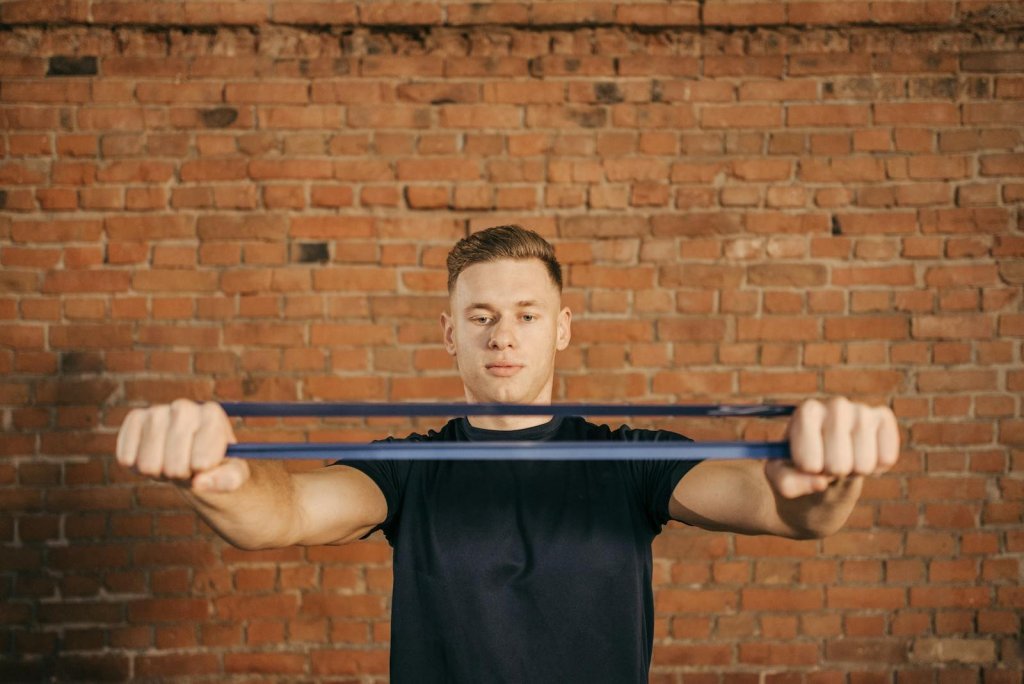
Most evidence-based shoulder programs focus on three pillars: gentle range-of-motion, rotator cuff strengthening (especially external rotation and scaption), and scapular control. The American Academy of Orthopaedic Surgeons (AAOS) emphasizes that shoulder conditioning programs should match your condition and may benefit from professional guidance when needed.
What Is the Supraspinatus and Why It Matters
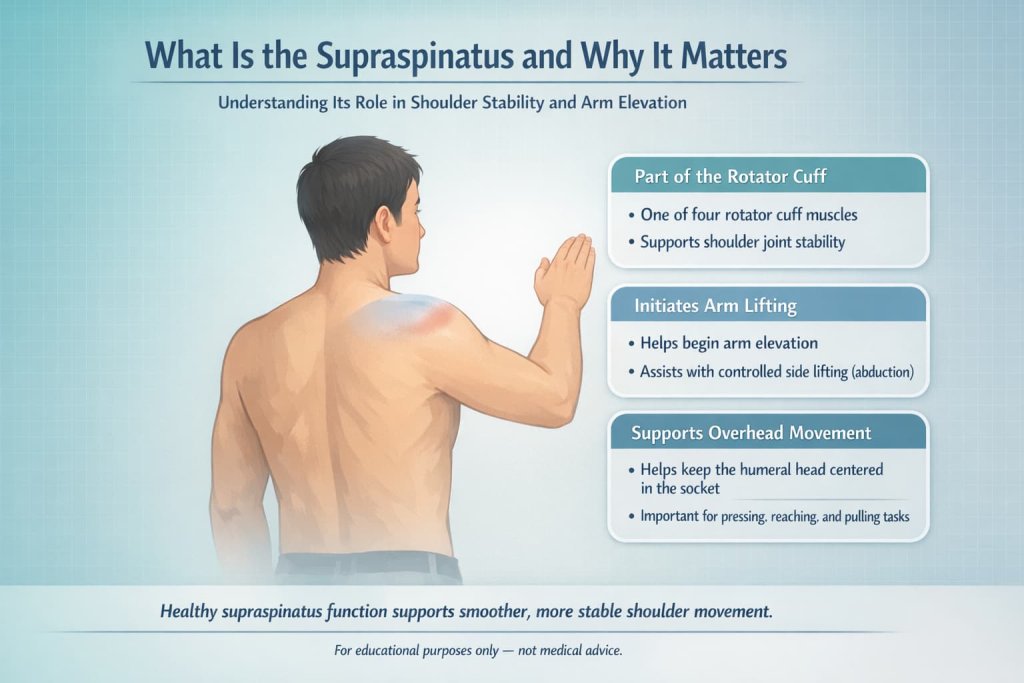
The supraspinatus is one of the four rotator cuff muscles. It helps initiate arm lifting and supports the head of the humerus in the shoulder socket during elevation. When it’s irritated or weak, you may notice discomfort with reaching overhead, lifting to the side, or certain pressing and pulling movements.
Common Signs of Supraspinatus Weakness or Irritation
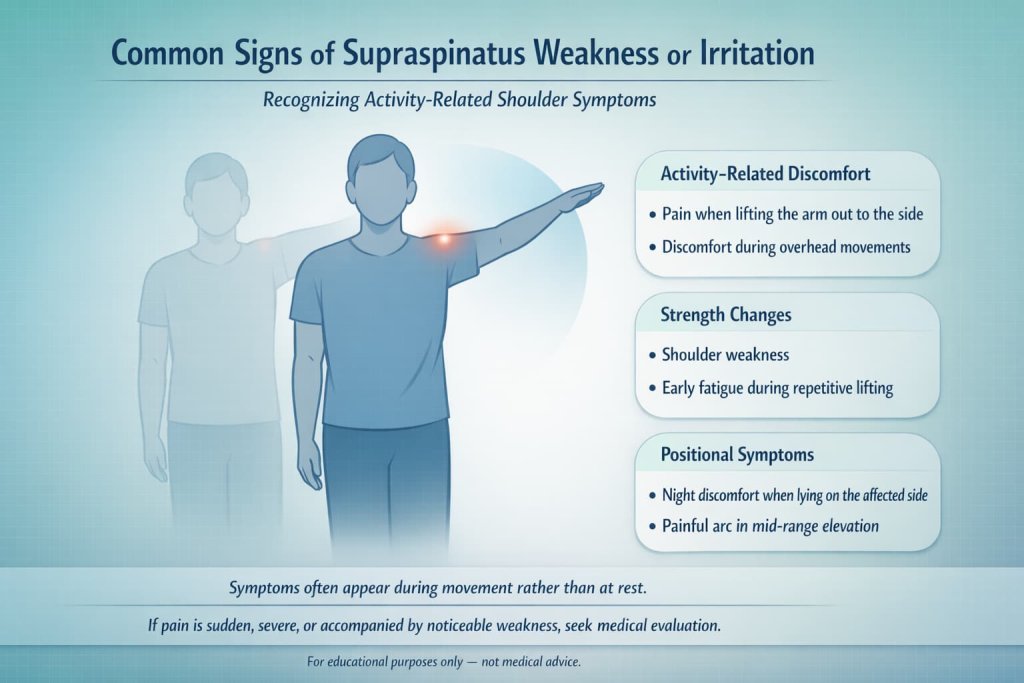
Supraspinatus irritation typically causes discomfort during arm lifting rather than constant pain at rest. Because this muscle helps initiate shoulder abduction and stabilize the joint, symptoms often appear with side or overhead movements.
Common signs include:
- Pain when lifting the arm out to the side
- Discomfort during overhead activities
- Shoulder weakness or early fatigue
- Night pain when lying on the affected side
- A “painful arc” in the middle of the lifting range
If pain is sudden, severe, or accompanied by noticeable weakness, medical evaluation is recommended.
Supraspinatus Exercises Safety Rules Before You Start
Use these rules to keep shoulder training joint-friendly:
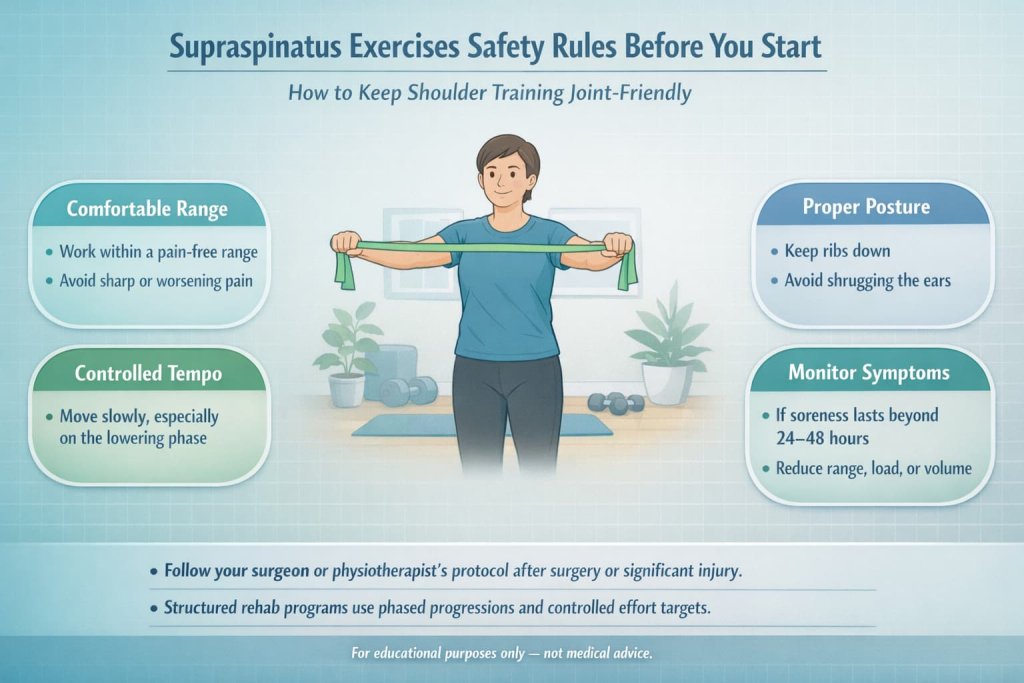
- Work in a comfortable range. Mild effort is fine; sharp pain is not.
- Move slowly on the lowering phase.
- Keep your ribs down and avoid shrugging up toward your ears.
- Start light (band or 1–5 lb / 0.5–2 kg) and progress gradually.
- If symptoms flare after training and stay worse for 24–48 hours, reduce range, load, or volume.
If you recently had surgery or a significant shoulder injury, follow your surgeon or physiotherapist’s protocol first. Many structured rehabilitation programs from institutions such as University Hospital Southampton NHS Foundation Trust outline phased progressions and effort targets.
9 Best Supraspinatus Exercises
Build stronger, more stable shoulders with these 9 evidence-informed supraspinatus exercises designed to support rotator cuff function and controlled arm movement.
These movements focus on safe progressions, scapular control, and pain-guided strengthening for better overhead comfort.
1) Pendulum Swings
Why it works: Pendulums are a low-load way to keep the shoulder moving without forcing the rotator cuff to work hard. They are commonly used early in rehabilitation to reduce stiffness and support comfort while maintaining gentle joint motion.
Muscles worked: This movement promotes gentle shoulder capsule motion with light activation around the rotator cuff and scapular stabilizers without heavy muscular demand.
How to do it:
- Lean forward and support your body with one hand on a table or chair.
- Let the other arm hang relaxed.
- Gently swing the arm forward and back, side to side, and in small circles.
- Keep the movement smooth and pain-free for 30–60 seconds.
Trainer Tip: Let your body create the movement by shifting your weight slightly. Avoid actively lifting the shoulder.
2) Isometric Shoulder Abduction (Wall Press)
Why it works: Isometrics help build rotator cuff tolerance with minimal joint movement. This makes them useful when lifting the arm feels sensitive but you still want to maintain muscle activation.
Muscles worked: Supraspinatus, light deltoid activation, and supporting rotator cuff stabilizers.
How to do it:
- Stand sideways next to a wall with your elbow bent to 90 degrees.
- Place the outside of your upper arm or elbow gently against the wall.
- Press into the wall at low effort (around 3–5 out of 10).
- Hold for 10–20 seconds, relax, and repeat.
Trainer Tip: Keep your shoulder down and back. Avoid shrugging or leaning into the wall.
3) Scaption Raise (Thumb Up “Full Can”)
Why it works: Scaption raises the arm in the scapular plane (about 30–45 degrees forward from the side), which many people tolerate better than strict lateral raises. The thumb-up position is commonly used in rehab settings because it may reduce stress on sensitive shoulder structures while still activating the supraspinatus.
Muscles worked: Supraspinatus, middle deltoid, serratus anterior, and lower trapezius for stabilization.
How to do it:
- Stand tall holding light dumbbells or no weight.
- Turn your thumbs up.
- Raise your arms slightly forward from your sides.
- Lift only to a comfortable height.
- Lower slowly and repeat.
Trainer Tip: Start with a small range of motion and slow tempo. Control matters more than height.
4) Side-Lying External Rotation
Why it works: External rotation is a foundational exercise in most rotator cuff programs because it strengthens stabilizers that help keep the shoulder centered during lifting and overhead movements.
Muscles worked: Infraspinatus, teres minor, and supraspinatus for stabilization support.
How to do it:
- Lie on your side with the working arm on top.
- Bend your elbow to 90 degrees and place a towel between your elbow and ribs.
- Rotate your forearm upward while keeping the elbow tucked.
- Lower slowly with control.
Trainer Tip: The towel helps maintain better shoulder alignment and reduces elbow drift.
5) Standing Band External Rotation
Why it works: Resistance bands allow gradual, adjustable loading and help build rotator cuff endurance and neuromuscular control.
Muscles worked: External rotators, supraspinatus (stabilization), and scapular stabilizers.
How to do it:
- Attach a light resistance band at elbow height.
- Stand sideways with your elbow bent to 90 degrees and tucked at your side.
- Rotate the forearm outward without letting the elbow move away from your body.
- Return slowly to the starting position.
Trainer Tip: Keep your ribs down and avoid twisting your torso to create momentum.
6) Band Full Can Scaption
Why it works: Bands maintain tension throughout the movement and can feel smoother than dumbbells for some individuals, especially when building early strength.
Muscles worked: Supraspinatus, deltoid, and serratus anterior.
How to do it:
- Stand on a light resistance band holding the ends.
- Keep thumbs up and arms slightly forward from your sides.
- Lift to a comfortable height.
- Lower slowly with control.
Trainer Tip: If form changes or you feel neck tension, reduce band resistance immediately.
7) Prone T Raise (Thumb Up)
Why it works: Strengthening the upper back helps balance shoulder mechanics and may reduce strain on the rotator cuff during lifting and reaching.
Muscles worked: Mid trapezius, posterior deltoid, and rotator cuff stabilizers.
How to do it:
- Lie face down on a bench or bed.
- Raise your arms out to the side into a T shape with thumbs up.
- Pause briefly at the top.
- Lower slowly and repeat.
Trainer Tip: Keep your neck neutral and avoid shrugging the shoulders upward.
8) Serratus Wall Slide
Why it works: Improved scapular control may help support smoother overhead motion and reduce overload on the supraspinatus during elevation.
Muscles worked: Serratus anterior, lower trapezius, and rotator cuff stabilizers.
How to do it:
- Stand facing a wall with forearms resting on the wall.
- Slide your arms upward slowly.
- Keep ribs down and avoid shrugging.
- Slide back down with control.
Trainer Tip: Only add a light band around the wrists if you can maintain smooth, controlled movement.
9) Shoulder Flexion Isometric (30–60 Degrees)
Why it works: Small-angle isometrics build tolerance and shoulder control while minimizing joint stress, which can be helpful in early strengthening phases.
Muscles worked: Supraspinatus (stabilization), anterior deltoid (light), and rotator cuff.
How to do it:
- Raise your arm slightly in front of you (30–60 degrees).
- Press gently into a wall or stable surface.
- Hold for 10–20 seconds.
- Relax and repeat.
Trainer Tip: Keep effort low and guided by comfort. If symptoms increase, reduce the angle or intensity.
How to Program Supraspinatus Exercises
A simple starting framework:
- Frequency: 3–5 days per week for light work
- Sets: 2–3 per exercise
- Reps: 8–15 controlled reps
- Isometrics: 5–8 holds of 10–20 seconds
- Rest: 30–60 seconds between sets
Progress gradually by increasing repetitions before adding load.
Common Mistakes That Can Irritate the Supraspinatus
- Using heavy weights too soon
- Shrugging during raises
- Forcing overhead range when painful
- Moving too quickly
- Ignoring scapular strengthening
Who Should Avoid or Modify Supraspinatus Exercises
Get medical guidance if you have:
- Sudden weakness after injury
- Significant swelling, redness, or warmth
- Rapidly worsening night pain
- Numbness or tingling with weakness
- A recent surgery or confirmed full-thickness tear
The American Academy of Orthopaedic Surgeons (AAOS) advises matching exercise programs to the specific diagnosis and recovery stage.
FAQs About Supraspinatus Exercises
How long do supraspinatus exercises take to work?
Improvements often take several weeks of consistent practice. Strength and tolerance typically build gradually over 6–12 weeks depending on the condition.
Should supraspinatus exercises hurt?
They should not cause sharp pain. Mild effort is acceptable, but worsening pain that lingers is a sign to reduce intensity or seek guidance.
What is the best beginner supraspinatus exercise?
Pendulum swings, low-effort wall isometrics, and light thumb-up scaption are usually good starting points.
Can I train the supraspinatus every day?
Light mobility and isometrics may be tolerated most days. Heavier strengthening is usually better 2–3 times per week.
Do I need scapular exercises too?
Yes. Proper scapular control supports shoulder mechanics and may reduce strain on the rotator cuff.
Are bands or dumbbells better?
Both can work. Bands provide smooth tension; dumbbells offer measurable loading. Choose what allows clean, controlled movement.
Conclusion
Supraspinatus exercises are most effective when you combine thumb-up scaption, external rotation work, and scapular control, then progress gradually. Consistency and proper form matter more than heavy resistance. If symptoms persist or worsen, consider professional evaluation to ensure your program matches your specific condition.
This content is for informational purposes only and not medical advice.
References
- American Academy of Orthopaedic Surgeons (AAOS) — Shoulder Rehabilitation PDF (Exercise Conditioning Program)
- Journal of Orthopaedic & Sports Physical Therapy (JOSPT) — 2025 Clinical Practice Guideline: Rotator Cuff Tendinopathy
- PubMed — Rotator Cuff Tendinopathy Clinical Practice Guideline Record (2025)
- PubMed Central — Exercise Rehabilitation in the Non-Operative Management of Rotator Cuff Tears (2016)
- Massachusetts General Hospital — Rehabilitation Protocol for Non-Operative Massive Rotator Cuff Tear(s)
- Kingston and Richmond NHS Foundation Trust — Shoulder Exercises for Rotator Cuff Tear