
Tennis elbow exercises are a mix of gentle stretching and progressive strengthening that gradually reloads the irritated tendon so you can reduce pain and rebuild grip and forearm strength. Understanding the right exercises (and the right progression) matters because doing “too much, too soon” is one of the most common reasons symptoms linger.

This guide follows conservative exercise guidance from the American Academy of Orthopaedic Surgeons and the NHS, along with modern physical therapy clinical practice guidelines for lateral elbow tendinopathy.
What Are Tennis Elbow Exercises?
Tennis elbow—often referred to clinically as lateral elbow tendinopathy or lateral epicondylitis—typically involves irritation of the tendon where the wrist extensor muscles attach near the outside of the elbow.
Tennis elbow exercises are designed to:
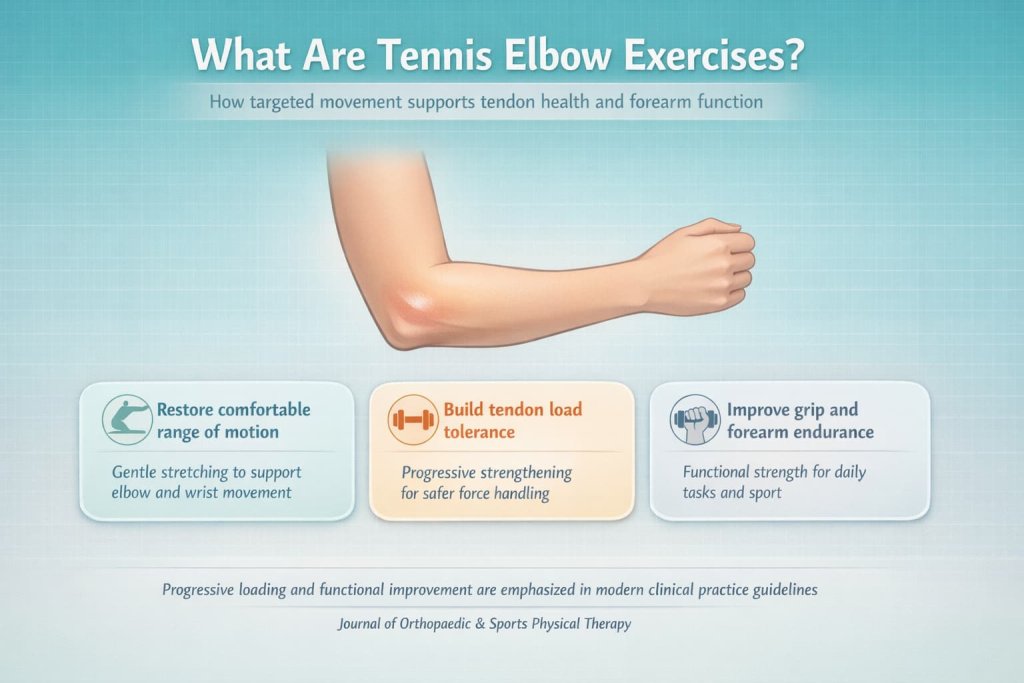
- Restore comfortable range of motion through gentle stretching
- Build tendon tolerance using progressive loading
- Improve grip strength and forearm endurance for daily activities and sport
Current clinical practice guidelines published by the Journal of Orthopaedic & Sports Physical Therapy emphasize progressive loading and functional improvement rather than relying on passive treatments alone.
When to Do Tennis Elbow Exercises and When to Get Checked First
Exercises are usually appropriate when pain is localized to the outer elbow and aggravated by gripping, lifting, or wrist extension.
Seek medical or physical therapy input first if you experience:
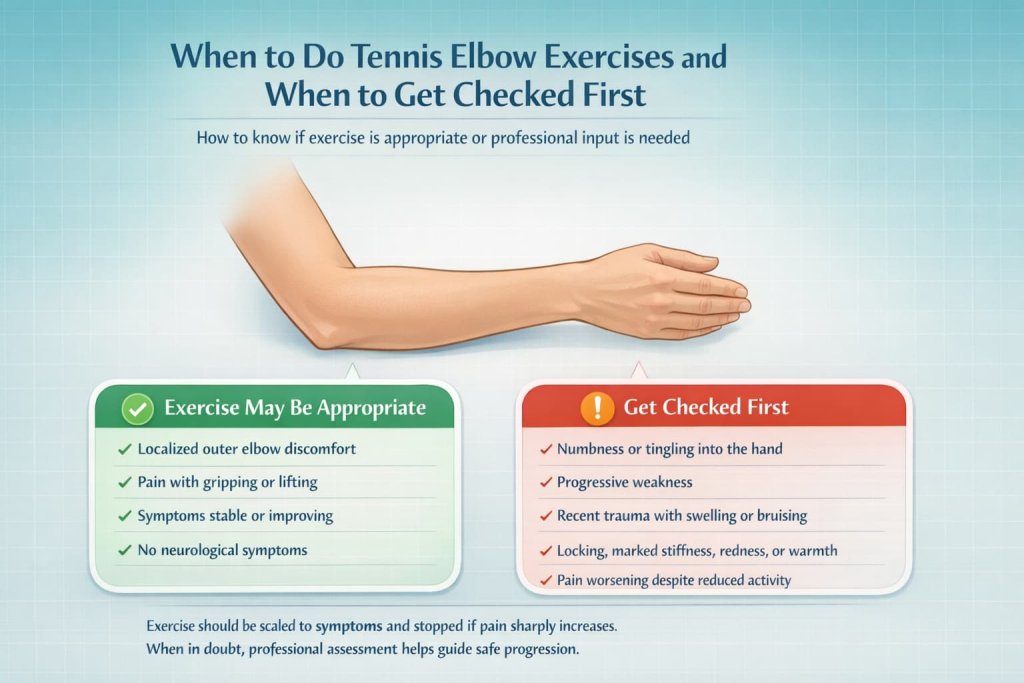
- Numbness or tingling into the hand
- Progressive weakness
- Recent trauma with swelling or bruising
- Locking, severe motion loss, redness, or warmth
- Pain that continues to worsen despite activity modification
10 Best Tennis Elbow Exercises
Tennis elbow exercises focus on gentle stretching and progressive strengthening to reduce pain and rebuild forearm and grip strength. When performed consistently and progressed gradually, these exercises help restore tendon load tolerance and support long-term elbow function.
1. Wrist Extensor Stretch
Why it works:
This stretch gently lengthens the wrist extensor muscles that commonly become overworked with repetitive gripping and wrist extension. Reducing resting tension in these muscles may help ease stiffness and make daily hand use more comfortable.
Muscles worked:
Wrist extensors, including extensor carpi radialis brevis and extensor carpi radialis longus.
How to do it:
- Extend the affected arm straight in front of you with the elbow relaxed
- Turn the palm to face down
- Use the opposite hand to gently bend the wrist downward
- Hold for 15–30 seconds without forcing the stretch
- Repeat 2–4 times
Trainer Tip:
You should feel a mild stretch through the forearm, not sharp elbow pain. If discomfort increases, reduce the stretch angle.
2. Wrist Flexor Stretch
Why it works:
Maintaining flexibility on the palm-side of the forearm helps balance wrist mechanics and may reduce compensatory tension that increases strain at the elbow.
Muscles worked:
Wrist flexor muscle group.
How to do it:
- Extend the affected arm with the palm facing up
- Gently pull the fingers and palm back using the opposite hand
- Keep the elbow relaxed, not locked
- Hold for 15–30 seconds
- Repeat 2–4 times
Trainer Tip:
This stretch should feel smooth and controlled. Back off if elbow pain increases rather than decreases.
3. Isometric Wrist Extension Hold
Why it works:
Isometric loading allows the tendon to experience force without joint movement, making it useful when symptoms are sensitive or easily aggravated by motion.
Muscles worked:
Wrist extensors.
How to do it:
- Rest the forearm on a table with the palm facing down
- Place the opposite hand over the back of the affected hand
- Attempt to lift the wrist while resisting so no movement occurs
- Hold for 10–30 seconds
- Repeat 3–5 times
Trainer Tip:
Use about 50–70% effort. Stronger contractions are not necessary and may increase irritation.
4. Eccentric Wrist Extension
Why it works:
Slow, controlled lowering helps improve tendon load tolerance and strength, which is important for long-term recovery.
Muscles worked:
Wrist extensors.
How to do it:
- Support the forearm on a table with the wrist hanging off the edge
- Use the non-affected hand to help lift the weight
- Slowly lower the affected wrist over 3–5 seconds
- Perform 2–3 sets of 8–12 reps
Trainer Tip:
Start with no weight or a very light object. Tendons respond better to gradual progression than heavy loading.
5. Wrist Extension Full Repetitions
Why it works:
Full-range wrist extension builds functional strength needed for lifting, carrying, and everyday hand use.
Muscles worked:
Wrist extensors.
How to do it:
- Support the forearm with the palm facing down
- Lift the wrist up through a comfortable range
- Lower it back down with control
- Perform 2–3 sets of 10–15 reps
Trainer Tip:
If pain increases during or after the set, reduce range of motion or return temporarily to isometric holds.
6. Forearm Pronation and Supination
Why it works:
Rotational forearm strength supports tasks like turning keys, using tools, and sport-specific movements that often aggravate tennis elbow.
Muscles worked:
Pronators, supinators, and supporting forearm stabilizers.
How to do it:
- Hold a hammer or light dumbbell with the elbow at your side
- Rotate the forearm slowly palm up, then palm down
- Keep the movement controlled
- Perform 2–3 sets of 8–12 reps each direction
Trainer Tip:
Grip closer to the head of the hammer to reduce load if discomfort appears.
7. Radial Deviation Strengthening
Why it works:
Strengthening radial deviation improves wrist stability during gripping and lifting, helping distribute forces away from the elbow.
Muscles worked:
Radial wrist stabilizers and assisting extensors.
How to do it:
- Support the forearm on a table with the thumb facing upward
- Lift the wrist toward the thumb side
- Lower slowly
- Perform 2–3 sets of 10–15 reps
Trainer Tip:
Small, controlled movements are more effective than large, fast motions.
8. Finger Extension With Rubber Band
Why it works:
Finger extension work balances frequent gripping by strengthening the opposing muscles, which may reduce excessive forearm tension.
Muscles worked:
Finger extensors.
How to do it:
- Place a rubber band around all five fingers
- Open the hand against the band
- Slowly return to the starting position
- Perform 2–3 sets of 15–25 reps
Trainer Tip:
Forearm fatigue is normal, but elbow pain is a signal to reduce resistance.
9. Gentle Grip Squeeze
Why it works:
Gradual grip loading restores endurance needed for daily activities without excessive tendon strain.
Muscles worked:
Forearm flexors and stabilizing muscles.
How to do it:
- Squeeze a soft ball or rolled towel at about 30–50% effort
- Hold for 3–5 seconds
- Relax fully between reps
- Perform 2–3 sets of 10–20 reps
Trainer Tip:
Avoid maximal squeezing early in recovery. Progress volume before intensity.
10. Scapular Retraction Row
Why it works:
Improving shoulder blade control can reduce unnecessary stress placed on the elbow during upper-limb tasks.
Muscles worked:
Mid-back muscles, including rhomboids and middle trapezius, plus rear deltoids.
How to do it:
- Anchor a resistance band at chest height
- Pull the band toward your chest while squeezing shoulder blades together
- Pause briefly, then return slowly
- Perform 2–3 sets of 10–15 reps
Trainer Tip:
Keep wrists neutral and grip relaxed to prevent turning this into a forearm-dominant exercise.
How to Progress Tennis Elbow Exercises Over Time
Progression should be slow and symptom-guided, not based on fixed timelines.
A safe progression approach:
- Start with low-load exercises such as isometrics
- Increase repetitions before adding resistance
- Progress to controlled full-range movements
- Add small weight increases only when symptoms stay stable
Mild discomfort during exercise can be acceptable, but pain should not worsen or remain elevated the next day. This gradual progression model aligns with conservative guidance from the American Academy of Orthopaedic Surgeons and helps reduce flare-ups.
How to Use This Routine Safely
Follow these principles to keep exercises productive and safe:
- Work within a tolerable discomfort range; sharp pain is a signal to stop
- Start with very light resistance and progress gradually
- Increase repetitions first, then load only when symptoms stay stable
The American Academy of Orthopaedic Surgeons recommends gradual progression based on symptom response rather than fixed timelines.
Simple Weekly Structure
- Daily: Stretching exercises
- 3–5 days per week: Strength exercises
- Progress volume first, then resistance
This gradual progression approach aligns with rehabilitation guidance from the American Academy of Orthopaedic Surgeons.
Common Mistakes That Slow Recovery
- Overloading grip too early
- Ignoring pain signals
- Increasing weight too quickly
- Aggressive stretching
What Else May Help Alongside Exercises?
Activity modification is commonly advised by the NHS, particularly avoiding repetitive gripping while rebuilding strength.
Evidence summarized by the Cochrane Library suggests that exercise, sometimes combined with manual therapy, may provide short-term symptom improvement.
Frequently Asked Questions
How long does recovery usually take?
Improvement often occurs over weeks, but tendon adaptation commonly takes several months.
Should I exercise every day?
Stretching can be daily; strengthening is usually best 3–5 days per week.
Are eccentric exercises mandatory?
No. Programs often combine isometric, eccentric, and full-range loading depending on symptom tolerance.
Should I stop all activity?
Usually not—reducing aggravating tasks while maintaining movement is typically preferred.
When should I see a professional?
If pain limits daily activities or fails to improve after several weeks of consistent exercise.
Conclusion
Tennis elbow responds best to patience, consistency, and progressive loading. Start light, progress gradually, and respect symptom feedback to restore strength and function safely.