
The TKE exercise (Terminal Knee Extension) is a targeted strengthening movement that trains the final phase of knee straightening to improve quadriceps activation, knee stability, and movement control.
Understanding how to perform TKEs correctly matters because controlled knee extension plays a key role in walking, standing up from a chair, climbing stairs, and returning to activity after periods of knee weakness. When done with proper technique and appropriate resistance, TKEs can be a safe, effective way to support knee function in both rehab-style and general strength programs.
This guide explains what the TKE exercise is, how to do it correctly, its benefits, safety considerations, and how to program it responsibly—based on widely accepted clinical and exercise science guidance.
What Is the TKE Exercise?
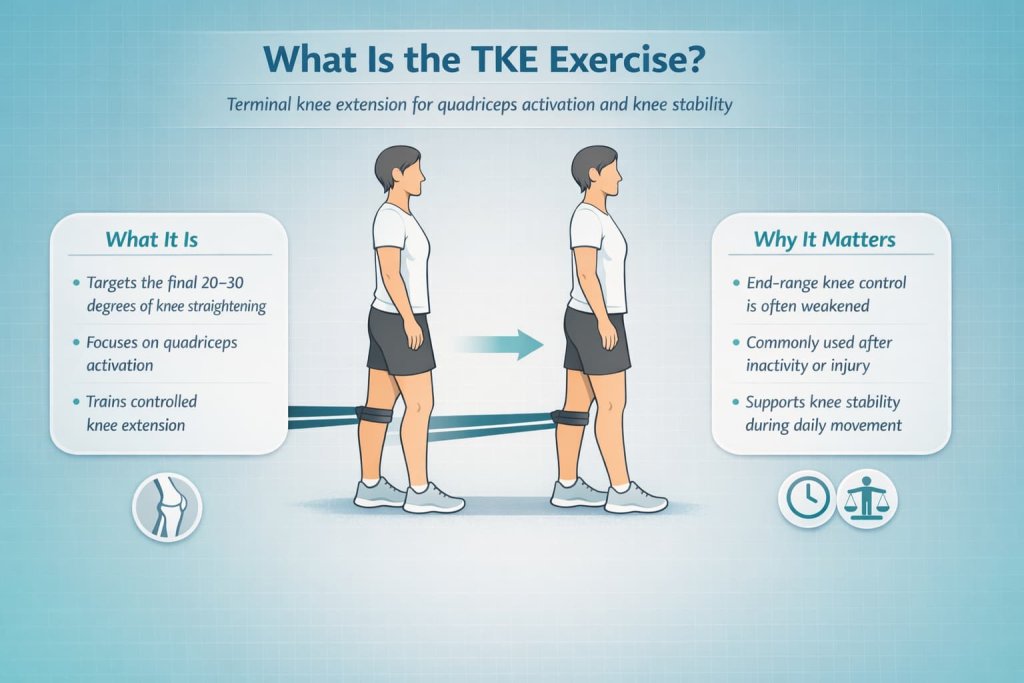
The TKE exercise, short for terminal knee extension, focuses on strengthening the quadriceps during the last 20–30 degrees of knee straightening. This end-range control is often where weakness or poor muscle activation shows up, especially after injury, surgery, or prolonged inactivity.
TKEs are most commonly performed with a resistance band anchored behind the knee, though supine (lying) and seated variations are also widely used in clinical settings. Organizations such as the American Academy of Orthopaedic Surgeons include terminal knee extension movements in multiple knee conditioning and recovery programs.
How to Do the TKE Exercise (Band Version)
How to do it
- Anchor a resistance band at knee height behind you
- Loop the band behind the working knee
- Stand tall with the foot flat on the floor
- Start with the knee slightly bent
- Slowly straighten the knee against band tension
- Fully extend the knee without locking aggressively
- Control the return to the starting position
Move slowly and deliberately—control matters more than resistance.
Why the TKE Exercise Works
The quadriceps are responsible for knee extension, but many people struggle to fully activate them near lockout. TKEs isolate this exact range, reinforcing neuromuscular control where it is often weakest.
Clinical exercise programs highlighted by organizations such as the Mayo Clinic emphasize gradual strengthening and consistent loading rather than complete rest when addressing knee weakness. TKEs align with this approach by providing low-impact, highly controlled resistance.
Muscles Worked During TKEs
The TKE exercise primarily targets:
- Quadriceps (especially the vastus medialis)
- Knee stabilizers
- Hip and ankle stabilizers (secondary support during standing)
While the movement looks simple, maintaining upright posture and foot contact also encourages coordinated lower-body control.
Key Benefits of the TKE Exercise
Improves Quadriceps Activation
TKEs help restore quad engagement in individuals who struggle to “feel” their quadriceps during larger movements like squats or step-ups.
Supports Knee Stability
Controlled terminal extension helps reinforce joint control during everyday actions such as standing, walking, and stair climbing.
Low-Impact and Joint-Friendly
Because resistance is adjustable and movement is slow, TKEs are commonly used in early-stage strengthening programs and return-to-activity plans.
Accessible and Equipment-Light
A single resistance band is enough to perform TKEs almost anywhere—at home, in a gym, or in a clinic.
Who Can Benefit Most From TKE Exercises?
TKEs are commonly used by:
- Adults rebuilding knee strength after inactivity
- People working on quadriceps control
- Individuals returning to exercise under professional guidance
- Seniors focusing on safe lower-body strength
- Athletes addressing knee stability deficits
Exercise guidance from groups such as the American College of Sports Medicine consistently emphasizes targeted strengthening as part of comprehensive lower-body conditioning.
Safety Guidelines
TKEs are generally considered safe when performed correctly, but caution is important in certain cases.
Use caution if you:
- Have had recent knee surgery
- Experience sharp pain during knee extension
- Have been advised to limit resisted knee extension ranges
Some post-surgical protocols restrict resisted terminal knee extension during early recovery phases. Always follow guidance from your healthcare professional or physical therapist if you are recovering from injury or surgery.
Common Mistakes to Avoid With TKEs
- Using too much resistance too soon
- Locking the knee forcefully at the top
- Allowing the heel to lift off the floor
- Rushing through repetitions
- Leaning backward instead of staying upright
Good form and slow tempo are more important than band strength.
How to Program the TKE Exercise
TKEs are typically programmed as an accessory or activation exercise.
General programming guidelines:
- 2–3 sets of 10–15 controlled repetitions
- Performed 2–3 days per week
- Light to moderate resistance
- Slow, deliberate tempo
They pair well with exercises like squats, step-ups, and leg presses when building full lower-body strength.
When to Progress or Regress the TKE Exercise
Adjusting the TKE exercise helps keep it safe and effective as knee strength changes.
Progress the exercise when:
- The knee straightens smoothly without discomfort
- Control is maintained through the full range
Progress by increasing band resistance or adding a brief pause at full extension.
Regress the exercise when:
- Knee pain, swelling, or loss of control appears
Regress by using lighter resistance or reducing the range of motion.
When to Seek Professional Guidance
Seek professional guidance if:
- Knee pain persists or worsens
- Swelling, locking, or instability is present
- You have had recent knee surgery or injury
- You are unsure how to progress safely
Organizations such as the American Academy of Orthopaedic Surgeons and the American Physical Therapy Association recommend individualized guidance when symptoms or recent injury are involved.
Frequently Asked Questions About the TKE Exercise
What does TKE stand for in exercise?
TKE stands for terminal knee extension, referring to the final portion of knee straightening.
Is the TKE exercise good for knee strength?
Yes. TKEs may help support quadriceps activation and knee control when performed correctly and progressed gradually.
Can beginners do TKE exercises?
Yes. TKEs are beginner-friendly because resistance can be adjusted and movement speed is controlled.
Do TKEs help with knee stability?
They may help by reinforcing controlled knee extension and improving quadriceps engagement.
How often should I do TKE exercises?
Most programs include them 2–3 times per week, depending on overall activity level and recovery.
Should TKEs cause knee pain?
No. Discomfort or sharp pain is a sign to stop and reassess technique or consult a professional.
Conclusion
The TKE exercise is a simple yet highly effective way to target quadriceps strength and knee stability with minimal equipment and joint stress. When performed with proper form and appropriate resistance, it fits seamlessly into knee-friendly strength programs, rehab-style routines, and general lower-body training.
If you’re looking to build stronger, more stable knees, the TKE exercise is a smart, evidence-informed place to start—especially when combined with consistent movement and professional guidance.
References
- AAOS: Knee Arthroscopy Exercise Guide (includes Terminal Knee Extension)
- AAOS PDF: Knee Conditioning Program
- Jakobsen et al. (2012): Quadriceps Activity With Elastic Tubing Knee Extensions (PMC)
- ACSM Position Stand: Progression Models in Resistance Training (PubMed)
- CDC: Adult Physical Activity Guidelines (muscle-strengthening recommendations)
- Wilk et al. (2021): Open Kinetic Chain Knee Extension Considerations After ACLR (PMC)