
Tricep cable exercises are one of the most effective ways to build bigger, stronger, and more defined arms because they keep constant tension on the muscles through the entire range of motion. Unlike free weights, cables allow you to adjust angles, resistance, and grip to better target all three heads of the triceps. Understanding how to use cable movements correctly helps you train more efficiently, reduce joint strain, and support long-term arm strength.
What Are Tricep Cable Exercises?
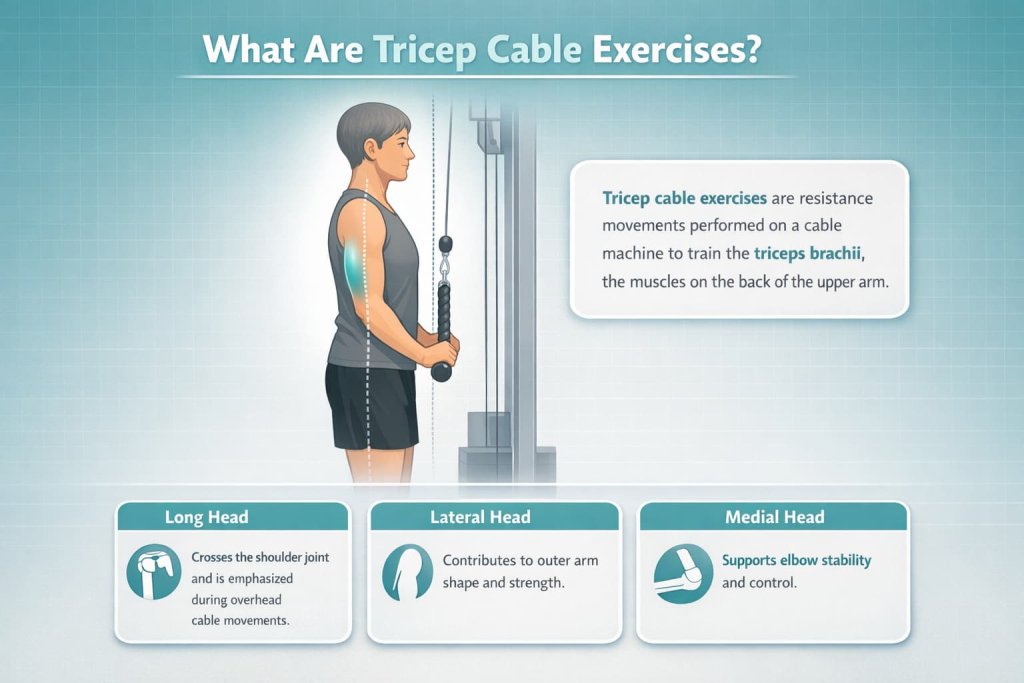
Tricep cable exercises are resistance movements performed on a cable machine to train the triceps brachii, the muscle group on the back of the upper arm. The triceps consist of three heads:
- Long head (crosses the shoulder joint)
- Lateral head
- Medial head
Cable exercises allow you to adjust pulley height and attachments, which helps emphasize different triceps heads while maintaining smooth, continuous resistance.
Why Tricep Cable Exercises Matter for Arm Growth
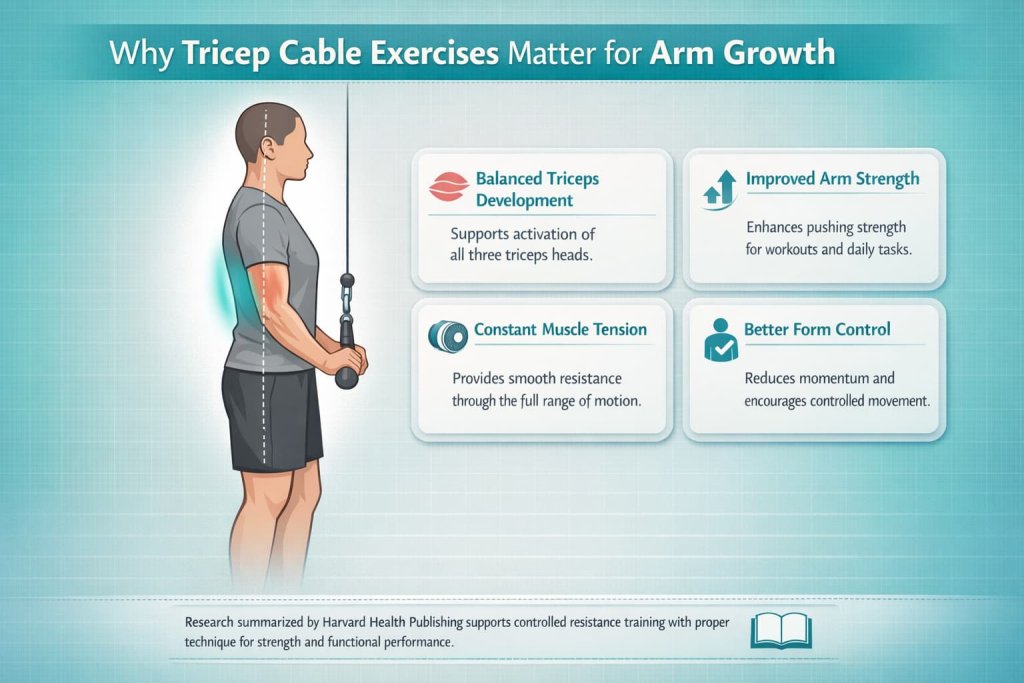
Regular tricep cable training may help support:
- Balanced development of all three triceps heads
- Improved arm strength for pushing movements
- Better control and muscle tension compared to free weights
- Reduced momentum and improved form consistency
Research summarized by Harvard Health Publishing highlights that controlled resistance training with proper technique supports muscle strength and functional performance when progressed gradually.
10 Best Tricep Cable Exercises for Bigger, Stronger Arms
Cable machines allow constant tension and precise control, making them ideal for effectively training all three heads of the triceps. The following exercises focus on proper angles, balanced muscle activation, and controlled resistance to support stronger, more defined arms.
1. Cable Rope Pushdown
How to do it:
- Attach a rope to the high pulley.
- Stand upright with elbows tucked close to your sides.
- Grip the rope with palms facing each other.
- Extend your elbows and push the rope down.
- Separate the rope ends slightly at the bottom.
- Return slowly to the start position under control.
Why it works:
The rope allows a neutral wrist position and a natural outward movement at lockout, which increases triceps engagement without excessive elbow stress.
Muscles worked:
Primarily the lateral and medial heads of the triceps, with stabilizing support from the forearms.
Trainer Tip:
Focus on spreading the rope only at the bottom—don’t turn it into a shoulder movement.
2. Straight-Bar Cable Pushdown
How to do it:
- Attach a straight bar to a high pulley.
- Stand tall with a firm stance.
- Grip the bar with palms facing down.
- Keep elbows pinned to your sides.
- Push the bar down until arms are fully extended.
- Control the return to the starting position.
Why it works:
The fixed grip allows heavier loading, making it effective for building triceps strength and size when performed with strict form.
Muscles worked:
Lateral and medial heads of the triceps.
Trainer Tip:
Avoid leaning forward—use elbow extension, not body weight, to move the load.
3. V-Bar Cable Pushdown
How to do it:
- Attach a V-bar to the cable machine.
- Hold the handles with a neutral-angled grip.
- Brace your core and keep elbows close.
- Push the bar down until arms are straight.
- Pause briefly, then return with control.
Why it works:
The angled handles reduce wrist strain while allowing heavier resistance than a rope attachment.
Muscles worked:
Triceps lateral head (primary), medial head (secondary).
Trainer Tip:
Think about “pushing the handles apart” slightly to improve muscle tension.
4. Reverse-Grip Cable Pushdown
How to do it:
- Attach a straight bar to a high pulley.
- Grip the bar with palms facing up.
- Keep elbows tight to your torso.
- Extend the elbows downward slowly.
- Control the return without losing elbow position.
Why it works:
The underhand grip increases medial head involvement and may feel more comfortable for sensitive elbows.
Muscles worked:
Medial head of the triceps, with assistance from the lateral head.
Trainer Tip:
Use lighter weight and slower tempo—this variation demands control.
5. Single-Arm Cable Pushdown
How to do it:
- Attach a single handle to a high pulley.
- Stand sideways or facing the machine.
- Hold the handle with one hand.
- Keep elbow fixed at your side.
- Extend the arm fully, then return slowly.
- Repeat before switching arms.
Why it works:
Unilateral training helps address strength imbalances and improves mind-muscle connection.
Muscles worked:
All three triceps heads, depending on arm angle.
Trainer Tip:
Match reps and tempo on both arms—even if one side feels weaker.
6. Cable Overhead Triceps Extension (Rope)
How to do it:
- Attach a rope to the low pulley.
- Face away from the machine.
- Hold the rope overhead with elbows bent.
- Keep upper arms stable.
- Extend elbows upward and forward.
- Lower slowly to the starting position.
Why it works:
Overhead positioning places the long head of the triceps under greater stretch, which supports full development.
Muscles worked:
Long head of the triceps (primary), lateral head (secondary).
Trainer Tip:
Keep ribs down and core braced to avoid arching the lower back.
7. Single-Arm Overhead Cable Extension
How to do it:
- Attach a single handle to a low pulley.
- Turn away from the machine.
- Hold the handle overhead with one arm.
- Keep the elbow pointing forward.
- Extend the arm fully, then lower with control.
Why it works:
This variation allows precise resistance control and improved focus on one triceps long head at a time.
Muscles worked:
Triceps long head, with stabilizing support from the shoulder.
Trainer Tip:
Think “elbow stays still”—movement should come only from extension.
8. Cable Skull Crusher (Lying Cable Extension)
How to do it:
- Attach a straight bar to a low pulley.
- Lie on a bench facing away from the machine.
- Hold the bar with arms extended.
- Bend elbows to lower the bar toward your forehead.
- Extend elbows to return to the start.
Why it works:
The cable maintains constant tension throughout the movement, unlike dumbbell or barbell versions.
Muscles worked:
All three heads of the triceps, with emphasis on the long head.
Trainer Tip:
Use slow eccentrics to maximize tension and control.
9. Cross-Body Cable Triceps Extension
How to do it:
- Attach a single handle to a high pulley.
- Grab the handle with the opposite hand.
- Pull the handle diagonally across your body.
- Extend the elbow fully.
- Return slowly and repeat.
Why it works:
The diagonal line of pull challenges the triceps differently and improves joint control.
Muscles worked:
Triceps lateral and long heads, plus stabilizers.
Trainer Tip:
Avoid rotating your torso—keep shoulders square.
10. Cable Triceps Kickback
How to do it:
- Attach a single handle to a low pulley.
- Hinge slightly at the hips.
- Keep upper arm parallel to the floor.
- Extend the elbow until arm is straight.
- Return slowly without swinging.
Why it works:
This movement emphasizes peak contraction and time under tension rather than heavy loading.
Muscles worked:
Triceps lateral and medial heads.
Trainer Tip:
Use lighter weight and pause briefly at full extension.
How to Program Tricep Cable Exercises
For general muscle growth and strength, evidence-based guidelines commonly recommend:
- Frequency: 2–3 times per week
- Sets: 2–4 sets per exercise
- Reps: 8–12 for hypertrophy, 12–15 for endurance
- Rest: 60–90 seconds between sets
The Centers for Disease Control and Prevention and ACSM both recommend training all major muscle groups at least twice per week as part of a balanced fitness routine.
Common Mistakes to Avoid
- Using excessive weight and swinging the torso
- Letting elbows flare excessively during pushdowns
- Rushing through reps instead of controlling the tempo
- Ignoring overhead movements that train the long head
Maintaining strict form improves muscle engagement and reduces unnecessary joint stress.
When to Modify or Stop Tricep Cable Exercises
You should modify or stop if you experience:
- Sharp elbow or shoulder pain
- Persistent joint discomfort that worsens with training
- Loss of control or inability to maintain proper form
If pain continues, professional evaluation may be appropriate, as advised by the American Academy of Orthopaedic Surgeons.
Frequently Asked Questions (FAQs)
Are tricep cable exercises better than dumbbells?
Cables are not “better,” but they provide constant tension and easier angle adjustments, which many people find helpful for muscle control.
Can beginners use cable tricep exercises?
Yes. Cable machines are often beginner-friendly because resistance is smooth and easy to scale.
How many tricep cable exercises should I do per workout?
Most workouts include 2–4 tricep cable exercises, depending on total volume and training goals.
Do cable exercises build triceps size?
When performed with proper load, volume, and progression, cable exercises can effectively support triceps hypertrophy.
Are overhead cable tricep exercises necessary?
They are not mandatory, but they are useful for emphasizing the long head of the triceps.
Should I train triceps before or after chest workouts?
Triceps are commonly trained after chest or shoulder workouts, but standalone arm days also work well.
Conclusion
Tricep cable exercises offer a versatile, joint-friendly way to build bigger and stronger arms by keeping constant tension on the muscles and allowing precise control. By combining pushdowns, overhead extensions, and unilateral movements, you can train all three triceps heads more effectively and support long-term arm strength. Start with manageable loads, focus on clean form, and progress gradually for the best results.
References
- American Council on Exercise (ACE) – Triceps Pushdowns (Exercise Library)
- Schoenfeld et al. (2017) – Dose-Response Relationship Between Weekly Training Volume and Muscle Hypertrophy (PubMed)
- Kraemer & Ratamess (2004) – Fundamentals of Resistance Training: Progression and Exercise Prescription (PubMed)
- Kholinne et al. (2018) – Different Role of Each Head of the Triceps During Shoulder Elevation (PMC)
- Hussain et al. (2020) – Triceps Push-Down Muscle Fatigue Across Heads at Different Intensities/Speeds (PMC)
- AAOS OrthoInfo – Tennis Elbow (Lateral Epicondylitis): Symptoms and When to Modify Activity