
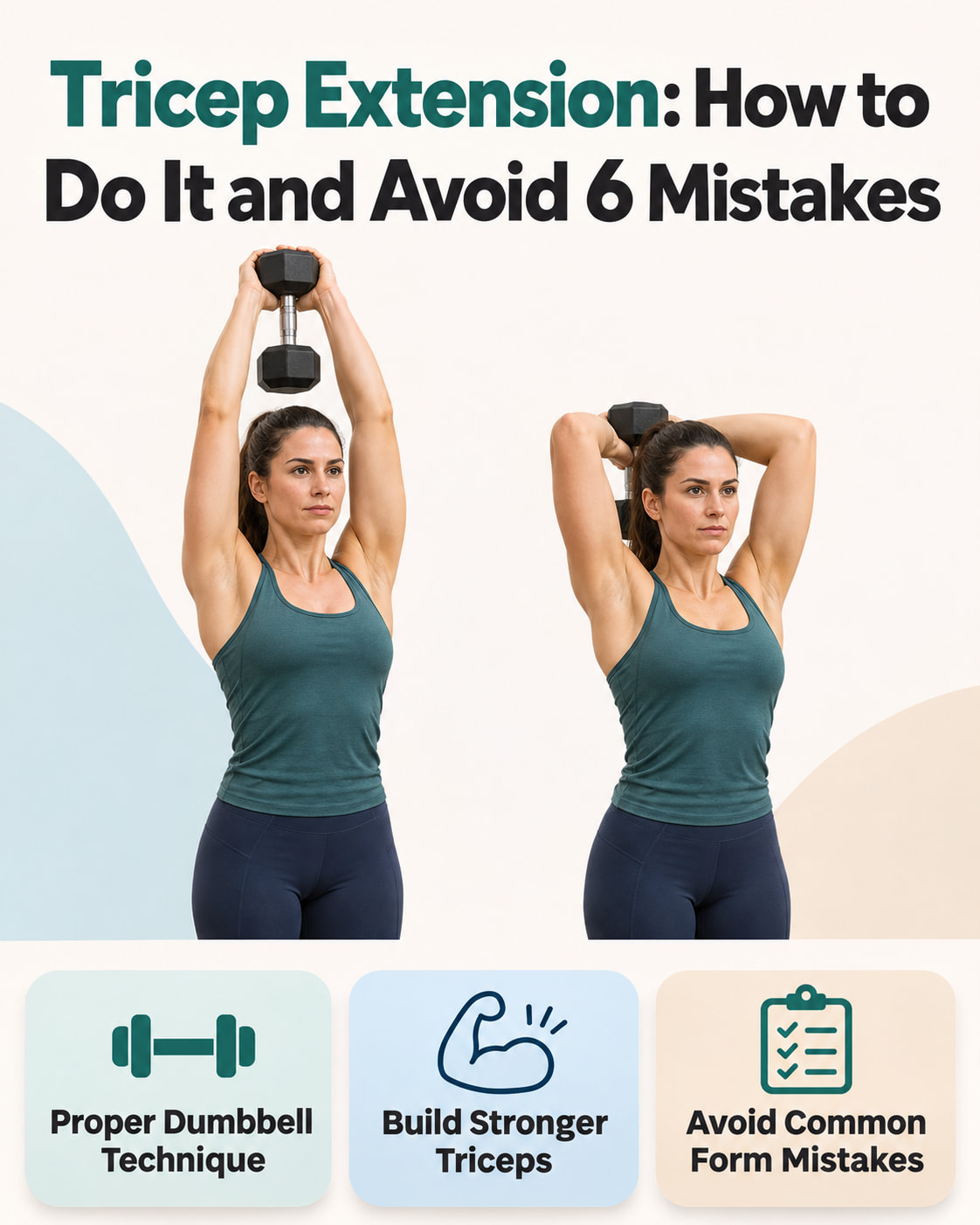
To do an overhead dumbbell tricep extension, hold one dumbbell securely with both hands, lower it behind your head by bending your elbows, and straighten your arms to raise it again. Keep your torso steady, use a manageable weight, and move through a comfortable range.
The exercise targets the back of your upper arms. Good technique helps you control the weight and makes it easier to recognize when a set should end. Start with a light load, learn the movement, and increase the challenge gradually.
What Is a Tricep Extension?
A tricep extension is a resistance exercise built around elbow extension—the action of straightening your arm. You may also see it called a triceps extension.
There are several versions. You can hold a dumbbell overhead, perform the movement while lying down, or use a cable machine.
This guide focuses on the two-hand overhead dumbbell tricep extension, with other options explained below.
What Muscles Does a Tricep Extension Work?
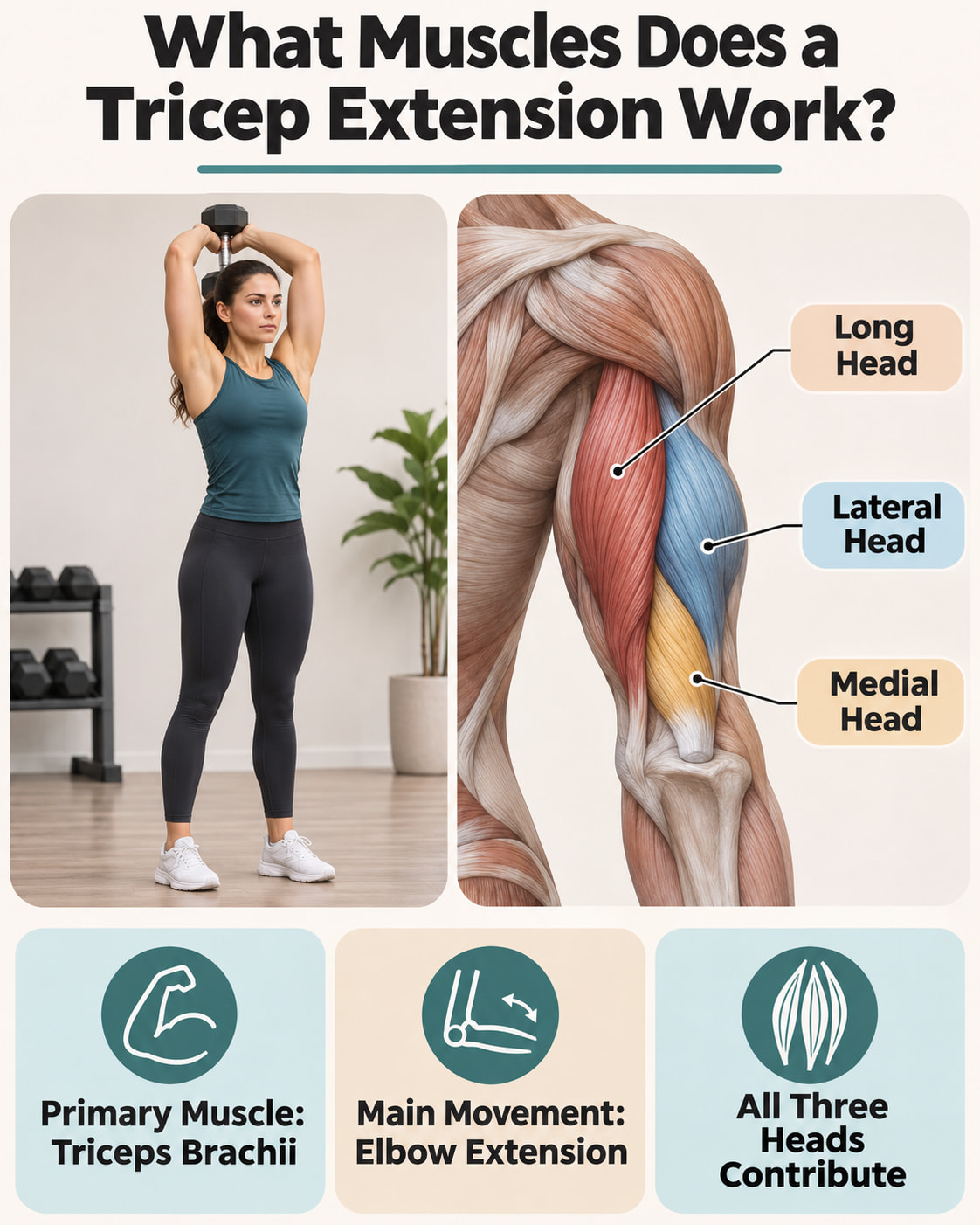
The primary muscle is the triceps brachii, located on the back of your upper arm. It has three heads:
- Long head
- Lateral head
- Medial head
All three contribute to elbow extension. The long head also crosses the shoulder, so changing your upper-arm position changes its length.
Holding your arms overhead places the long head at a longer muscle length than keeping your arms beside your body. The overhead movement still trains the triceps as a group.
Does the Overhead Position Help Build Muscle?
A small cable-extension study, published online in 2022 and in a 2023 journal issue, followed 21 adults for 12 weeks. Whole-triceps muscle volume increased by 19.9% in the arm trained overhead, compared with 13.9% in the arm trained beside the body.
Both positions produced growth. The study supports overhead cable extensions as an effective option, but it does not establish identical results for dumbbells or make overhead work necessary for everyone.
How to Do an Overhead Dumbbell Tricep Extension
Choose a light dumbbell you can control while getting into position, performing the repetitions, and putting it down.
Before lifting, warm up with several minutes of easy movement and rehearse the exercise without a weight or with a lighter load.
The ACE exercise guide emphasizes a stable stance, controlled elbow movement, and steady upper arms.
- Set your stance. Stand with your feet comfortably apart. Placing one foot slightly forward may help you feel balanced.
- Secure your grip. Hold the dumbbell vertically with both hands supporting the underside of its upper end. Make sure your grip feels secure before raising it.
- Bring the weight overhead. Keep your head facing forward and your torso steady. Position your upper arms comfortably near your head.
- Lower with control. Inhale as you bend your elbows, allowing the dumbbell to move behind your head. Keep it clear of your head and neck.
- Use a comfortable depth. Stop lowering before pain or loss of position occurs.
- Extend your elbows. Exhale as you straighten your arms smoothly. Keep your upper arms reasonably steady during the repetition.
- Finish carefully. Bring the dumbbell forward and down to chest level with both hands, then set it down under control.
If you cannot manage the setup or put-down comfortably, choose a lighter weight or ask a qualified trainer to demonstrate.
6 Tricep Extension Mistakes to Avoid
1. Using More Weight Than You Can Control
A weight is too demanding for the set if you need to swing your body, lose your grip, or change your position to keep lifting.
This can also happen toward the end of a set, even when the first few repetitions felt manageable.
What to do: Reduce the weight or finish the set sooner. The last repetition should still look controlled.
Mayo Clinic guidance recommends lowering the weight or repetition count when you cannot maintain proper form.
2. Arching Your Lower Back
Watch for your chest lifting and your lower back arching more as the dumbbell moves overhead. You may be leaning backward to make room for the movement.
What to do: Gently engage your abdominal muscles and keep your rib cage positioned over your pelvis. Use a lighter load if that helps you stay steady.
If maintaining the overhead position remains uncomfortable, consider a variation with a different arm position. Avoid forcing extra range by leaning farther back.
3. Letting Your Upper Arms Swing
During the repetitions, the main movement should come from bending and straightening your elbows. Repeatedly sweeping your upper arms forward and backward changes the movement you are practicing.
What to do: Aim for reasonably steady upper arms and repeat a consistent path.
Use comfortable elbow spacing. You do not need to squeeze your elbows together or press them tightly against your ears.
4. Rushing or Bouncing Through Repetitions
Dropping the dumbbell quickly and jerking it upward makes the weight harder to control. An abrupt change of direction behind your head is also an unnecessary complication.
What to do: Lower the weight smoothly, change direction without bouncing, and raise it at a pace you can manage.
You do not need an exact stopwatch tempo. Each repetition should be deliberate enough that you can notice your position and stop when needed.
5. Forcing an Uncomfortable Range of Motion
Trying to lower the dumbbell as far as possible can lead you to move your neck, arch your back, or lose your upper-arm position.
What to do: Use the range you can control without pain. Keep your head still and avoid chasing a deeper stretch.
You do not need to force every repetition to an exact elbow angle. At the top, straighten smoothly without snapping your elbows into their end position.
6. Holding Your Breath
It is easy to hold your breath when concentrating on several form cues at once.
What to do: Exhale as you raise the dumbbell and inhale as you lower it. Keep breathing throughout the set.
If coordinating breathing and movement feels difficult, practice with less weight.
Tricep Extension Sets, Reps, and Frequency
For someone learning the movement, the following is a practical starting example:
| Training detail | Starting example |
|---|---|
| Sets | Begin with 1; add a second when control and recovery are good |
| Repetitions | 12–15 controlled repetitions |
| Effort | Finish while you feel you could perform about 2–3 more good repetitions |
| Frequency | Twice weekly on nonconsecutive days |
| Rest | Rest long enough to repeat the exercise with steady form |
This combines general training guidance into a simple example. Adjust it to your experience, overall workout, and recovery.
The 2026 ACSM position stand supports training all major muscle groups at least twice weekly and progressing the challenge over time. It also explains that reaching complete muscular failure is not required for benefits.
Tricep extensions can be one part of that routine. Consider the arm work already included in your other exercises when deciding how many additional sets to perform.
How to Progress Your Tricep Extension
First, make your repetitions consistent. When you can complete your planned sets comfortably with good control, try the smallest practical increase in weight.
For example, if 12 repetitions are manageable, gradually work toward 15 before increasing the load. After an increase, reassess your form and repetition count.
You do not need to add weight every week. Repeat the current load when you are still learning the movement or recovering from previous sessions.
Tricep Extension Variations
Different versions change your arm position, equipment, and setup. Choose one that you can perform comfortably and control throughout the set.
Single-Arm Overhead Dumbbell Extension
Hold a lighter dumbbell in one hand and raise that arm overhead. Bend the elbow to lower the weight behind your head, then straighten it smoothly.
Your opposite hand can lightly support the working upper arm. Keep your head still and avoid leaning sideways.
Practice each arm separately, adjusting the load when needed to maintain control.
Lying Dumbbell Tricep Extension
Lie on a bench or the floor with a light dumbbell in one hand. Point your upper arm toward the ceiling, bend your elbow, then straighten it to lift the weight.
Keep the upper arm reasonably steady and move slowly. Your other hand can help support the upper arm while you learn.
Plan the movement so the dumbbell stays clear of your face and head.
Cable Triceps Pushdown
Stand facing a high cable attachment. Hold the handle with your elbows bent and your upper arms comfortably close to your sides.
Straighten your elbows to move the handle downward, then return slowly. Keep your torso steady.
This variation lets you train elbow extension with your arms beside your body. It is an option to consider when you prefer to avoid an overhead position.
When to Modify or Stop the Exercise
Stop if you experience joint pain, sharp pain, or symptoms that worsen with successive repetitions. Pain is a reason to reassess the exercise, load, and range.
The Veterans Health Library advises stopping an overhead extension if it causes pain and contacting a healthcare professional if pain persists.
If you are recovering from an elbow or shoulder injury or surgery, follow your clinician’s exercise restrictions. A general fitness guide cannot determine which variation fits your recovery.
For uncertainty about technique, a qualified trainer can help you check the setup and movement.
Frequently Asked Questions
Are Tricep Extensions Suitable for Beginners?
They can be, provided you can control the weight and reach the chosen arm position comfortably. Start light, practice the setup, and keep the first sessions modest. Get help with the movement if handling a dumbbell overhead feels awkward.
How Much Weight Should I Use for Tricep Extensions?
Choose a load that lets you complete your planned repetitions without swinging, arching, or losing control. There is no single starting weight that suits everyone. You should also be able to raise and lower the dumbbell safely during setup and finishing.
Should I Do Tricep Extensions Seated or Standing?
Either position can be used for the overhead variation. If seated, use a sturdy bench or chair with your feet supported. If standing, choose a balanced stance. In either position, check that you can keep your torso steady and move comfortably.
Should My Elbows Stay Close Together?
Keep them in a comfortable, reasonably stable position. Approximately shoulder-width spacing can be a useful starting cue, but forcing your elbows together is unnecessary. Focus on avoiding uncontrolled swinging as you bend and straighten them.
Are Overhead Extensions Better Than Pushdowns?
A small cable-training study found greater muscle growth with overhead extensions, but both positions produced growth. Your choice should also account for comfort, equipment, and the rest of your routine. The study does not establish one universally best variation.
Can I Do Tricep Extensions Every Day?
For someone starting out, two nonconsecutive sessions per week are a practical approach. Allow recovery between demanding sessions for the same muscles, and consider your other arm exercises before adding more work. Daily direct triceps training is unnecessary for getting started.
Conclusion
A tricep extension is easier to learn when the weight is manageable and each repetition follows a consistent path. Secure your grip, keep your torso steady, and bend and straighten your elbows smoothly.
At your next workout, begin with one light practice set. Check your position and comfort before adding repetitions, sets, or weight.
References
- American Council on Exercise. Triceps Extension.
- Mayo Clinic. Weight training: Do’s and don’ts of proper technique.
- American College of Sports Medicine. Resistance-training prescription for healthy adults.
- Maeo and colleagues. Overhead versus neutral-arm triceps training.
- Veterans Health Library. Elbow Extension/Triceps Press.
- Mayo Clinic. Triceps extension with dumbbell.
- Mayo Clinic. Triceps extension with weight machine.