
The dumbbell bench press is a compound upper-body exercise that primarily works the pectoralis major, while the triceps and front deltoids help press the weights. Proper form requires a stable body position, neutral wrists, controlled lowering, a comfortable elbow angle, and a pain-free range of motion.
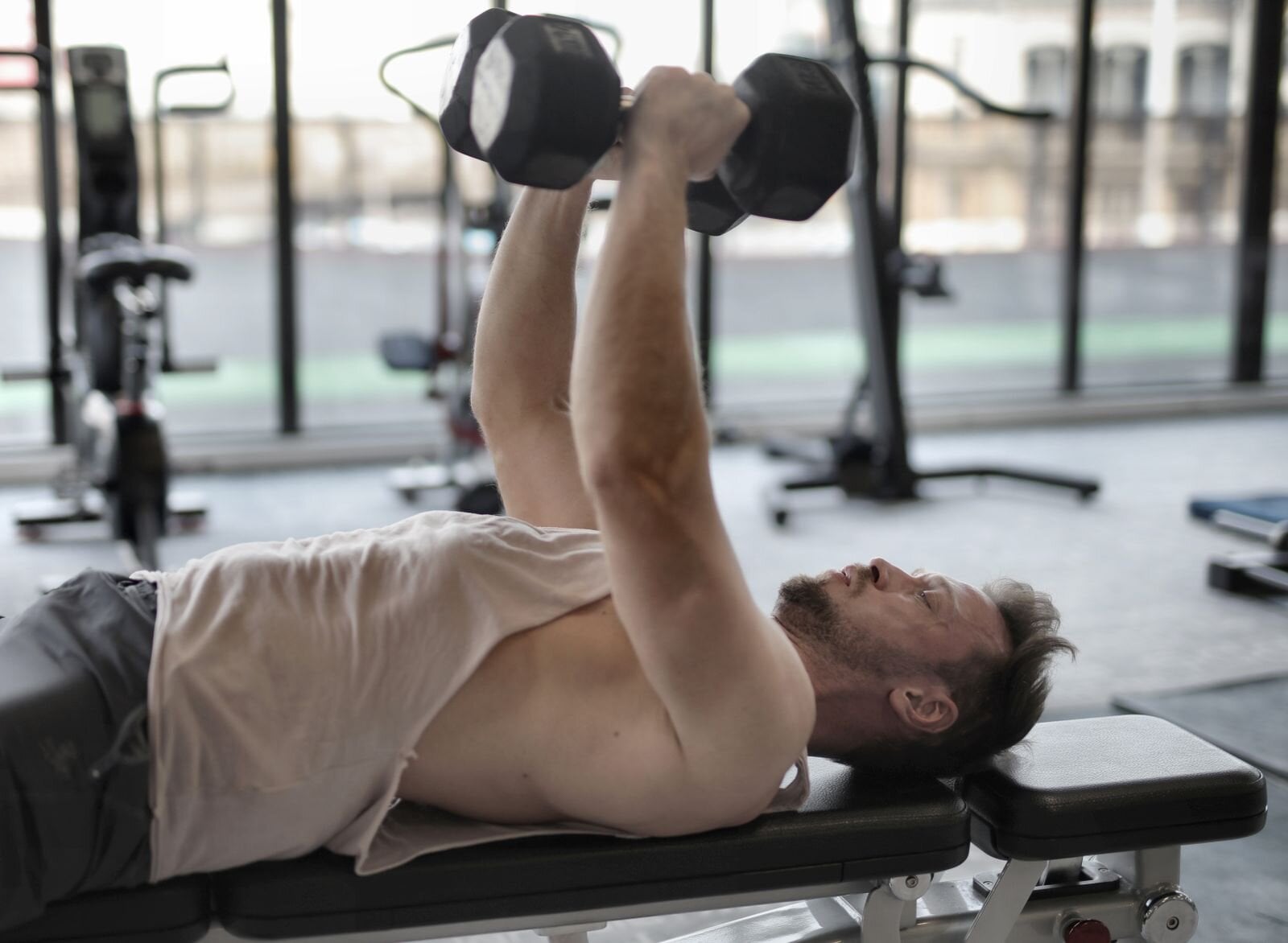
Learning the correct technique is important because each dumbbell moves independently. This gives your arms more freedom than a barbell, but it also requires more control and stability. Start with manageable weights, keep your feet planted, and focus on consistent repetitions before trying to lift heavier.
The ACE exercise guide recommends keeping the head, shoulders, glutes, and feet supported while maintaining neutral wrists and a controlled movement.
| Dumbbell Bench Press Overview | Details |
|---|---|
| Primary muscle | Pectoralis major |
| Assisting muscles | Triceps brachii and anterior deltoids |
| Stabilizing muscles | Rotator cuff, biceps, forearms, upper back, and core |
| Equipment | Flat bench and two dumbbells |
| Movement type | Compound horizontal press |
| Main goals | Chest strength, muscle growth, and upper-body pressing ability |
How to Do the Dumbbell Bench Press With Proper Form
1. Choose a Manageable Weight
Select dumbbells you can control through the entire repetition. You should not need to bounce the weights, lift your hips, shorten the range excessively, or bend your wrists backward.
When learning the exercise, use a lighter weight than you think you need. Proper positioning is easier to learn when you are not struggling to keep the dumbbells balanced.
2. Get Into Position Safely
Sit on the end of a flat, stable bench with your feet on the floor. Rest one dumbbell vertically on each thigh.
Lie back under control while using your thighs to help guide the dumbbells toward your chest. Avoid trying to curl heavy dumbbells from the floor directly into the starting position.
Once you are lying down:
- Place your feet firmly on the floor
- Keep your head and upper back on the bench
- Keep your glutes in contact with the bench
- Hold the dumbbells close to your chest until you are stable
Use a trained spotter when handling weights that are difficult to move into position safely.
3. Build a Stable Base
Position your feet about hip- to shoulder-width apart. Your exact stance can vary, but both feet should feel secure.
Brace your abdominal muscles gently and maintain the natural curve of your lower back. A small natural arch is acceptable. Avoid creating an exaggerated arch or lifting your hips from the bench.
Use your feet for stability rather than pushing so aggressively that your body slides or your glutes leave the bench.
4. Set Your Shoulders, Wrists, and Elbows
Gently draw your shoulder blades back and down against the bench. Think about creating a stable platform with your upper back rather than forcefully squeezing the shoulder blades together.
Hold the dumbbells with your thumbs wrapped around the handles. At the top of the movement:
- Keep the dumbbells over the chest and shoulder area
- Keep your wrists straight
- Stack the wrists over the elbows
- Keep your arms nearly straight without forcefully locking the elbows
A slight inward turn of the hands is acceptable if it feels more comfortable than keeping the palms completely forward.
5. Lower the Dumbbells Under Control
Inhale as you lower the dumbbells toward the outer edges of your mid-chest.
The dumbbells should move down and slightly outward in a controlled arc. Do not let them fall quickly toward your shoulders.
Keep your forearms approximately vertical when viewed from the front. Your wrists should remain over your elbows instead of drifting inside or outside them.
A practical starting position is to keep the upper arms roughly 45 to 70 degrees away from the torso. Viewed from above, your arms should resemble an arrow shape rather than a straight “T.”
Stop lowering when:
- Your upper arms are approximately level with your torso
- You feel a controlled stretch across the chest
- Your shoulders remain stable
- Your wrists stay over your elbows
- You can reverse the movement without bouncing
- You do not feel joint pain
6. Press the Dumbbells Up
Exhale as you press the dumbbells upward and slightly toward one another.
Think about pushing your upper arms toward the center rather than simply moving your hands. Keep your wrists straight and maintain even pressure through both arms.
Finish with the dumbbells over your chest and shoulders. They may come closer together, but they do not need to touch or collide.
Keep your head, upper back, and glutes supported throughout the repetition.
7. End the Set Carefully
After the final repetition, bring the dumbbells close to your torso. Raise your knees and guide the dumbbells back onto your thighs before sitting up under control.
Do not twist suddenly, throw the dumbbells to the side, or drop them near your head or shoulders.
For heavy sets, ask a spotter to assist at the wrists. Continue holding the dumbbells firmly until the spotter has full control.
Quick Dumbbell Bench Press Form Checklist
Before beginning each working set, check that:
- Your feet are firmly planted
- Your head, upper back, and glutes are supported
- Your shoulder blades are gently back and down
- Your wrists are straight and stacked over your elbows
- Your elbows follow a comfortable, moderate angle
- The dumbbells move at the same controlled speed
- Your range of motion remains pain-free
How Low Should You Lower the Dumbbells?
You do not need to lower the dumbbells as far as physically possible.
For most beginners, stopping when the upper arms are approximately level with the torso or bench is a sensible starting point. The correct depth may vary with arm length, shoulder mobility, bench width, dumbbell size, and injury history.
The Mayo Clinic demonstration advises against allowing the elbows to drop excessively below the horizontal line of the body. It also recommends keeping the movement smooth and controlled.
A slightly deeper range may feel comfortable for some experienced lifters, but depth should never come at the expense of:
- Shoulders rolling forward
- Wrists bending backward
- Loss of upper-back stability
- Bouncing at the bottom
- Shoulder or chest pain
Using more range of motion is not automatically better when you cannot control that range.
What Is the Best Elbow Angle for a Dumbbell Bench Press?
There is no single elbow angle that is perfect for every person. A useful starting range is approximately 45 to 70 degrees from the torso.
Keeping the elbows directly out to the sides at about 90 degrees creates a very wide position. This may feel uncomfortable and make it harder to keep the shoulders stable.
At the opposite extreme, pressing with the elbows tightly against the ribs shifts more work toward the triceps and may create an awkward wrist position.
Use these two checks instead of trying to copy an exact angle:
- Your forearms should be approximately vertical near the bottom.
- Your shoulders, elbows, and wrists should remain comfortable and controlled.
A 2024 biomechanical study of barbell bench-press variations found that scapular retraction and avoiding excessively wide grips reduced some modeled shoulder-joint forces. Because the study involved only 10 experienced athletes performing barbell presses, it supports general technique principles but does not prove that one exact dumbbell position prevents injury.
Dumbbell Bench Press Muscles Worked
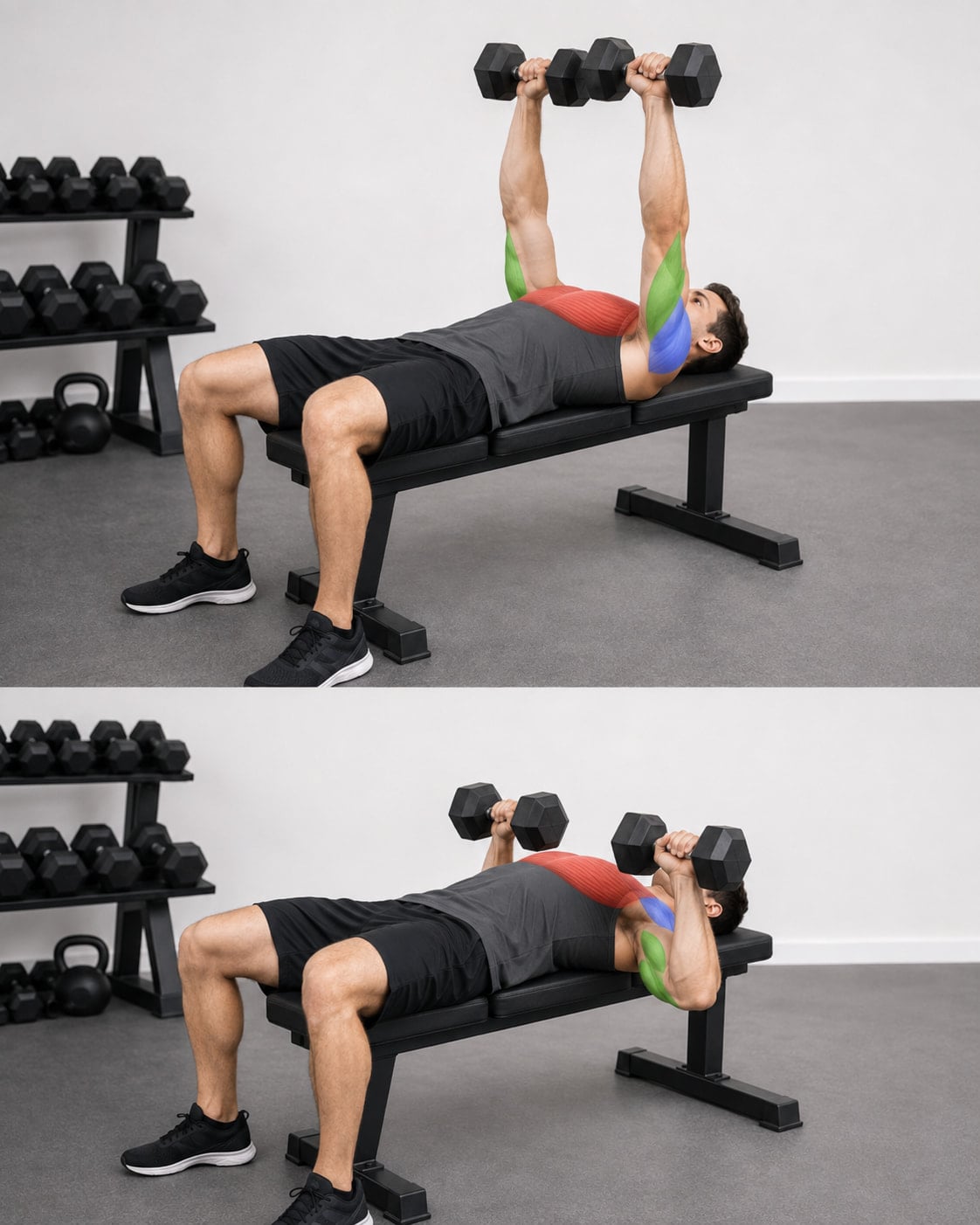
The dumbbell bench press trains several upper-body muscles at the same time. However, each muscle has a different role.
Pectoralis Major
The pectoralis major is the large muscle covering the front of the chest. It is the primary muscle used during the dumbbell bench press.
Its main role is to move the upper arms toward the center of the body as you press the dumbbells upward. Both the sternal and clavicular regions of the pectoralis major contribute during a flat dumbbell press.
Triceps Brachii
The triceps are located on the backs of the upper arms. They extend, or straighten, the elbows during the upward phase of the press.
Bringing the elbows closer to the torso generally increases the contribution from the triceps. However, excessively tucking the elbows may create an awkward pressing path.
Anterior Deltoids
The anterior deltoids are the front portions of the shoulder muscles. They assist the chest by moving the upper arms forward during the press.
The front deltoids may take over more of the movement when:
- The elbows flare too far outward
- The dumbbells move toward the face
- The shoulders roll forward
- The bench is set at a steep incline
- The weights are too heavy to control
Stabilizing Muscles
The rotator-cuff muscles help stabilize the shoulder joints. Muscles around the shoulder blades help maintain a steady upper-back position.
The biceps, forearms, and grip muscles also help control the dumbbells. Your abdominal and trunk muscles contribute by keeping the body stable and preventing unwanted twisting or excessive back movement.
Laboratory research has found that the greater stability demands of dumbbells can increase biceps activity compared with barbell and Smith-machine chest presses. This does not mean the dumbbell bench press is a biceps-building exercise; the biceps are primarily helping to control the weights.
Benefits of the Dumbbell Bench Press
Trains Several Upper-Body Muscles
The dumbbell bench press trains the chest, triceps, and front deltoids in one movement. This makes it an efficient compound exercise for upper-body workouts.
Allows Each Arm to Work Independently
Each arm controls its own dumbbell. This can reveal differences in strength, coordination, range of motion, or stability between your right and left sides.
Use the same manageable weight in both hands and stop the set if one side can no longer follow the same path.
Provides a Flexible Hand and Elbow Path
A bar fixes both hands in one position. Dumbbells allow the hands to rotate slightly and the elbows to follow a more individualized path.
Some people find this freedom more comfortable, although dumbbells are not automatically safer for every shoulder.
Supports Progressive Overload
Dumbbell weight, repetitions, sets, range of motion, and movement control can all be progressed over time.
You do not have to increase the weight every workout. Completing more high-quality repetitions with the same weight is also progress.
Works in Home and Commercial Gyms
The exercise requires only dumbbells and a stable bench. A dumbbell floor press can provide a useful alternative when a bench is unavailable.
Dumbbell Bench Press vs. Barbell Bench Press
Neither version is universally better. The right choice depends on your goals, experience, equipment, and comfort.
| Feature | Dumbbell Bench Press | Barbell Bench Press |
|---|---|---|
| Arm movement | Each arm moves independently | Both arms are connected to one bar |
| Maximum loading | Usually lower | Usually higher |
| Stability demand | Higher | Lower |
| Hand position | Can rotate naturally | Fixed on the bar |
| Side-to-side compensation | Easier to notice | Stronger side may compensate more |
| Heavy setup | Can be difficult | Easier when using a rack |
| Best suited for | Independent control, chest training, accessory work | Maximal barbell strength and powerlifting specificity |
A small comparative study found that 12 resistance-trained men lifted about 17% less total weight with dumbbells than with a barbell. Pectoralis-major and anterior-deltoid activity was similar, while dumbbells produced higher biceps activity and lower triceps activity in that testing protocol.
Another study involving 19 trained men reported greater pectoralis-major activity and more completed repetitions with dumbbells than with a barbell during a specific four-set protocol. However, muscle-activation studies use small samples and do not prove that one exercise produces greater long-term muscle growth.
Choose dumbbells when you value independent arm control and a flexible movement path. Choose a barbell when your main goal is maximizing barbell-specific strength or handling heavier absolute loads. Many effective programs use both.
Common Dumbbell Bench Press Mistakes
| Mistake | Why It Is a Problem | How to Correct It |
|---|---|---|
| Using excessive weight | Causes shortened, uneven, or uncontrolled repetitions | Reduce the weight until every repetition follows the same path |
| Bending the wrists backward | Places the load behind the forearms | Keep knuckles facing upward and wrists stacked over elbows |
| Flaring the elbows directly outward | May make the shoulders harder to control | Begin around 45–70 degrees from the torso |
| Tucking the elbows too tightly | May create an awkward press and shift most work to the triceps | Allow a comfortable space between the arms and ribs |
| Lowering too deeply | Can cause the shoulders to roll forward | Stop at a controlled, pain-free depth |
| Shrugging the shoulders | Reduces upper-back stability | Keep shoulders away from the ears |
| Lifting the hips | Changes body position and may indicate excessive weight | Keep glutes supported and reduce the load |
| Lowering quickly | Reduces control at the most vulnerable part of the repetition | Use a smooth, deliberate lowering phase |
| Moving one arm faster | Allows the stronger side to dominate | Reduce the weight and match both sides |
| Banging the dumbbells together | Disrupts control without improving the exercise | Stop just before the dumbbells touch |
| Holding your breath repeatedly | May cause unnecessary pressure or lightheadedness | Inhale while lowering and exhale while pressing |
| Dropping the dumbbells after the set | Can injure you or someone nearby | Return them to your thighs or use a spotter |
How Many Sets and Reps Should You Do?
Your ideal sets and repetitions depend on your goal, training experience, weekly workload, and recovery.
The 2026 ACSM resistance-training update reviewed 137 systematic reviews representing more than 30,000 participants. It emphasized that regular participation matters more than unnecessarily complicated programming. For maximizing strength, ACSM highlights heavier loads of approximately 80% of one-repetition maximum or more for two to three sets. For muscle growth, higher weekly training volume—around 10 sets per muscle group—may be useful.
The following are practical starting ranges rather than rigid rules:
| Goal | Working Sets | Repetitions | Suggested Effort |
|---|---|---|---|
| Learning proper form | 1–3 | 8–15 | Finish with 3–4 good repetitions available |
| General fitness | 2–3 | 8–15 | Finish with 2–3 repetitions available |
| Muscle growth | 3–4 | 6–15 | Finish with 1–3 repetitions available |
| Strength | 2–3 | 4–8 | Use heavier weight without losing control |
“Repetitions available” means how many additional repetitions you could probably perform before reaching muscular failure. For example, finishing with two repetitions available means you stop when you believe you could complete approximately two more with good form.
You do not need to press to complete muscular failure in every set. End the set when technique begins to change, even if your chest muscles could continue working.
How Often Should You Do the Dumbbell Bench Press?
The dumbbell bench press can usually be performed one to three times per week, depending on your program and total pressing volume.
Current U.S. physical activity guidance recommends muscle-strengthening activities for all major muscle groups on at least two days each week. That does not mean you must perform this specific exercise twice weekly. Chest training can also include push-ups, machine presses, barbell presses, and other suitable movements.
Allow enough recovery between hard pressing sessions for soreness to decrease and normal performance to return.
How to Choose the Right Dumbbell Weight
Choose a weight that lets you reach your target repetition range without losing your body position or movement control.
For example, suppose your target is 8–12 repetitions:
- Select a conservative weight.
- Perform the set with controlled form.
- Stop when you have approximately two or three good repetitions remaining.
- Assess whether both arms followed the same path.
The weight is probably too heavy when you cannot complete eight repetitions without changing your technique.
It may be too light when you can easily complete more than 12 repetitions while still having several repetitions available.
When Should You Increase the Weight?
Use a simple double-progression method:
- Keep the same weight until you can reach the top of your repetition range for every working set.
- Confirm that your wrists, elbows, shoulders, and body position remain consistent.
- Repeat that performance during another workout.
- Increase to the next manageable dumbbell weight.
- Expect your repetitions to decrease temporarily after increasing the load.
For example, once you can perform three controlled sets of 12 repetitions, increase the weight slightly and work back up from approximately 8–10 repetitions.
If the next dumbbell is too large a jump, continue progressing by improving control, adding a repetition, using a slightly longer lowering phase, or adding one appropriate working set.
Where Should the Dumbbell Bench Press Go in a Workout?
Place the dumbbell bench press near the beginning of an upper-body or full-body workout when chest strength or growth is a priority.
Complete a general warm-up first. Then perform one or more lighter practice sets before your working weight.
A simple upper-body sequence could be:
- Dumbbell bench press
- Dumbbell or cable row
- Overhead press
- Pulldown or pull-up variation
- Optional arm exercises
Including pulling exercises helps create a more balanced upper-body routine rather than performing only chest and shoulder presses.
Dumbbell Bench Press Variations
Neutral-Grip Dumbbell Bench Press
Turn your palms toward each other while pressing. This usually keeps the elbows closer to the torso and may feel more comfortable for some shoulders or elbows.
A neutral grip is not guaranteed to eliminate pain. Use it only when the movement remains comfortable.
Dumbbell Floor Press
Perform the press while lying on the floor. Your upper arms stop when they contact the floor, naturally limiting the bottom range.
This is useful when:
- You do not have a bench
- You want to emphasize the triceps
- A deep bottom position is difficult to control
- A shorter range is more comfortable
Incline Dumbbell Bench Press
Set the bench at a low or moderate incline. This shifts more emphasis toward the upper region of the chest and the front deltoids.
Avoid turning the bench nearly upright unless you intend to perform more of a shoulder press.
Single-Arm Dumbbell Bench Press
Press one dumbbell while keeping the other hand free or holding the second dumbbell in position. The uneven load increases the demand on the abdominal and trunk muscles.
Use a lighter weight because your body must resist rotating toward the loaded side.
Alternating Dumbbell Bench Press
Hold one dumbbell at the top while pressing the other side. This increases coordination demands and time under tension.
Maintain a stable torso and avoid allowing one shoulder to rise from the bench.
Why Do I Feel the Dumbbell Bench Press in My Shoulders?
The front deltoids normally assist during the dumbbell bench press, so some muscular effort in the shoulders is expected. Sharp pain, pinching, or worsening joint discomfort is not.
Common reasons the shoulders may dominate include:
- The weights are too heavy
- The elbows are flared too widely
- The dumbbells are lowered too deeply
- The shoulders roll forward at the bottom
- The dumbbells drift toward the face
- The upper back is not stable
- The front deltoids are already fatigued
Try reducing the weight and shortening the range. Recheck your wrist and elbow alignment, and keep your shoulders away from your ears.
A neutral-grip press or floor press may be easier to tolerate because these variations can reduce elbow flare or limit the bottom range. However, persistent pain should be assessed rather than repeatedly trained through.
Safety Tips and When to Stop
Use a stable bench on a level surface, keep the surrounding area clear, and inspect adjustable dumbbells before lifting.
Stop the set immediately if you experience:
- Sharp or sudden shoulder, elbow, wrist, or chest pain
- Numbness or tingling
- Unexplained grip weakness
- Swelling
- A sudden loss of control
- Pain that becomes worse with each repetition
The NASM guidance on bench-press pain recommends reducing load and volume, using pain-free modifications, and seeking professional evaluation when symptoms are persistent, worsening, associated with swelling, or accompanied by numbness, tingling, night pain, or unexplained weakness.
Speak with an appropriate healthcare professional before heavy pressing if you have a recent shoulder, chest, elbow, wrist, or spine injury or have recently had surgery.
New or unexplained chest pressure or pain—especially with unusual shortness of breath, sweating, lightheadedness, nausea, or pain spreading to the arm, jaw, neck, or back—requires urgent medical attention. Call 911 or your local emergency number rather than assuming the discomfort is exercise-related.
Frequently Asked Questions
What muscles does the dumbbell bench press work?
The dumbbell bench press primarily works the pectoralis major. The triceps and anterior deltoids assist with pressing, while the rotator cuff, biceps, forearms, upper-back muscles, and core help stabilize the movement.
Is the dumbbell bench press better than the barbell bench press?
Neither is better for every goal. Dumbbells offer independent arm movement, greater stability demands, and a flexible hand position. A barbell usually allows you to lift more total weight and is more appropriate for developing barbell-specific strength.
How low should I lower the dumbbells?
Lower the dumbbells until your upper arms are approximately level with your torso or until you reach the deepest position you can control without pain or shoulder movement. Do not force a deeper range merely to make the dumbbells touch your chest.
What angle should my elbows be?
Approximately 45 to 70 degrees from the torso is a useful starting range. Adjust the angle based on comfort while keeping the wrists over the elbows and the forearms approximately vertical near the bottom.
Should the dumbbells touch at the top?
No. The dumbbells may move toward one another, but touching or banging them together is unnecessary. Finish with the weights balanced over your chest and shoulders.
How much weight should a beginner use?
There is no standard beginner weight. Choose a load you can press for approximately 8–15 controlled repetitions while keeping two or more good repetitions available. Reduce the weight whenever your wrists bend, hips rise, shoulders roll forward, or the two arms move unevenly.
Can I do a dumbbell bench press without a bench?
Yes. Perform a dumbbell floor press while lying on the floor. The movement uses a shorter range because the upper arms stop when they contact the floor.
Conclusion
The dumbbell bench press is an effective exercise for strengthening the chest, triceps, and front deltoids. Its main advantage is not that it is universally better than other presses, but that each arm can move independently through a comfortable path.
Start with a manageable weight. Keep your feet planted, upper back stable, wrists neutral, and elbows in a moderate position. Lower the dumbbells only as far as you can control, and increase the resistance gradually as your technique improves.
During your next workout, prioritize identical, pain-free repetitions before adding more weight.
References
- American Council on Exercise: Chest Press Exercise Guide
- Mayo Clinic: Chest Press With Dumbbells
- American College of Sports Medicine: 2026 Resistance Training Guidelines
- PubMed: Comparison of Muscle Activity and Strength Across Three Chest-Press Exercises
- PubMed: Muscle Activation During Dumbbell, Barbell, and Machine Bench Presses
- Frontiers in Physiology: Effects of Bench Press Technique on Shoulder Loads