
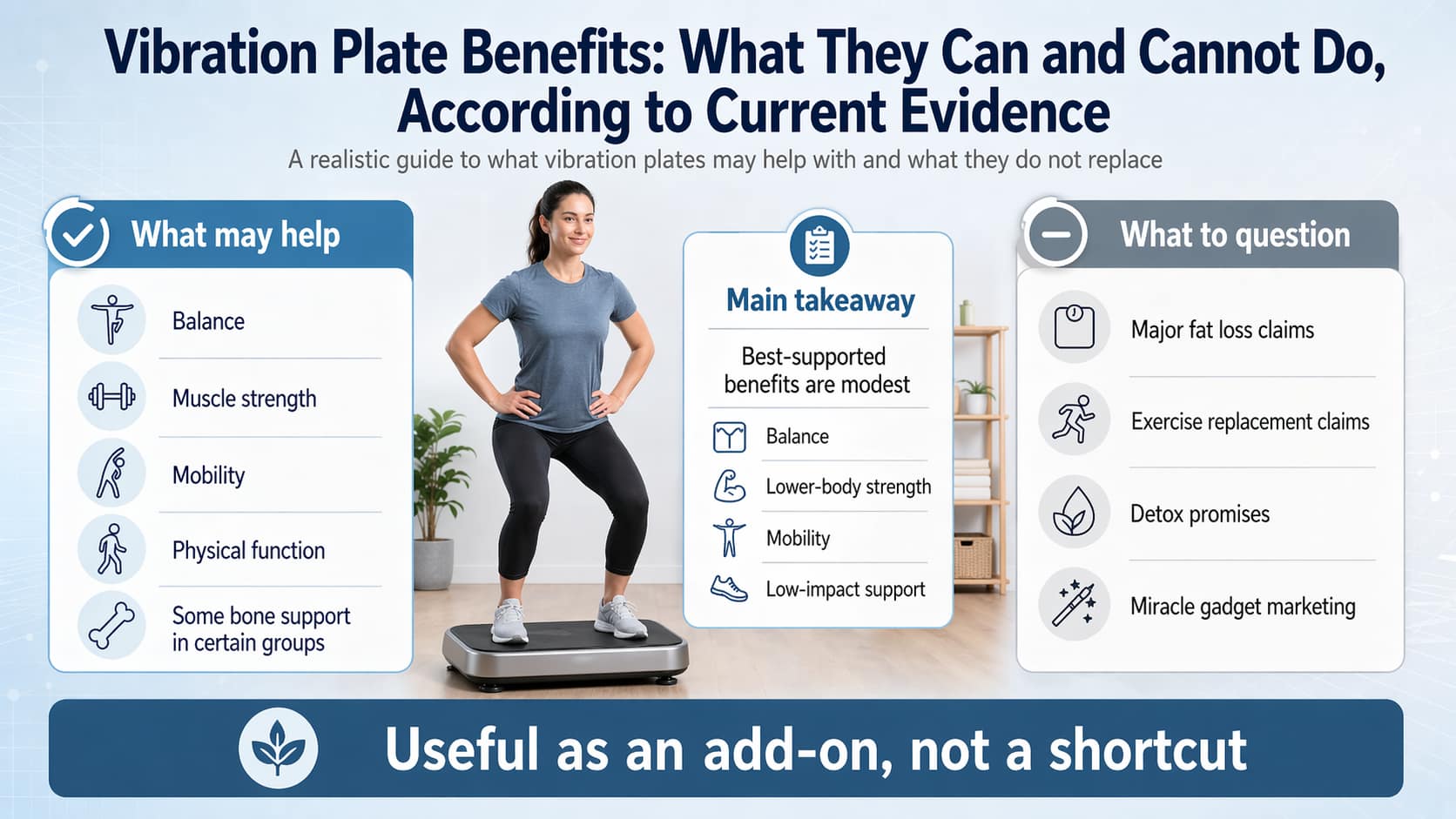
Vibration plate benefits are real, but they are usually modest. The best-supported benefits of a vibration plate are improvements in balance, lower-body muscle strength, mobility, and possibly some bone support in certain groups, especially older adults or people who need low-impact exercise. It is not a proven shortcut for major fat loss, and it should not replace regular exercise.
If you are researching vibration plate benefits because of social media claims, the most important step is separating evidence-backed uses from marketing hype. Current medical sources focus much more on muscle, balance, mobility, and bone-related outcomes than on broad claims like detox or dramatic standalone weight loss.
What Is a Vibration Plate?
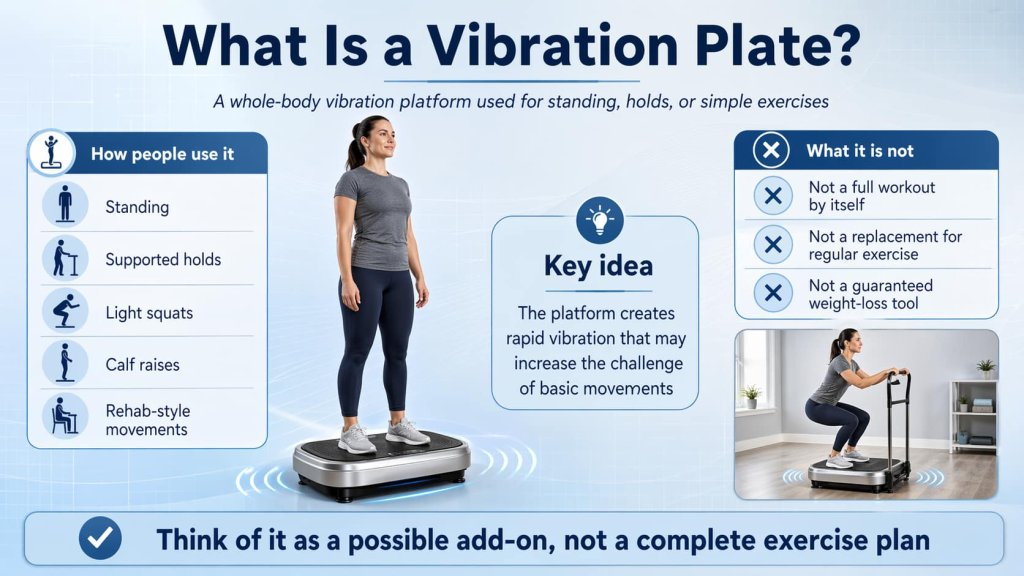
A vibration plate, also called a whole-body vibration platform, is a machine you stand or sit on while it produces rapid vibrations. Some people simply stand on it, while others use it during basic movements such as squats or light holds. The platform stimulates muscles to contract and release multiple times per second, which may increase the training demand of simple exercises. Research is still incomplete, so it is better to think of a vibration plate as a possible add-on, not a full replacement for conventional training.
Not all vibration plates are the same
This is an important detail because vibration plates vary a lot by design and settings. Some use side-to-side or oscillating motion, some use more vertical motion, and some are marketed with 3D or 4D modes. Research results do not automatically apply equally to every home model because study devices often use tightly controlled frequencies, amplitudes, and session protocols. That is one reason people can have very different experiences with different machines, even when the marketing claims sound similar.
Vibration Plate Benefits Backed by Current Evidence
May improve muscle strength
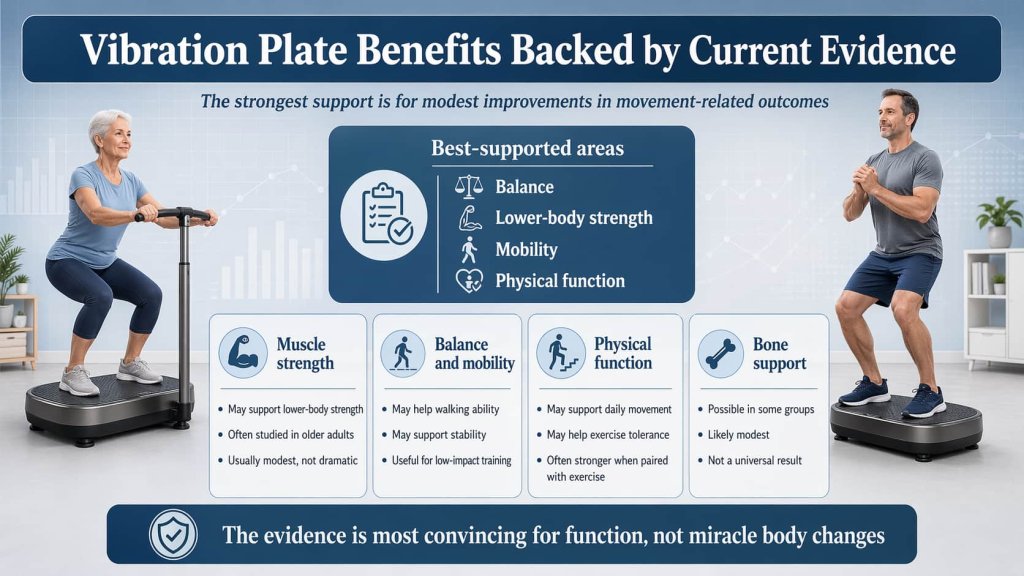
Some research suggests whole-body vibration may help improve muscle strength. A 2023 systematic review also reported significant improvements in lower-limb muscle strength and physical performance among older adults. This does not mean everyone will see major muscle gains, but it does support vibration plates as a possible low-impact training tool, especially for people who are deconditioned or older.
May improve balance, mobility, and walking ability
This is one of the more consistent findings in the literature. A 2024 review in Physical Therapy reported that several systematic reviews have found promising results for muscle strength, walking ability, mobility, body balance, and fall-related outcomes in older adults, even though protocols vary. A newer network meta-analysis published in 2026 also focused on how vibration frequency affects strength, balance, and gait performance in older adults, which suggests that dosing matters rather than all devices working the same way.
May support physical function in older adults
Whole-body vibration is often studied in older adults because it offers a lower-impact way to train. Reviews published in 2024 and 2025 suggest it may support physical function, especially in populations dealing with age-related declines in strength, balance, or mobility. That makes vibration plates more relevant for fall-risk reduction and daily function than for flashy “fat-burning” marketing.
May help some people with knee osteoarthritis when combined with exercise
A 2022 systematic review and meta-analysis in the Journal of Rehabilitation Medicine found that whole-body vibration combined with strengthening exercise improved pain, physical function, Timed Up and Go performance, and knee extensor strength in people with knee osteoarthritis compared with strengthening exercise alone. The same review found no clear improvement in stiffness, balance ability, quality of life, or knee flexor strength. That makes this a targeted benefit, not a blanket promise.
May modestly support bone health in some groups
Bone health is one of the main reasons vibration plates have been studied. Whole-body vibration may help reduce bone loss, and low-intensity vibration has shown possible bone and muscle support in some groups. At the same time, newer meta-analyses suggest the bone-density effect may be modest and site-specific rather than broad across the whole skeleton. In other words, “may help support bone health in certain groups” is more accurate than “builds bone fast.”
May be useful as a low-impact adjunct
For people who cannot tolerate heavy loading well, whole-body vibration may offer a gentler way to add neuromuscular challenge. Low-intensity vibration is a noninvasive, nondrug approach that may help preserve bone and muscle in some contexts, and it may appeal to people who want lower-impact training. The key word is adjunct. The evidence supports supplementation more than substitution.
Most benefits seem stronger when vibration is paired with exercise
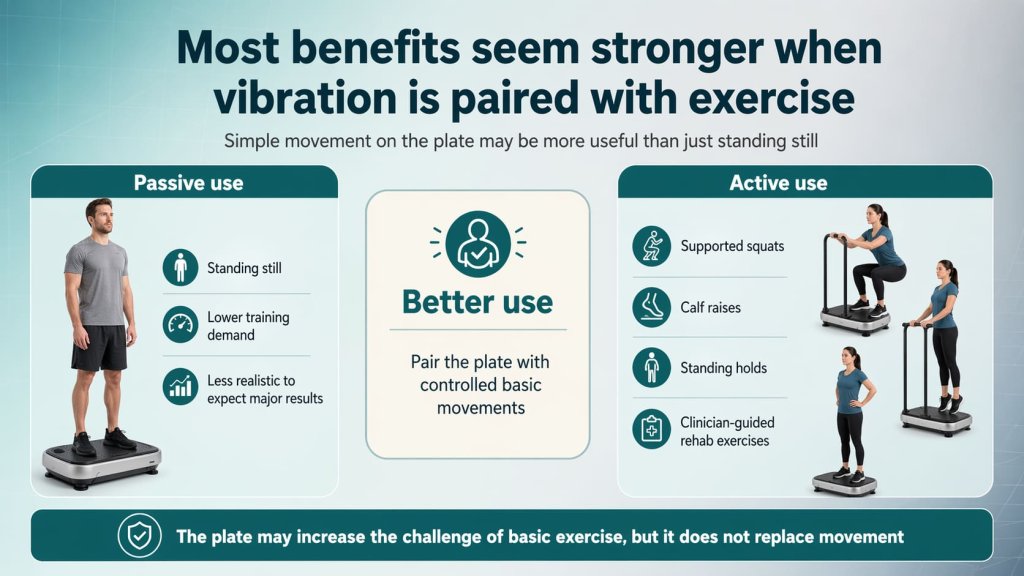
One of the most useful takeaways for readers is that vibration plates generally make more sense when they are combined with simple movements rather than used as a passive stand-on machine. In practice, that may mean doing light squats, calf raises, supported holds, or clinician-guided rehab exercises on the plate instead of just standing still and expecting major results. This helps set realistic expectations: the plate may increase the challenge of basic exercise, but it does not turn inactivity into a full workout.
Which Vibration Plate Benefits Are Overstated Online?
Some claims go beyond what current evidence supports.
- Major weight loss from standing on the plate alone: Vibration may help with weight loss when paired with a calorie deficit and regular exercise, but it is not a standalone shortcut.
- Replacing regular exercise: Vibration plates should not replace physical activity. Adults still need regular aerobic and muscle-strengthening exercise. The CDC recommends at least 150 minutes of moderate-intensity activity per week plus 2 days of muscle-strengthening work.
- Broad detox or cure-all claims: Current authoritative sources focus much more on muscle, mobility, balance, and bone-related outcomes than on sweeping detox-style promises.
Who Is Most Likely to Benefit From a Vibration Plate?
The people most likely to benefit are usually not the people looking for a miracle gadget. They are more often people who want a low-impact supplement to an existing routine, older adults working on balance and lower-body function, or people doing clinician-guided rehab or strengthening work. The better studies often pair vibration with exercise rather than treating passive standing as a complete workout.
That is why a realistic approach matters. A vibration plate may make a light squat, calf raise, or hold more challenging, but it does not erase the need for walking, resistance training, and basic activity habits.
Who Should Be Careful Before Using a Vibration Plate?
Safety depends on your health history. Extra caution is important for people with high blood pressure, a history of heart attack or stroke, blood-clotting disorders, severe osteoporosis, seizure disorders, vertigo, active infection, recent injury or surgery, implanted devices like pacemakers, pregnancy, and for children.
If you have a medical condition, balance problems, recent fracture, joint replacement, or you are in active rehab, getting personalized medical advice first is the safest move.
How to Use a Vibration Plate More Realistically
If your clinician says it is okay to use one, a practical starting approach looks like this:
- Start with short sessions, around 5 to 10 minutes.
- Begin at a low setting.
- Hold a stable support if balance is a concern.
- Keep the knees soft rather than locked.
- Add simple movements only if you can control them well.
- Stop if you feel pain, nausea, dizziness, or unusual discomfort.
Just as important, keep your regular training in place. Vibration plates make more sense as an add-on to walking, cardio, and strength work than as a replacement for them.
What to realistically expect from a vibration plate
For most people, the most realistic benefits are subtle improvements in balance, lower-body control, exercise tolerance, and general movement confidence over time. It is less realistic to expect dramatic fat loss, visible muscle gain, or major body changes from vibration plate use alone. Thinking of it as a small-support tool rather than a body-transformation shortcut will help readers judge results more fairly.
How Much Do Home Vibration Plates Cost?
Price is one reason people get confused about vibration plate benefits. Research devices and premium clinical-style machines are not the same as entry-level home platforms. Study devices are built to deliver specific signal frequencies and intensities, and research-grade products can cost several thousand dollars.
As of 2026, official site examples included:
- Lifepro Waver: $199.99 on the official Lifepro product page
- Lifepro Rumblex 4D: $399.99 on the official Lifepro page
- Bluefin Ultra Slim Plus: £159.99 on the official Bluefin page
- Bluefin Premium Pro: £219.99 on the official Bluefin page
- Power Plate MOVE: $3,300.00 sale price on the official U.S. product page
That gap matters. A low-cost consumer plate may still be useful, but you should not assume it delivers the same signal, build quality, or study-backed protocol as a research device.
What to Look for Before Buying a Vibration Plate
Price matters, but it should not be the only factor. A more useful buying checklist includes:
- A stable platform that does not feel flimsy or overly shaky
- A user weight capacity that fits the intended user
- Clear settings that are easy to understand
- A size and shape that lets you stand comfortably
- Good warranty and return-policy terms
- Realistic support options if balance is a concern, such as a nearby rail, wall, or sturdy surface
- A manual that explains safe setup, progression, and session length
This helps readers focus on safety and usability, not just on the promise of more vibration modes or stronger marketing language.
Are Vibration Plates Worth It?
A vibration plate may be worth it if your goal is modest support for balance, lower-body strength, mobility, or low-impact training variety. It is less convincing if your main goal is major fat loss without changing diet and overall activity. For many people, spending the same money on a walking plan, resistance bands, dumbbells, or a gym membership may produce broader benefits.
FAQs About Vibration Plate Benefits
Do vibration plates really work?
Yes, but within limits. Current evidence supports modest improvements in muscle strength, balance, mobility, and some bone-related outcomes in certain populations. They work better as a supplement to exercise than as a standalone fix.
Are all vibration plates equally effective?
No. Device design, vibration settings, build quality, and how the plate is used can all affect the experience. A low-cost home model may still be useful, but readers should not assume it delivers the same stimulus used in research settings or on premium clinical-style machines.
Are vibration plates good for weight loss?
They may help a little when combined with a calorie deficit and regular exercise, but the evidence does not support major weight loss from simply standing on a vibration plate.
What are the best-supported vibration plate benefits for seniors?
The strongest evidence in older adults points to lower-body strength, balance, mobility, gait, and physical function. These are the benefits that appear most consistently in reviews.
Can a vibration plate replace walking or strength training?
No. Medical sources say vibration plates should not replace regular physical activity. Adults still need aerobic exercise and muscle-strengthening work each week.
How long should you use a vibration plate?
A sensible beginner approach is short, low-intensity sessions of about 5 to 10 minutes, then adjusting based on comfort and medical guidance.
Who should avoid vibration plates?
People who are pregnant, have recent injuries or surgeries, implanted medical devices, certain cardiovascular or neurological conditions, severe osteoporosis, clotting problems, or major balance issues should get medical clearance first.
Conclusion
Vibration plate benefits are best viewed as modest but potentially useful, not magical. The most evidence-backed upsides are better balance, lower-body strength, mobility, and some support for physical function or bone health in selected groups. The smartest way to use a vibration plate is as one piece of a larger plan that still includes walking, strength training, and medically appropriate exercise.
If you are considering buying one, compare the evidence first, check whether your health history makes it a poor fit, and judge it as a supplement rather than a shortcut. That mindset will save you money and lead to better decisions.
This content is for informational purposes only and not medical advice.
References
- Mayo Clinic: Whole-body vibration — An effective workout?
- UT MD Anderson: Vibration plates — Are there health benefits?
- CDC: Adult Activity Guidelines
- University Hospitals: Can Vibration Plates Improve Your Fitness?
- Journal of Rehabilitation Medicine: Effects of Whole-Body Vibration Therapy on Knee Osteoarthritis
- Archives of Physical Medicine and Rehabilitation: Evaluating the Impact of Whole-Body Vibration Training on Older Adults Strength, Balance, and Gait Performance
- PeerJ: Effect of whole-body vibration training on bone mineral density in older adults
- Lifepro Waver official product page
- Lifepro Rumblex 4D official product page
- Bluefin Ultra Slim Plus official product page
- Bluefin Premium Pro official product page
- Power Plate MOVE official product page