
Hatha yoga combines physical postures and breathing practices. On modern class schedules, a Hatha class usually moves at a deliberate pace, giving you time to explore individual poses and finish with relaxation.
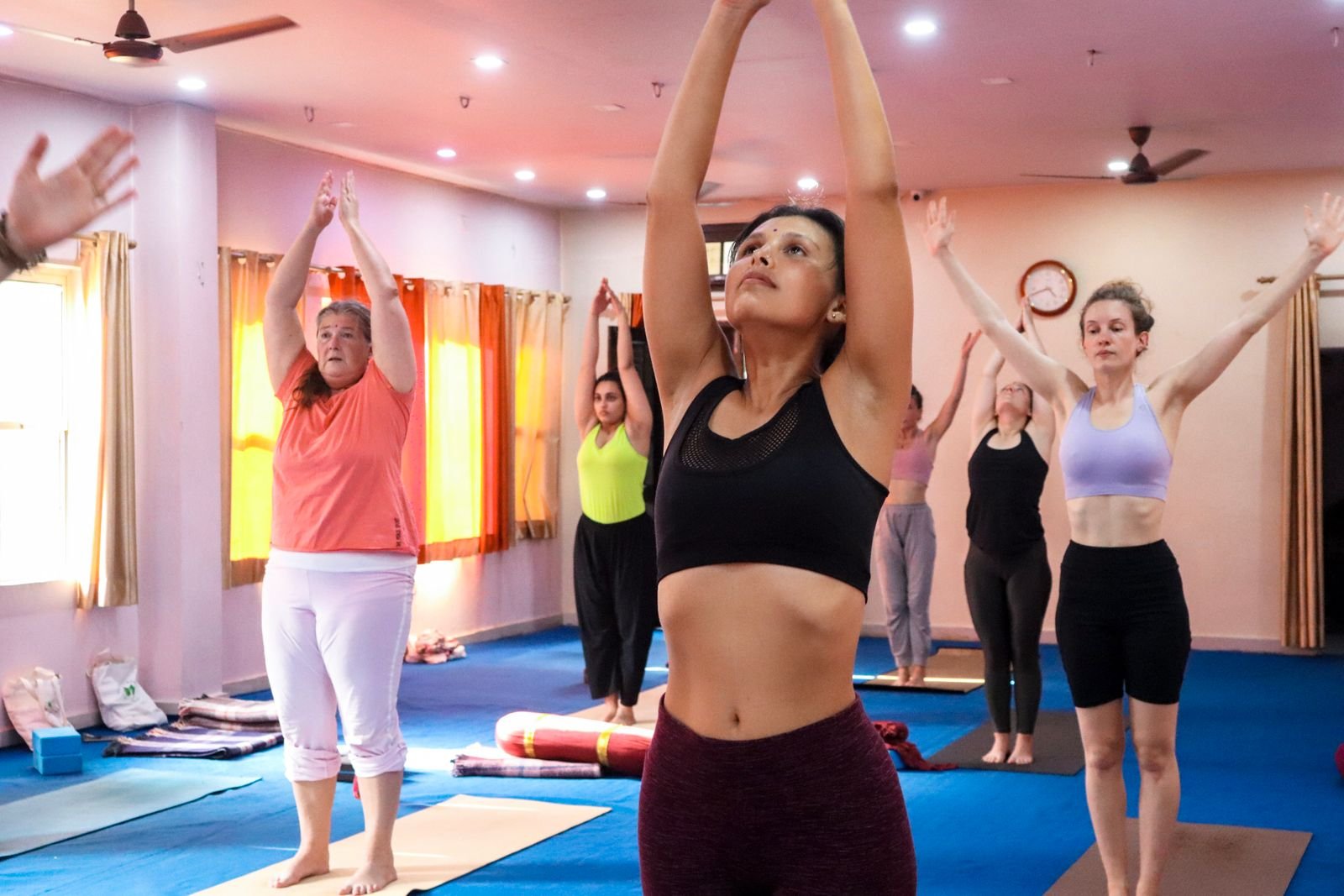
Knowing what to expect can help you choose a class that suits your experience and comfort level. Start with beginner instruction, wear clothing you can move in, and ask the teacher about options for any movements that feel difficult.
What Is Hatha Yoga?
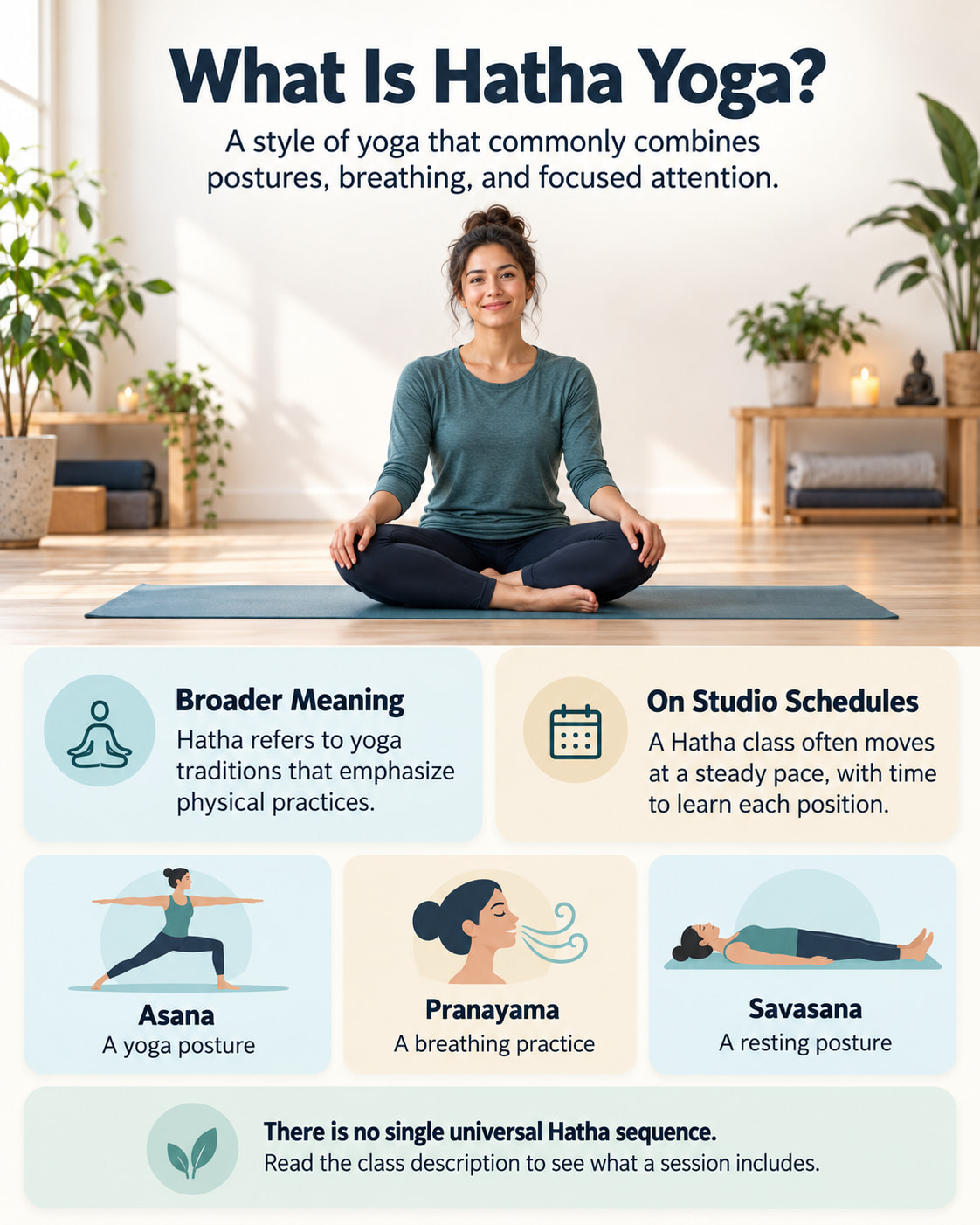
Hatha has a broad meaning and a more specific use on studio schedules.
In the broader sense, it describes yoga traditions that emphasize physical practices. Hatha traditions developed in medieval India and influenced much of the physical yoga practiced today.
When a studio advertises a Hatha yoga class, it commonly means a session that combines postures, breathing, and focused attention. You may spend time in one position before moving to the next, allowing the teacher to explain the movement.
Three terms you might hear are:
- Asana: A yoga posture.
- Pranayama: A breathing practice.
- Savasana: A resting posture often used near the end of class.
Hatha does not identify one universal sequence. Some teachers include flowing movements, meditation, or other elements. Read the class description to understand what that particular session involves.
Is Hatha Yoga Good for Beginners?
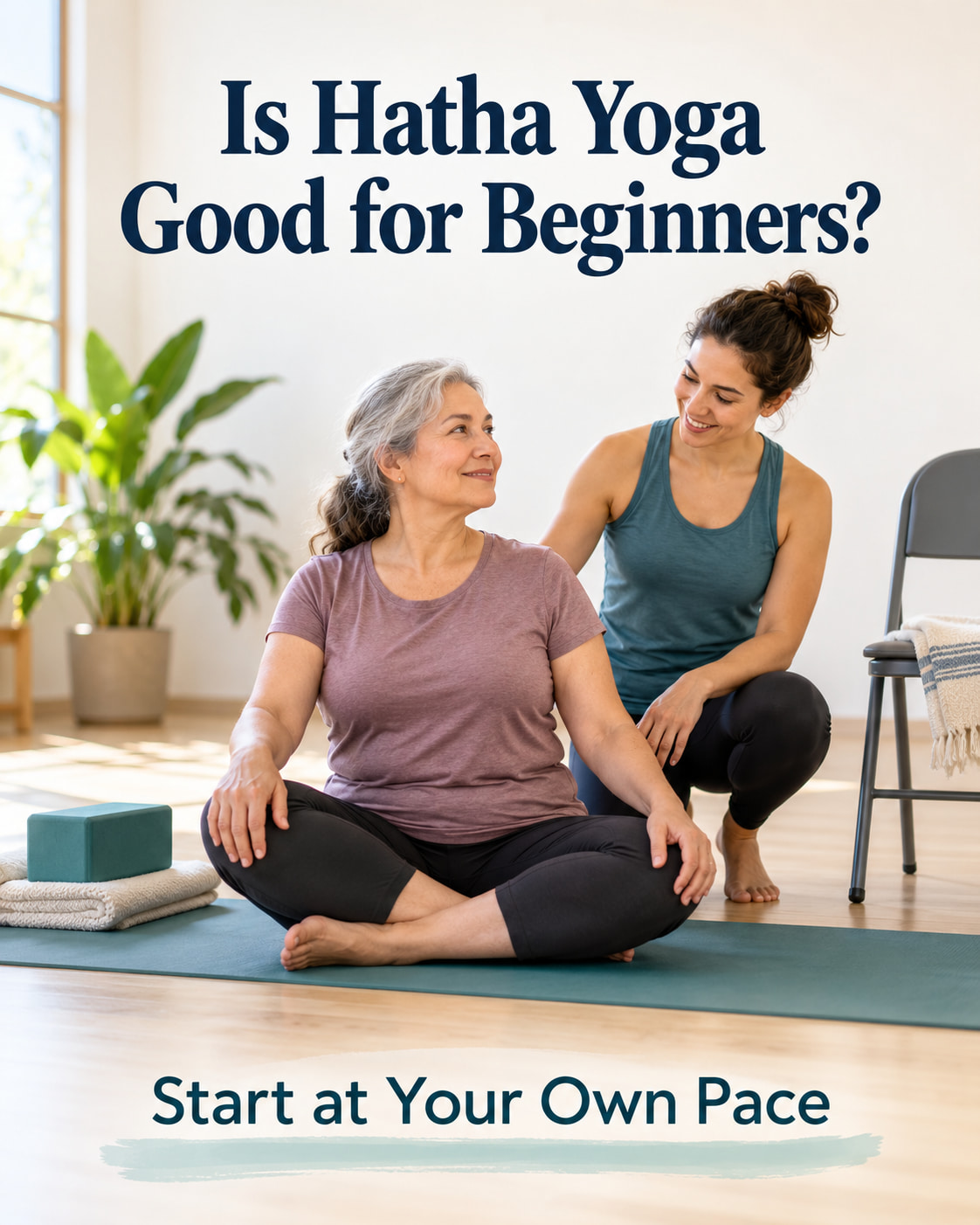
A beginner Hatha class can be an approachable introduction because a deliberate pace gives you time to follow instructions and ask for adjustments.
You do not need to touch your toes or arrive with good balance. An introductory class should help you work within your current abilities.
However, slow movement can still require effort. Holding a standing pose may challenge your legs, and getting down to the mat may be difficult for some people.
Look for words such as beginner, introductory, or gentle. Before booking, ask:
- Does the class welcome people with no yoga experience?
- Can the teacher offer alternatives to floor poses or balancing movements?
- Is the room heated?
- Are mats and props provided?
The class description and teacher’s response are more useful than the style name alone.
What to Expect in Your First Hatha Yoga Class
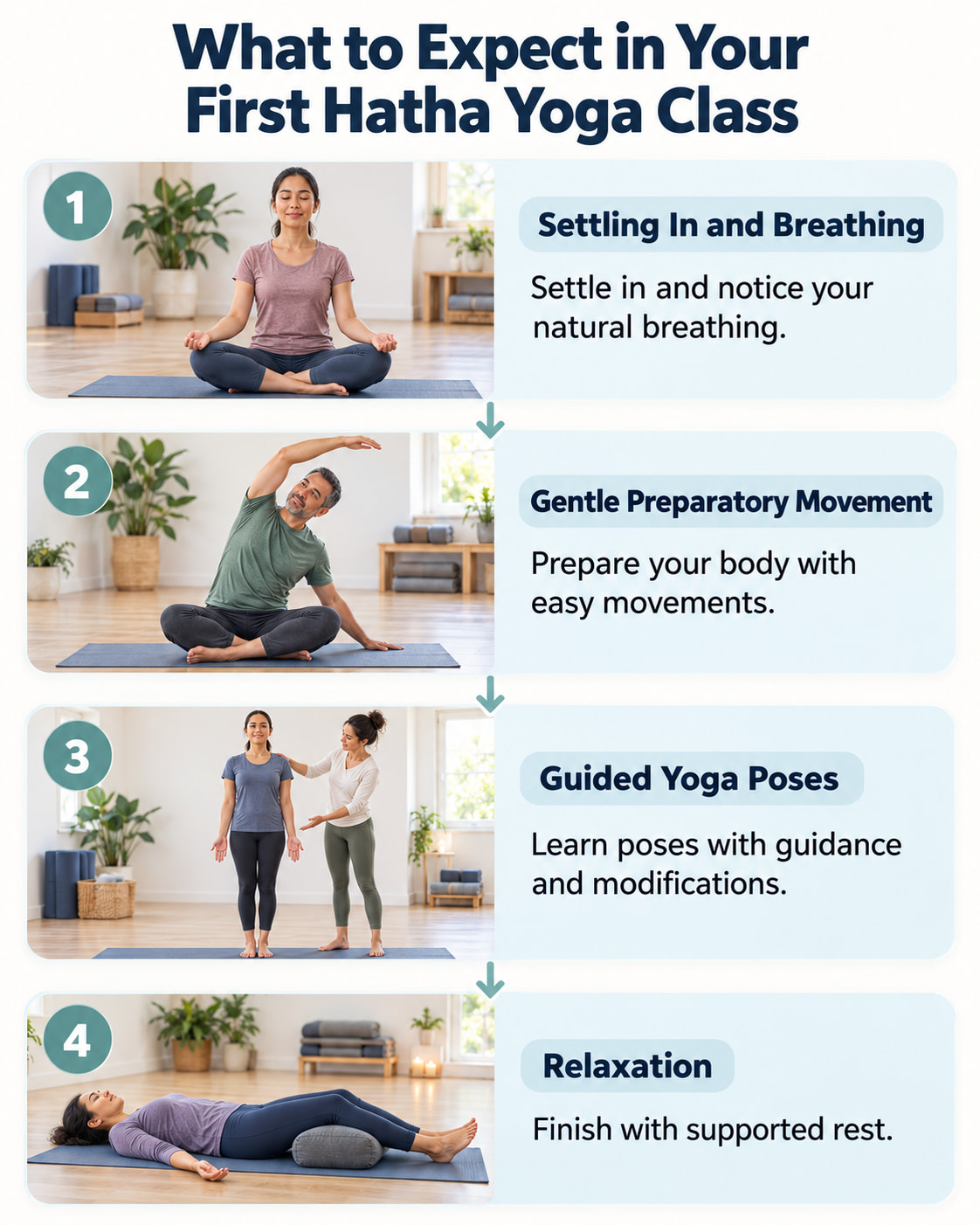
Most yoga classes last 45–90 minutes, according to MedlinePlus. Check the schedule because individual Hatha classes may be shorter or longer.
The following is a common pattern, although teachers vary the order and emphasis.
Settling In and Breathing
The teacher may invite you to sit, lie down, or find another comfortable position while noticing your breathing.
You might focus on the movement of your ribs or the feeling of air entering and leaving your nose. Follow comfortable breathing instructions without forcing a deep breath or holding it.
Gentle Preparatory Movement
Classes often begin with simple movements that gradually prepare you for the postures ahead.
Move within a range you can control. Take time to understand a cue before trying to match the teacher’s position.
Guided Yoga Poses
You may practice a mixture of standing, seated, balancing, and floor poses. The teacher will describe where to place your body and may offer props or alternatives.
Your version of a pose may look different from someone else’s. Ask for help when an instruction does not make sense or a position feels uncomfortable.
Relaxation
Many classes finish with Savasana or another supported rest. You can use cushioning or a different position if lying flat is uncomfortable.
The teacher may offer guided relaxation, quiet time, or meditation. Allow yourself to rest without trying to force your mind to become completely blank.
Common Hatha Yoga Poses for Beginners
These examples help you recognize movements you may encounter. They are not a required sequence.
Cleveland Clinic’s beginner guidance includes Mountain, Tree, Forward Fold, and Child’s Pose among foundational options. Your teacher can help you choose appropriate versions.
1. Mountain Pose
Stand with your feet comfortably apart. Let your arms rest by your sides, soften your shoulders, and look ahead.
Think about standing steadily while continuing to breathe.
2. Tree Pose
Shift your weight onto one leg. Bring the other foot toward the inside of your standing ankle, keeping its toes on the floor if needed.
Use a stable chair or counter for support. Change sides when ready.
3. Standing Forward Fold
With both feet planted, bend gently from your hips and keep your knees soft.
Rest your hands on your thighs or another comfortable support. There is no need to reach the floor.
4. Child’s Pose
From kneeling, ease your hips toward your heels and lower your torso forward.
Skip this position if it is uncomfortable, and ask for another resting option.
5. Savasana
Rest on your back with your body supported comfortably. A cushion under your knees or a folded blanket under your head may help.
You can also choose a supported side-lying position. The purpose is to settle into rest without straining to maintain a particular shape.
Hatha Yoga vs. Vinyasa and Other Yoga Styles
The clearest difference between many Hatha and Vinyasa classes is how you move between poses.
Hatha often provides more time to explore individual positions. Vinyasa usually links movements into a flowing sequence coordinated with breathing.
| Style | Common format | What to check before joining |
|---|---|---|
| Hatha | Individual poses, deliberate transitions, breathing, and relaxation | Whether the class is introductory and how physically demanding the holds are |
| Vinyasa | Poses connected into a continuous flow | Pace, experience level, and available modifications |
| Yin | Extended holds, often in floor-based positions | Whether the positions and hold times suit you |
| Restorative | Supported positions using props, with an emphasis on rest | Whether the teacher can help you get comfortable in each position |
These labels provide a starting point. Teachers may combine approaches, so two classes with the same name can feel different.
Potential Benefits of Hatha Yoga
Regular practice may support several aspects of physical and mental well-being. Benefits depend on the program, the individual, and how consistently they participate.
May Support Flexibility, Balance, and Strength
An eight-week trial of Hatha yoga and functional fitness, published in The Journals of Gerontology: Series A in 2016, included 118 sedentary, healthy adults, with an average age of 62.
Participants attended either Hatha yoga or stretching and strengthening classes three times weekly. Both groups improved measures of balance, strength, flexibility, and mobility.
The findings support Hatha as one option for working on physical function. They do not establish that it is better than other exercise or that every studio class produces the same results.
May Help With Everyday Stress
A randomized trial of Hatha yoga and stress, published in the January 2025 issue of Psychoneuroendocrinology, involved 98 participants.
After eight weeks, the Hatha group reported lower momentary stress than a waitlist group. The researchers did not find a significant effect on daily salivary cortisol or alpha-amylase levels.
This suggests that Hatha may help some people feel less stressed. The study does not support promising a change in stress hormones, and its waitlist comparison could not separate the practice’s effects from expectations or participation in a regular activity.
Can Complement Other Physical Activity
Yoga can provide opportunities to practice controlled movement, balance, and flexibility alongside activities you already enjoy.
The physical demands vary. Some classes challenge muscular endurance, while others emphasize gentle movement and rest. Plan your broader exercise routine around your needs rather than assuming every Hatha class provides the same aerobic or strengthening workload.
How to Prepare for Your First Hatha Yoga Class
Wear Comfortable Clothing
Choose clothes that allow you to bend, reach, and sit comfortably. A top that stays in place when you lean forward can make practice easier.
Yoga is commonly practiced barefoot. If you need footwear for a medical or other reason, ask the instructor about a suitable arrangement.
Check What Equipment Is Provided
Ask whether you can borrow a mat before buying one. Studios may also provide:
- Blocks for support.
- Straps to make some positions more accessible.
- Blankets for cushioning.
- Chairs or bolsters for supported practice.
Bring water and check any studio-specific instructions. You do not need to buy a complete set of equipment before trying a class.
Give Yourself Time to Meet the Teacher
Arrive with enough time to introduce yourself, mention that you are new, and explain relevant movement limitations privately.
A simple request can be enough: “This is my first class. Could you show me another option if something is too difficult?”
Silence your phone before the session begins.
State Your Preferences About Physical Adjustments
You can ask the teacher to use verbal instructions instead of touching or repositioning you.
Yoga Alliance’s professional standards require its members to obtain explicit, informed consent before physical adjustments. Agreeing to an adjustment once does not automatically give permission for future contact.
Hatha Yoga Safety Tips and Modifications
NCCIH’s yoga safety guidance describes yoga as generally safe for healthy people when practiced appropriately with qualified instruction. Sprains and strains can occur, while serious injuries are rare.
Start With Accessible Versions
Use props, reduce your range of movement, or skip a pose when needed. If getting on and off the floor is difficult, ask about chair-based options.
Beginners should avoid advanced practices such as headstands, shoulder stands, full Lotus Pose, and forceful breathing. Learning the basics is enough for a first class.
Stop When a Pose Causes Pain
Do not push farther into a position because other people appear comfortable. Stop, rest, and ask for an alternative if you feel pain or become too fatigued to move with control.
If symptoms persist or you have an existing injury, seek appropriate medical guidance rather than repeatedly testing the painful movement.
Discuss Health Conditions and Pregnancy
Some people need individual guidance or modifications, including those with existing injuries, significant balance difficulties, glaucoma, severe high blood pressure, or pregnancy.
Discuss relevant restrictions with your healthcare professional and instructor. Pregnant participants should avoid hot yoga because of overheating risk.
A group class should not delay assessment of a medical concern.
Frequently Asked Questions
Do You Need to Be Flexible to Start Hatha Yoga?
No. You can begin with your current range of movement. Choose an introductory class and ask for props or alternatives when needed. Reaching the floor or copying someone else’s posture is not an entry requirement.
Is Hatha Yoga Always Gentle?
No. A class may move slowly while still including demanding holds or balancing positions. Look at the advertised level and ask the teacher what the session involves.
Is Hatha Yoga Done in a Heated Room?
The word Hatha does not specify the room temperature. Some providers offer heated versions, so check before booking, especially if heat is a concern for you.
How Long Do You Hold Poses in Hatha Yoga?
There is no universal hold time. Teachers may use a few breaths or a longer stay, depending on the pose and class. You can come out earlier when needed and ask how to rest comfortably.
How Often Should a Beginner Practice Hatha Yoga?
Start with a schedule you can repeat comfortably. One beginner class per week can be a manageable starting example, with brief practice of familiar movements between classes if suitable. Increase gradually as you learn how your body responds.
Can You Practice Hatha Yoga at Home?
Yes. Choose instruction aimed at beginners and keep the space clear. Live instruction can be useful when you need help understanding a position or finding a modification. Pause or skip movements you cannot perform comfortably.
Conclusion
Hatha yoga can provide a manageable introduction to postures, breathing, and relaxation. The most useful first step is to find a beginner class whose pace and teaching style suit you.
Read the description, ask about modifications, and introduce yourself to the teacher. Give yourself permission to rest and learn gradually as you discover what works for your body.
References
- British Wheel of Yoga — Finding Your Yoga
- SOAS University of London — The Hatha Yoga Project
- MedlinePlus — Yoga for Health
- Kripalu School of Yoga — Yoga for the Absolute Beginner
- Cleveland Clinic — Yoga for Beginners
- Harvard Nutrition Source — Yoga for Exercise
- University of Illinois — Hatha Yoga and Functional Fitness Trial
- PubMed — Hatha Yoga, Stress, and Salivary Biomarkers
This content is for informational purposes only and not medical advice.