
The back extension exercise strengthens your spine, glutes, and core, helping improve posture and reduce stiffness. Back extension movements work the muscles that support your back, making daily activities easier and reducing the chance of strain.

Understanding how back extension exercises work is important because they target the posterior chain—an area most people undertrain due to prolonged sitting. This guide covers 15 of the best back extension variations, clear how-to steps, safety guidelines, progression tips, and recent evidence-based recommendations.
What Is a Back Extension Exercise?
A back extension exercise is any movement that extends the spine or hips, lengthening the torso upward or lifting the legs from a prone or supported position. These movements strengthen:
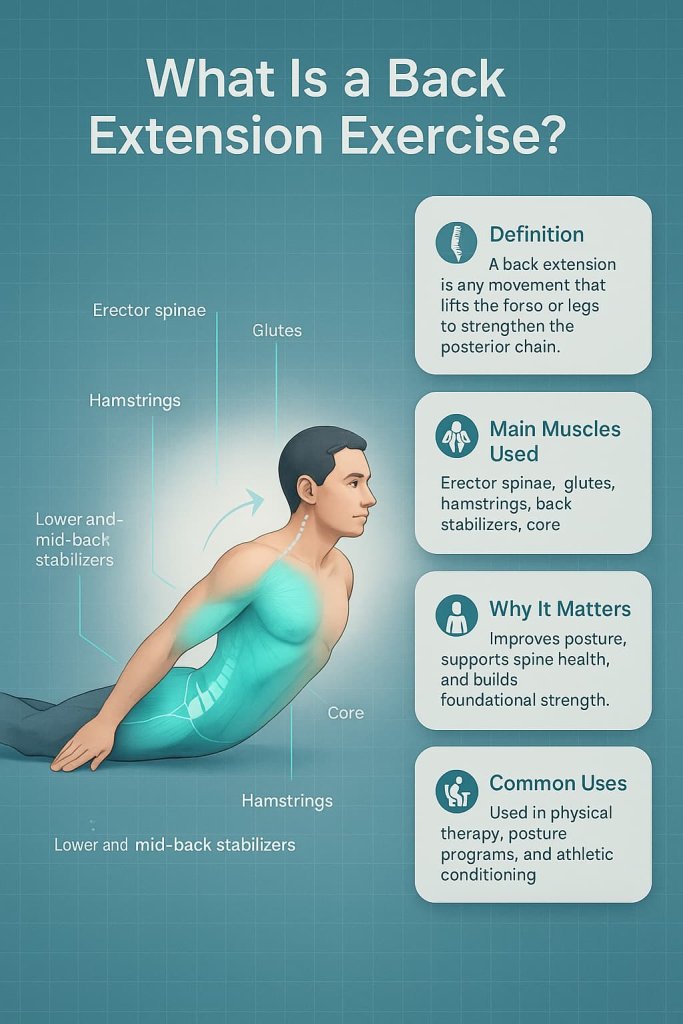
- Erector spinae
- Glutes
- Hamstrings
- Lower- and mid-back stabilizers
- Core muscles
They are widely used in posture training, athletic conditioning, and physical therapy.
Benefits of Back Extension Exercises
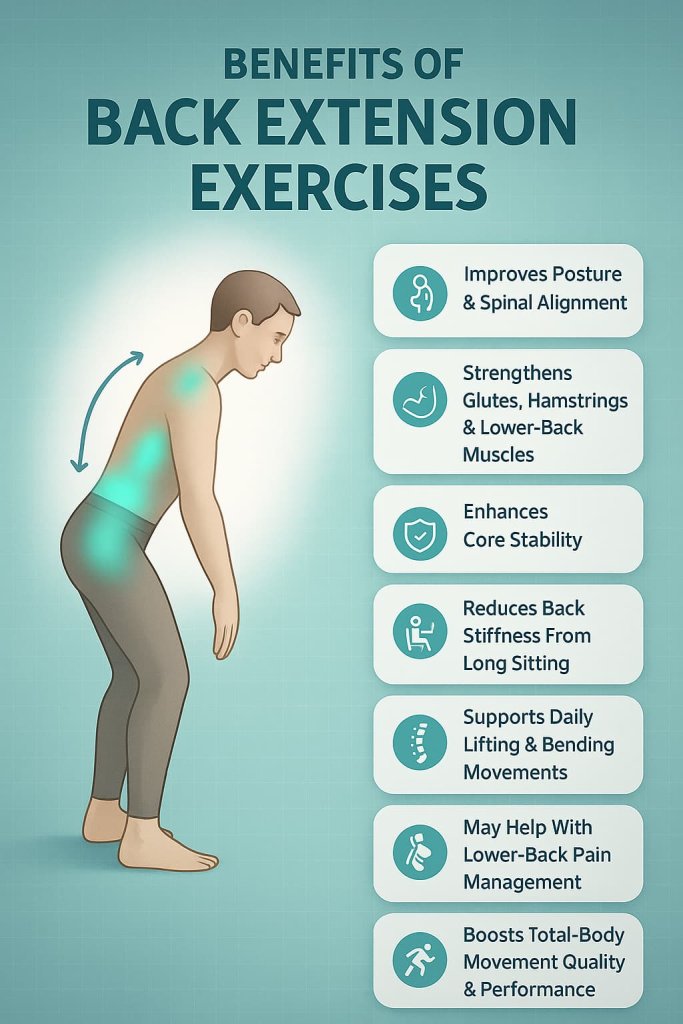
- Improves posture and spinal alignment
- Strengthens glutes, hamstrings, and lower-back muscles
- Enhances core stability
- Helps reduce back stiffness from long sitting
- Supports daily activities like lifting and bending
- Can contribute to lower-back pain management when used appropriately
- Boosts total-body movement quality and athletic performance
15 Best Back Extension Exercises
Below are 15 variations categorized by equipment type. Each includes benefits and performance cues for safe execution.
1. Prone Back Extension (Floor Back Raise)
A simple, beginner-friendly back extension that teaches basic spinal control.
How to Do It
- Lie face down with arms at your sides or behind your head.
- Brace your core lightly.
- Lift your chest a few inches off the floor without arching excessively.
- Pause briefly, then lower under control.
- Perform 10–12 slow reps.
Why It Works
Strengthens the spinal extensors with minimal load, improving endurance and posture for beginners or those with deconditioned backs.
Muscles Worked
Erector spinae, glutes, mid-back stabilizers.
Trainer Tip
Keep your chin slightly tucked and look at the floor to prevent neck strain.
2. Superman Exercise
A classic bodyweight posterior-chain builder involving arms and legs simultaneously.
How to Do It
- Lie face down with arms extended overhead.
- Lift arms, chest, and legs together in a smooth motion.
- Hold 1–2 seconds, then lower slowly.
- Perform 8–12 reps.
Why It Works
Engages the entire posterior chain and improves global trunk coordination and endurance.
Muscles Worked
Lower back, glutes, hamstrings, shoulders.
Trainer Tip
Lift only a few inches—control matters more than height.
3. Alternating Superman
A gentler, more controlled variation ideal for warm-ups or beginners.
How to Do It
- Lie face down.
- Lift right arm and left leg together.
- Lower and repeat with opposite limbs.
- Perform 10–12 reps per side.
Why It Works
Improves cross-body stability with less spinal stress, making it appropriate for all fitness levels.
Muscles Worked
Erector spinae, glutes, core.
Trainer Tip
Keep hips square to the floor to avoid rotation.
4. Bird Dog
A physical-therapy staple for spinal stability and anti-rotation control.
How to Do It
- Start on hands and knees in a neutral spine.
- Extend opposite arm and leg.
- Hold 2–3 seconds.
- Switch sides.
Why It Works
Enhances spinal stability by training the deep core and back muscles without forcing spinal extension.
Muscles Worked
Core, glutes, lumbar stabilizers.
Trainer Tip
Imagine balancing a cup on your lower back—minimize movement in the torso.
5. Hip Bridge
A hip-focused extension alternative great for individuals sensitive to spinal loading.
How to Do It
- Lie on your back with knees bent and feet flat.
- Press through heels to lift your hips.
- Squeeze glutes, pause, then lower slowly.
- Perform 12–15 reps.
Why It Works
Strengthens glutes and hips, reducing excessive load on the lumbar spine.
Muscles Worked
Glutes, hamstrings, lower back.
Trainer Tip
Avoid arching your back; drive power from your glutes.
6. Marching Bridge
A single-leg challenge to core and hip stability.
How to Do It
- Hold a stable bridge.
- Lift one knee toward your chest.
- Lower and repeat with the opposite leg.
- Perform 8–10 reps each leg.
Why It Works
Improves anti-rotation control and strengthens imbalances between left and right sides.
Muscles Worked
Glutes, hamstrings, deep core.
Trainer Tip
Keep hips level—avoid dropping to one side.
7. 45-Degree Back Extension (Roman Chair)
A controlled and safe strengthening movement performed at the gym.
How to Do It
- Adjust pad height to secure hips.
- Lower your torso toward the floor.
- Lift until your body is straight, not hyperextended.
- Perform 10–15 reps.
Why It Works
Provides direct strengthening of spinal extensors using a stable angle to limit excessive extension.
Muscles Worked
Erector spinae, glutes, hamstrings.
Trainer Tip
Stop at a straight body line to protect the lower back.
8. Horizontal Back Extension
Challenging variation where your torso works parallel to the floor.
How to Do It
- Start with torso hanging straight down.
- Lift until your body becomes level.
- Lower slowly with full control.
Why It Works
Offers a tougher angle on spinal extensors for advanced lifters.
Muscles Worked
Lower back, glutes, hamstrings.
Trainer Tip
Add a brief pause at the top for endurance and stability.
9. Weighted Back Extension
A progression designed to increase strength and load tolerance.
How to Do It
- Hold a plate or dumbbell across your chest.
- Perform controlled back extensions.
- Aim for 8–12 reps.
Why It Works
Adds progressive resistance to challenge spinal extensors and glutes more effectively.
Muscles Worked
Erector spinae, glutes, hamstrings.
Trainer Tip
Start light to maintain perfect form—never let weight dictate range.
10. Single-Leg Back Extension
A unilateral version for stability and pelvic control.
How to Do It
- Position yourself on a Roman chair.
- Lift torso while raising one leg behind you.
- Lower and switch legs.
Why It Works
Improves core stability and corrects muscle imbalances on each side of the posterior chain.
Muscles Worked
Glutes, hamstrings, spinal stabilizers.
Trainer Tip
Keep hips and shoulders aligned; slow tempo increases benefits.
11. Stability Ball Back Extension
A supportive, spine-friendly extension option.
How to Do It
- Lie face down on a stability ball.
- Brace feet against a wall.
- Lift your torso upward until your body forms a straight line.
- Lower with control.
Why It Works
Allows greater mobility and reduces spinal compression thanks to the ball’s support.
Muscles Worked
Lower back, glutes, core.
Trainer Tip
A larger ball provides more stability and better body positioning.
12. Stability Ball Reverse Hyper
A gentle reverse hyper alternative done without machines.
How to Do It
- Lie with hips supported on the ball.
- Lift legs upward behind you.
- Lower slowly in a controlled motion.
Why It Works
Targets glutes and hamstrings while minimizing shear forces on the lumbar spine.
Muscles Worked
Glutes, lower back.
Trainer Tip
Keep the torso still—use the glutes, not momentum.
13. Reverse Hyperextension (Machine or Bench)
A strength and rehabilitation favorite for hip extension power.
How to Do It
- Lie face down with hips on pad.
- Lift legs upward behind you.
- Lower slowly.
Why It Works
Builds strong glutes and hamstrings with minimal compressive load on the spine.
Muscles Worked
Glutes, hamstrings, lower back.
Trainer Tip
Start with minimal weight to develop proper movement control.
14. Lumbar Extension Machine
A guided machine-based exercise ideal for controlled strengthening.
How to Do It
- Adjust the pad to align with your pelvis.
- Extend backward through the machine’s range.
- Perform 10–12 slow reps.
Why It Works
Provides predictable resistance and precise load increments for targeted lumbar strengthening.
Muscles Worked
Lumbar extensors, glutes.
Trainer Tip
Keep movements smooth—avoid pushing into pain at any point.
15. Cable or Band Hip Extension
A standing extension variation focusing on hip movement rather than spinal arching.
How to Do It
- Secure cable or band to your ankle.
- Kick the working leg backward with control.
- Keep torso stable and core engaged.
Why It Works
Strengthens glutes and posterior chain without stressing the spine.
Muscles Worked
Glutes, hamstrings, lower-back stabilizers.
Trainer Tip
Keep your ribs down and avoid arching your lower back as you kick.
How Often Should You Do Back Extension Exercises?
- 2–3 days per week for strengthening
- 48 hours rest between intense sessions
- For posture or rehab: light core movements like bird dog or bridges can be done daily if pain-free
- Start with 1–2 sets of 8–12 reps, progressing gradually
These recommendations align with ACSM and physical-therapy guidelines.
Common Mistakes to Avoid
Improper technique is one of the main reasons people experience discomfort during extension exercises. Avoiding common mistakes ensures better muscle activation and reduces injury risk.
1. Hyperextending the Lower Back
Pushing too high at the top of the movement creates unnecessary spinal compression.
Fix: Lift only until your body is straight or slightly above parallel.
2. Leading With the Neck
Looking upward strains the cervical spine.
Fix: Keep your chin gently tucked and eyes on the floor.
3. Using Momentum or Jerking Movements
This reduces muscle engagement and increases stress on the lower back.
Fix: Move slowly with full control on both the lift and the lowering phase.
4. Not Engaging the Core
A loose core increases shear force on the spine.
Fix: Lightly brace your abdominal muscles before lifting.
5. Arching the Lower Back During Hip-Dominant Exercises
Common during bridges or band hip extensions.
Fix: Squeeze the glutes and keep ribs down to maintain neutral alignment.
6. Lifting the Legs Too High
Especially in exercises like Superman or reverse hyper.
Fix: Keep the range small—focus on muscle tension, not height.
7. Ignoring Pain Signals
Back extension should feel like muscle work, not sharp or radiating pain.
Fix: Stop immediately if discomfort moves beyond normal muscular effort.
Safety Guidelines
- Keep movements slow and controlled—avoid jerking.
- Never force your spine into pain or sharp discomfort.
- Maintain a neutral neck; avoid hyperextending your head.
- Start with bodyweight before progressing to weighted versions.
- People with spinal injury, disc herniation, or osteoporosis should consult a clinician before performing extension exercises.
- Stop immediately if you feel tingling, radiating pain, or numbness.
Who Should Avoid Back Extension Exercises
Back extension exercises are safe for most people, but certain individuals should avoid them or get medical clearance before starting. Because these movements involve spinal loading and extension, extra caution is important.
You Should Avoid Back Extension Exercises If:
- You have a recent back injury or trauma
Including acute muscle strain, ligament injury, or sudden onset pain. - You have a diagnosed disc herniation or nerve compression
Lumbar extension may increase nerve irritation in some cases. - You experience radiating symptoms
Such as tingling, numbness, sharp shooting pain, or leg weakness. - You have spinal fractures or severe osteoporosis
Extension forces may increase fracture risk without professional supervision. - You have recently undergone spinal surgery
Follow your surgeon’s rehabilitation plan and timeline. - You have chronic conditions that worsen with extension
Example: certain types of spondylolisthesis or spinal stenosis.
When to Get Medical Guidance
If you have back pain that lasts more than a few weeks, unexplained weakness, mobility limitations, or any condition affecting your spine, consult a:
- Physical therapist
- Orthopedic specialist
- Healthcare professional familiar with spinal rehab
These movements can be part of a safe strengthening program when properly prescribed.
Frequently Asked Questions (FAQ)
1. Are back extension exercises safe?
Yes, when performed correctly and within a comfortable range. People with acute spine injuries should seek medical guidance first.
2. Do back extensions help posture?
Yes—strengthening spinal extensors helps counter forward rounding and improves upright alignment.
3. Can back extensions reduce lower-back pain?
They may support lower-back pain management when performed gently, but they are not medical treatment. Always consult a professional for persistent pain.
4. Which back extension exercise is best for beginners?
Bird dog, hip bridge, and floor back extensions are the safest starting options.
5. Should I avoid hyperextending my back?
Yes. Lift only until your body is straight. Avoid excessive arching.
6. Can I do back extensions every day?
Heavy versions should not be daily, but light stability exercises can be done more frequently.
7. What equipment is best for back extensions?
A Roman chair, stability ball, or simply the floor can all be effective depending on your fitness level.
Conclusion
Back extension exercises are an essential part of building a strong, stable, and well-supported spine. Whether you exercise at home or in the gym, choosing the right variations can improve posture, strengthen the posterior chain, and support healthy daily movement. Start with simple bodyweight exercises and progress gradually for the best results.
If you’re ready to strengthen your back safely, choose 3–4 exercises from this list and begin today.
References
- American Academy of Orthopaedic Surgeons (AAOS). “Spine Conditioning Program.” OrthoInfo – AAOS.
https://orthoinfo.aaos.org/en/recovery/spine-conditioning-program/ - American Academy of Orthopaedic Surgeons (AAOS). “Low Back Pain Exercise Guide.” OrthoInfo – AAOS (PDF).
https://mdortho.co.za/wp-content/uploads/2021/03/5-Low-Back-Pain-Exercise-Guide.pdf - Harvard Health Publishing. “Effective exercises for building a strong back.”
https://www.health.harvard.edu/exercise-and-fitness/effective-exercises-for-building-a-strong-back - Harvard Health Publishing. “Three moves for better spine health.”
https://www.health.harvard.edu/staying-healthy/three-moves-for-better-spine-health - Harvard Health Publishing. “Stretching and strengthening exercises to relieve and prevent lower back pain.”
https://www.health.harvard.edu/pain/stretching-and-strengthening-exercises-to-relieve-and-prevent-lower-back-pain - Delitto A, George SZ, Van Dillen LR, et al. “Low back pain: Clinical practice guidelines linked to the International Classification of Functioning, Disability and Health.” Journal of Orthopaedic & Sports Physical Therapy. 2012;42(4):A1–A57.
https://www.jospt.org/doi/10.2519/jospt.2012.42.4.A1 - American College of Sports Medicine (ACSM). “Physical Activity Guidelines.”
https://www.acsm.org/education-resources/trending-topics-resources/physical-activity-guidelines/ - Cleveland Clinic. “Exercises and stretches for low back pain.”
https://health.clevelandclinic.org/exercises-and-stretches-for-low-back-pain