
Erector spinae exercises are strength and stability movements that support the spine, help maintain upright posture, and control bending and lifting tasks. Training this muscle group correctly may help reduce injury risk, improve back endurance, and support pain-free daily movement when combined with good technique and gradual progression.
Understanding how to train the erector spinae matters because these muscles work constantly—during sitting, standing, lifting, and most athletic movements. This guide explains what the erector spinae does, why strengthening it is important, the best exercises for different levels, safety considerations, and how to program them effectively based on current evidence and official guidelines.
What Are the Erector Spinae Muscles?
The erector spinae is a group of long muscles that run along both sides of the spine, from the pelvis up to the neck. It includes three main columns:
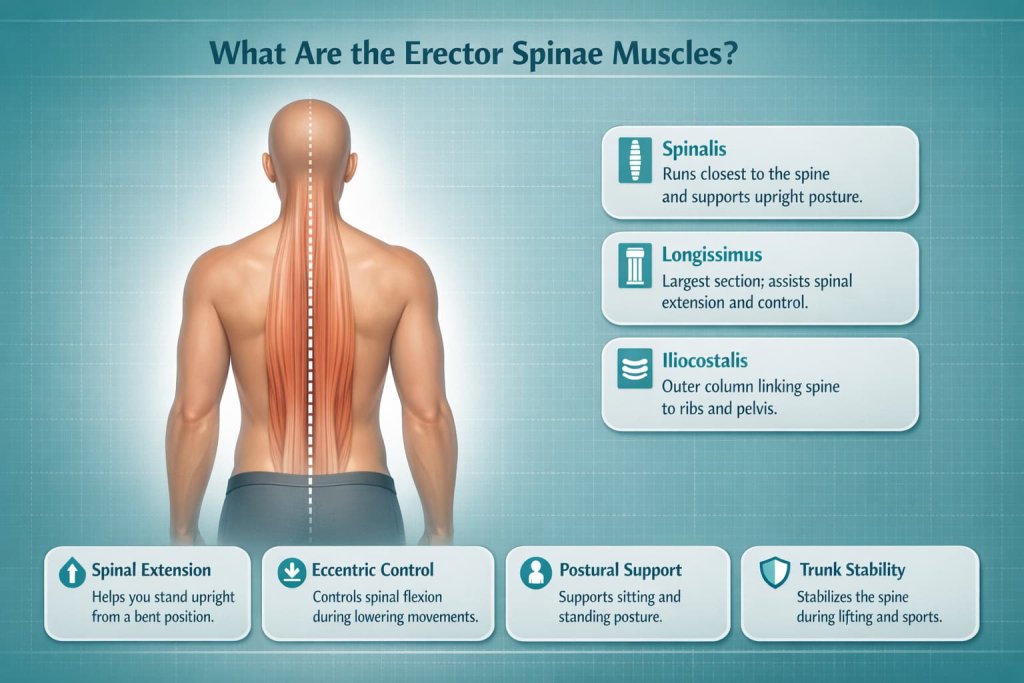
- Spinalis
- Longissimus
- Iliocostalis
Together, they help:
- Extend the spine (standing upright from a bent position)
- Control spinal flexion during lowering movements (eccentric control)
- Support posture during sitting and standing
- Stabilize the trunk during lifting and athletic tasks
Anatomy references from medical and academic sources consistently describe the erector spinae as essential for spinal stability and controlled movement.
Why Erector Spinae Exercises Matter for Back Health
Strengthening the erector spinae may help support long-term back health when exercises are performed with proper form and progression.
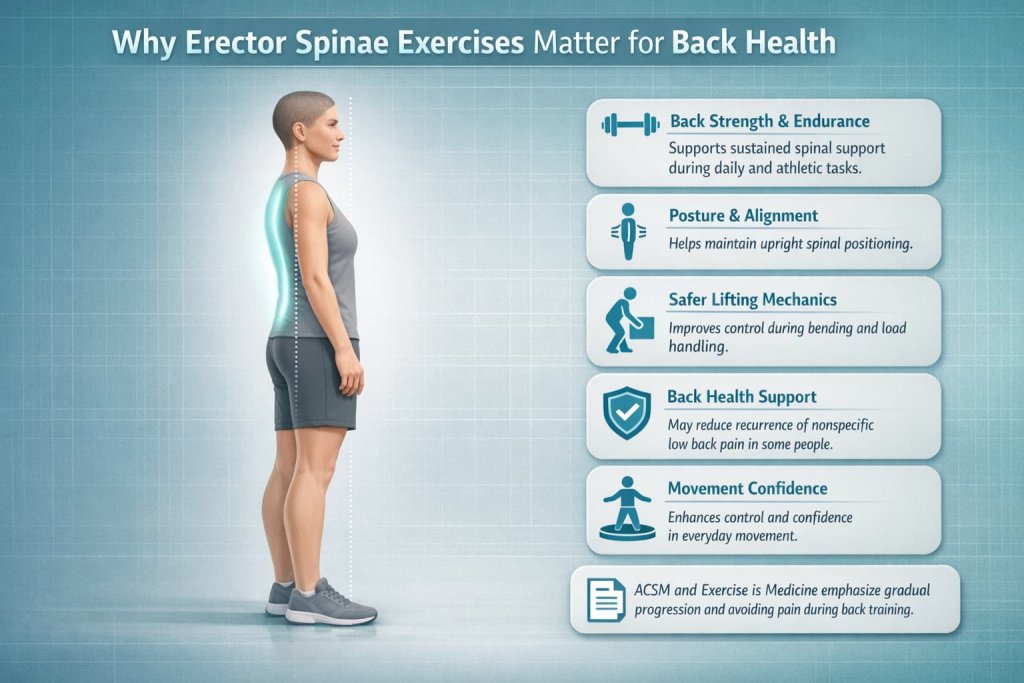
Research and clinical guidance suggest that spinal extensor training may help:
- Improve back strength and muscular endurance
- Support posture and spinal alignment
- Enhance lifting mechanics and load tolerance
- Reduce recurrence of nonspecific low back pain in some populations
- Improve confidence and control during daily activities
The American College of Sports Medicine (ACSM) emphasize progressive strengthening and avoiding pain-provoking movements during back training.
15 Best Erector Spinae Exercises
The following exercises progress from low-load stability work to higher-load strength movements. Choose options appropriate to your experience level.
1. Bird Dog
Why it works:
The bird dog trains the erector spinae through low-load spinal stabilization rather than movement. It emphasizes anti-rotation and anti-extension control, helping the spine resist unwanted motion during daily activities and lifting.
Muscles worked:
Erector spinae, transverse abdominis, multifidus, gluteus maximus, gluteus medius, shoulders (stabilizers).
How to do it:
- Start on all fours with hands under shoulders and knees under hips
- Brace your core gently without holding your breath
- Extend one arm forward and the opposite leg backward
- Keep hips and shoulders level
- Hold briefly, then return with control
- Alternate sides
Trainer Tip:
Move slowly and stop the range as soon as you lose spinal neutrality—control matters more than reach length.
2. Glute Bridge
Why it works:
Although primarily a hip exercise, the glute bridge trains the erector spinae isometrically by maintaining a neutral spine during hip extension, reinforcing proper load sharing between hips and lower back.
Muscles worked:
Gluteus maximus, erector spinae, hamstrings, deep core stabilizers.
How to do it:
- Lie on your back with knees bent and feet flat on the floor
- Brace your core and keep ribs down
- Drive through your heels to lift hips
- Pause briefly at the top
- Lower hips slowly back to the floor
Trainer Tip:
Avoid arching your lower back at the top—think “hips up, ribs down.”
3. Hip Hinge (Bodyweight)
Why it works:
The hip hinge teaches proper forward bending mechanics, training the erector spinae to control spinal position during movement rather than flexing excessively.
Muscles worked:
Erector spinae, gluteus maximus, hamstrings.
How to do it:
- Stand tall with feet hip-width apart
- Place hands on hips or along thighs
- Push hips backward while keeping spine neutral
- Lower torso until you feel hamstring tension
- Return to standing by driving hips forward
Trainer Tip:
Think of closing a car door with your hips, not your chest dropping forward.
4. Superman Hold (Modified)
Why it works:
A modified superman builds low-intensity endurance in the spinal extensors when performed with small ranges and short holds, rather than aggressive hyperextension.
Muscles worked:
Erector spinae, gluteus maximus, upper back stabilizers.
How to do it:
- Lie face down with arms at sides or slightly forward
- Gently brace your core
- Lift chest and/or legs slightly off the floor
- Hold briefly
- Lower slowly and relax
Trainer Tip:
If you feel compression in your lower back, reduce lift height or switch to bird dogs.
5. Prone Back Extension (Floor)
Why it works:
This exercise trains spinal extension through a controlled, short range, helping build awareness and strength without heavy loading.
Muscles worked:
Erector spinae, glutes, upper back muscles.
How to do it:
- Lie face down with hands near temples or at sides
- Brace core lightly
- Lift chest a few inches off the floor
- Keep neck neutral
- Lower slowly
Trainer Tip:
Stop the lift before your lower back feels compressed—this is about control, not height.
6. Stability Ball Back Extension
Why it works:
The unstable surface increases demand on spinal stabilizers while reducing compressive load compared to rigid equipment.
Muscles worked:
Erector spinae, gluteus maximus, core stabilizers.
How to do it:
- Position hips on the ball with feet anchored
- Brace core and keep spine neutral
- Lower torso slightly
- Extend spine to neutral
- Control both lifting and lowering
Trainer Tip:
Aim to return to neutral spine—not excessive arching.
7. Reverse Hyper (Light Load)
Why it works:
Reverse hypers train spinal extensors dynamically while allowing the hips to share the load, which can feel more comfortable for some individuals.
Muscles worked:
Erector spinae, glutes, hamstrings.
How to do it:
- Lie face down on a bench or machine
- Hold handles for support
- Lift legs using hip extension
- Stop when body is straight
- Lower legs under control
Trainer Tip:
Use slow tempo—momentum reduces benefit and increases strain.
8. Good Morning (Light to Moderate Load)
Why it works:
Good mornings heavily challenge the erector spinae’s ability to maintain spinal alignment under load, especially during the lowering phase.
Muscles worked:
Erector spinae, hamstrings, glutes.
How to do it:
- Place barbell lightly across upper back
- Stand with soft knees
- Hinge at hips while keeping spine neutral
- Lower until torso is near parallel
- Return to standing with hip drive
Trainer Tip:
Start extremely light—this is a technique-first movement.
9. Romanian Deadlift
Why it works:
The erector spinae work isometrically to resist spinal flexion while the hips move, making this a key posterior-chain exercise.
Muscles worked:
Erector spinae, hamstrings, glutes, grip muscles.
How to do it:
- Hold weight close to thighs
- Push hips back with slight knee bend
- Keep spine neutral throughout
- Lower until hamstrings stretch
- Stand by extending hips
Trainer Tip:
If the bar drifts forward, spinal load increases unnecessarily.
10. Deadlift (Conventional or Trap Bar)
Why it works:
Deadlifts demand high spinal stiffness and coordinated force production, making them one of the most effective compound lifts for erector spinae strength.
Muscles worked:
Erector spinae, glutes, hamstrings, quadriceps, core.
How to do it:
- Set feet under the bar
- Brace core before lifting
- Push through floor to stand
- Keep spine neutral throughout
- Lower with control
Trainer Tip:
Trap bars often reduce spinal shear for beginners and those with back sensitivity.
11. Back Extension Machine
Why it works:
Machines allow controlled loading and range, making them useful for hypertrophy or rehab-style strengthening.
Muscles worked:
Erector spinae, glutes.
How to do it:
- Adjust machine so hips align with pad
- Brace core
- Lower torso under control
- Extend back to neutral
- Avoid locking out aggressively
Trainer Tip:
Neutral spine beats maximum range every time.
12. Cable Pull-Through
Why it works:
This hip-dominant movement trains erector spinae isometrically while reinforcing proper hinge mechanics.
Muscles worked:
Erector spinae, glutes, hamstrings.
How to do it:
- Stand facing away from cable
- Hold rope between legs
- Hinge hips back
- Drive hips forward to stand
- Maintain neutral spine
Trainer Tip:
Think “hips move, spine stays.”
13. Kettlebell Swing (Technique-Dependent)
Why it works:
Swings train spinal stiffness and endurance during rapid hip extension, demanding precise timing and control.
Muscles worked:
Erector spinae, glutes, hamstrings, core.
How to do it:
- Start with kettlebell between feet
- Hinge hips back
- Explosively extend hips
- Let bell float forward
- Re-hinge to repeat
Trainer Tip:
If your back feels sore instead of hips and glutes, reduce load and slow down.
14. Bent-Over Row
Why it works:
The erector spinae work continuously to hold the torso position, leading to high activation during sustained sets.
Muscles worked:
Erector spinae, lats, rhomboids, rear delts.
How to do it:
- Hinge forward with neutral spine
- Hold weight close to body
- Pull elbows back
- Lower weight with control
- Maintain torso position
Trainer Tip:
If posture collapses, end the set—spinal endurance is the limiter here.
15. Farmer’s Carry
Why it works:
Loaded carries challenge spinal endurance and posture under real-world conditions, mimicking daily load-bearing tasks.
Muscles worked:
Erector spinae, core stabilizers, traps, grip.
How to do it:
- Hold weights at sides
- Stand tall with ribs stacked over pelvis
- Walk slowly and steadily
- Avoid leaning or shrugging
- Set weights down with control
Trainer Tip:
Short, perfect walks beat long sloppy carries.
How to Program Erector Spinae Exercises Safely
Safe programming focuses on gradual progression, controlled movement, and adequate recovery, rather than maximum loading.
General programming principles include:
- Frequency: 2–3 sessions per week within a full-body or posterior-chain program
- Volume: 2–4 exercises per session, depending on total training load
- Repetitions:
- Stability and endurance exercises: 8–15 controlled reps or short holds
- Strength-focused lifts: 3–8 reps with proper form
- Load progression: Increase resistance slowly and only when technique remains consistent
- Rest: Allow at least 48 hours between heavy spinal loading sessions
For most people, erector spinae training should support overall movement quality, not dominate the workout. Exercises that maintain a neutral spine and emphasize control are often better tolerated than aggressive end-range loading.
Common Mistakes to Avoid During Erector Spinae Training
Many back-related issues arise not from the exercises themselves, but from how they are performed or programmed.
Common mistakes include:
- Overextending the lower back instead of returning to a neutral spine
- Using excessive load too early, especially on good mornings or deadlifts
- Training through pain rather than adjusting range, load, or exercise selection
- Rushing repetitions and relying on momentum
- Neglecting recovery, especially when combining multiple hinge-based movements
- Ignoring breathing and bracing, which can increase spinal strain
Avoiding these errors helps keep erector spinae exercises supportive rather than stressful to the spine.
Are Erector Spinae Exercises Safe?
When performed with proper technique and appropriate load, erector spinae exercises are generally considered safe for healthy individuals.
Key safety principles include:
- Maintain a neutral spine whenever possible
- Avoid jerky or ballistic movements
- Progress load gradually
- Stop any exercise that causes sharp or worsening pain
- Emphasize control over range of motion
Exercise is Medicine and orthopedic organizations consistently recommend avoiding training through pain, especially for individuals with existing back conditions.
Who Should Modify or Avoid These Exercises?
Some individuals may need to modify intensity, range, or exercise selection, or seek professional guidance before performing erector spinae exercises.
Extra caution is recommended for people who:
- Are experiencing acute or worsening low back pain
- Have a history of spinal disc, nerve, or stress-related conditions
- Are recovering from recent back surgery or injury
- Experience pain during basic activities such as standing, walking, or bending
In these cases, lower-load stability exercises (such as bird dogs or supported hinges) are often used first, with progression guided by a qualified healthcare or fitness professional.
Erector Spinae Exercises at Home vs Gym
At home:
- Bird dogs
- Glute bridges
- Bodyweight hip hinges
- Modified supermans
- Farmer’s carries with household objects
At the gym:
- Deadlifts
- Back extension machines
- Good mornings
- Cable pull-throughs
- Weighted carries
Both settings can be effective when exercises are matched to ability level.
FAQs About Erector Spinae Exercises
What is the best exercise for the erector spinae?
There is no single “best” exercise. A combination of stability, endurance, and strength movements provides the most balanced approach.
Can erector spinae exercises help back pain?
They may help support function and reduce recurrence of nonspecific back pain when performed correctly and progressively, according to clinical guidelines.
Are back extensions bad for your spine?
Back extensions are not inherently harmful. Risk depends on technique, load, range of motion, and individual tolerance.
Should beginners train the erector spinae?
Yes, but beginners should start with low-load stability exercises and focus on form before adding resistance.
How do erector spinae exercises improve posture?
They help maintain upright spinal alignment by improving endurance and control during prolonged sitting or standing.
Can I train erector spinae every day?
Daily low-intensity activation may be acceptable, but heavy or high-load training should allow recovery days.
Conclusion
Erector spinae exercises play a crucial role in building a strong, stable, and resilient back. When selected appropriately and performed with proper technique, they may help support posture, improve movement control, and enhance long-term back health.
If your goal is pain-free strength and better spinal support, focus on quality movement, gradual progression, and consistency—and consider professional guidance if you have a history of back issues.
References
- ACSM Position Stand: Progression Models in Resistance Training for Healthy Adults (PubMed)
- Exercise Is Medicine: Exercising With Lower Back Pain (PDF)
- Exercise Is Medicine: Rx for Health – Low Back Pain (PDF)
- AAOS OrthoInfo: Spine Conditioning Program
- McGill Stabilization vs Conventional Physiotherapy for Chronic Low Back Pain (PMC)
- ACE Sponsored Research: What Is the Best Back Exercise? (EMG Findings)
- Electromyographic Activity in Deadlift Exercise and Its Variants (PMC)