
The best leg exercises for bad knees are low-impact, controlled movements that strengthen the muscles around the knee—especially the quadriceps, hamstrings, glutes, and calves—without placing excessive stress on the joint.
Understanding which exercises are knee-friendly is important because strong, well-supported knees often tolerate daily activities better than weak ones. The right exercises may help improve stability, support movement, and reduce discomfort during walking, sitting, and climbing stairs.
According to major clinical guidelines, exercise is a core, first-line recommendation for people with knee discomfort or knee osteoarthritis when done correctly and progressed gradually. This guide explains the safest options, how to perform them, and what to avoid.
What Are Leg Exercises for Bad Knees?
Leg exercises for bad knees are joint-friendly movements designed to build strength in the muscles that support and stabilize the knee without deep bending, jumping, or high impact.
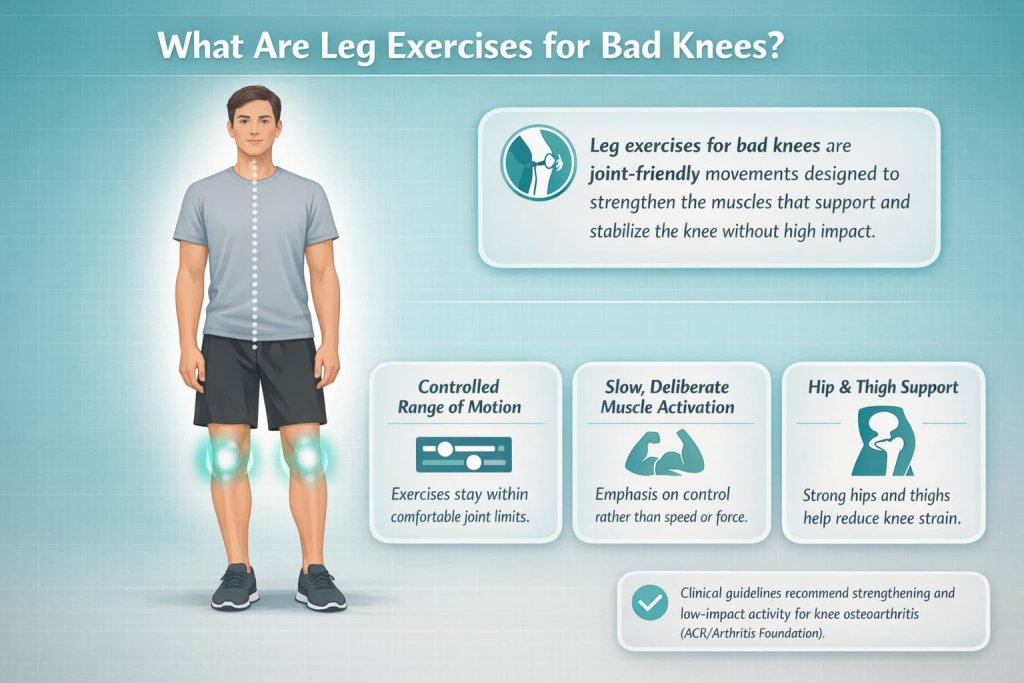
They typically focus on:
- Controlled ranges of motion
- Slow, deliberate muscle activation
- Strong hip and thigh engagement to reduce knee strain
Authoritative guidelines from the American College of Rheumatology and the Arthritis Foundation emphasize strengthening and low-impact activity as core management strategies for knee osteoarthritis and chronic knee pain (ACR/AF Guideline, 2019).
Why Leg Exercises for Bad Knees Matter
Regular, well-designed leg exercises may help support:
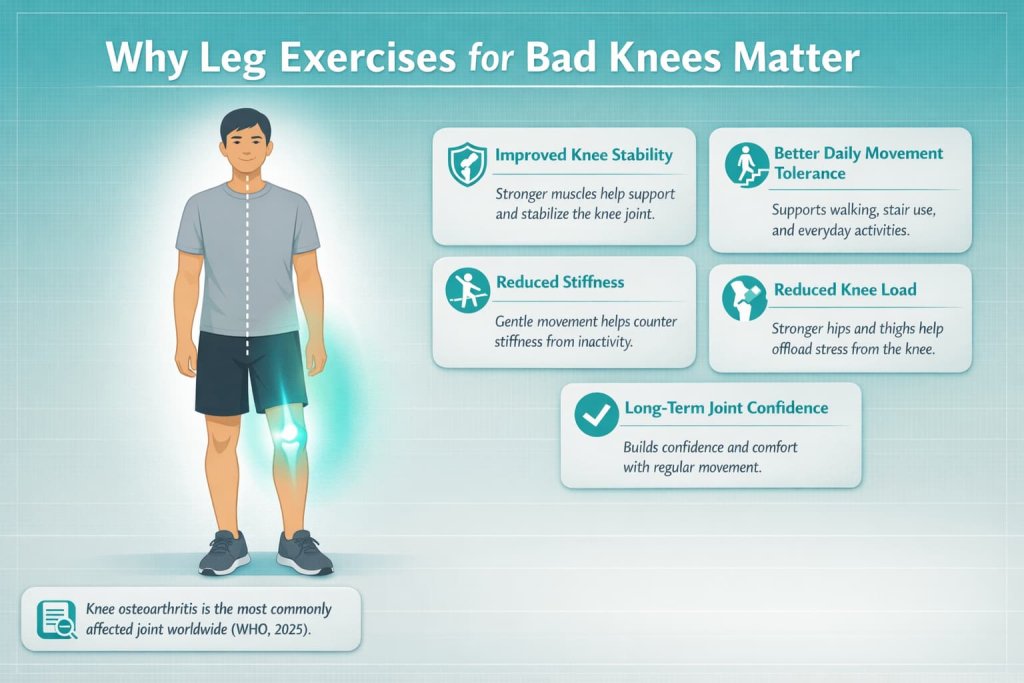
- Improved knee stability and joint support
- Better tolerance for walking, stairs, and daily tasks
- Reduced stiffness from inactivity or prolonged sitting
- Stronger hips and thighs, which reduce load on the knee
- Long-term joint function and confidence with movement
The World Health Organization reports that knee osteoarthritis is the most commonly affected joint worldwide, highlighting the importance of safe, accessible exercise strategies (WHO, 2023).
13 Best Leg Exercises for Bad Knees
These knee-friendly leg exercises focus on low-impact strengthening to support stability, mobility, and everyday movement. They are designed to build muscle around the knee while minimizing joint stress and discomfort.
1. Straight Leg Raise
Why it works:
This exercise strengthens the quadriceps while keeping the knee joint straight and unloaded. Because there is no bending, it is commonly used in early rehabilitation and knee-friendly strengthening programs.
Muscles worked:
Quadriceps, hip flexors, core stabilizers
How to do it:
- Lie on your back with one knee bent and the other leg straight
- Tighten the thigh of the straight leg
- Slowly lift the straight leg to the height of the opposite knee
- Hold briefly, then lower with control
- Repeat before switching sides
Trainer Tip:
Focus on tightening the thigh before lifting—this improves quadriceps activation without stressing the knee.
2. Seated Leg Extension
Why it works:
Seated leg extensions strengthen the front of the thigh in a controlled, supported position, making them suitable for people with knee sensitivity when performed within a comfortable range.
Muscles worked:
Quadriceps
How to do it:
- Sit upright in a chair with feet flat on the floor
- Slowly extend one leg forward until it is straight or nearly straight
- Pause briefly at the top
- Lower the leg slowly back down
- Alternate sides
Trainer Tip:
Avoid snapping the knee into lockout; stop just short of full extension if that feels more comfortable.
3. Wall Sit (Partial Depth)
Why it works:
Wall sits build thigh strength through an isometric hold while the wall supports body weight, allowing knee angles to remain shallow and controlled.
Muscles worked:
Quadriceps, glutes, calves
How to do it:
- Stand with your back against a wall
- Slide down slightly into a shallow squat position
- Keep knees aligned over toes
- Hold for a comfortable time
- Slowly return to standing
Trainer Tip:
Only lower as far as you can hold without pain—partial depth is effective and knee-friendly.
4. Hamstring Curl (Standing or Lying)
Why it works:
Strong hamstrings help balance quadriceps forces and reduce uneven stress across the knee joint during movement.
Muscles worked:
Hamstrings, glutes (secondary)
How to do it:
- Stand holding a chair or lie face down
- Slowly bend one knee, bringing the heel toward the buttocks
- Pause briefly
- Lower the leg with control
- Switch sides
Trainer Tip:
Move slowly—fast curls can increase knee strain and reduce muscle control.
5. Glute Bridge
Why it works:
Glute bridges strengthen the hips and posterior chain, which helps reduce excessive load on the knees during walking, standing, and stair use.
Muscles worked:
Glutes, hamstrings, core
How to do it:
- Lie on your back with knees bent and feet flat
- Press through your heels
- Lift hips until your body forms a straight line
- Hold briefly
- Lower slowly
Trainer Tip:
Keep ribs down and avoid arching your lower back to maximize glute engagement.
6. Step-Ups (Low Height)
Why it works:
Step-ups replicate everyday stair climbing while allowing control over height, speed, and knee angle.
Muscles worked:
Quadriceps, glutes, hamstrings
How to do it:
- Stand facing a low step or platform
- Step up with one foot
- Push through the heel to stand tall
- Step back down with control
- Alternate sides
Trainer Tip:
Start with a very low step and increase height only if pain-free.
7. Sit-to-Stand from a Chair
Why it works:
This functional exercise strengthens the legs using a movement pattern required for daily independence.
Muscles worked:
Quadriceps, glutes, hamstrings
How to do it:
- Sit tall on a chair
- Lean slightly forward
- Press through your heels to stand
- Slowly sit back down
- Repeat with control
Trainer Tip:
Use armrests or a higher chair if needed to reduce knee load.
8. Calf Raises
Why it works:
Strong calves help support proper ankle and knee alignment during walking and standing activities.
Muscles worked:
Gastrocnemius, soleus
How to do it:
- Stand holding a stable surface
- Rise slowly onto the balls of your feet
- Pause briefly at the top
- Lower heels back down slowly
Trainer Tip:
Control the lowering phase—it’s just as important as lifting.
9. Side-Lying Leg Raise
Why it works:
This exercise strengthens the hip abductors, which help control knee alignment and reduce inward knee collapse.
Muscles worked:
Gluteus medius, hip stabilizers
How to do it:
- Lie on your side with legs straight
- Lift the top leg upward slightly behind the body
- Keep hips stacked
- Lower slowly
- Switch sides
Trainer Tip:
Small, controlled lifts are more effective than swinging the leg.
10. Mini Squat
Why it works:
Mini squats strengthen the legs through a limited range of motion, avoiding deep knee bending.
Muscles worked:
Quadriceps, glutes, hamstrings
How to do it:
- Stand with feet shoulder-width apart
- Bend knees slightly while pushing hips back
- Keep chest upright
- Return to standing
Trainer Tip:
Stop well before discomfort—depth is optional, control is essential.
11. Resistance Band Leg Press (Seated)
Why it works:
This exercise mimics a leg press with adjustable resistance and minimal joint impact.
Muscles worked:
Quadriceps, hamstrings, glutes
How to do it:
- Sit upright with a band looped around your foot
- Hold band ends securely
- Press the foot forward against resistance
- Slowly return
Trainer Tip:
Choose lighter resistance and increase gradually over time.
12. Terminal Knee Extension (Band-Assisted)
Why it works:
Terminal knee extensions improve quadriceps control near full extension, which is important for walking and standing stability.
Muscles worked:
Quadriceps
How to do it:
- Anchor a band behind your knee
- Slightly bend the knee
- Straighten the leg against the band
- Hold briefly, then relax
Trainer Tip:
Focus on smooth control rather than forceful locking.
13. Cycling or Stationary Bike (Low Resistance)
Why it works:
Cycling provides rhythmic knee motion with low joint impact, supporting endurance and mobility.
Muscles worked:
Quadriceps, hamstrings, glutes, calves
How to do it:
- Set the seat so knees stay slightly bent at the bottom
- Use low resistance
- Pedal at a comfortable, steady pace
Trainer Tip:
If pain increases, reduce resistance or duration rather than speed.
How Often Should You Do Leg Exercises for Bad Knees?
Most clinical and rehabilitation guidelines suggest:
- 2–3 days per week for strengthening exercises
- 1–3 sets of 8–15 repetitions, based on comfort
- At least one rest day between sessions for recovery
Common Mistakes to Avoid With Bad Knees
- Exercising through sharp or worsening pain
- Using deep squats or lunges too early
- Increasing resistance too quickly
- Ignoring hip and glute strengthening
- Skipping warm-ups before exercise
Who Should Be Careful With These Exercises?
You should use extra caution or seek professional guidance if you have:
- Severe or rapidly worsening knee pain
- Significant swelling, redness, or warmth in the knee
- Knee locking, catching, or instability
- Recent knee surgery or acute injury
A physical therapist or qualified healthcare professional can help individualize exercise selection and progression.
Safety Guidelines Before Starting Leg Exercises for Bad Knees
Before beginning any leg exercise routine for bad knees, it’s important to prioritize joint safety and gradual progression. Exercise is widely recommended for knee discomfort, but it should always feel controlled and manageable rather than painful.
Key safety guidelines include:
- Exercises should feel comfortable to mildly challenging, not sharp or painful
- Move through a pain-free or low-discomfort range of motion
- Start with low resistance and slow tempo to allow joints and muscles to adapt
- Maintain proper alignment, keeping knees tracking comfortably over the toes
- Warm up with gentle movement (such as easy walking or cycling) before strengthening
- Allow rest days between strengthening sessions to support recovery
When to Modify or Stop Leg Exercises for Knee Pain
While mild muscle fatigue is normal, certain symptoms indicate that an exercise should be modified or stopped to protect knee health.
You should modify or stop exercises if you notice:
- Sharp, stabbing, or worsening knee pain during movement
- Pain that increases significantly and lasts longer than 24–48 hours after exercise
- Noticeable swelling, warmth, or redness around the knee joint
- Knee locking, catching, or a feeling of instability
- Reduced ability to bear weight or perform daily activities comfortably
If symptoms persist despite exercise modification, or if pain interferes with normal movement, it’s important to seek guidance from a qualified healthcare professional or physical therapist. Early assessment can help rule out underlying issues and ensure exercises are appropriate for your condition.
Frequently Asked Questions (FAQs)
Are leg exercises safe for knee osteoarthritis?
Yes. Major guidelines recommend exercise as a core treatment for knee osteoarthritis when performed at a tolerable intensity and progressed gradually.
Should I stop exercising if my knees hurt?
Mild muscle discomfort can be normal, but sharp or increasing knee pain is a signal to modify or stop the exercise.
Are squats bad for bad knees?
Deep squats may be uncomfortable for some people, but shallow or supported squats are often well tolerated.
What muscles protect the knees the most?
The quadriceps, hamstrings, glutes, and calves all play key roles in knee support and stability.
Can seniors do these leg exercises?
Yes. Many of these exercises are commonly used in senior fitness and rehabilitation programs with appropriate modifications.
Is walking good for bad knees?
Walking is often recommended if it is comfortable and performed at a manageable pace.
Conclusion
The best leg exercises for bad knees focus on controlled, low-impact strengthening that supports the knee rather than stressing it. When performed consistently and progressed gradually, these exercises may help improve stability, movement confidence, and everyday comfort.
If knee pain persists or limits daily life, consider working with a qualified professional to personalize your exercise plan and ensure long-term joint health.
References
- World Health Organization (WHO) – Osteoarthritis (Fact sheet)
- Centers for Disease Control and Prevention (CDC) – Osteoarthritis
- American College of Rheumatology/Arthritis Foundation – Osteoarthritis Management Guideline (Hand, Hip, Knee)
- NICE – Osteoarthritis in over 16s: diagnosis and management (NG226)
- OARSI – Non-surgical management guidelines for knee/hip/polyarticular osteoarthritis (PubMed)
- AAOS – Knee Conditioning Program (Rehab PDF)
- AAOS – Management of Osteoarthritis of the Knee (Non-Arthroplasty) Clinical Practice Guideline (PDF)
- Cochrane – Exercise for treating knee osteoarthritis (Evidence review)