
Quad exercises for bad knees are safe, effective strengthening movements that improve knee support without increasing joint stress when performed with proper form and controlled range. Strengthening the quadriceps is one of the most widely recommended strategies to support knee comfort, daily function, and long-term joint health.
This guide explains which quad exercises are knee-friendly, why they work, and how to perform them safely—whether you’re managing chronic knee discomfort, recovering from irritation, or simply want joint-smart strength training.
What Are Quad Exercises for Bad Knees?
Quad exercises for bad knees are lower-body movements designed to strengthen the quadriceps muscles while minimizing compressive and shear forces at the knee joint. Unlike deep squats or high-impact training, these exercises emphasize:
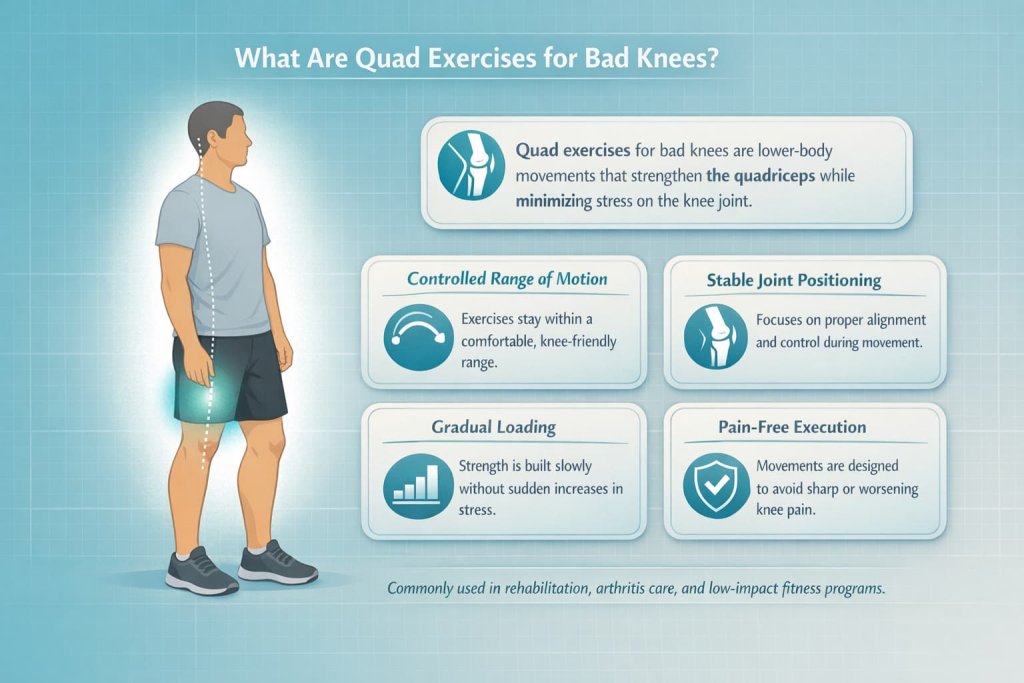
- Controlled range of motion
- Stable joint positioning
- Gradual loading
- Pain-free execution
They are commonly used in rehabilitation, arthritis management, and low-impact fitness programs.
12 Best Quad Exercises for Bad Knees
These 12 quad exercises for bad knees focus on strengthening the thigh muscles while keeping knee stress low and movements controlled. They are designed to improve daily function, stability, and confidence without aggravating knee pain when performed correctly.
1. Quad Sets
Why it works:
Quad sets activate the quadriceps without moving the knee joint, making them ideal when bending or loading the knee is uncomfortable. This exercise helps maintain neuromuscular connection and supports knee stability during pain flare-ups or early rehabilitation.
Muscles worked:
Quadriceps
How to do it:
- Sit or lie down with the leg fully straight and relaxed
- Tighten the thigh muscle by pressing the knee gently toward the floor or bed
- Keep the foot relaxed and the leg still
- Hold the contraction briefly, then fully relax
Trainer tip:
Focus on feeling the muscle tighten above the knee rather than pushing hard into the surface.
2. Straight Leg Raises
Why it works:
This exercise strengthens the quadriceps while keeping the knee in a straight, supported position. It builds strength without compressive knee forces, making it a common choice for knee-sensitive training programs.
Muscles worked:
Quadriceps, hip flexors
How to do it:
- Lie on your back with one knee bent and the other leg straight
- Tighten the thigh of the straight leg
- Lift the straight leg to the height of the bent knee
- Lower the leg slowly with control
Trainer tip:
Pull your toes slightly upward to increase quad engagement and prevent hip dominance.
3. Short Arc Quads
Why it works:
Short arc quads strengthen the quadriceps through a limited, knee-friendly range of motion. This allows strength development without deep bending, reducing stress on sensitive knee structures.
Muscles worked:
Quadriceps
How to do it:
- Place a rolled towel or foam roll under your knee
- Start with the knee bent over the support
- Slowly straighten the leg by lifting the foot
- Lower back down with control
Trainer tip:
Move slowly and avoid snapping the knee straight at the top.
4. Seated Knee Extensions (Limited Range)
Why it works:
This movement improves quad control and endurance while removing bodyweight from the knee. Limiting the range keeps joint stress low while still strengthening the muscle.
Muscles worked:
Quadriceps
How to do it:
- Sit upright in a chair with feet flat on the floor
- Slowly extend one leg partway forward
- Pause briefly, then lower with control
- Repeat before switching sides
Trainer tip:
Stop just short of full lockout to keep tension on the muscles and protect the joint.
5. Sit-to-Stand (Chair Squats)
Why it works:
Sit-to-stand exercises build functional quad strength needed for daily tasks like standing up, sitting down, and climbing stairs—all while keeping movement controlled and predictable.
Muscles worked:
Quadriceps, glutes
How to do it:
- Sit on a chair with feet hip-width apart
- Lean slightly forward and press through your heels to stand
- Stand fully upright
- Slowly sit back down with control
Trainer tip:
Use armrests or a higher chair height if knee discomfort appears.
6. Wall Sit (Shallow Depth)
Why it works:
Wall sits develop isometric quad strength without joint movement. A shallow knee angle allows strengthening while limiting compressive forces on the knee.
Muscles worked:
Quadriceps
How to do it:
- Stand with your back against a wall
- Slide down slightly into a partial squat
- Keep knees comfortable and aligned
- Hold the position briefly, then stand up
Trainer tip:
Short holds with perfect form are more effective than long, painful ones.
7. Step-Ups (Low Height)
Why it works:
Low step-ups strengthen the quads through controlled single-leg loading, which improves knee coordination and confidence during everyday movements like stairs.
Muscles worked:
Quadriceps, glutes
How to do it:
- Stand in front of a low step or platform
- Step up with one foot and straighten the leg
- Step back down slowly
- Repeat before switching sides
Trainer tip:
Start with a very low step and increase height only if pain-free.
8. Terminal Knee Extensions (Band)
Why it works:
This exercise targets the final portion of knee extension, an area often weak in people with knee pain. It improves quad activation and knee stability during standing and walking.
Muscles worked:
Quadriceps
How to do it:
- Anchor a resistance band behind your knee
- Start with the knee slightly bent
- Straighten the knee against the band
- Slowly return to the starting position
Trainer tip:
Move slowly and keep tension in the band throughout the movement.
9. Mini Squats
Why it works:
Mini squats strengthen the quads and glutes without deep knee flexion, helping improve lower-body strength while keeping joint stress manageable.
Muscles worked:
Quadriceps, glutes
How to do it:
- Stand with feet shoulder-width apart
- Bend knees slightly as if starting to sit
- Keep chest upright and heels grounded
- Return to standing
Trainer tip:
Only squat as low as you can without discomfort.
10. Supported Split Squat (Short Range)
Why it works:
This exercise improves single-leg quad strength and balance while external support reduces joint load and instability.
Muscles worked:
Quadriceps, glutes
How to do it:
- Stand in a split stance holding a chair or rail
- Lower slightly by bending the front knee
- Press through the front foot to stand
- Repeat before switching legs
Trainer tip:
Keep the front knee aligned with the toes to reduce strain.
11. Resistance Band Leg Press (Seated)
Why it works:
This movement mimics a leg press without heavy resistance, allowing quad strengthening in a seated, controlled position that is often more comfortable for bad knees.
Muscles worked:
Quadriceps
How to do it:
- Sit tall with a resistance band looped around your feet
- Hold the band ends securely
- Press both legs forward until nearly straight
- Slowly return to the start
Trainer tip:
The slow return phase is where most of the strength benefit occurs.
12. Isometric Knee Holds
Why it works:
Isometric knee holds strengthen the quadriceps without movement, making them ideal on days when bending feels limited or painful.
Muscles worked:
Quadriceps
How to do it:
- Bend the knee slightly to a comfortable angle
- Tighten the thigh muscles
- Hold the position without moving
- Relax fully before repeating
Trainer tip:
These are excellent “low-energy” strength options during recovery days.
How to Program Quad Exercises for Bad Knees
- Train 2–3 days per week with rest days between sessions
- Use 1–3 sets of 8–15 reps or 10–30 second holds
- Start with isometrics, then move to controlled functional exercises
- Increase volume gradually, not all at once
- On flare-up days, reduce range and intensity
Safety Guidelines Before Starting Quad Exercises for Bad Knees
- Stay in a pain-free range; mild effort is normal, sharp pain is not
- Avoid deep knee bends and do not lock the knee
- Progress slowly—add reps or resistance gradually
- Stop if swelling, instability, or sharp pain appears
- If pain worsens or lasts longer than 24 hours, scale back
Why Quad Strength Matters for Knee Health
Strong quadriceps play a key role in knee function. They help:
- Control knee alignment during walking and stairs
- Absorb force during daily movements
- Reduce excessive joint stress
- Improve confidence and stability
Clinical guidance from the Centers for Disease Control and Prevention and the World Health Organization highlights muscle strengthening as a cornerstone of joint-friendly physical activity, especially for aging adults and people with knee osteoarthritis.
Key Muscles Targeted
- Rectus femoris
- Vastus medialis (VMO)
- Vastus lateralis
- Vastus intermedius
Supporting muscles include the glutes, hamstrings, and calves, which help reduce load on the knee.
Common Mistakes to Avoid
- Pushing into sharp or worsening pain
- Using deep knee bends too early
- Locking out the knees
- Rushing repetitions
- Ignoring swelling or joint irritation
Who Should Be Extra Cautious?
- Recent knee surgery
- Significant swelling or instability
- Locking or catching sensations
- Sudden pain increase
Consult a qualified healthcare or rehabilitation professional if symptoms persist.
Frequently Asked Questions
Can quad exercises make knee pain worse?
When done incorrectly or too aggressively, yes. Proper range, form, and progression are key.
Are quad exercises good for arthritis?
Yes. Strength training is strongly recommended by arthritis organizations to support joint function.
Should I stop if my knees hurt during exercise?
Mild discomfort is common, but sharp pain or swelling is not. Adjust or stop if symptoms worsen.
Are these exercises safe for seniors?
Yes. Many are commonly used in senior fitness and rehabilitation programs.
Can I do quad exercises every day?
Light isometric work may be done daily, but strengthening exercises usually need rest days.
Do I need equipment?
Most exercises use bodyweight, chairs, or light resistance bands.
Conclusion
Quad exercises for bad knees are one of the most effective ways to improve knee support, confidence, and daily movement—without unnecessary joint stress. By choosing controlled, knee-friendly movements and progressing gradually, you can build strength safely at any age.
References
- NICE Guideline NG226: Osteoarthritis in over 16s (Diagnosis and Management)
- Cochrane Review (2024): Exercise for Osteoarthritis of the Knee (CD004376)
- ACR/Arthritis Foundation Guideline (2020): Management of Osteoarthritis of the Hand, Hip, and Knee
- OARSI Guidelines (2019): Non-Surgical Management of Knee, Hip, and Polyarticular Osteoarthritis
- AAOS Knee Conditioning Program (PDF)
- AAOS Clinical Practice Guideline (PDF, 3rd Ed.): Management of Osteoarthritis of the Knee (Non-Arthroplasty)
- BJSM Best Practice Guide (2024): Patellofemoral Pain Management (Exercise + Education)