
Gluteus medius exercises are targeted movements that strengthen the side hip muscles responsible for pelvic stability, balance, and efficient lower-body movement. Strengthening this muscle group may help support better posture, improved balance, and reduced strain on the hips, knees, and lower back during daily activities and exercise.
Understanding and training the gluteus medius is especially important if you sit for long periods, experience hip or knee discomfort, or want to move more confidently during walking, stairs, or workouts. Below, you’ll find a clear, research-informed guide to the best gluteus medius exercises, how to perform them safely, and how to program them effectively.
What Is the Gluteus Medius?
The gluteus medius is a fan-shaped muscle located on the outer side of your hip, beneath the gluteus maximus.
Its primary roles include:
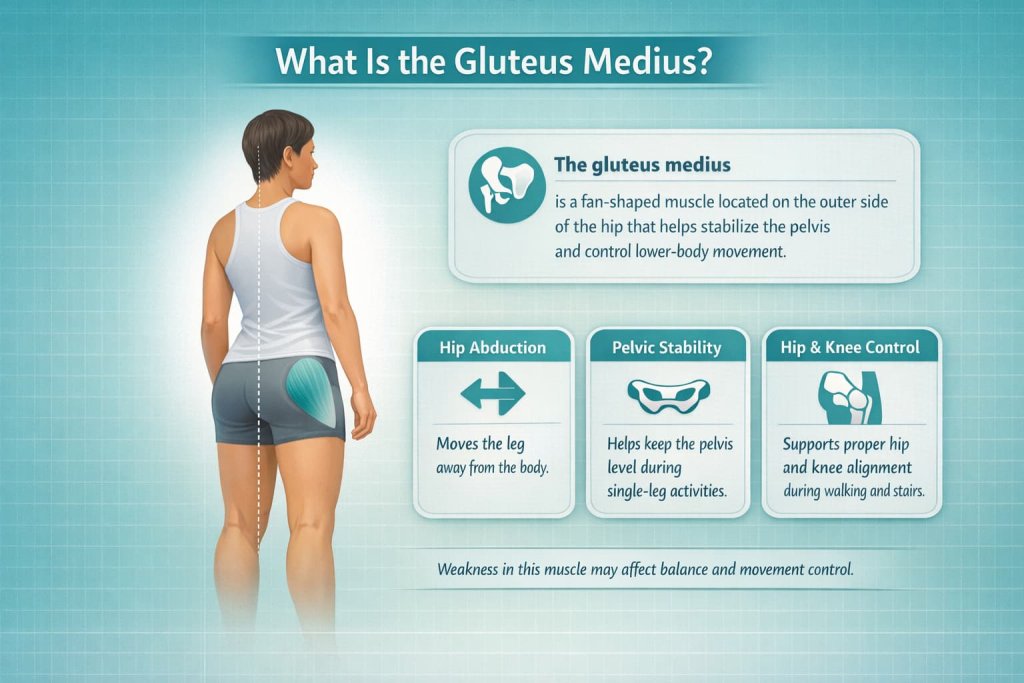
- Hip abduction (moving the leg away from the body)
- Pelvic stabilization during single-leg activities
- Controlling hip and knee alignment when walking, running, or climbing stairs
Weakness in this muscle is commonly associated with poor balance, hip instability, and compensatory movement patterns.
15 Best Gluteus Medius Exercises
These 15 gluteus medius exercises focus on strengthening the side hip muscles that support pelvic stability, balance, and proper lower-body alignment. They include a mix of activation, strength, and functional movements designed to improve control during walking, stairs, and single-leg activities while keeping joint stress low.
1. Side-Lying Hip Abduction
A foundational exercise that directly targets the gluteus medius with minimal joint stress.
Why it works:
This exercise isolates the gluteus medius by placing the body in a stable, side-lying position. Because gravity provides resistance, it allows focused strengthening without loading the spine or knees, making it suitable for beginners and rehabilitation settings.
How to do it:
- Lie on your side with legs stacked and hips aligned
- Keep the top leg straight and toes facing forward
- Lift the top leg upward slowly without rotating the hips
- Pause briefly, then lower with control
Trainer Tip:
Think about reaching the leg long rather than lifting high to prevent hip rolling and momentum.
2. Clamshell
A beginner-friendly activation exercise for lateral hip control.
How to do it:
- Lie on your side with knees bent and feet together
- Stack hips directly on top of each other
- Open the top knee while keeping feet touching
- Close slowly with control
Why it works:
The clamshell trains hip external rotation while the pelvis remains stable. This reinforces neuromuscular control of the gluteus medius, which is essential for balance and knee alignment.
Trainer Tip:
Keep the movement small and controlled—quality matters more than range.
3. Banded Clamshell
A progression of the clamshell that increases muscular demand.
How to do it:
- Place a resistance band just above the knees
- Lie on your side with hips stacked
- Open the top knee against band resistance
- Return slowly to the start position
Why it works:
Adding band resistance increases time under tension, which helps build strength and endurance in the gluteus medius without increasing joint compression.
Trainer Tip:
Choose the lightest band that allows full control through the entire movement.
4. Standing Hip Abduction (Band or Cable)
A functional exercise that trains the gluteus medius in an upright position.
How to do it:
- Stand tall and hold a stable support if needed
- Move one leg out to the side against resistance
- Keep torso upright and pelvis level
- Slowly return to the starting position
Why it works:
Standing hip abduction challenges the gluteus medius to stabilize the pelvis while the leg moves, closely mimicking real-life walking and single-leg tasks.
Trainer Tip:
Avoid leaning away from the resistance—upright posture keeps the work on the hip.
5. Lateral Band Walk
A popular exercise for continuous lateral hip activation.
How to do it:
- Place a band around the ankles or just above the knees
- Slightly bend hips and knees
- Step sideways with control
- Keep constant tension on the band
Why it works:
Maintaining band tension throughout the movement keeps the gluteus medius engaged for extended periods, improving endurance and control.
Trainer Tip:
Short, slow steps increase muscle engagement more than wide, fast steps.
6. Monster Walk
A dynamic variation that challenges hip control in multiple directions.
How to do it:
- Place a resistance band around thighs or ankles
- Slightly hinge at the hips
- Step forward and diagonally
- Keep hips level throughout
Why it works:
The diagonal stepping pattern combines hip abduction and external rotation, increasing overall gluteal activation and coordination.
Trainer Tip:
Maintain consistent band tension—do not allow the band to slack.
7. Single-Leg Bridge
A unilateral exercise emphasizing pelvic stability.
How to do it:
- Lie on your back with one foot planted on the floor
- Extend the opposite leg
- Lift hips while keeping the pelvis level
- Lower slowly
Why it works:
By lifting one leg, the gluteus medius must work to prevent pelvic drop, reinforcing single-leg control important for walking and stairs.
Trainer Tip:
If the hips tilt or drop, return to a two-leg bridge until strength improves.
8. Hip Hitch (Pelvic Drop)
A highly targeted exercise for pelvic control.
How to do it:
- Stand on one leg on a low step
- Let the opposite hip drop slightly
- Lift the pelvis back to level using the stance leg
- Move slowly and deliberately
Why it works:
Hip hitches directly train the gluteus medius to control pelvic alignment during single-leg stance, a key function during walking.
Trainer Tip:
Avoid pushing off with the free leg—control should come from the hip.
9. Lateral Step-Up
A functional strength exercise with real-world carryover.
How to do it:
- Stand beside a step or box
- Place the near foot on the step
- Push through the heel to stand
- Step back down with control
Why it works:
Stepping up sideways requires the gluteus medius to stabilize the hip and knee, reinforcing proper alignment during stair climbing.
Trainer Tip:
Keep the knee tracking in line with the toes throughout the movement.
10. Curtsy Lunge (Controlled)
A multi-planar strengthening exercise.
How to do it:
- Step one leg diagonally behind the body
- Lower into a controlled lunge
- Push back to standing
Why it works:
The diagonal movement pattern increases lateral hip demand and challenges balance and coordination.
Trainer Tip:
Limit depth if balance or hip comfort is an issue.
11. Single-Leg Romanian Deadlift
A balance-focused hip hinge exercise.
How to do it:
- Stand on one leg
- Hinge forward at the hips
- Keep hips square and spine neutral
- Return to standing
Why it works:
This movement forces the gluteus medius to stabilize the pelvis while the body hinges forward, enhancing hip control under load.
Trainer Tip:
Use a wall or dowel for balance support if needed.
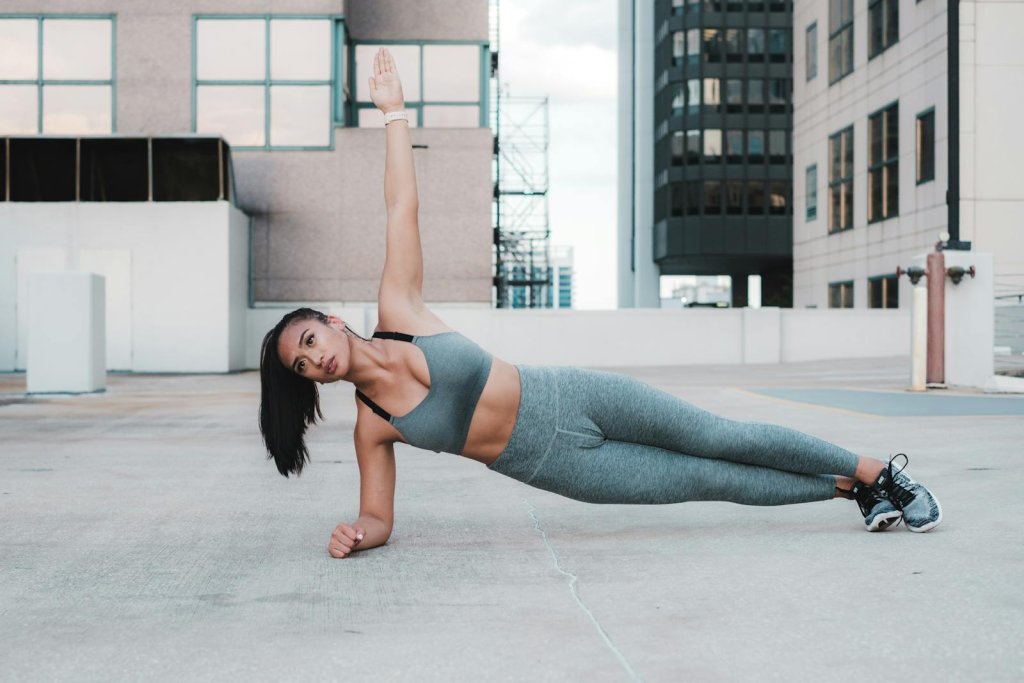
12. Side Plank
A static hold for lateral stability.
How to do it:
- Lie on your side with elbow under shoulder
- Lift hips off the floor
- Hold a steady position
Why it works:
Side planks engage the gluteus medius isometrically while also strengthening the core, improving whole-body stability.
Trainer Tip:
Bend the bottom knee to reduce difficulty.
13. Side Plank with Leg Lift
An advanced progression of the side plank.
How to do it:
- Hold a side plank position
- Lift the top leg slightly
- Lower with control
Why it works:
Adding a leg lift increases the load on the gluteus medius while maintaining core engagement.
Trainer Tip:
Only lift as high as you can without losing balance.
14. Cable Hip Abduction (Single-Leg Stance)
A controlled resistance-based exercise.
How to do it:
- Attach an ankle strap to a low cable
- Stand tall on the support leg
- Move the working leg out to the side
- Control the return
Why it works:
Cable resistance provides consistent tension throughout the movement, improving strength across the full range of motion.
Trainer Tip:
Use light weight and slow tempo for best results.
15. Isometric Wall Press
A low-impact endurance exercise.
How to do it:
- Stand sideways next to a wall
- Press the outer knee or foot into the wall
- Hold steady tension
Why it works:
Isometric contractions build gluteus medius endurance and improve neuromuscular activation without joint movement.
Trainer Tip:
Maintain steady breathing and avoid holding your breath.
How Often Should You Do Gluteus Medius Exercises?
General physical-activity guidelines from organizations like the Centers for Disease Control and Prevention and the American Heart Association recommend muscle-strengthening activities at least 2 days per week.
For gluteus medius training:
- 2–3 sessions per week
- 2–3 exercises per session
- 8–15 controlled reps or 20–40-second holds
Common Mistakes to Avoid
- Rolling hips backward during side-lying exercises
- Using momentum instead of slow control
- Letting the knee collapse inward
- Progressing resistance too quickly
Why Gluteus Medius Exercises Matter
Strengthening the gluteus medius may help support:
- Pelvic and hip stability during daily movement
- Better balance and single-leg control
- Reduced compensatory stress on the knees and lower back
- More efficient walking, running, and stair climbing mechanics
Clinical and rehabilitation guidelines frequently emphasize hip abductor strengthening as part of lower-body conditioning and injury-prevention programs.
Signs of a Weak Gluteus Medius
When the gluteus medius is not providing enough support, movement quality can be affected. While this is not a diagnosis, common movement-related signs may include:
- Hip drop during walking or single-leg standing
- Knees collapsing inward during squats or stairs
- Poor balance on one leg
- Side-to-side torso sway when walking
- Early fatigue or discomfort in the outer hips
Improving lateral hip strength and control is commonly used to help address these patterns.
Is It Safe to Do Gluteus Medius Exercises With Hip or Knee Pain?
In many cases, gluteus medius exercises can be performed safely with hip or knee pain when they are low-impact, controlled, and properly modified.
General safety tips:
- Use bodyweight or light resistance
- Move slowly within a comfortable range
- Stop if pain increases or feels sharp
If pain is persistent, worsening, or limits daily activity, seek guidance from a qualified healthcare or movement professional before progressing exercises.
When to Modify or Stop
Modify or pause exercises if you notice:
- Sharp or worsening hip pain
- Pain that lingers beyond normal muscle soreness
- Loss of balance or control
Consult a qualified professional if symptoms persist.
Frequently Asked Questions
Are gluteus medius exercises good for knee pain?
They may help support better knee alignment by improving hip stability.
Can beginners do these exercises?
Yes. Start with bodyweight and low-resistance options.
Do I need equipment?
No. Many effective exercises use only bodyweight or light bands.
How long until results are noticeable?
Many people notice improved control and balance within 4–6 weeks.
Can I do these every day?
Light activation work can be done frequently, but strength work needs rest days.
Are these safe for older adults?
Yes, when performed with proper form and appropriate progression.
Conclusion
Strong gluteus medius muscles play a key role in hip stability, balance, and confident movement. By consistently practicing the right exercises with proper technique, you can support healthier movement patterns and long-term joint comfort.
If you want structured progressions or exercise modifications tailored to your needs, consider working with a qualified fitness or rehabilitation professional.
References
- Moore D, Semciw AI, Pizzari T. Systematic Review and Meta-Analysis: Therapeutic exercises with highest gluteus medius/minimus activation (2020) – PubMed
- Macadam P, Cronin J, Contreras B. Systematic Review: Gluteus maximus/medius EMG across hip and lower-limb exercises (2015) – PMC
- Boren K, et al. Electromyographic analysis of gluteus medius and maximus during rehabilitation exercises (2011) – PubMed
- Trendelenburg Gait (hip abductor weakness, pelvic drop) – StatPearls, NCBI Bookshelf (updated 2024)
- Greater Trochanteric Pain Syndrome (GTPS): overview and self-care guidance – NHS Inform (updated 2025)
- Greater Trochanteric Pain Syndrome (GTPS) patient information (PDF) – Royal Berkshire NHS (Nov 2024)
- CDC. Adult Physical Activity Guidelines (muscle-strengthening 2+ days/week) – CDC (updated 2023)