
Bodyweight bicep exercises can build arm strength and definition without dumbbells by using your own body as resistance. When done with proper form, progressive variations, and enough weekly volume, these exercises effectively train the biceps while also improving grip strength, shoulder stability, and overall upper-body control.
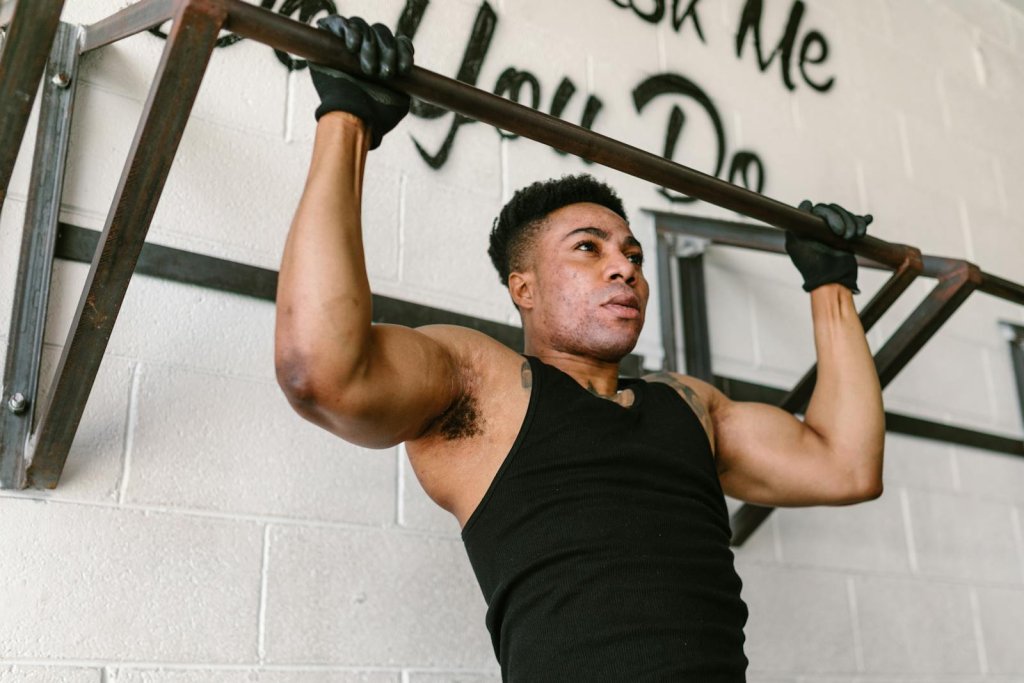
Understanding how to apply leverage, tempo, and range of motion is key to getting results without equipment.
What Are Bodyweight Bicep Exercises?
Bodyweight bicep exercises are resistance movements that primarily train the biceps brachii, along with supporting muscles like the brachialis and brachioradialis, using body position and leverage instead of external weights.
They typically fall into three categories:
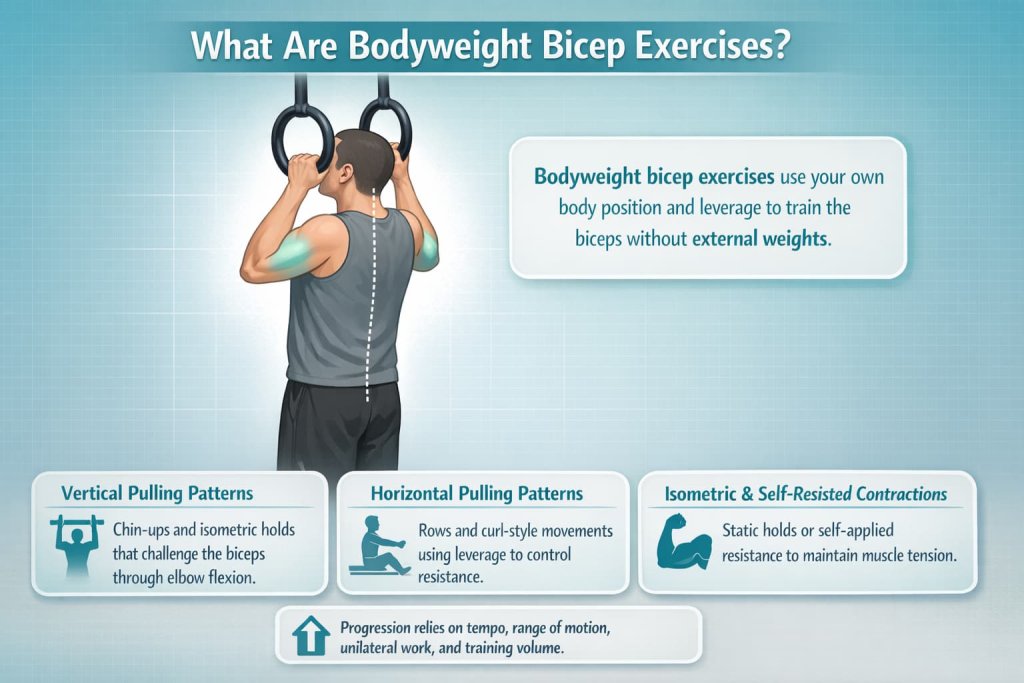
- Vertical pulling patterns (chin-ups and holds)
- Horizontal pulling patterns (rows and curls using leverage)
- Self-resisted or isometric bicep contractions
Because external load is limited, progression relies on tempo, range of motion, unilateral work, and volume.
12 Best Bodyweight Bicep Exercises
These bodyweight bicep exercises use chin-up variations, rows, curls, and isometric holds to build arm strength without weights. When performed with proper form and progression, they effectively train the biceps at home or anywhere.
1. Chin-Up (Underhand Grip)
How to do it:
- Grip the bar with palms facing toward you, hands shoulder-width apart
- Hang with arms fully extended and shoulders engaged
- Pull your chest toward the bar by bending the elbows
- Keep elbows close to your sides throughout the movement
- Lower yourself back down slowly with control
Why it works:
The underhand (supinated) grip places the biceps in a mechanically strong position, increasing elbow flexion demand compared to overhand pull-ups. This makes chin-ups one of the most effective bodyweight exercises for bicep strength while also training the upper back.
Muscles worked:
Biceps brachii, brachialis, brachioradialis, latissimus dorsi, upper back, forearms
Trainer Tip:
Think “pull with your elbows, not your hands” to keep tension on the biceps rather than relying on momentum.
2. Assisted Chin-Up
How to do it:
- Use a resistance band, box, or chair for foot support
- Take an underhand grip on the bar
- Apply just enough assistance to complete the pull smoothly
- Pull until your chin clears the bar
- Lower yourself under control
Why it works:
Assisted chin-ups allow you to train the same movement pattern while reducing load. This helps build strength, confidence, and proper technique before progressing to full bodyweight reps.
Muscles worked:
Biceps brachii, brachialis, upper back, forearms
Trainer Tip:
Gradually reduce assistance over time instead of increasing reps too quickly.
3. Negative Chin-Up
How to do it:
- Start with your chin above the bar using a jump or step
- Take an underhand grip
- Slowly lower your body for 5–10 seconds
- Fully extend the arms at the bottom before resetting
Why it works:
Slow eccentric (lowering) contractions increase time under tension, which may help improve strength and muscle control even when full chin-ups are not yet possible.
Muscles worked:
Biceps brachii, brachialis, forearms, upper back
Trainer Tip:
If your lowering phase becomes fast or uncontrolled, increase rest time between reps.
4. Isometric Chin-Up Hold
How to do it:
- Pull yourself up to the top of a chin-up position
- Hold with elbows bent and chin above the bar
- Maintain steady breathing and shoulder control
- Hold for 10–30 seconds
- Lower slowly when finished
Why it works:
Isometric holds challenge the biceps to maintain tension without movement, improving strength endurance and joint stability.
Muscles worked:
Biceps brachii, brachialis, forearms, upper back, grip muscles
Trainer Tip:
Start with shorter holds and increase duration gradually rather than forcing long holds.
5. Inverted Row (Underhand Grip)
How to do it:
- Set a bar at waist height or use suspension straps
- Lie underneath and grab the bar with palms facing you
- Keep your body in a straight line from head to heels
- Pull your chest toward the bar by bending the elbows
- Lower yourself slowly
Why it works:
The underhand grip increases elbow flexion involvement, shifting more work to the biceps while still engaging the back.
Muscles worked:
Biceps brachii, brachialis, upper back, rear shoulders, core
Trainer Tip:
Pause briefly at the top to eliminate momentum and increase bicep activation.
6. Feet-Elevated Inverted Row
How to do it:
- Place your heels on a bench or step
- Grip the bar with palms facing you
- Keep your body straight and core engaged
- Pull your chest toward the bar
- Lower under control
Why it works:
Elevating the feet increases the percentage of bodyweight lifted, making this variation more demanding for the biceps and upper back.
Muscles worked:
Biceps brachii, brachialis, upper back, core
Trainer Tip:
Maintain a neutral neck position to avoid compensating with the shoulders.
7. Bodyweight Curl (Using Rings or TRX)
How to do it:
- Hold rings or handles with palms facing up
- Lean back with arms extended
- Curl your hands toward your forehead by bending the elbows
- Keep elbows high and stationary
- Slowly extend arms to return
Why it works:
This movement closely mimics a traditional bicep curl while allowing easy resistance adjustment through body angle.
Muscles worked:
Biceps brachii, brachialis, forearms
Trainer Tip:
The more upright your body, the easier the exercise; lean back further to increase difficulty.
8. Close-Grip Inverted Row
How to do it:
- Set up as for a standard inverted row
- Place hands closer than shoulder-width
- Use an underhand grip
- Pull chest toward the bar with elbows tucked
- Lower slowly
Why it works:
A closer grip increases elbow flexion demand, shifting emphasis toward the biceps rather than the upper back.
Muscles worked:
Biceps brachii, brachialis, forearms, upper back
Trainer Tip:
Avoid flaring the elbows outward, which reduces bicep involvement.
9. Towel Row
How to do it:
- Loop two towels over a bar
- Grip the towels with palms facing each other or up
- Lean back into an inverted row position
- Pull your chest toward your hands
- Lower with control
Why it works:
The towel grip increases grip demand and forearm activation while maintaining strong bicep engagement.
Muscles worked:
Biceps brachii, brachialis, forearms, grip muscles, upper back
Trainer Tip:
Squeeze the towels tightly throughout the movement to maximize arm engagement.
10. Self-Resisted Bicep Curl
How to do it:
- Bend one arm at the elbow
- Use the opposite hand to apply resistance
- Curl against that resistance slowly
- Control both lifting and lowering phases
- Switch arms
Why it works:
Self-resistance allows precise control of tension and is useful when equipment or bars are unavailable.
Muscles worked:
Biceps brachii, brachialis
Trainer Tip:
Apply resistance smoothly rather than jerking or overpowering the movement.
11. Isometric Bicep Squeeze
How to do it:
- Press palms or fists together in front of your chest
- Contract the biceps forcefully
- Hold the squeeze for 10–30 seconds
- Relax briefly and repeat
Why it works:
Isometric squeezing creates muscle tension without joint movement, which may help improve mind–muscle connection and endurance.
Muscles worked:
Biceps brachii, forearms
Trainer Tip:
Gradually increase squeeze intensity instead of jumping straight to maximal effort.
12. Slow-Tempo Underhand Row
How to do it:
- Set up for an underhand inverted row
- Pull up for 2–3 seconds
- Pause briefly at the top
- Lower for 4–6 seconds
- Repeat with strict control
Why it works:
Slowing both lifting and lowering phases increases time under tension, which is essential for stimulating muscle adaptation in bodyweight training.
Muscles worked:
Biceps brachii, brachialis, upper back, core
Trainer Tip:
If tempo breaks down, shorten the set rather than speeding up.
How Often Should You Do Bodyweight Bicep Exercises?
For most adults:
- 2–3 sessions per week
- At least 48 hours of rest between hard bicep sessions
- 2–4 sets per exercise, depending on intensity
This aligns with CDC and WHO strength-training guidelines.
Why Bodyweight Bicep Exercises Matter
Regular bodyweight bicep training may help support:
- Improved arm strength for daily pulling tasks
- Better elbow and shoulder joint stability
- Increased muscular endurance
- Balanced upper-body development without equipment
- Safer training for beginners or home workouts
According to the Mayo Clinic, strength training with bodyweight is effective when exercises are challenging, well-controlled, and progressively overloaded.
How to Progress Bodyweight Bicep Exercises
Progression without weights can be achieved by:
- Slowing the eccentric (lowering) phase
- Increasing range of motion
- Elevating feet or changing leverage
- Adding pauses or isometric holds
- Increasing total sets and weekly volume
The American College of Sports Medicine recommends gradually increasing training demands as strength improves, even when using bodyweight methods.
Muscles Worked in Bodyweight Bicep Exercises
Bodyweight bicep exercises primarily train the muscles responsible for elbow flexion, while also engaging several supporting muscles that help stabilize the arms and shoulders during pulling and curling movements.
Primary muscles involved:
- Biceps brachii – the main muscle responsible for bending the elbow and contributing to arm shape and definition.
Secondary muscles involved:
- Brachialis – lies underneath the biceps and contributes significantly to elbow flexion strength.
- Brachioradialis – a forearm muscle that assists with elbow flexion, especially during neutral or underhand grips.
Supporting muscles:
- Forearm flexors and extensors for grip strength
- Upper back muscles that stabilize the shoulder blades during pulling movements
- Core muscles that help maintain body alignment in rows and hangs
Because bodyweight exercises often involve multi-joint movement, these muscles work together to produce controlled, efficient motion rather than isolated contraction alone.
Who Should Be Careful with Bodyweight Bicep Exercises
While bodyweight bicep exercises are generally accessible and adaptable, certain individuals should approach them with extra caution or modify movements as needed.
You may need to be careful if you:
- Experience ongoing elbow, shoulder, or wrist discomfort
- Are returning to exercise after an upper-body injury
- Are new to strength training and lack pulling strength
- Notice sharp pain, joint strain, or loss of control during exercises
In these cases, starting with assisted variations, slower tempos, or isometric holds may help reduce strain. Stopping an exercise if pain occurs and prioritizing proper form over repetitions is essential.
If symptoms persist or worsen, seeking guidance from a qualified fitness or healthcare professional may be appropriate.
Common Mistakes to Avoid
- Relying on momentum instead of controlled movement
- Letting shoulders shrug excessively during pulls
- Using partial range of motion
- Training biceps daily without recovery
- Ignoring grip and forearm fatigue signals
FAQs About Bodyweight Bicep Exercises
Can bodyweight bicep exercises build muscle?
Yes, when exercises are challenging enough and progressed over time, they can stimulate muscle growth.
Are chin-ups better than curls for biceps?
Chin-ups engage more muscles overall, but both patterns are effective when performed with proper form.
Do I need equipment at all?
A pull-up bar, rings, or suspension trainer expands options but isn’t strictly required.
Are these exercises beginner-friendly?
Yes. Assisted and isometric variations allow gradual progression.
How long before I see results?
Most people notice strength improvements within 3–6 weeks with consistent training.
Can I train biceps every day with bodyweight?
Daily training is not recommended; recovery is still necessary.
Conclusion
Bodyweight bicep exercises offer a practical, equipment-free way to build stronger, more defined arms at home. By choosing the right variations, focusing on controlled movement, and progressing intelligently, you can effectively train your biceps while supporting long-term joint health and overall upper-body strength. Start with a few foundational movements, stay consistent, and gradually increase the challenge.
References
- CDC – What You Can Do to Meet Physical Activity Guidelines
- Physical Activity Guidelines for Americans, 2nd Edition (HHS PDF)
- WHO 2020 Guidelines on Physical Activity and Sedentary Behaviour (Full Text on PubMed Central)
- Mayo Clinic – Strength training: Get stronger, leaner, healthier
- ACSM Position Stand – Progression Models in Resistance Training for Healthy Adults (PubMed)
- EMG Study – Muscle Activation During Pull-Up Variations (PubMed)
- Suspension Training – Muscle Activation Systematic Review (PubMed)
- Low- vs High-Load Training for Strength and Hypertrophy: Systematic Review and Meta-Analysis (PubMed)