
Posterior chain exercises are movements that strengthen the muscles along the back side of your body—primarily the glutes, hamstrings, and back—which are essential for full-body strength, posture, and efficient daily movement.

Understanding posterior chain training is important because these muscles power core actions like lifting, walking, climbing stairs, and maintaining spinal alignment. When trained consistently, they support balanced strength, movement quality, and long-term joint health.
This guide explains what posterior chain exercises are, why they matter, and the 16 best posterior chain exercises you can include in a safe, effective strength routine.
What Are Posterior Chain Exercises?
Posterior chain exercises focus on muscles located on the back side of the body that work together during hip extension, spinal stabilization, and pulling movements.
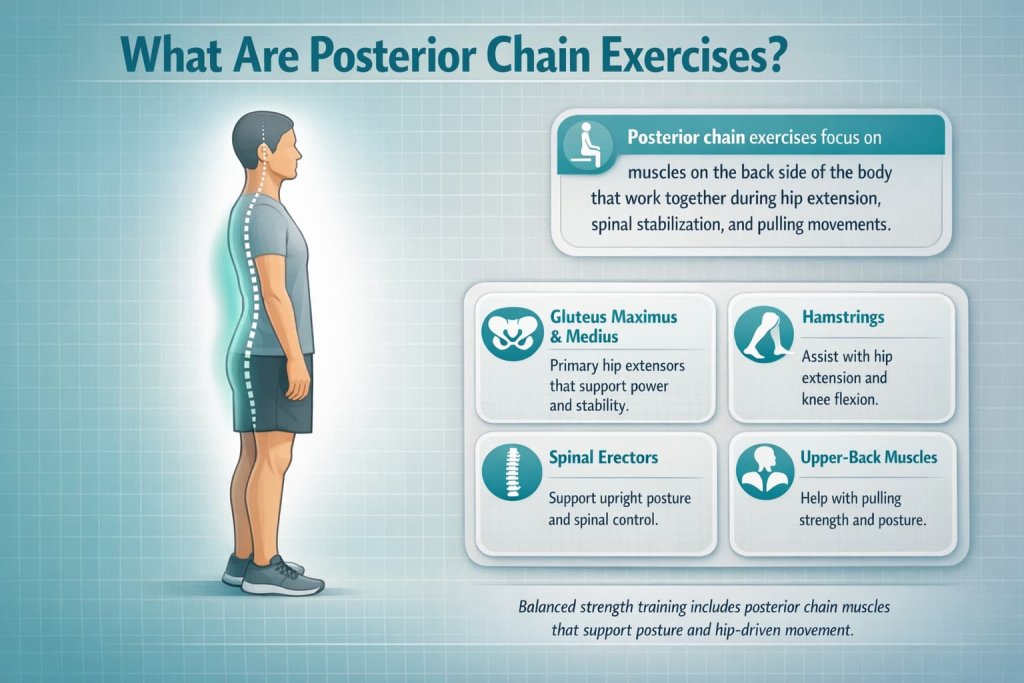
Key posterior chain muscles include:
- Gluteus maximus and gluteus medius
- Hamstrings
- Spinal erectors
- Upper-back muscles (lats, rhomboids, rear deltoids)
Strength-training guidance shared by the American College of Sports Medicine emphasizes working all major muscle groups—including those responsible for posture and hip-driven movement—to support overall physical function.
16 Best Posterior Chain Exercises for Full-Body Strength
These posterior chain exercises target the glutes, hamstrings, and back to support full-body strength, posture, and efficient movement. The list below includes beginner-friendly to advanced options you can use to build strength safely and progressively.
Lower-Body Posterior Chain Exercises
1. Romanian Deadlift
Why it works:
The Romanian deadlift emphasizes hip hinging with minimal knee bend, placing sustained tension on the hamstrings and glutes. This controlled pattern helps build posterior chain strength while reinforcing proper spinal alignment.
Muscles worked:
Hamstrings, gluteus maximus, spinal erectors, adductors, core stabilizers.
How to do it:
- Stand tall holding a barbell or dumbbells in front of thighs
- Brace the core and soften the knees slightly
- Push hips back while lowering the weight along the legs
- Keep spine neutral and chest open
- Lower until hamstrings feel tension
- Drive hips forward to return to standing
Trainer Tip:
Think “hips back, ribs down” to avoid turning the movement into a squat or rounding the lower back.
2. Conventional or Trap-Bar Deadlift
Why it works:
Deadlifts train nearly the entire posterior chain by combining hip extension with spinal stability. Trap-bar variations can reduce spinal stress while still allowing heavy loading.
Muscles worked:
Glutes, hamstrings, spinal erectors, lats, core, quadriceps.
How to do it:
- Stand with feet hip-width inside the bar (or bar over mid-foot)
- Brace core and grip handles firmly
- Push the floor away while extending hips and knees
- Keep chest tall and spine neutral
- Lock out by squeezing glutes, not leaning back
- Lower with control
Trainer Tip:
Neutral spine and bar path matter more than lifting heavy—master technique before load.
3. Hip Thrust
Why it works:
Hip thrusts maximize glute activation by loading hip extension at end range, with less spinal compression than many hinge lifts.
Muscles worked:
Gluteus maximus, hamstrings, adductors, core.
How to do it:
- Sit with upper back against a bench
- Roll barbell or weight over hips
- Plant feet flat and shoulder-width
- Brace core and drive hips upward
- Pause briefly at full hip extension
- Lower hips under control
Trainer Tip:
Keep ribs down and chin tucked to prevent over-arching the lower back.
4. Glute Bridge
Why it works:
The glute bridge is a low-load hip extension exercise that helps activate and strengthen the glutes, especially for beginners or warm-ups.
Muscles worked:
Glutes, hamstrings, core stabilizers.
How to do it:
- Lie on your back with knees bent
- Place feet flat, hip-width apart
- Brace core and squeeze glutes
- Lift hips until torso forms a straight line
- Pause briefly at the top
- Lower slowly
Trainer Tip:
Avoid pushing through the lower back—glutes should initiate the movement.
5. Single-Leg Romanian Deadlift
Why it works:
This unilateral hinge challenges balance, hip stability, and posterior chain strength on each side independently.
Muscles worked:
Hamstrings, glutes, spinal stabilizers, core.
How to do it:
- Hold weight in one or both hands
- Shift weight onto one leg
- Hinge hips while extending opposite leg back
- Keep hips square and spine neutral
- Lower until hamstring tension is felt
- Return to standing under control
Trainer Tip:
Move slowly—control matters more than range of motion.
6. Kettlebell Swing
Why it works:
Kettlebell swings train explosive hip extension, reinforcing power production through the glutes and hamstrings.
Muscles worked:
Glutes, hamstrings, spinal erectors, core.
How to do it:
- Stand with feet shoulder-width
- Hinge hips and grab kettlebell
- Snap hips forward to drive bell upward
- Let arms stay relaxed
- Allow bell to swing back between legs
- Repeat rhythmically
Trainer Tip:
This is a hinge, not a squat—the hips generate the movement.
7. Good Morning (Light Load)
Why it works:
Good mornings reinforce hinge mechanics and strengthen the posterior chain under lighter loads.
Muscles worked:
Hamstrings, glutes, spinal erectors, core.
How to do it:
- Place bar lightly across upper back
- Stand with feet hip-width
- Brace core and push hips back
- Maintain neutral spine
- Lower until hamstrings are loaded
- Return upright by driving hips forward
Trainer Tip:
Start very light—this is a technique-first exercise.
8. Cable Pull-Through
Why it works:
Cable pull-throughs train hip extension with constant tension, making them joint-friendly and effective for glute engagement.
Muscles worked:
Glutes, hamstrings, core.
How to do it:
- Stand facing away from cable machine
- Hold rope between legs
- Hinge hips back under tension
- Keep spine neutral
- Drive hips forward to stand tall
- Control return
Trainer Tip:
Squeeze glutes fully at the top without leaning back.
9. 45-Degree Back Extension
Why it works:
Back extensions strengthen spinal support muscles while engaging glutes during hip extension.
Muscles worked:
Spinal erectors, glutes, hamstrings.
How to do it:
- Position hips on pad with feet secured
- Cross arms or hold light weight
- Hinge forward from hips
- Maintain neutral spine
- Extend torso until body is straight
- Lower slowly
Trainer Tip:
Think “long spine,” not hyperextension.
10. Hamstring Curl (Machine or Stability Ball)
Why it works:
Hamstring curls isolate knee-flexion strength, which complements hip-dominant posterior chain exercises.
Muscles worked:
Hamstrings (all heads).
How to do it:
- Lie prone on machine or supine on ball
- Brace core
- Curl heels toward glutes
- Pause briefly
- Lower slowly
Trainer Tip:
Control the eccentric phase—it matters for strength development.
11. Nordic Hamstring Curl
Why it works:
Nordics build exceptional eccentric hamstring strength, which supports knee and hip stability.
Muscles worked:
Hamstrings, glutes, core.
How to do it:
- Kneel with ankles secured
- Brace core and glutes
- Slowly lower torso forward
- Catch yourself with hands if needed
- Push back to start
Trainer Tip:
Start with partial range—this is an advanced movement.
12. Reverse Lunge (Glute-Biased)
Why it works:
Stepping backward increases hip loading and reduces knee stress while emphasizing glute engagement.
Muscles worked:
Glutes, hamstrings, quadriceps, core.
How to do it:
- Stand tall with feet together
- Step one foot back
- Lower into lunge with slight forward torso
- Push through front heel
- Return to standing
Trainer Tip:
Drive through the heel to emphasize glutes.
13. Step-Ups (Hip-Height or Higher)
Why it works:
Step-ups mimic real-life movement while training unilateral hip extension.
Muscles worked:
Glutes, hamstrings, quadriceps, core.
How to do it:
- Place one foot on elevated surface
- Lean slightly forward
- Push through heel to stand
- Control the descent
Trainer Tip:
Avoid pushing off the back leg—let the lead leg do the work.
14. Bulgarian Split Squat (Glute Emphasis)
Why it works:
This split squat variation increases posterior chain demand through longer hip range of motion.
Muscles worked:
Glutes, hamstrings, quadriceps, core.
How to do it:
- Place rear foot on bench
- Front foot far enough forward
- Lower with slight torso lean
- Drive through front heel
- Return upright
Trainer Tip:
A longer stance increases glute involvement.
Upper-Back Posterior Chain Exercises
15. Chest-Supported Row
Why it works:
Chest support minimizes lower-back strain while allowing focused upper-back engagement.
Muscles worked:
Lats, rhomboids, rear deltoids, biceps.
How to do it:
- Lie chest-down on incline bench
- Hold dumbbells or bar
- Pull elbows back toward hips
- Squeeze shoulder blades
- Lower slowly
Trainer Tip:
Lead with elbows, not hands.
16. Face Pull or Rear-Delt Row
Why it works:
These movements support shoulder stability and posture by strengthening upper posterior muscles.
Muscles worked:
Rear deltoids, upper traps, rhomboids, rotator cuff.
How to do it:
- Set cable at face height
- Pull rope toward face or chest
- Keep elbows high
- Squeeze upper back
- Control return
Trainer Tip:
Use light-to-moderate load for clean form and control.
How Often Should You Train Posterior Chain Exercises?
General evidence-based guidance suggests:
- 2–3 days per week for beginners
- 3–4 days per week for intermediate lifters
- 4+ days per week for advanced programs, with adequate recovery
A simple structure:
- 2–4 posterior chain exercises per session
- 2–4 sets per exercise
- 8–15 controlled repetitions
Why Posterior Chain Exercises Matter
Regular posterior chain training may help support:
- Better posture and spinal stability
- Stronger hip drive for lifting and athletic tasks
- Reduced muscle imbalance from prolonged sitting
- Improved efficiency during daily activities
- Long-term back and joint comfort
Public health recommendations from the World Health Organization and the Centers for Disease Control and Prevention consistently recommend muscle-strengthening activities involving major muscle groups at least two days per week.
The Hip Hinge: A Key Posterior Chain Movement Pattern
Many posterior chain exercises are built around the hip hinge, a movement where the hips move backward while the spine remains neutral.
Key hip-hinge cues:
- Push the hips back instead of bending excessively at the knees
- Keep the spine long and neutral
- Brace the core before moving
- Control the descent and ascent
Mastering this pattern helps improve performance and reduces unnecessary strain during common posterior chain lifts.
Common Posterior Chain Training Mistakes to Avoid
- Turning hip hinges into squat-dominant movements
- Rounding the lower back under load
- Using excessive weight before mastering technique
- Ignoring upper-back involvement
- Training glutes but neglecting hamstrings
Key Muscles of the Posterior Chain
The posterior chain includes muscles on the back side of the body that work together to support hip extension, posture, and spinal stability. These muscles are essential for full-body strength and efficient movement.
Key muscles include:
- Glutes (maximus and medius) – Drive hip extension and pelvic stability
- Hamstrings – Assist with hip extension and knee flexion
- Spinal erectors – Support the spine during bending and lifting
- Upper-back muscles (lats, rhomboids, rear delts) – Aid posture and pulling strength
Who Should Be Careful With Posterior Chain Exercises?
Most adults can perform posterior chain exercises with proper scaling. Extra care is advised for individuals with:
- Recent lower-back injuries
- Hip or hamstring strains
- Balance limitations
In these cases, lighter loads, slower tempo, and professional guidance are recommended.
Frequently Asked Questions
Are posterior chain exercises only for athletes?
No. They are valuable for everyday movement, posture, and general strength at all fitness levels.
Can I do posterior chain exercises at home?
Yes. Glute bridges, step-ups, hip hinges, and resistance-band exercises work well at home.
Do posterior chain exercises help posture?
They may help support posture by strengthening muscles that stabilize the spine and hips.
Are deadlifts required for posterior chain training?
No. Deadlifts are effective, but alternatives like hip thrusts, bridges, and pull-throughs are also effective.
How long does it take to see results?
Many people notice strength and movement improvements within 4–6 weeks of consistent training.
Can older adults perform posterior chain exercises?
Yes, with appropriate modifications, lighter resistance, and a focus on control and balance.
Conclusion
Posterior chain exercises are a cornerstone of balanced strength training. By consistently training the glutes, hamstrings, and back with proper technique, you support stronger movement, better posture, and long-term physical resilience.
Start with fundamental movements, progress gradually, and prioritize quality over heavy loads for lasting benefits.
References
- U.S. Department of Health and Human Services — Physical Activity Guidelines for Americans, 2nd Edition (PDF)
- ACSM Position Stand — Progression Models in Resistance Training (Ratamess et al., 2009) (PubMed)
- American Heart Association — Resistance Exercise Training Scientific Statement (Paluch et al., 2024)
- Hospital for Special Surgery (HSS) — Posterior Chain Strengthening Exercises
- Nordic Hamstring Exercise Evidence — van Dyk et al., 2019 (PubMed)