
Upper glute exercises focus on strengthening the upper fibers of the glute muscles—especially the gluteus medius and the upper portion of the gluteus maximus—to help create a lifted, rounder butt shape. Understanding how to train this area matters because the upper glutes play a key role in hip stability, posture, and lower-body strength. With the right exercises, angles, and weekly structure, you can target this area effectively at home or in the gym.
What Are Upper Glute Exercises?
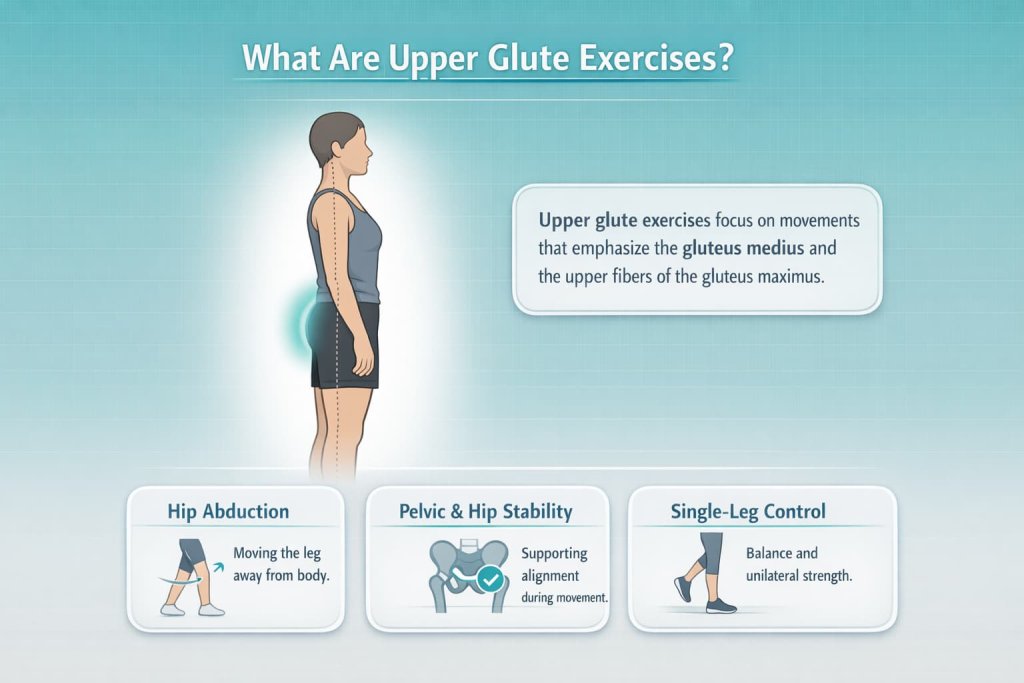
Upper glute exercises are movements that place greater emphasis on the gluteus medius and the upper fibers of the gluteus maximus. These muscles sit higher and slightly to the side of the butt and are heavily involved in:
- Hip abduction (moving the leg away from the body)
- Pelvic and hip stability
- Single-leg balance and control
By choosing exercises that challenge these functions, you can bias training toward the upper glute region rather than only the lower glute fibers.
12 Best Upper Glute Exercises
Upper glute exercises focus on strengthening the upper and outer portion of the glutes to support better hip stability, posture, and overall lower-body strength. These movements emphasize lateral, single-leg, and controlled patterns to help build a higher, rounder, and more balanced glute shape when practiced consistently.
1. Side-Lying Leg Raises
How to do it:
- Lie on your side with hips stacked and legs straight
- Rest your head on your lower arm and brace your core
- Lift the top leg upward without rolling the hips backward
- Pause briefly at the top, then lower slowly with control
Why it works:
This exercise isolates hip abduction without momentum, allowing the gluteus medius to work through a clean range of motion. The slow tempo increases time under tension, which supports upper-glute strength development.
Muscles worked:
Gluteus medius, gluteus minimus, upper gluteus maximus, deep hip stabilizers
Trainer Tip:
Think “long leg” instead of “high lift.” Lifting too high often shifts tension away from the upper glutes.
2. Lateral Band Walks
How to do it:
- Place a resistance band around the ankles or just above the knees
- Bend slightly at the hips and knees
- Step sideways while maintaining constant band tension
- Keep the feet parallel and chest upright
Why it works:
Continuous lateral tension forces the upper glutes to stay engaged throughout the movement, improving endurance and hip stability rather than relying on short bursts of effort.
Muscles worked:
Gluteus medius, upper gluteus maximus, hip abductors
Trainer Tip:
Avoid letting the trailing foot snap inward—controlled steps keep tension where it belongs.
3. Monster Walks
How to do it:
- Place a band around the ankles or knees
- Step forward diagonally while maintaining tension
- Stay low with knees slightly bent
- Alternate forward steps in a slow, controlled pattern
Why it works:
The diagonal stepping pattern increases glute activation while challenging pelvic control, making this an effective upper-glute endurance and activation exercise.
Muscles worked:
Gluteus medius, gluteus maximus, hip stabilizers
Trainer Tip:
Smaller steps increase muscle tension—avoid long strides that reduce band resistance.
4. Curtsy Lunges
How to do it:
- Stand tall with feet hip-width apart
- Step one leg diagonally behind the other
- Lower into a controlled lunge
- Push through the front heel to return to standing
Why it works:
The diagonal load shifts emphasis toward the upper and outer glute fibers, increasing lateral hip demand compared to standard lunges.
Muscles worked:
Upper gluteus maximus, gluteus medius, quadriceps, adductors
Trainer Tip:
Keep the hips square—excessive twisting reduces upper-glute engagement.
5. Single-Leg Squats
How to do it:
- Stand on one leg with the other leg slightly forward
- Sit back into a squat while keeping the pelvis level
- Drive through the heel to stand
- Repeat before switching sides
Why it works:
Single-leg loading forces the gluteus medius to stabilize the pelvis, which significantly increases upper-glute activation.
Muscles worked:
Gluteus medius, upper gluteus maximus, quadriceps, core stabilizers
Trainer Tip:
Use a box or chair at first to control depth and alignment.
6. Bulgarian Split Squats
How to do it:
- Place the rear foot on a bench or elevated surface
- Lower the front leg into a lunge
- Keep a slight forward torso angle
- Push through the front heel to rise
Why it works:
Rear-foot elevation increases hip loading on the working leg, intensifying upper-glute activation through greater stabilization demands.
Muscles worked:
Upper gluteus maximus, gluteus medius, quadriceps, hamstrings
Trainer Tip:
A longer front-foot distance increases glute involvement.
7. Step-Ups (Slight Forward Lean)
How to do it:
- Stand in front of a box or bench
- Step up using one foot
- Lean slightly forward at the hips
- Control the descent back to the floor
Why it works:
The forward lean shifts force toward the hip extensors and upper glutes rather than the quads.
Muscles worked:
Upper gluteus maximus, gluteus medius, quadriceps
Trainer Tip:
Choose a box height that allows control—higher isn’t always better.
8. Cable or Band Hip Abductions
How to do it:
- Attach a band or cable to one ankle
- Stand tall holding support if needed
- Move the leg outward without leaning
- Return slowly to the start
Why it works:
Standing abduction directly targets the upper glutes while allowing precise resistance control and clean movement mechanics.
Muscles worked:
Gluteus medius, gluteus minimus
Trainer Tip:
Keep the toes facing forward to avoid hip-flexor compensation.
9. Side Plank with Leg Lift
How to do it:
- Hold a side plank position
- Lift the top leg while maintaining balance
- Pause briefly, then lower slowly
- Maintain steady breathing
Why it works:
This exercise combines lateral core stability with intense upper-glute engagement, improving both strength and control.
Muscles worked:
Gluteus medius, obliques, upper gluteus maximus
Trainer Tip:
If balance is difficult, perform the plank from the knees first.
10. Hip Thrusts (Narrow Stance)
How to do it:
- Sit with upper back supported on a bench
- Place feet slightly narrower than hip-width
- Drive hips upward until fully extended
- Lower slowly under control
Why it works:
A narrower stance reduces lower-glute dominance and shifts more tension toward the upper glute fibers.
Muscles worked:
Gluteus maximus (upper emphasis), gluteus medius, hamstrings
Trainer Tip:
Pause at the top to reinforce upper-glute activation.
11. Single-Leg Romanian Deadlifts
How to do it:
- Stand on one leg holding a weight or bodyweight only
- Hinge at the hips while keeping the spine neutral
- Extend the free leg backward
- Return to standing with control
Why it works:
Unilateral hinging increases pelvic stability demands, forcing the upper glutes to work continuously.
Muscles worked:
Upper gluteus maximus, gluteus medius, hamstrings
Trainer Tip:
Think “reach long” rather than “bend low” to maintain balance.
12. Fire Hydrants
How to do it:
- Start on all fours with neutral spine
- Lift one knee outward while keeping hips level
- Pause briefly at the top
- Lower slowly and repeat
Why it works:
This controlled abduction pattern isolates the upper glutes without spinal load, making it ideal for activation and beginner programming.
Muscles worked:
Gluteus medius, gluteus minimus, upper gluteus maximus
Trainer Tip:
Slow reps matter more than height—avoid swinging the leg.
How Often Should You Train Upper Glutes?
For most people, 2–3 upper-glute-focused sessions per week is effective and sustainable. Each session can include:
- 4–6 exercises
- 2–4 sets per exercise
- 8–15 controlled repetitions
The American College of Sports Medicine supports progressive resistance training using moderate loads and sufficient recovery to promote strength and hypertrophy.
Upper Glute Anatomy: What You’re Actually Training
The upper glutes are not a separate muscle. The term refers to the upper and outer portion of the glute area, mainly involving:
- Gluteus medius – supports hip abduction and pelvic stability
- Gluteus minimus – assists with hip control and alignment
- Upper fibers of the gluteus maximus – contribute to hip extension and outward movement
Exercises that emphasize side-to-side motion, single-leg work, and controlled abduction place greater demand on these muscles, which is why they are commonly used to target the upper glute region.
Who Should Be Careful With Upper Glute Exercises
Upper glute exercises are generally safe, but some people may need modifications.
Use extra caution if you:
- Are new to strength training
- Have balance limitations
- Experience hip, knee, or lower-back discomfort
- Are returning after injury or long inactivity
Helpful adjustments include:
- Starting with bodyweight or bands
- Reducing range of motion
- Using support for balance
- Moving slowly with full control
If discomfort persists, seeking guidance from a qualified professional is recommended.
Common Mistakes to Avoid
- Using momentum instead of slow, controlled movement
- Letting the hips rotate or the pelvis tilt during single-leg exercises
- Choosing resistance that is too heavy to maintain proper form
- Neglecting unilateral (single-leg) movements
Upper Glute Exercises at Home vs Gym
At home:
Bands, bodyweight, and floor-based exercises can effectively target the upper glutes when tempo and alignment are controlled.
At the gym:
Cables, machines, and added load allow for easier progression and precise resistance adjustments.
Both approaches can be effective when exercises are selected thoughtfully.
Frequently Asked Questions
Do upper glute exercises really lift your butt?
Upper glute exercises strengthen the muscles that contribute to a higher, rounder appearance. Visible changes depend on consistency, load, and overall body composition.
How long does it take to see upper glute results?
Most people notice strength improvements within a few weeks, with visible shape changes often appearing after 8–12 weeks of consistent training.
Are bands enough for upper glute growth?
Resistance bands can be effective, especially for beginners or home workouts, as long as tension and volume are sufficient.
Should I train upper glutes separately from legs?
Upper glutes can be trained within lower-body workouts or as a focused accessory section after compound lifts.
Can beginners do upper glute exercises?
Yes. Many upper glute exercises are beginner-friendly when started with bodyweight or light resistance.
Are upper glutes important for posture?
Yes. Strong upper glutes help stabilize the pelvis, which supports better lower-body alignment and posture.
Conclusion
Upper glute exercises are a smart addition to any lower-body program if your goal is better shape, strength, and hip stability. By focusing on hip-abduction and single-leg movements, training 2–3 times per week, and progressing gradually, you can build a higher, rounder butt while supporting long-term joint health.
References
- CDC: Adult Activity Guidelines (Muscle-strengthening 2+ days/week)
- WHO: Physical Activity Recommendations (Strengthening 2+ days/week)
- Physical Activity Guidelines for Americans, 2nd Edition (Official PDF)
- Bull FC, et al. (2020): WHO Guidelines on Physical Activity and Sedentary Behaviour (Free full text)
- NCBI Bookshelf (StatPearls): Gluteus Medius Muscle Anatomy and Function
- Distefano LJ, et al. (2009): Gluteal Muscle Activation During Common Therapeutic Exercises (JOSPT)
- Boren K, et al. (2011): EMG Analysis of Gluteus Medius/Maximus During Rehabilitation Exercises (Free full text)
- Contreras B, et al. (2015): Back Squat vs Barbell Hip Thrust EMG Comparison (PDF)