
Wall Pilates exercises are a low-impact, beginner-friendly way to improve core strength, balance, and flexibility using a wall for support and alignment. By practicing Pilates-based movements with the wall, you gain better posture awareness, controlled muscle engagement, and added stability—making these exercises especially suitable for home workouts.
Understanding wall Pilates matters because it offers a safe, accessible way to move your body with intention, improve daily movement quality, and support long-term joint and muscle health without equipment.
What Are Wall Pilates Exercises?
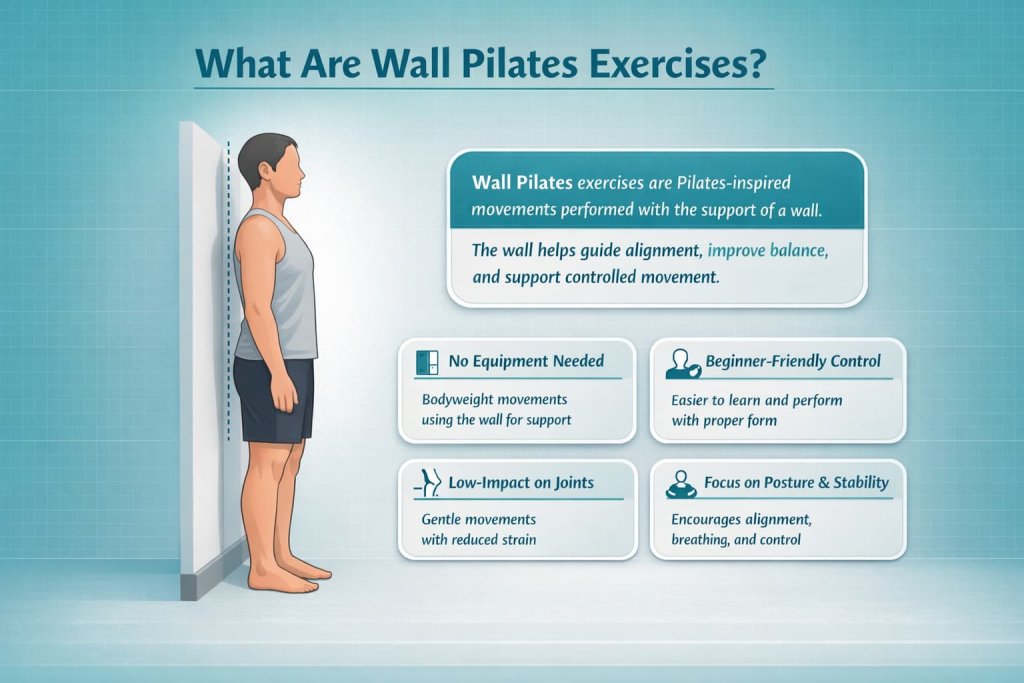
Wall Pilates exercises are Pilates-inspired movements performed with the help of a wall. The wall acts as a support system, alignment guide, and balance aid, allowing you to focus on controlled movement and proper form.
Compared to traditional mat or reformer Pilates, wall Pilates:
- Requires no equipment
- Is easier to control for beginners
- Reduces impact on joints
- Emphasizes posture, breathing, and stability
9 Best Wall Pilates Exercises for Core Strength, Balance, and Flexibility
Wall Pilates exercises use the wall for support and alignment to help improve core strength, balance, and flexibility with controlled, low-impact movements. These nine exercises are beginner-friendly and can be done at home without equipment.
1. Wall Roll Down
How to do it
- Stand with your back, hips, and head lightly touching the wall
- Feet hip-width apart, about 6–8 inches away from the wall
- Inhale to prepare
- Exhale and slowly tuck your chin, rolling the head and spine down one vertebra at a time
- Let your arms hang naturally
- Pause briefly at the bottom
- Engage your core and slowly roll back up, stacking the spine against the wall
Why it works
This movement encourages controlled spinal flexion and extension while reinforcing proper alignment. Using the wall provides feedback that helps reduce excessive rounding or collapsing through the spine.
Muscles worked
Deep core muscles, spinal stabilizers, abdominal muscles, and postural muscles along the back.
Trainer Tip
Move slowly and focus on spinal control—not depth. If your lower back pulls away from the wall too quickly, reduce the range.
2. Wall Squat with Core Engagement
How to do it
- Stand with your back flat against the wall
- Walk your feet forward slightly
- Inhale to prepare
- Slide down the wall until knees are comfortably bent
- Engage your core and keep ribs down
- Hold briefly, then press through the feet to return to standing
Why it works
The wall supports proper squat mechanics while allowing you to focus on core engagement and lower-body strength without excessive joint stress.
Muscles worked
Quadriceps, glutes, hamstrings, core stabilizers.
Trainer Tip
Keep knees tracking over toes and avoid pushing into pain. Depth should feel controlled and stable.
3. Wall Leg Lifts
How to do it
- Stand sideways next to the wall
- Lightly place one hand on the wall for balance
- Shift weight onto the leg closest to the wall
- Slowly lift the outside leg to the side
- Lower with control and repeat
Why it works
This exercise trains hip stability and balance while strengthening the muscles responsible for lateral movement and pelvic control.
Muscles worked
Hip abductors, gluteus medius, core stabilizers.
Trainer Tip
Avoid leaning toward the wall. Keep your torso tall and movement slow.
4. Wall Bridge
How to do it
- Lie on your back with knees bent and feet placed on the wall
- Arms rest by your sides
- Inhale to prepare
- Exhale and press through the feet to lift hips
- Keep ribs down and core engaged
- Lower slowly with control
Why it works
Using the wall encourages even pressure through both feet and helps maintain neutral spine alignment during the bridge.
Muscles worked
Glutes, hamstrings, core, spinal stabilizers.
Trainer Tip
Think “lengthen” through the spine rather than lifting as high as possible.
5. Wall Plank
How to do it
- Place hands or forearms on the wall at chest height
- Step feet back until body forms a straight line
- Engage core and glutes
- Hold while breathing steadily
Why it works
The wall reduces load while still training core stability, making this a joint-friendly plank variation.
Muscles worked
Core muscles, shoulders, chest, glutes.
Trainer Tip
Avoid arching your lower back. Keep ribs stacked over hips.
6. Wall Calf Raises
How to do it
- Face the wall with hands lightly placed for support
- Feet hip-width apart
- Slowly rise onto the balls of your feet
- Pause briefly at the top
- Lower heels with control
Why it works
This movement strengthens the lower legs while improving ankle stability and balance.
Muscles worked
Calves (gastrocnemius and soleus), foot stabilizers.
Trainer Tip
Move slowly on the way down—this control matters more than speed.
7. Wall Side Stretch
How to do it
- Stand with one side close to the wall
- Reach the outside arm overhead
- Gently bend away from the wall
- Hold while breathing deeply
Why it works
This stretch improves lateral spinal flexibility and reduces tension along the sides of the torso.
Muscles worked
Obliques, lats, spinal muscles.
Trainer Tip
Keep both feet grounded and avoid twisting while stretching.
8. Wall Single-Leg Balance Hold
How to do it
- Stand facing the wall
- Lightly place fingertips on the wall if needed
- Lift one foot slightly off the floor
- Hold while maintaining upright posture
Why it works
Single-leg balance challenges the nervous system and improves coordination while engaging core stabilizers.
Muscles worked
Ankles, calves, glutes, core.
Trainer Tip
Focus your eyes on a fixed point to improve balance.
9. Wall Assisted Spine Twist
How to do it
- Sit or stand upright near the wall
- Keep hips stable and spine tall
- Gently rotate the torso toward the wall
- Return to center and repeat
Why it works
Controlled spinal rotation supports mobility and posture awareness without forcing range of motion.
Muscles worked
Obliques, spinal rotators, core stabilizers.
Trainer Tip
Rotation should feel smooth and controlled—never forced.
How Often Should You Do Wall Pilates Exercises?
Most adults can safely practice wall Pilates:
- 2–4 times per week
- Sessions lasting 15–30 minutes
- As part of a balanced activity routine that includes strength and mobility work
The CDC and WHO recommend combining muscle-strengthening activities with regular movement each week.
How Wall Pilates Exercises Support Core Strength, Balance, and Flexibility
Wall Pilates exercises work by reinforcing three key movement foundations:
- Core strength: The wall provides feedback that helps activate deep abdominal and spinal muscles.
- Balance: Light wall contact allows you to challenge balance safely while improving coordination.
- Flexibility: Controlled ranges of motion encourage mobility without forcing stretches.
These principles align with how Pilates is commonly used to support posture, movement efficiency, and body awareness.
How to Prepare Before Wall Pilates Exercises
Before beginning:
- Wear comfortable, flexible clothing
- Use a clear wall space with non-slip flooring
- Warm up with gentle marching, shoulder rolls, or pelvic tilts
- Move within a pain-free range
- Focus on slow, controlled breathing
Correct Breathing and Form Tips for Wall Pilates
- Inhale through the nose to prepare
- Exhale through the mouth during effort
- Keep ribs stacked over hips
- Avoid holding your breath
- Prioritize control over range or speed
Common Mistakes to Avoid
- Rushing through movements
- Holding your breath
- Over-arching the lower back
- Using the wall for support without engaging muscles
Who Should Try Wall Pilates Exercises (and Who Should Be Careful)
Wall Pilates exercises may be suitable for:
- Beginners new to Pilates
- Adults looking for low-impact exercise
- Desk workers focusing on posture
- People returning to movement after a break
Use extra caution if you:
- Have ongoing pain, dizziness, or joint instability
- Are recovering from surgery or injury
- Experience sharp or worsening discomfort during movement
In these cases, professional guidance is recommended before starting.
FAQs About Wall Pilates Exercises
Are wall Pilates exercises good for beginners?
Yes. Wall support helps improve control and alignment, making them beginner-friendly.
Can wall Pilates help improve balance?
Research on Pilates suggests it may help support balance and coordination when practiced consistently.
Do wall Pilates exercises require equipment?
No. A clear wall space is enough.
How long should a wall Pilates session be?
Most sessions range from 15 to 30 minutes.
Can seniors do wall Pilates exercises?
Many movements can be adapted for older adults with balance support, but modifications may be needed.
Is wall Pilates safe for people with joint issues?
Low-impact movements may be suitable, but individuals with conditions should consult a qualified professional.
Conclusion
Wall Pilates exercises offer a practical, low-impact way to build core strength, improve balance, and increase flexibility at home. By using the wall for support and alignment, you can practice controlled movement safely and effectively. Start slowly, focus on form, and stay consistent to get the most benefit.
If you’re ready to begin, choose a few exercises from this list and build a short routine you can repeat each week.
References
- Pilates for beginners (NHS Fitness Studio)
- Pilates 101: What It Is and Health Benefits (Cleveland Clinic)
- Why you should strengthen your core muscles (Mayo Clinic)
- Balance exercises (Mayo Clinic)
- Adult Activity Guidelines (CDC)
- Physical activity fact sheet (WHO)
- Pilates exercises and postural balance in older adults: systematic review/meta-analysis (PubMed)