
If you’re looking for the best foot and ankle exercises, here’s the short answer: the right combination of mobility, strength, and balance exercises may help improve stability, walking mechanics, and overall lower-body function. These exercises support the muscles that lift, stabilize, and move your foot and ankle—helping you prevent stiffness, improve balance, and better tolerate daily activities.
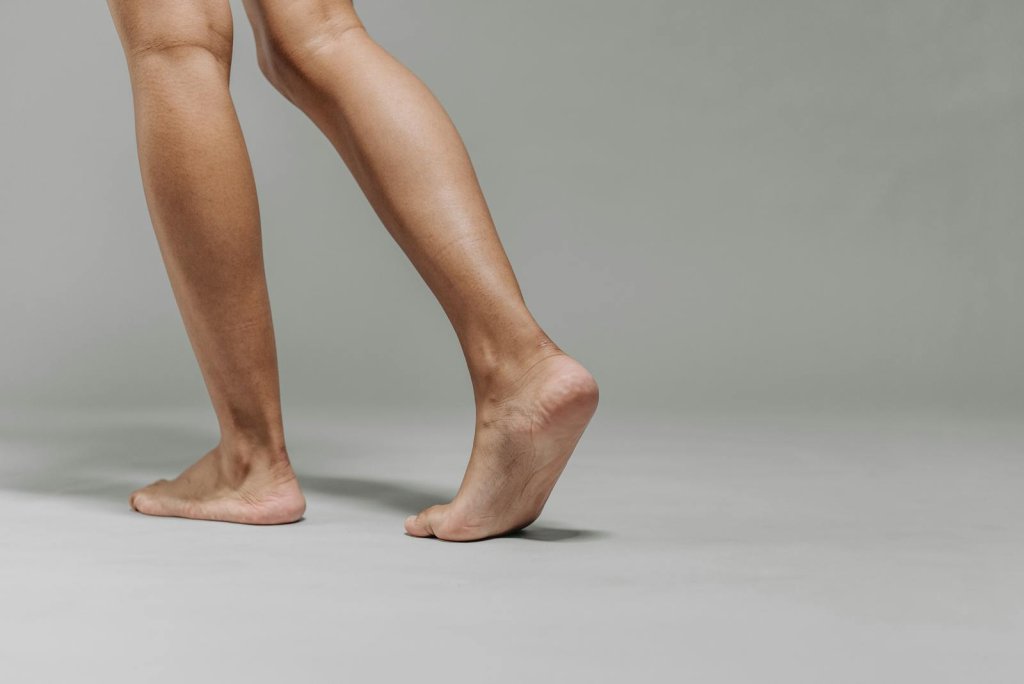
Understanding how to train your feet and ankles is important because these joints are responsible for supporting your entire body weight with every step. Limited mobility or weak stabilizing muscles can lead to discomfort, recurring sprains, reduced balance, and inefficient walking mechanics.
This guide provides step-by-step instructions, research-backed recommendations, real-world examples, and safety notes so you can confidently strengthen your feet and ankles.
Why Are Foot and Ankle Exercises Important?
Foot and ankle exercises are important because they help maintain the strength, mobility, and stability needed for efficient walking, standing, and overall lower-body function. When these joints become weak or stiff, it can affect balance, posture, and movement quality. Consistent exercise may support healthier mechanics and reduce the risk of minor strains during daily activities.
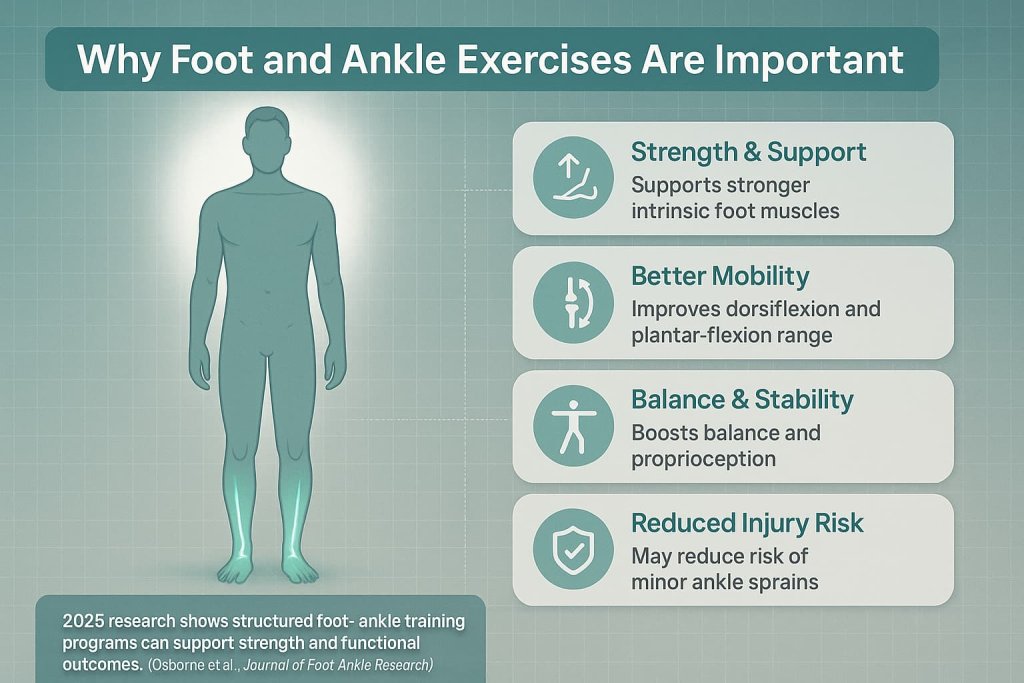
Foot and ankle exercises offer several evidence-supported benefits:
- Support stronger intrinsic foot muscles
- Improve dorsiflexion and plantar-flexion range of motion
- Boost balance and proprioception
- Reduce the risk of ankle sprains
- Improve gait efficiency and stability
- Support arch posture and midfoot strength
- Help counteract stiffness from sitting or standing
- Enhance performance in walking, running, and sports
Recent research, including a 2025 scoping review on muscle strengthening exercises for the foot and ankle, shows that structured foot–ankle training programs can improve strength and functional outcomes, and are commonly used to address balance and mobility limitations. (Osborne et al., 2025 – Journal of Foot and Ankle Research)
The 10 Best Foot and Ankle Exercises
These 10 exercises target mobility, strength, and balance to help support healthier foot and ankle function. Each movement is simple, beginner-friendly, and designed to improve stability, control, and everyday movement efficiency.
1. Ankle Dorsiflexion Rocks (Mobility)
Why it works:
This exercise improves ankle dorsiflexion, which is essential for smooth walking, stair climbing, squatting, and absorbing force during daily movement. Better dorsiflexion may also reduce compensations like knee collapse or excessive forward lean during lower-body exercises.
Muscles worked:
Tibialis anterior, soleus, gastrocnemius, ankle joint capsule (mobility focus)
How to do it:
- Stand facing a wall with one foot in front.
- Keep the heel of the front foot firmly on the ground.
- Gently bend your knee toward the wall without letting the heel lift.
- Rock forward and back with slow, controlled movement for 10–15 reps.
Trainer Tip:
Stop the forward motion the moment the heel begins to rise—quality dorsiflexion matters more than depth.
2. Ankle Circles (Mobility)
Why it works:
Ankle circles enhance joint lubrication, improve multi-directional ankle movement, and help maintain healthy mobility for balance and gait control.
Muscles worked:
Tibialis anterior, tibialis posterior, peroneals, gastrocnemius–soleus complex (light activation)
How to do it:
- Sit or stand with one foot slightly lifted.
- Draw slow, full ankle circles clockwise.
- Reverse direction and draw circles counterclockwise.
- Perform 10 reps each direction.
Trainer Tip:
Move only the ankle—avoid rotating the whole leg to ensure the joint is doing the work.
3. Calf Stretch — Knee Straight (Mobility)
Why it works:
This stretch targets the gastrocnemius, improving stride length and reducing tightness that limits dorsiflexion and efficient push-off.
Muscles worked:
Gastrocnemius (primary), Achilles tendon
How to do it:
- Step one foot back behind you.
- Keep the heel down and the knee completely straight.
- Lean forward until you feel a stretch in the upper calf.
- Hold 20–30 seconds.
Trainer Tip:
Point your toes straight ahead—turning the foot outward reduces stretch effectiveness.
4. Calf Stretch — Knee Bent (Mobility)
Why it works:
Bending the knee shifts the stretch into the soleus muscle, improving deep ankle mobility crucial for squatting, running, and walking on inclines.
Muscles worked:
Soleus (primary), gastrocnemius (secondary)
How to do it:
- Step one foot back and bend the back knee slightly.
- Keep the heel firmly on the ground.
- Lean forward until you feel the stretch lower in the calf.
- Hold 20–30 seconds.
Trainer Tip:
This stretch should feel lower than the straight-knee version—adjust knee bend until the sensation moves deeper.
5. Standing Calf Raise (Strength)
Why it works:
Calf raises build plantar-flexion strength, supporting walking, running, balance, and ankle stability. Strong calves also contribute to better shock absorption.
Muscles worked:
Gastrocnemius, soleus, Achilles tendon loading
How to do it:
- Stand tall with feet hip-width apart.
- Lift your heels upward slowly.
- Pause at the top.
- Lower under control.
- Perform 10–15 reps.
Trainer Tip:
Avoid leaning forward or pushing off your toes—rise straight up to maximize muscle activation.
6. Tibialis Anterior Raise (Strength)
Why it works:
This exercise strengthens the tibialis anterior, the muscle responsible for lifting the foot during walking. It may help improve toe clearance and support gait mechanics.
Muscles worked:
Tibialis anterior, dorsiflexor group
How to do it:
- Stand with your back against a wall.
- Walk feet slightly forward.
- Lift your toes upward while keeping heels on the floor.
- Slowly lower.
- Perform 10–15 reps.
Trainer Tip:
Keep shins vertical—leaning too far forward reduces workload on the tibialis anterior.
7. Resistance Band Inversion (Strength)
Why it works:
Inversion strengthens the tibialis posterior, a key stabilizer that supports the arch and improves side-to-side ankle control.
Muscles worked:
Tibialis posterior, deep medial foot stabilizers
How to do it:
- Sit with legs extended in front.
- Loop a resistance band around the inside of the forefoot.
- Slowly pull the foot inward against resistance.
- Return with control.
- Perform 10–15 reps.
Trainer Tip:
The movement should come from the ankle, not the hip—keep the leg still while the foot moves inward.
8. Resistance Band Eversion (Strength)
Why it works:
Strengthening the peroneal muscles helps protect the ankle from rolling outward, reducing the risk of ankle sprains.
Muscles worked:
Peroneus longus, peroneus brevis (lateral ankle stabilizers)
How to do it:
- Loop a resistance band around the outside of your forefoot.
- Pull the foot outward against resistance.
- Control the return to the starting position.
- Perform 10–15 reps.
Trainer Tip:
Keep toes relaxed—curling them reduces targeted activation in the peroneal muscles.
9. Short-Foot Exercise (Strength)
Why it works:
This exercise activates intrinsic foot muscles that help support the arch, improve stability, and enhance balance and posture.
Muscles worked:
Abductor hallucis, flexor digitorum brevis, intrinsic foot stabilizers
How to do it:
- Stand tall with feet flat.
- Gently draw the ball of the foot toward the heel without curling the toes.
- Hold 5–8 seconds.
- Repeat 8–10 times.
Trainer Tip:
Watch your arch—there should be a subtle lift without gripping the toes.
10. Single-Leg Balance (Balance & Stability)
Why it works:
Single-leg balance enhances proprioception, ankle stabilization, and neuromuscular control. It may help reduce fall risk and improve overall lower-body coordination.
Muscles worked:
Intrinsic foot muscles, peroneals, tibialis posterior, calf complex, hip stabilizers
How to do it:
- Stand on one leg for 20–30 seconds.
- To progress:
- Turn your head side to side.
- Close your eyes.
- Stand on a cushion, pillow, or foam pad.
Trainer Tip:
Keep the standing knee soft—not locked—to allow proper ankle adjustments and improved stability.
How Often Should You Do Foot and Ankle Exercises?
Most people benefit from:
- 2–3 sessions per week for strengthening
- Daily mobility work if stiffness is present
- Balance training 3–4 times per week
A typical routine lasts 5–10 minutes.
Safety Guidelines & When to Avoid These Movements
Foot and ankle exercises should be performed slowly and without pain. Keep movements controlled, use support if needed, and avoid pushing past your comfortable range.
Stop or avoid the exercises if you experience:
- Sharp pain or swelling
- Numbness or tingling
- Recent severe injury (sprain, fracture)
- Unstable or weak ankles that give way
People with circulation or nerve issues should seek medical guidance before starting.
When to See a Healthcare Professional
See a licensed healthcare provider if you notice:
- Pain that doesn’t improve after a few days
- Repeated ankle sprains or instability
- Difficulty walking or bearing weight
- Significant swelling, bruising, or numbness
- Changes in foot sensation, especially with diabetes
Seek urgent care if the foot looks deformed, cannot bear weight, or swells rapidly after injury.
FAQs
1. Can foot and ankle exercises improve balance?
Yes. Strengthening the intrinsic foot muscles and ankle stabilizers helps improve proprioception and postural control.
2. How long does it take to see results?
Most people notice improvements in 4–8 weeks with 2–3 weekly sessions.
3. Can these exercises help prevent ankle sprains?
They may help strengthen stabilizers like the peroneals, which support ankle stability during movement.
4. Are these exercises safe for beginners?
Yes—start with mobility drills, then progress to strengthening and balance exercises as tolerated.
5. Should I do these exercises before or after walking/running?
Mobility drills work well before activity; strengthening and balance can be done after or on non-running days.
6. Do I need equipment?
A resistance band and a step or wall are helpful but optional.
7. Can these exercises help with plantar fasciitis?
Some may support stronger intrinsic foot muscles, but they do not replace medical evaluation.
Conclusion
Foot and ankle exercises play a key role in improving mobility, balance, and lower-body stability. By consistently practicing the 10 exercises above, you may support better walking mechanics, reduce stiffness, and build resilience against sprains and everyday strain.
Start with the basics, progress gradually, and consult a healthcare provider if you have underlying conditions or persistent symptoms.
Take the next step: Try incorporating 3–4 of these exercises into your routine this week to build more stable, mobile, and stronger feet and ankles.
References
- Osborne JWA, et al. Muscle strengthening exercises for the foot and ankle: a scoping review. Journal of Foot and Ankle Research. 2025.
- Pabón-Carrasco M, et al. Effect of intrinsic foot muscle exercise on foot pronation: a randomized clinical trial. International Journal of Environmental Research and Public Health. 2020;17(13):4882.
- Ferreira JSSP, et al. Effectiveness of a web-based foot–ankle exercise program in people with diabetes at risk for foot ulceration. Scientific Reports. 2024.
- Hung YJ. Neuromuscular control and rehabilitation of the unstable ankle. World Journal of Orthopedics. 2015.
- Massachusetts General Hospital. Physical Therapy Guidelines for Lateral Ankle Sprain.
- Dill KE, et al. Altered knee and ankle kinematics during squatting in individuals with limited ankle dorsiflexion. Clinical Biomechanics. 2014.
- Almansoof HS, et al. Role of ankle dorsiflexion in sports performance and injury risk: a narrative review. 2023.