
Dumbbell quad exercises are one of the most effective ways to build stronger, more defined thighs—even without a barbell. These movements increase knee stability, boost leg power, and support healthier movement patterns in daily life.
Strengthening your quadriceps matters because the quads help you walk, climb stairs, squat, stabilize the knee joint, and perform nearly every athletic lower-body action. This guide covers the 12 best dumbbell quad exercises, explains exactly how to do them, and gives research-supported tips for safe and effective training.
What Are Dumbbell Quad Exercises?
Dumbbell quad exercises are movements that primarily target the quadriceps through knee flexion and controlled resistance. These include squats, lunges, split-squats, step-ups, and isometric holds performed with dumbbells for added load.
Benefits include:
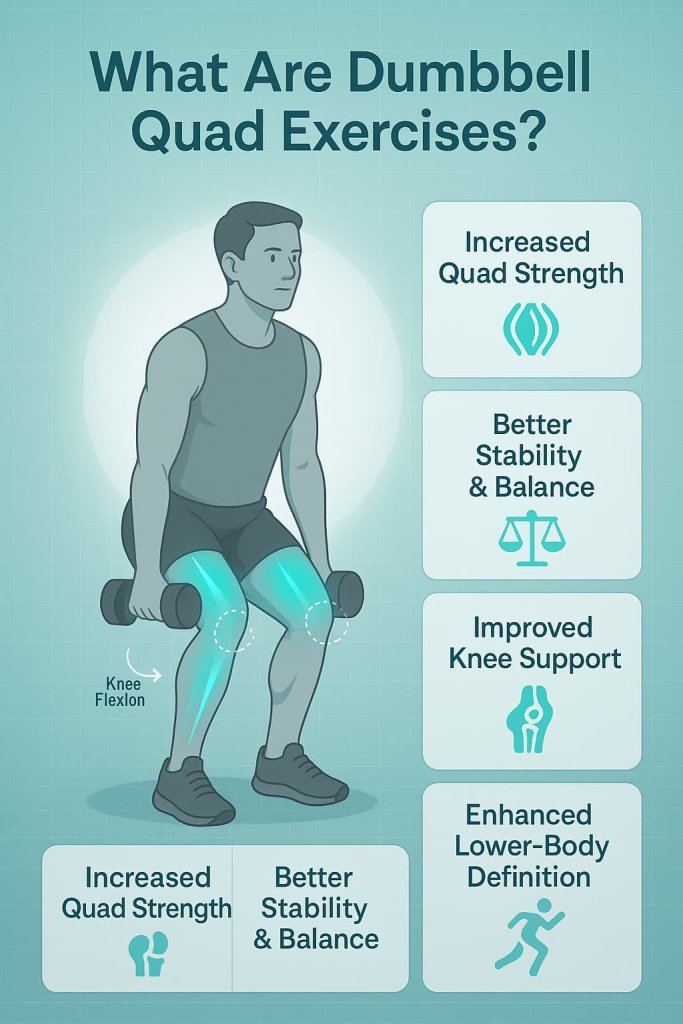
- Increased quad strength
- Better stability and balance
- Improved knee support
- Enhanced lower-body definition
- More power for running, jumping, and everyday activities
12 Best Dumbbell Quad Exercises
Below are the best dumbbell quad exercises, each with clear instructions and safety cues.
1. Dumbbell Goblet Squat
Why it works:
The front-loaded dumbbell position shifts your center of gravity forward, increasing knee flexion and placing greater tension on the quadriceps. It also encourages a more upright torso, which reduces lower-back strain and allows deeper, safer squatting for most people.
Muscles worked:
Quadriceps, glutes, core stabilizers, adductors.
How to do it:
- Hold one dumbbell vertically against your chest with both hands cupping the top end.
- Stand with feet shoulder-width apart, toes slightly turned out.
- Brace your core and keep your chest tall.
- Sit straight down into a squat, letting your knees travel forward naturally.
- Keep elbows close to your torso as you lower.
- Drive through your mid-foot and heels to return to standing.
Trainer Tip:
Place small plates or a wedge under your heels to increase knee flexion and further load your quads.
2. Dumbbell Front Squat (Double Rack)
Why it works:
Holding the dumbbells at shoulder height forces your torso upright and increases anterior load. This significantly boosts quad recruitment by allowing more forward knee movement during the descent.
Muscles worked:
Quadriceps, upper back, glutes, core, hip flexors.
How to do it:
- Hold two dumbbells at shoulder level with elbows angled slightly forward.
- Stand tall with feet hip- to shoulder-width apart.
- Squat down under control, keeping ribs stacked over hips.
- Aim for thighs parallel or deeper if mobility allows.
- Push through your heels and mid-foot to stand tall.
Trainer Tip:
Keep elbows lifted and forward—this stabilizes the rack position and prevents you from tipping forward.
3. Dumbbell Back Squat (Dumbbells at Sides)
Why it works:
Holding dumbbells at your sides creates a balanced load and allows you to squat without excessive trunk extension. It provides strong quad stimulus while reducing stress on the spine compared to a barbell squat.
Muscles worked:
Quadriceps, glutes, hamstrings, calves, core.
How to do it:
- Hold a dumbbell in each hand at your sides.
- Stand tall with feet shoulder-width apart.
- Push hips slightly back as you bend your knees into a squat.
- Keep knees in line with your toes throughout the movement.
- Drive upward through your legs to return to standing.
Trainer Tip:
Think “knees forward, hips under” during descent to maximize quad involvement.
4. Heel-Elevated Dumbbell Squat
Why it works:
Elevating the heels reduces ankle dorsiflexion demands and lets your knees travel forward more easily. This increases quad activation dramatically while helping you maintain an upright, balanced squat.
Muscles worked:
Quadriceps, VMO (vastus medialis), hip flexors, glutes.
How to do it:
- Place heels on plates, a slant board, or a stable wedge.
- Hold dumbbells at your sides or chest.
- Lower into a controlled squat, allowing knees to track forward.
- Keep weight centered over mid-foot.
- Stand back up without leaning forward.
Trainer Tip:
Ensure heels stay fully supported; partial support can cause ankle strain.
5. Dumbbell Bulgarian Split Squat
Why it works:
This unilateral powerhouse places the majority of the load on the front leg, targeting the quads intensely through deep knee flexion. It also improves balance, stability, and corrects side-to-side imbalances.
Muscles worked:
Quadriceps, glutes, hip stabilizers, core.
How to do it:
- Stand a few feet in front of a bench.
- Place your back foot on the bench and hold dumbbells at your sides.
- Lower your back knee toward the floor while keeping chest tall.
- Push through the front leg to stand tall again.
Trainer Tip:
A shorter stance increases quad emphasis, while a longer stance recruits more glutes.
6. Front-Foot Elevated Split Squat
Why it works:
Elevating the front foot creates a greater knee-over-toe angle, isolating the quadriceps more than traditional lunges. The increased range of motion enhances strength and muscle growth.
Muscles worked:
Quadriceps, glutes, adductors, core.
How to do it:
- Place your front foot on a step or low platform.
- Hold dumbbells in both hands.
- Lower into a deep lunge while keeping your torso upright.
- Let the front knee travel forward naturally.
- Press through the front foot to return to standing.
Trainer Tip:
Slow your lowering phase to a 3-second descent for maximum quad tension.
7. Dumbbell Forward Lunge
Why it works:
Stepping forward forces your quads to control the lowering phase and then powerfully push you back to the starting position. This dynamic movement builds strength, coordination, and leg stability.
Muscles worked:
Quadriceps, glutes, hamstrings, calves, core.
How to do it:
- Stand tall holding dumbbells.
- Step forward and lower into a lunge, keeping torso upright.
- Push back through your front leg to return to standing.
- Alternate sides or perform single-leg sets.
Trainer Tip:
Take shorter steps to increase quad dominance; longer steps shift emphasis to the glutes.
8. Dumbbell Reverse Lunge
Why it works:
Stepping backward places less forward shear on the knee joint, making it more knee-friendly while still activating the quads strongly—especially for beginners or those with mild knee discomfort.
Muscles worked:
Quadriceps, glutes, hamstrings, hip stabilizers.
How to do it:
- Hold dumbbells at your sides.
- Step one foot back and lower into a lunge.
- Keep your front knee aligned and stable.
- Push through the front leg to stand again.
Trainer Tip:
Lean your torso slightly forward to stay balanced and increase quad activation.
9. Dumbbell Walking Lunge
Why it works:
Continuous stepping increases time under tension, an essential factor for muscle growth. This variation challenges endurance, stability, and quad strength simultaneously.
Muscles worked:
Quadriceps, glutes, hamstrings, core, calves.
How to do it:
- Hold dumbbells and take a controlled step forward.
- Lower into a lunge and continue stepping forward without pausing.
- Maintain an upright torso and controlled stride.
Trainer Tip:
Keep strides moderate—too long shifts work away from the quads.
10. Dumbbell Step-Up
Why it works:
Step-ups build quad strength through a stable, single-leg pattern with less knee strain than deep lunges. They are beginner-friendly and excellent for functional strength.
Muscles worked:
Quadriceps, glutes, calves, hip stabilizers.
How to do it:
- Stand in front of a bench or box.
- Step onto the platform with one foot.
- Drive through the mid-foot to lift your body up.
- Lower back down with control and repeat.
Trainer Tip:
Use a box height that brings your front knee to roughly 90 degrees or slightly less.
11. Dumbbell Squat to Box
Why it works:
Using a box improves squat consistency, helps with depth control, and loads the quads effectively without risking collapse at the bottom.
Muscles worked:
Quadriceps, glutes, hamstrings, core.
How to do it:
- Stand in front of a sturdy box or bench.
- Hold dumbbells at your sides.
- Sit back lightly until your glutes touch the box.
- Immediately stand back up without resting.
Trainer Tip:
Only tap the box—do not sit fully or relax, as this removes tension from the quads.
12. Dumbbell Wall Sit (Weighted)
Why it works:
This isometric hold builds endurance in the quadriceps and enhances knee stability by keeping the muscles under constant tension.
Muscles worked:
Quadriceps, hip flexors, core.
How to do it:
- Hold a dumbbell close to your chest.
- Slide down the wall until thighs are parallel to the floor.
- Keep knees aligned over ankles.
- Hold the position for 20–45 seconds or more as tolerated.
Trainer Tip:
Avoid letting your knees drift inward—press them slightly outward for proper alignment.
Recommended Sets, Reps, and Frequency
For most adults training general strength:
- Frequency: 2–3 days per week
- Sets: 2–3 per exercise
- Reps: 8–12 controlled reps for most movements
- Rest: 1–2 minutes between sets
- Progression: Increase dumbbell weight when last reps feel easy
If you experience sharp knee or hip pain, stop and reassess before continuing.
Safety Tips for Quad Training
- Warm up for 2–3 minutes before lifting.
- Keep knees aligned with toes; avoid inward collapse.
- Move slowly through each rep for joint safety.
- Start light and progress gradually.
- Consult a healthcare professional if you have knee injuries or medical concerns.
Frequently Asked Questions (FAQ)
1. Are dumbbell quad exercises effective for building leg size?
Yes. Movements like goblet squats, lunges, and split squats provide enough load and tension for muscle growth when performed progressively.
2. Can beginners use dumbbells safely for quad training?
Absolutely. Start with light weights, practice proper form, and increase gradually.
3. How many quad exercises should I do in one workout?
Most people do well with 3–5 exercises per session, depending on volume and experience.
4. Are these exercises good for knee pain?
Quad strengthening may help support knee stability, but avoid painful movements and consult a professional first.
5. Should I train quads and hamstrings on the same day?
Yes. Many programs combine both for balanced lower-body development.
6. Can I build strong quads at home with minimal equipment?
Definitely. A pair of dumbbells is enough to perform all 12 exercises effectively.
7. How fast will I see results?
Most people notice improvements in strength within 2–4 weeks with consistent training.
Conclusion
Dumbbell quad exercises offer one of the most accessible and effective ways to build stronger, more defined legs at home or in the gym. With the right mix of squats, lunges, split squats, and step-ups, you can target the quadriceps from multiple angles and support better knee stability, everyday function, and athletic performance.
Start with the exercises that match your level, progress gradually, and train consistently for the best results.
References
- Ratamess NA, Alvar BA, Evetoch TE, et al. (2009). Progression models in resistance training for healthy adults. Medicine & Science in Sports & Exercise, 41(3):687–708.
- American College of Sports Medicine (ACSM). Physical Activity Guidelines and Exercise Recommendations.
- Imoto AM, Peccin MS, Teixeira LEPP, et al. (2012). Quadriceps strengthening exercises are effective in improving pain, function and quality of life in patients with knee osteoarthritis. Clinical Rehabilitation.
- Murray AM, et al. (2015). The associations between quadriceps muscle strength and knee joint biomechanics during gait in people with knee osteoarthritis. Clinical Biomechanics.
- Gong Z, Zhang J, et al. (2022). Quadriceps strength is negatively associated with knee joint structural damage features in females: Data from a cohort with knee osteoarthritis. BMC Musculoskeletal Disorders.
- Longpré HS, et al. (2015). Muscle activation and knee biomechanics during squatting and lunging in healthy adults. Journal of Electromyography and Kinesiology (biomechanics/EMG study).
- Hoogenboom BJ, et al. (2024). The Reverse Lunge: A descriptive electromyographic study. Applied Sciences, 14(24):11480.
- Schoenfeld BJ, Grgic J, et al. (2021). Loading recommendations for muscle strength, hypertrophy and local endurance: Re-examining the repetition continuum. Sports, 9(2):32.