
If you want stronger, more defined arms and shoulders, arm and shoulder exercises are one of the most effective ways to build upper-body strength and mobility. These muscles support almost every daily movement—from lifting and reaching to pushing and stabilizing—so improving them brings both aesthetic and functional benefits.
This guide gives you the 10 best exercises, how to do them correctly, and how to structure your training safely. You’ll also learn the key steps, options, and requirements so you can begin confidently, even as a beginner. The information is written in a friendly, expert tone, following current fitness guidelines.
10 Best Arm and Shoulder Exercises for Strength, Definition & Mobility
These ten exercises target every major muscle in your arms and shoulders to build strength, stability, and balanced definition. Each movement is beginner-friendly, easy to learn, and designed to improve both function and mobility.
1. Dumbbell Shoulder Press
Why it works
This compound lift targets the entire shoulder complex, especially the front and side deltoids. Because you’re pressing weight overhead, the exercise also engages the triceps and upper chest while forcing your core to stabilize your spine. It’s one of the most effective moves for building shoulder strength, improving overhead mobility, and developing visible upper-arm definition.
Muscles worked
- Anterior deltoids
- Lateral deltoids
- Triceps brachii
- Upper chest (assists during the press)
- Core stabilizers (to maintain upright posture)
How to do it
- Hold dumbbells at shoulder height with elbows under wrists.
- Press overhead until arms are nearly straight—but don’t lock elbows forcefully.
- Lower slowly, keeping control throughout the full range.
- Maintain a neutral spine and steady breathing.
Trainer Tip
Keep your ribs down and glutes lightly engaged. If your back arches, lower the weight or switch to a seated version for more support.
2. Incline or Wall Push-Up
Why it works
An incline push-up reduces load while still training the chest, shoulders, and triceps. It’s excellent for beginners or anyone wanting to perfect push-up technique without stressing the shoulders. It also improves upper-body stability and control.
Muscles worked
- Front deltoids
- Pectoralis major
- Triceps
- Core for body alignment
How to do it
- Place hands on a wall or bench slightly wider than shoulder width.
- Maintain a straight body line from head to heels.
- Lower your chest toward the surface with elbows angled 30–45 degrees.
- Push back up to full extension.
Trainer Tip
Adjust the height of the incline:
Higher = easier.
Lower = harder.
3. One-Arm Dumbbell Row
Why it works
This single-arm pulling exercise strengthens the upper back, improves posture, and develops shoulder stability. Working one arm at a time also helps correct muscle imbalances and improves core engagement.
Muscles worked
- Latissimus dorsi
- Rhomboids
- Rear deltoids
- Biceps
- Obliques (stabilization)
How to do it
- Support your body with one hand and knee on a bench.
- Hold a dumbbell in your free hand and let it hang straight down.
- Pull the weight toward your hip, leading with your elbow.
- Lower with control.
Trainer Tip
Keep shoulders square to the ground. Avoid twisting—let the back muscles do the work.
4. Seated or Band Row
Why it works
Rowing strengthens the middle and upper back, helping counteract rounded shoulders from long hours of sitting. It improves shoulder positioning, stability, and mobility—important for preventing shoulder discomfort.
Muscles worked
- Rhomboids
- Middle and lower trapezius
- Rear deltoids
- Biceps
How to do it
- Sit tall with arms extended.
- Pull handles or band toward your torso.
- Squeeze your shoulder blades together at the end.
- Return slowly to the starting position.
Trainer Tip
Don’t shrug your shoulders. Keep them down and back throughout the movement.
5. Lateral Raises
Why it works
This isolation exercise targets the side deltoids, which give the shoulders width and roundness. It enhances shoulder definition and helps balance pressing movements.
Muscles worked
- Lateral deltoids
- Supraspinatus (initiates lift)
How to do it
- Hold dumbbells by your sides.
- Raise arms to shoulder height, elbows slightly bent.
- Pause at the top, then lower slowly.
Trainer Tip
Use a light weight and strict form. If you swing your body, the side delts stop working effectively.
6. Face Pulls or Band External Rotation
Why it works
This is one of the best exercises for shoulder health. It strengthens the rotator cuff and upper back muscles responsible for stabilizing the shoulder joint. It also helps correct forward posture and improves shoulder mobility.
Muscles worked
- Rear deltoids
- External rotators (infraspinatus, teres minor)
- Middle and lower trapezius
- Rhomboids
How to do it
- Pull a band or cable toward your face.
- Rotate thumbs backward as elbows flare outward.
- Squeeze rear delts.
- Return slowly to start.
Trainer Tip
Keep elbows high in line with the shoulders. Move slowly for best muscle activation.
7. Dumbbell Biceps Curl
Why it works
The curl isolates the biceps, helping you build shape and strength in the front of the upper arm. Strong biceps support pulling tasks and improve grip and lifting performance.
Muscles worked
- Biceps brachii
- Brachialis
- Forearm flexors (secondary)
How to do it
- Hold dumbbells with palms facing forward.
- Curl toward your shoulders with elbows tucked at your sides.
- Lower slowly with full control.
Trainer Tip
Avoid swinging or using momentum—slow reps give far better results.
8. Hammer Curl
Why it works
The neutral grip strengthens the brachialis and brachioradialis—muscles that add thickness to the upper arm and improve forearm strength. It also reduces wrist stress for people sensitive to supinated curls.
Muscles worked
- Brachialis
- Brachioradialis
- Biceps brachii
How to do it
- Hold dumbbells with palms facing inward.
- Curl upward while keeping elbows at your sides.
- Lower slowly.
Trainer Tip
Focus on keeping your wrists straight and neutral throughout the movement.
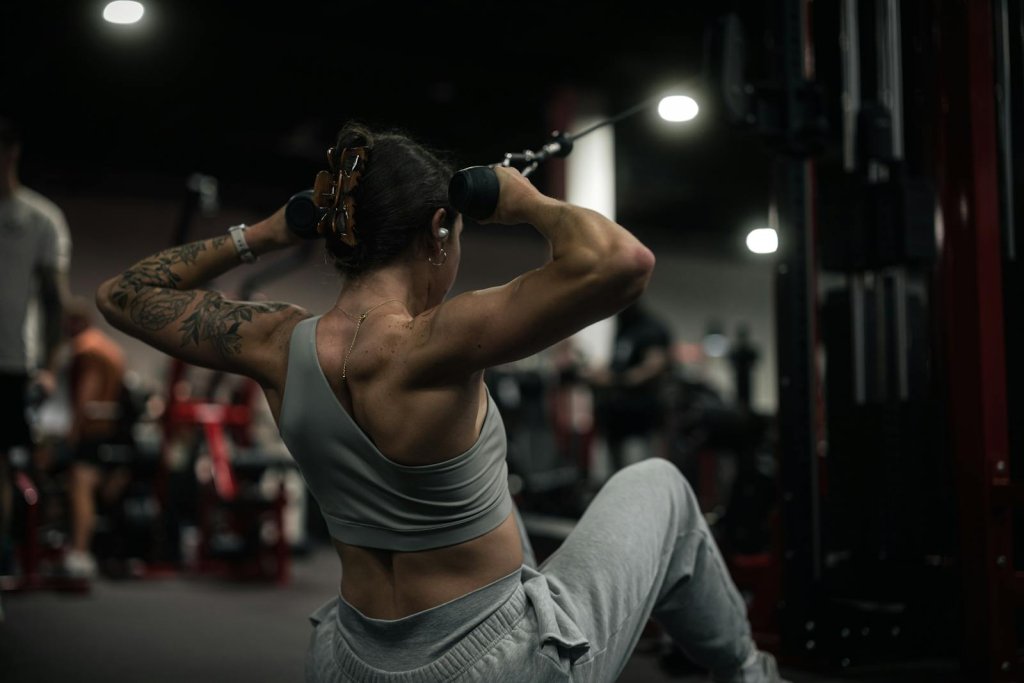
9. Overhead Triceps Extension (Dumbbell or Band)
Why it works
This movement stretches the long head of the triceps, which contributes significantly to upper-arm size and shape. Training overhead improves pressing strength and arm definition.
Muscles worked
- Triceps brachii (long head emphasis)
How to do it
- Hold a dumbbell or band overhead.
- Lower the weight behind your head by bending elbows.
- Extend elbows fully to return to start.
Trainer Tip
Keep elbows pointing straight ahead—not flaring outward—to protect the shoulders.
10. Triceps Push-Down or Bench Dip
Why it works
These exercises target the triceps more directly than almost any other movement. Push-downs offer controlled tension, while dips build functional strength using body weight.
Muscles worked
- Triceps
- Anterior deltoid (stabilizer)
- Chest (secondary during dips)
How to do it
Push-down:
- Press the bar or band downward from elbow height.
- Extend fully, then control the return.
Bench dip:
- Lower your body by bending elbows.
- Push back up without letting shoulders roll forward.
Trainer Tip
If you have shoulder sensitivity, use push-downs or limit dip depth to a smaller, pain-free range.
Example Weekly Routine
Upper-Body Strength Day (Beginner–Intermediate)
- Warm-Up: 5 minutes (arm circles, band pull-aparts)
- Dumbbell Shoulder Press — 3×8–12
- One-Arm Row — 3×8–12 each
- Lateral Raises — 3×12–15
- Face Pulls — 2×12–15
- Biceps Curl — 2×10–12
- Hammer Curl — 2×10–12
- Triceps Extension — 2×10–12
- Triceps Push-Down — 2×10–12
- Cool-down: light shoulder stretch
Programming Tips
- Increase weight once final reps feel easy.
- Prioritize controlled tempo and full range of motion.
- Train arms and shoulders 2× weekly for best results.
- Include mobility work to support joint health.
Why Arm and Shoulder Strength Matters
Building strong arms and shoulders supports:
- Better posture and upper-body alignment
- Stronger pushing, pulling, and lifting ability
- Improved mobility and range of motion
- Daily functional tasks like carrying bags, opening doors, and reaching overhead
- Joint stability and long-term shoulder health
- Visible muscle definition in the deltoids, biceps, and triceps
Regular resistance training also helps slow age-related muscle loss and supports long-term functional independence.
Safety Guidelines Before You Begin
- Warm up 5 minutes (arm circles, shoulder rolls).
- Start with light weights or bands.
- Use slow, controlled movements.
- Keep shoulders down and back.
- Stop immediately if you feel sharp pain.
- Consult a professional if you have shoulder or joint issues.
Frequently Asked Questions
1. How often should I train arms and shoulders?
Two to three times per week works well for most people.
2. Do I need heavy weights?
No. Moderate weight with correct form is enough to build strength and definition.
3. Can beginners do these exercises?
Yes—start with lighter dumbbells or resistance bands.
4. Should I train arms and shoulders together?
You can train them in one session or split them depending on your program.
5. How long until I see results?
Most people notice improvements in 4–6 weeks with consistent training.
6. What’s the best warm-up?
Arm circles, shoulder rolls, light band rows, and mobility drills.
7. Are these exercises suitable for older adults?
Yes—use lighter loads, slower tempo, and controlled movements.
Conclusion
Arm and shoulder exercises help build upper-body strength, enhance muscle definition, and support healthy shoulder mobility. Training these muscles with proper form and balanced movement patterns can improve performance, posture, and long-term joint health.
References
- Peterson MD, Rhea MR, Sen A, Gordon PM.
Resistance Exercise for Muscular Strength in Older Adults: A Meta-Analysis. Ageing Research Reviews. 2010. - Fragala MS, Cadore EL, Dorgo S, et al.
Resistance Training for Older Adults: Position Statement From the National Strength and Conditioning Association. Journal of Strength and Conditioning Research. 2019. - American College of Sports Medicine.
Progression Models in Resistance Training for Healthy Adults. Medicine & Science in Sports & Exercise. 2009. - El-Kotob R, Ponzano M, Chaput J-P, et al.
Resistance Training and Health in Adults: An Overview of Systematic Reviews. Applied Physiology, Nutrition, and Metabolism. 2020. - Lafrance S, Charron M, Dubé M-O, et al.
The Efficacy of Exercise Therapy for Rotator Cuff–Related Shoulder Pain According to the FITT Principle: A Systematic Review With Meta-Analyses. Journal of Orthopaedic & Sports Physical Therapy. 2024. - Steuri R, Sattelmayer M, Elsig S, et al.
Effectiveness of Conservative Interventions Including Exercise, Manual Therapy and Medical Management in Adults With Shoulder Impingement: A Systematic Review and Meta-Analysis of RCTs. British Journal of Sports Medicine. 2017. - Kuhn JE.
Exercise in the Treatment of Rotator Cuff Impingement: A Systematic Review and a Synthesized Evidence-Based Rehabilitation Protocol. Journal of Shoulder and Elbow Surgery. 2009. - Chepeha J, Silveira A, Sheps D, et al.
A Standardized Criteria-Based Progressive Shoulder Exercise Program Is Effective in Managing Rotator Cuff–Related Shoulder Pain: A Prospective Cohort Study. PLOS ONE. 2025.